
Water-cooled chiller acceptance testing: six HRT checkpoints
Machine-translated from Vietnamese. Read the original in Vietnamese
Acceptance testing Water Cooled Chiller strictly technical with 6 verification checkpoints from CEO Đoàn Văn Hoàng – HRT, which ensures safety, performance and sustainable operation.
Acceptance testing Water Cooled Chiller: 6 verification checkpoints before handing over operation
In managing commercial and industrial HVAC projects, I always put a requirement to the technical team:
Water Cooled Chiller running is not enough. The system must operate properly designed, safe, stable and have clear acceptance testing evidence.
A Chiller can start normally but the chilled-water system has not been balanced. cooling tower can work but the condenser water temperature has not met the requirement. BMS can show full parameters but the protection functions have not been verified.
If these problems are not resolved, handing over the equipment can create operational risks and future disposal costs.
At HRT, I want to manage quality according to the principle:
Proper inspection – Clear measurement – Confirmed enough – Responsible handover.
For Water Cooled Chiller system, I propose six verification checkpoints to be completed before approving the handover operation.
1. verification checkpoint first: Confirm the mounting system to the right design
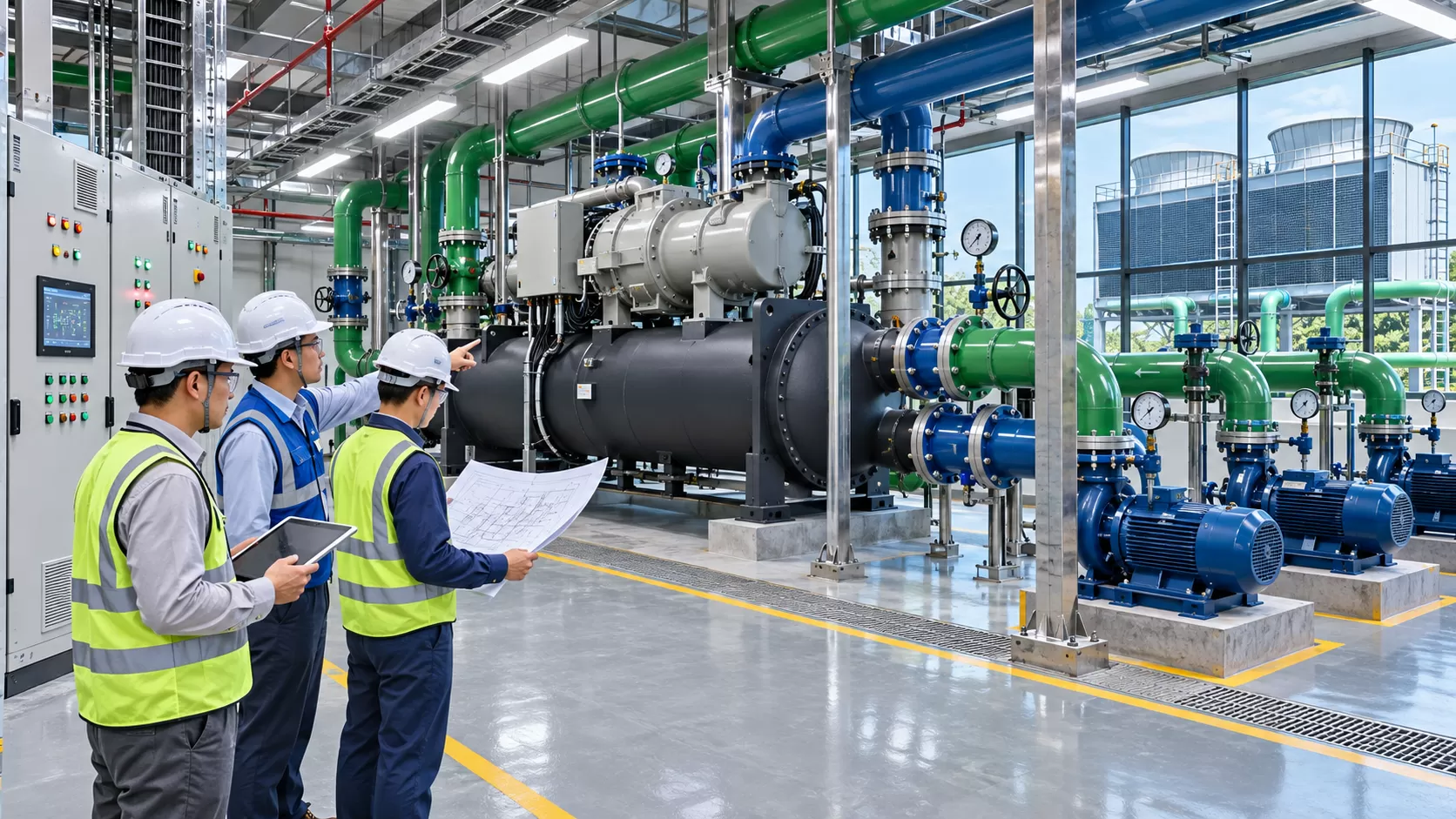
Before commissioning, the manager must determine whether the actual system is consistent with the approved profile.
Do not start the chiller as soon as the contractor tells you it is ready to install.
Testing the system range
A conventional water-cooled chiller system consists of the following main components:
-
Chiller and associated protective equipment.
-
Chilled-water pump (CHWP).
-
Condenser water pump (CWP).
-
Cooling tower (Cooling Tower).
-
Pipelines, valves and fittings.
-
AHU/FCU heat exchangers or technology loads.
-
Electrical, control and BMS systems.
Each component has its own functions but must be coordinated to operate the system properly.
I asked the engineer to check the compatibility between the design documentation, as-built drawings and actual installation.
Items to confirm
| Category: | Contents of the inspection |
|---|---|
| Chiller Machine | Model, capacity, electrical parameters, installation location |
| Circulating Pump | Flow rate, pressure head, rotation direction, redundant configuration |
| Pipeline | Size, material, rack, flow direction |
| Valves and accessories | Type, location, installation dimension, accessibility |
| Cooling tower | Heat exhaust capacity, location and ventilation conditions |
| Measuring equipment | Location, measurement range, calibration and inspection capabilities |
| Control system | I/O Points, Connection, Monitoring Function |
In particular, changes to the design must be recorded and approved according to the project's process.
Decisions to be closed: Is the system fully installed, in the correct configuration and eligible for technical inspection?
Output: Installation inspection record and list of existing to be dealt with.
2. Second checkpoint verification: Confirm the chilled-water system quality
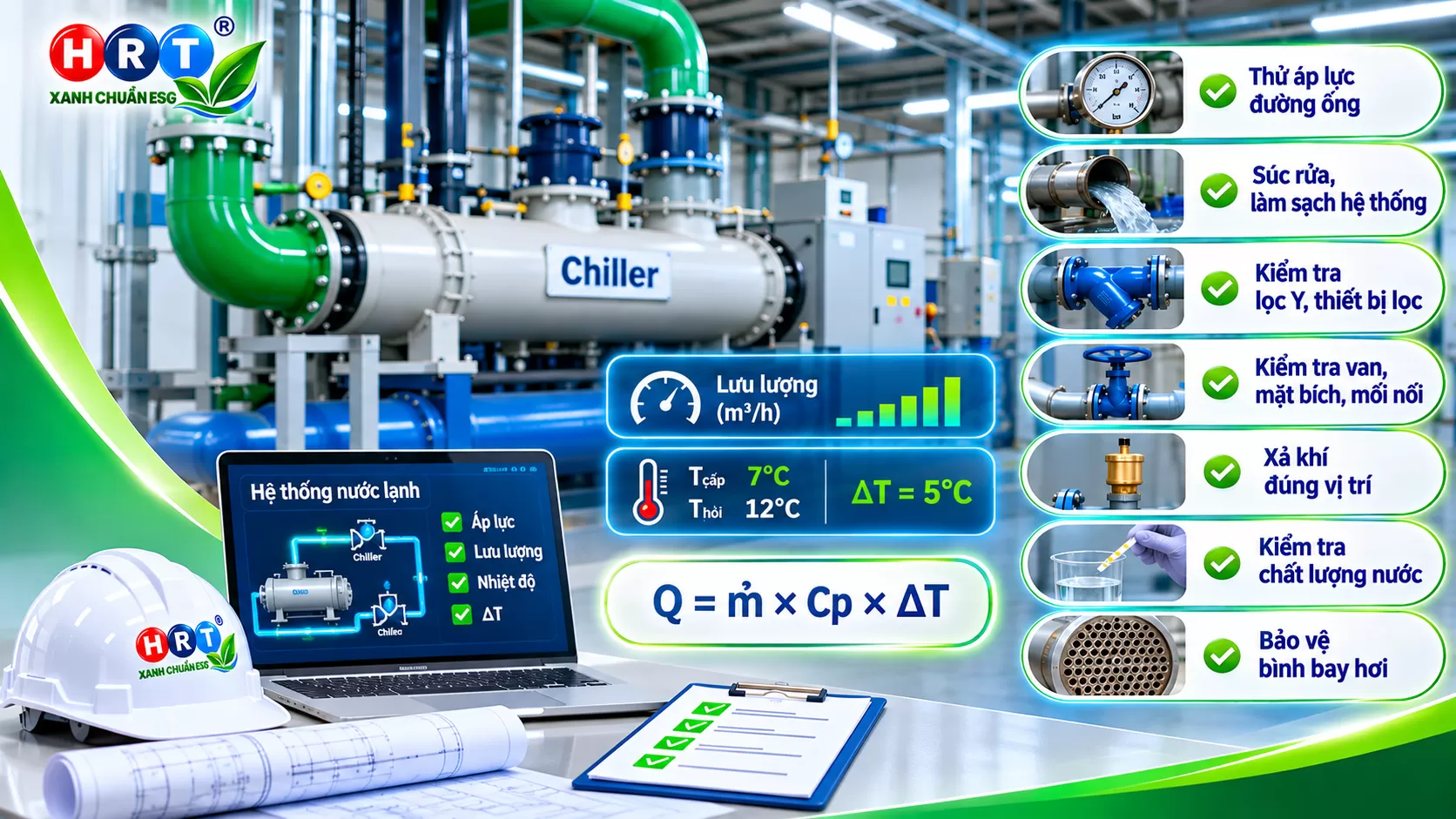
For Water Cooled Chiller, the operation capability depends directly on the quality of hydraulic system.
A high performance chiller cannot work in the design conditions if the water flow rate is not consistent, the pipeline is dirty or the system has not been treated for gas.
Check before water supply to Chiller
I ask the engineering team to confirm the work done according to the project dossier and equipment instructions:
-
Test and pressure testing pipe force as required.
-
Rinse and clean the system.
-
Check Y filtration and filtration devices.
-
Check the status of valves, flanges and joints.
-
Discharge the air in the appropriate locations.
-
Water quality test before put into operation.
-
Protect the evaporator and sensitive equipment during rinsing.
Test pressure, test duration and acceptance criteria must be based on the approved technical dossiers and equipment limits.
It is not allowed to default the whole system can bear the same test pressure.
Confirm cold water flow rate
Water flow rate need to meet the requirement of Chiller and distribution system.
If the flow rate is lower than the permitted level, the device may give warning or stop protection.
If the flow rate is too high, the system can increase the pressure drop, consume more pump power and other operation with design conditions.
Therefore, acceptance testing must be based on measurement data rather than just confirming that the pump has run.
Temperature and Delta T Rating
For many comfortable air conditioning systems, chilled-water supply and return temperatures are typically designed around 7°C and 12°C. However, this is not a mandatory parameter for all buildings.
Actual value must be based on design documentation.
The water side heat exchanger capacity is determined according to the principle:
Q = ṁ × cp × ΔT
Where:
-
Q: Heat exchanger capacity, kW.
-
ṁ: flow rate of water volume, kg/s.
-
cp: Specific heat capacity, kJ/(kg·K).
-
ΔT: Water temperature difference, K.
Cooling capacity cannot be assessed by supply-water temperature or Delta T alone.
Decisions to be closed: Is the cold water clean, airtight, flow rate suitable and safe operation?
Output: Pressure testing, rinsing, flow rate measurement and chilled-water system testing.
3. third checkpoint verification: Confirm the cooling system to work synchronously
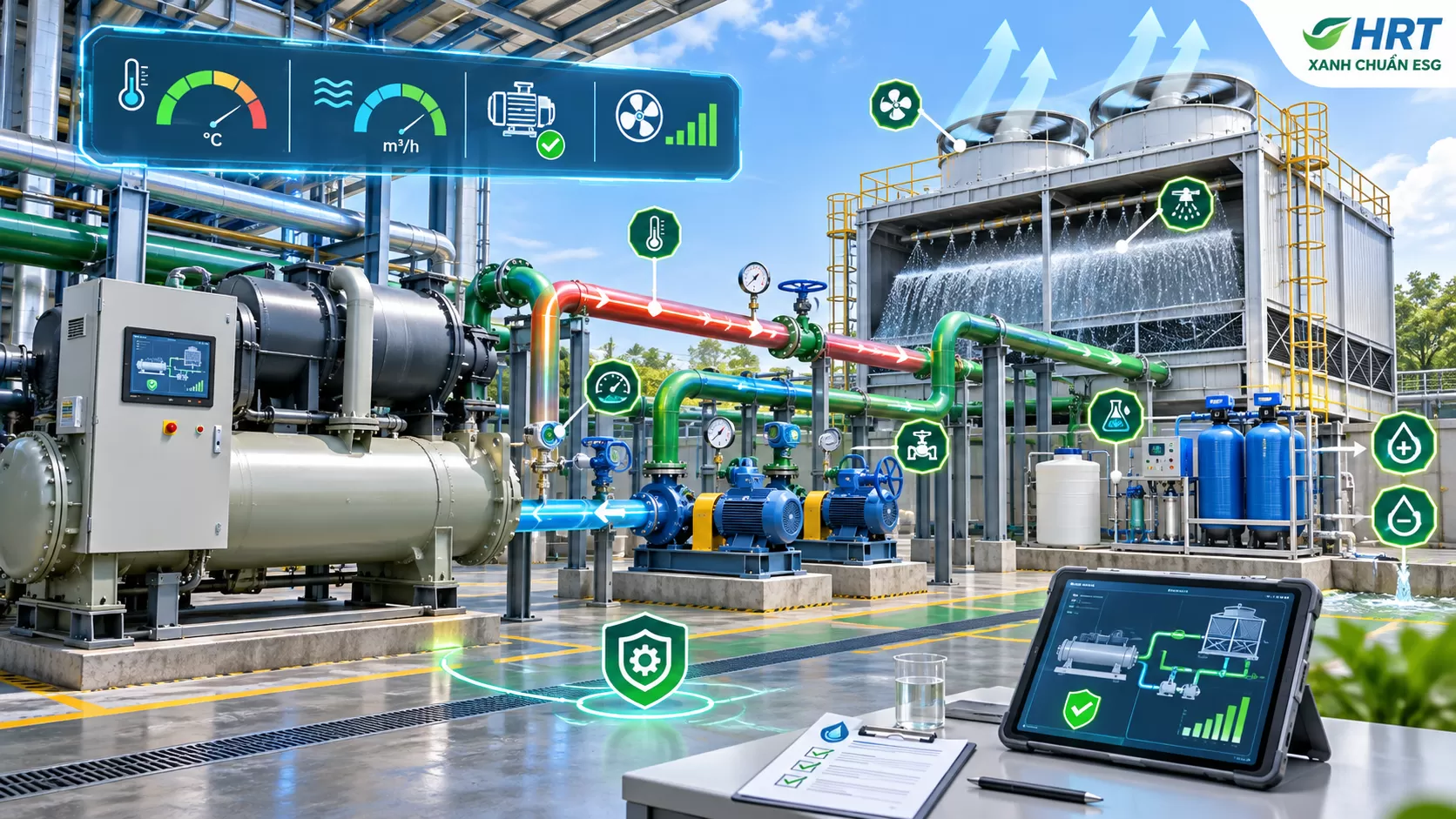
Different from Air Cooled Chiller, the common Water Cooled Chiller configuration uses a water condenser ring to transfer heat from the condenser to the cooling tower.
Therefore, acceptance testing should not be focused only on the Chiller.
Heat Discharge Capacity Test
For Cooling Tower use system, it should be checked:
Water Condenser Pump
Confirm rotation, flow rate, pressure and coordination with Chiller.
Cooling tower
Test the fan, water distribution system, heat sink plate, water trough and heat exchange conditions with the environment.
Pipelines and valves
Confirm valve status, leakage status and water circulation capacity.
Controlling Devices
Test temperature sensor, fan control signal and protection conditions.
Do not ignore the quality of water condenser
I'm particularly interested in this.
Cooling tower uses circulating water, in which the water quality can affect scale, corrosion and microbial development.
This is not only a performance issue but also health safety related, especially Legionella bacteria risk.
Therefore, before handover, it is necessary to confirm the appropriate water management program, including control, monitoring and handling measures implemented by a specialized unit.
Check the critical operation conditions
| Category: | Request confirmation |
|---|---|
| Temperature condenser water | Suitable design and operation conditions |
| Water flow rate | Meet the Limit of Chiller |
| Cooling Tower Fan | Operate and control as required |
| Water Distribution System | No abnormalities affecting heat exchanger |
| Water Treatment | There are processes, control limits and people in charge |
| Additional water, bottom flushing | Operating under water management plan |
Don't aim to lower the condenser water temperature by any means.
It is necessary to evaluate the capacity of the Chiller, pump, tower fan and operation limits simultaneously.
Decisions to be closed: Has the cooling system met the necessary safety, water quality and heat discharge capacity?
Output: Record acceptance testing of cooling system and water quality management records.
4. verification fourth checkpoint: Verify the control logic and protect the equipment
A modern Chiller system can be connected to BMS for operation monitoring and coordination.
But having a BMS doesn't mean the system is properly controlled.
I want the engineering team to distinguish between two concepts:
Control signal available and... The device actually responds to that signal..
Check the boot sequence
For each configuration, it is necessary to determine the sequence of start and stop machine and interlocking conditions according to the design.
For example, before Chiller is allowed to run, it is necessary to confirm the conditions such as:
-
Water system meets flow rate requirements.
-
The necessary auxiliary equipment is ready.
-
Suitable valve and pump status.
-
No boot protection warning exists.
-
Signal for operation authorization confirmed.
The specific sequence must follow the approved manufacturer documentation and control logic, not applying a fixed sequence to every system.
Interlocking Function Test
Functional testing plans should be prepared for the situations specified in the dossier:
-
Lost water flow rate confirmation.
-
Pump error is active.
-
Errors or loss of control device communication.
-
Temperature and pressure conditions exceed the protection limit.
-
Switch main and backup equipment.
-
Restart after troubleshooting.
The simulation of protection situations must be safely organized, planned and supervised by competent persons.
Do not arbitrarily disable the protection device to force Chiller operation.
BMS Data Testing
I'm requesting that both the equipment and the BMS be checked.
If a value is noted by the sensor but is not displayed correctly by the BMS, the operation report may draw incorrect conclusions.
Decisions to be closed: Have the operation, interlock and protection modes been verified within the project requirements?
Output: The record of control test and the list of I/O, warning and interlocking test results.
5. verification checkpoint fifth: acceptance testing capacity and whole station performance
This is the verification checkpoint I'm particularly interested in.
The Chiller running stable is not enough to conclude the system reaches the designed capacity.
Measurement data under suitable conditions are required for evaluation.
Determine the actual cooling capacity
For chilled-water systems, the determination of heat exchange capacity is based on flow rate and temperature difference.
The result should be compared with the design documentation and actual load conditions.
A project operating at low load cannot automatically be used to conclude that the machine has reached its rated capacity at full load.
If the full load test is not available, the scope, load and limit of acceptance testing must be specified.
Performance rating in kW/RT
In Chiller Plant Management, I ask the technical team to distinguish:
Chiller Specific Performance: Machine power divided by cooling capacity at the same measurement condition.
Whole Station Performance: Total electrical capacity of appliances within the rated range divided by useful cooling capacity.
Formula:
kW/RT = Total input power (kW) / actual cooling capacity (RT)
Where:
1 RT ≈ 3,517 kW cooling capacity.
For water-cooled chiller station, total electric power usually need to consider both Chiller, chilled-water pump, water condenser pump and tower fan.
The measuring range must be clearly announced.
Testing according to the load conditions
If contract or test plan requires, should be assessed at load levels consistent with actual conditions and equipment capabilities.
Do not conclude the year performance from only a few operation points.
Suggested KPI acceptance testing table
| Indexes | Unit | Purposes |
|---|---|---|
| Cooling capacity | RT or kW | Confirm cooling capacity |
| Chiller Power Capacity | kW | The rating of the machine's own power |
| Total station power capacity | kW | Evaluate the whole system |
| kW/RT full station | kW/RT | Energy Performance Monitoring |
| Temperature chilled-water supply – feedback | °C | Check the system status |
| cold water flow rate | m³/h | Confirm hydraulic condition |
| Temperature condenser water | °C | Evaluation of condenser conditions |
| Alerts and Incidents | Status of the | Stable and safe test |
The measurement results are only valid when the measuring device is suitable, the measuring position is correct and the operation conditions are recorded.
Decisions to be closed: Has the system proven load responsiveness and performance within the approved test range?
Output: Commissioning report, power measurement data and performance acceptance testing conclusion.
6. Sixth checkpoint verification: Handover of records and long-term operation responsibility
For me, acceptance testing is not the end point of project responsibility.
This is the time to transfer from the construction team to the operation department.
If records are incomplete, the recipient may have difficulty maintaining or troubleshooting.
The transfer dossier must be practically usable
I propose a dossier comprising:
-
As-built drawing and schematic diagram.
-
- Equipment documents and technical specifications.
-
Record pressure testing, rinsing and water quality testing.
-
Water flow rate balance report.
-
Test results of control, interlocking and protection functions.
-
Commissioning results, capacity and performance testing.
-
Maintenance plan, water treatment and list of existence.
-
- The training record and the certification of the recipient.
Build operational background data
Right from the time of handover, parameters should be saved for comparison later.
For example:
-
Temperature chilled-water supply and return.
-
Flow rate and water pressure.
-
Electrical capacity of each Chiller.
-
Power pump system, tower.
-
Cooling load.
-
kW/RT.
-
Warning states.
-
Time operation device.
These data are the basis for detecting performance trends changes or equipment abnormal operation.
Clearly define responsibilities
I want the record to answer:
Ai operation?
Who monitors water quality?
Who is responsible for equipment maintenance?
Who handles alerts?
When to report and reassess performance?
These responsibilities should be specifically assigned between the management unit, operation and relevant parties.
Decisions to be closed: Does the system have sufficient records, data, guidance and personnel to receive for long-term operation?
Output: Complete handover records and operation management plan.
7. Matrix 6 port acceptance testing Water Cooled Chiller according to HRT
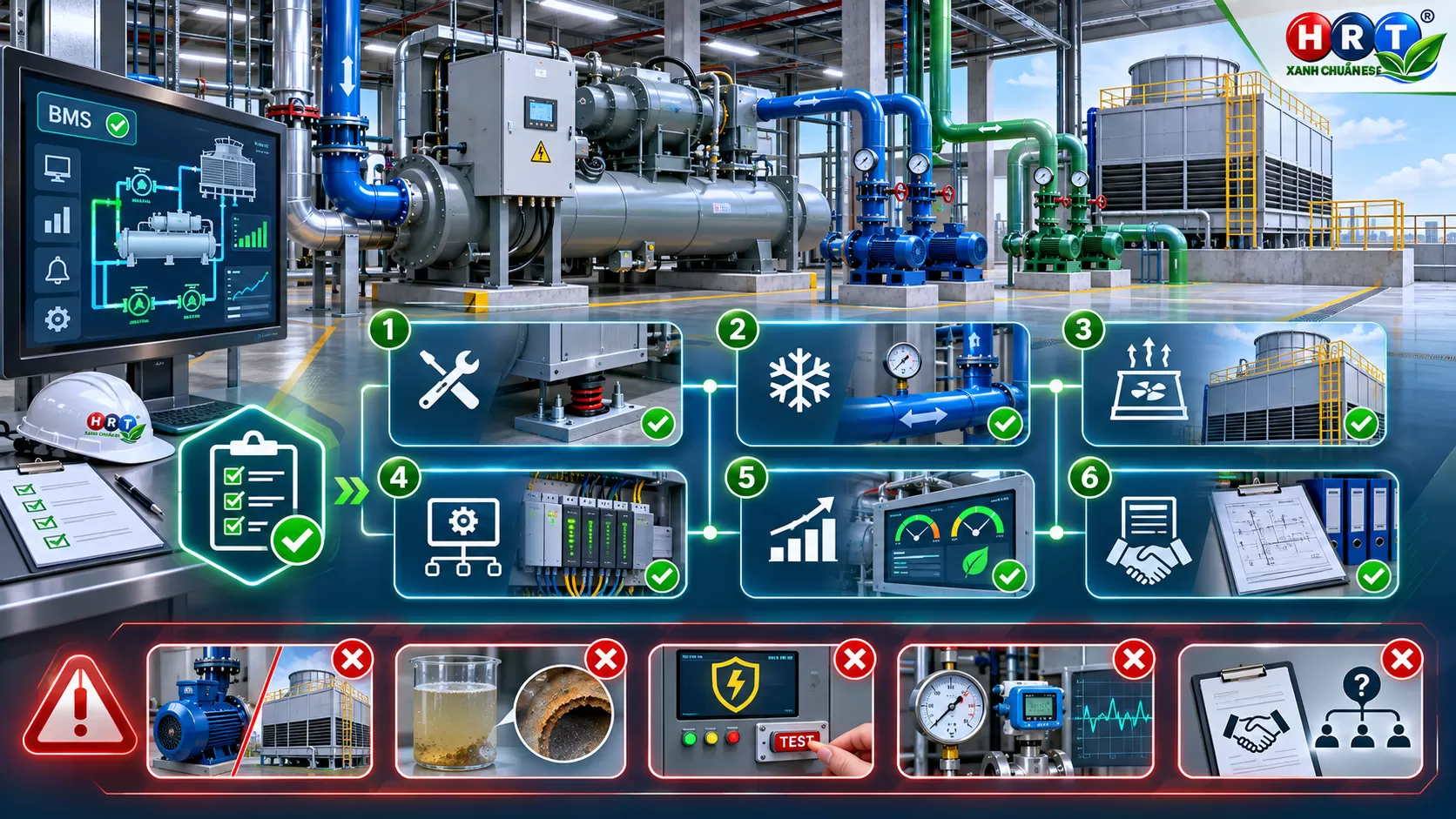
For easy control, I suggest using the following pivot table:
| Gate | Controlled focus | Evidence to be had |
|---|---|---|
| 1. Installation | Correct configuration, enough equipment | Inspection record, as-built drawing |
| 2. Cold water | Airtightness, cleanliness, flow rate | Results of pressure testing, rinsing, measuring |
| 3. Heat dissipation | Tower, Pump, Circulating Water | Testing results and water treatment records |
| 4. Controller | Logic, Interlocking, Protection | Functional test report |
| 5. Performance | Cooling capacity, kW/RT | Testing reports, commissioning |
| 6. Handover | Profile and operation responsibilities | Handover minutes, maintenance plan |
Each port must be confirmed by appropriate evidence before conclusion.
If the requirements are not met, the existence, the extent of impact and handling responsibility should be clearly stated.
It is not recommended to lump the incomplete parts into a general conclusion that the whole system has reached.
8. Five mistakes to avoid when acceptance testing water-cooled chiller
Mistake 1 – Only check the Chiller but ignore the pump and cooling tower
A normally functioning unit does not prove the station as a whole is qualified.
Actions: Synchronous control of auxiliary systems.
Mistake 2 – Ignoring the water quality before operation
Inappropriate residue and water can affect heat exchanger and equipment life.
Actions: Confirm water treatment program and inspection results as required before handover.
Mistake 3 – Failure to Try Full Protection Functions
The device can run normally under favorable conditions but has not been tested in incident situations.
Actions: - To draw up and implement plans on safety function tests according to the approved plans.
Mistake 4 – Evaluate Performance Without Trusted Data
If the sensor or measuring device is not suitable, the power and performance results may be misleading.
Actions: Inspect measuring equipment, measurement conditions and calculation methods.
Mistake 5 – Handover when operation responsibilities are unknown
Lack of records or persons in charge can cause minor incidents to last and affect the operation of the work.
Actions: Complete the application, provide training and confirm the responsibility for receiving.
9. FAQs about acceptance testing Water Cooled Chiller
9.1. What does acceptance testing of Water Cooled Chiller need to test?
Need to check installation, chilled-water system, condenser water, water quality, control, interlock protection, cooling capacity and handover profile according to project requirements.
9.2. Is cold water flow rate measurement necessary for acceptance testing?
Yes, when this is the parameter to confirm according to the design and equipment instructions. flow rate helps to test the operation condition and supports to determine the heat exchange capacity.
9.3. Does the chiller run properly and meet acceptance testing requirements?
No. Successful startup only demonstrates a part of the operational capability. The system must also meet the agreed technical requirements and acceptance testing criteria.
9.4. Is it mandatory to test the Chiller at 100% capacity?
Depends on the contract, technical documents and approved testing plan. If not tested at full load, the report must specify the tested load conditions and limits of conclusion.
9.5. acceptance testing cooling tower need water quality test?
It is necessary to check according to the requirements of the building and water management program. This is important for performance, corrosion, scale and microbiological hazard control.
9.6. Is the kW/RT compulsory?
The recognition depends on the scope of acceptance testing and project requirements. However, for systems with energy management goals, it is useful to build initial operation data.
10. HRT – Chiller management by quality and responsibility
From the perspective of the project manager, I think that the value of a Water Cooled Chiller system does not lie in how many units are installed.
It is important that the system is designed, constructed and operated as required.
That's how I want the HRT team to implement three core values:
YES
Understand the principles, technical requirements and operation conditions of the whole system before making a decision.
CLINICAL
All jobs must have scope, acceptance testing criteria, measurement parameters and confirmation evidence.
VISION
Monitoring until the system is eligible for handover and the operator has the ability to take over effectively.
HRT provides general contractor HVAC solutions:
-
Consulting and designing Water Chiller system.
-
Execute water-cooled chiller system.
-
Installation of AHUs, FCUs, piping and pumping systems.
-
Built-in BMS control system.
-
Testing, commissioning and acceptance testing support.
-
Maintenance, repair and renovation of Chiller Plant.
-
Evaluate and optimize HVAC operation performance.
For the works with large cooling load requirements, HRT aims to the appropriate plan for capacity, reliability and energy efficiency throughout the life cycle.
11. Conclusion: Chiller quality must be proved by the results
A Water Cooled Chiller system can be installed complete and started successfully.
But for long-term operation, the manager needs to have a sufficient confirmation of technical, safety and operation efficiency.
I require six checkpoint verifications to be made explicit:
Proper installation – Reach water system – Appropriate heating – Safe control – Proven performance – Responsible handover.
It is the HRT methodology towards when deploying and managing commercial and industrial chiller projects.
KS. Đoàn Văn Hoàng – CEO HRT
HRT – Green Breath for All Buildings
Right from the beginning – Clear to the end – Sustainable Green.
HRT Contact Information
Website: https://hrt.vn
Email: ceo@hrt.vn
Hotline: 0909 326 888
Source: Publisher’s English edition · Vietnamese original on doanvanhoang.com