
Poor cooling after cleaning an AHU coil? Seven things to check
Machine-translated from Vietnamese. Read the original in Vietnamese

AHU still less cold after cleaning coil? CEO Đoàn Văn Hoàng – HRT sharing 7 checkpoints that help identify the right cause, restore performance and optimize HVAC operation.
Cleaning coil AHU is still poor cold? 7 points to check
In HVAC operation management, I often ask a question after completing maintenance of the AHU system:
Heat exchanger has been cleaned, but why is the room temperature still unsatisfactory?
This is a situation that needs to be properly considered.
Coil cleaner does not mean the entire air conditioning system has restored design performance. Air handling capacity also depends on airflow rate, chilled-water system, control valves, fans, filters and actual thermal load.
At HRT, I don't want to end up with the answer: “Cleaned up".
I ask for a well - founded conclusion: What causes have been dealt with? What parameters improved? What problems still exist?
To determine poor cooling AHU after coil cleaning, I suggest checking the seven important points below.
1. Check differential pressure through coil before concluded clean
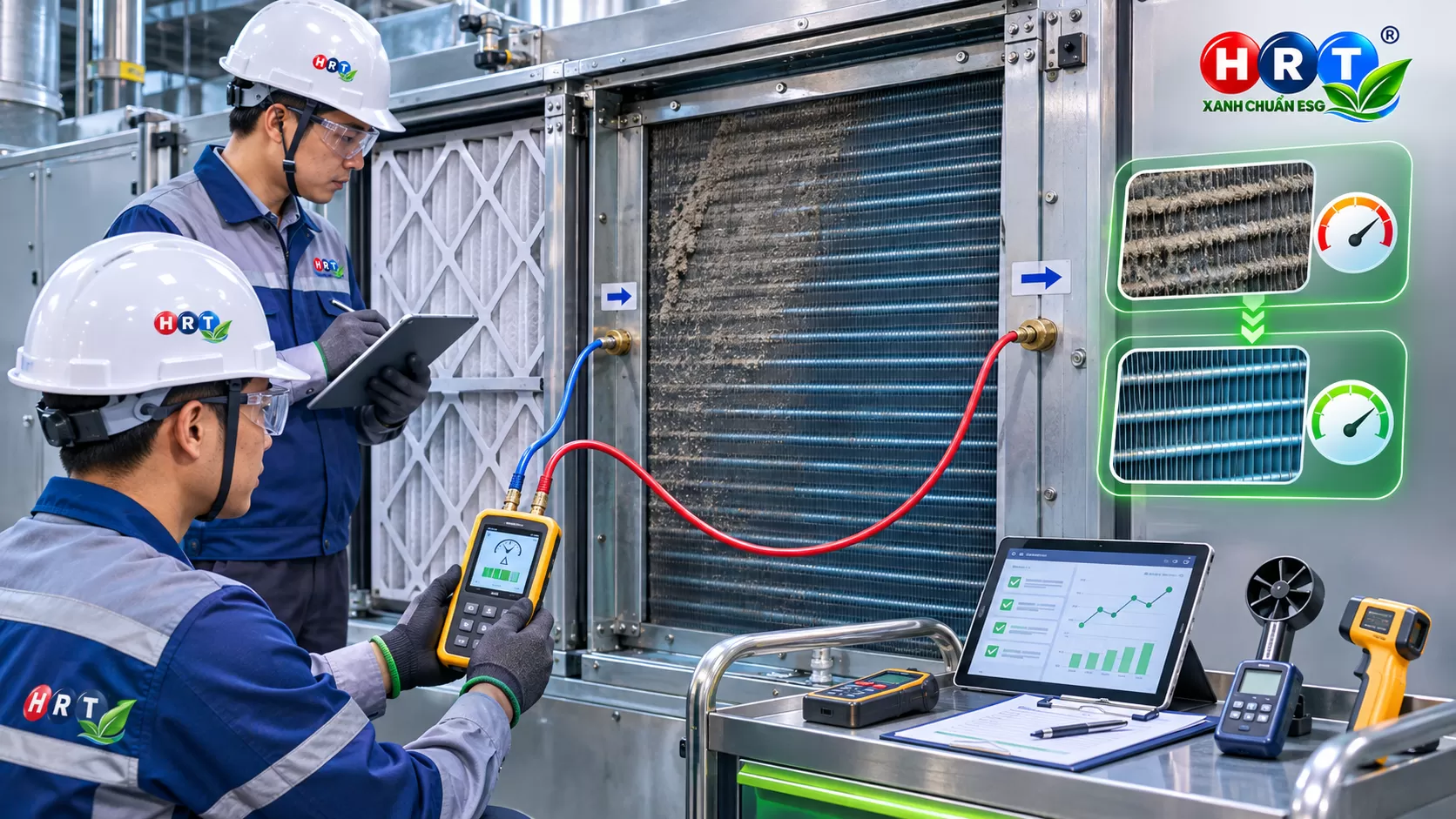
For AHU heat exchangers, dust accumulating on the radiator blades can increase air-side pressure loss.
When proper cleaning method is applied, the dust part that hinders is removed, the ventilation saving condition can be improved.
However, only observation of the coil surface is not sufficient to assess the overall internal condition.
Parameters to check
-
Differential pressure air side through coil, Pa unit.
-
Airflow rate at the time of measurement.
-
Surface condition before and after cleaning.
-
The level of contamination at the accessible locations.
-
Status of radiator blades, heat exchanger tubes and coatings.
Differential pressure through coil depends on airflow rate. Therefore, the comparison before and after cleaning must be done at equivalent operation conditions or with appropriate assessment of the difference.
If differential pressure is still abnormally high, the technician should consider the possibility of dirt deep in the coil, deformed wings or other obstructions.
HRT Action: No coil is qualified just because the surface looks clean. Test results that match maintenance criteria are required.
2. Check the actual airflow rate of AHU
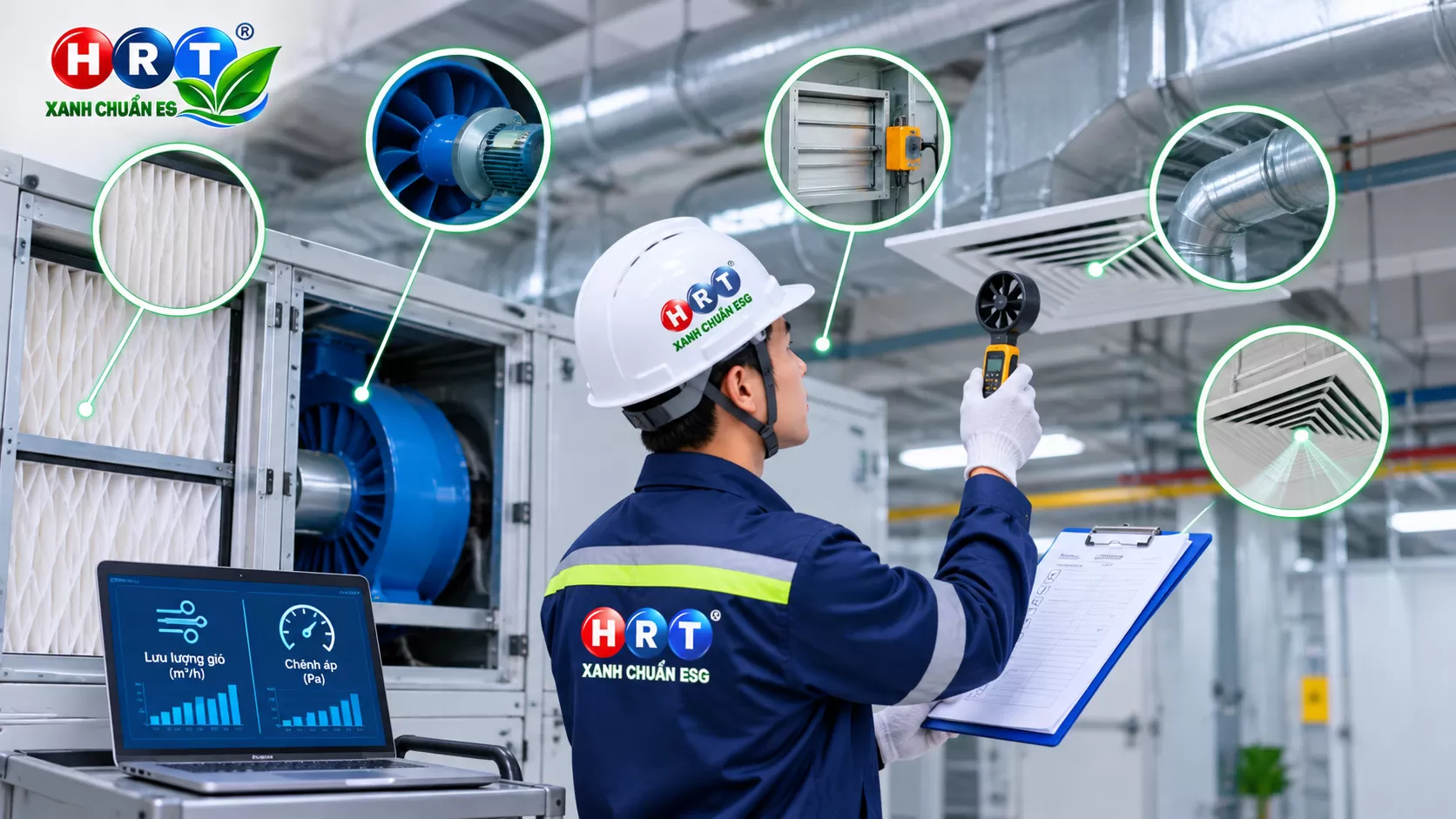
An AHU system with clean coil but airflow rate that does not meet the requirements may still cause the area to fail to reach the desired temperature conditions.
I want the engineering team to evaluate the entire air distribution route instead of just focusing on the equipment.
Positions to check
Air Filter: Dirty filters, wrong or inappropriate fitting can increase pressure loss.
AHU Fan: Check the operation status, speed and actual working point.
Damper: Confirm the opening and closing status and control signal.
Air duct system: Check for potential leaks, obstructions, or cross section changes.
Air outlet: Check flow rate in areas that are cold shortage.
Three situations need to be distinguished
| Phenomenon | Testing Direction |
|---|---|
| Total low airflow rate | Fan, filter, pressure loss and control system |
| Total flow rate is good but some rooms lack wind | Air balancing, damper and distribution branches |
| Flow rate reaches but high level air temperature | Coil, cold water, water valve and load |
I do not recommend speeding up the fan as soon as a room is found to be cold.
Before adjustment, it must confirm the cause and check the operation limit of the equipment.
HRT Action: Measure flow rate, identify abnormal position and adjust only after assessing the whole system.
3. Chilled-water supply and return temperature test
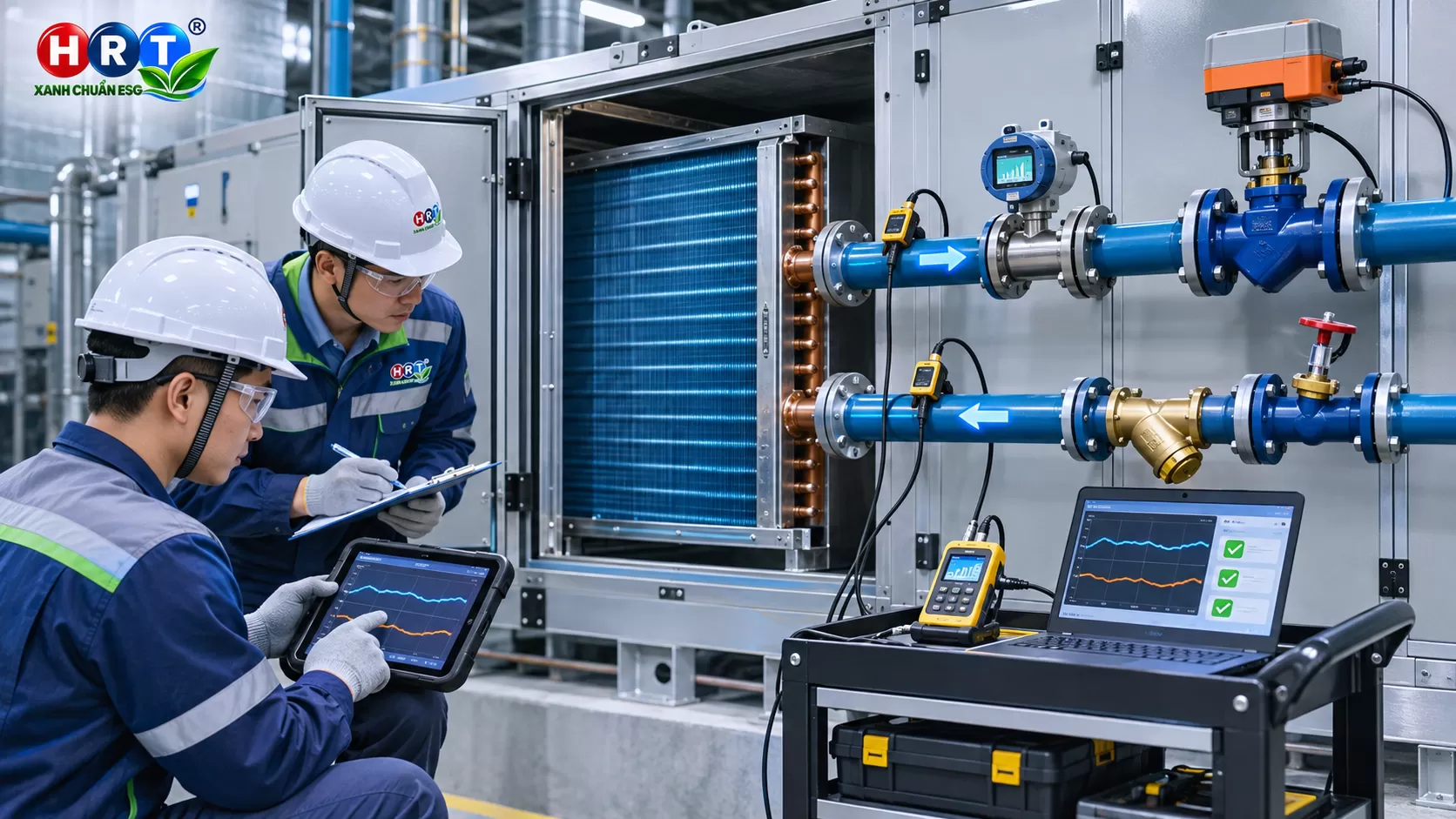
For AHUs using cold water coils, cooling efficiency depends significantly on the condition of water supplied to the unit.
If the chilled-water supply temperature does not meet the requirements or the water flow rate is inappropriate, air side coil cleaning may not solve the cold shortage.
Issues to be evaluated
-
Water temperature into coil.
-
Water temperature out coil.
-
Water flow rate through coil if suitable measuring device is available.
-
Control valve status.
-
Y-filter status, balancing valve and related parts.
-
Ability to supply cold water from Chiller system.
Do not conclude only from the difference in water temperature
The supply - water temperature difference is important but can not represent refrigerant yield by itself.
In principle, the water - side heat exchange capacity is determined according to:
Q = ṁ × cp × ΔT
Where:
-
Q: Heat exchanger capacity, kW.
-
ṁ: flow rate of water volume, kg/s.
-
cp: Specific heat of water, kJ/(kg·K).
-
ΔT: Supply-water temperature and return difference, K.
To evaluate actual yields, both flow rate, temperature difference and measurement reliability should be considered.
For systems using glycol solutions, the physical thermal properties must be determined in accordance with the concentration and temperature of operation.
HRT Action: Compare water side parameters with design and operation conditions before concluding that coil has reduced heat exchange capacity.
4. Check the control valve and BMS signal
One cause often overlooked when evaluating poor cooling AHUs is the control system.
Coil may have been properly cleaned, cold water may be ready, but control valve is not working as required.
Technical questions to answer
-
Is the control signal from BMS suitable for operation requirements?
-
Does the valve actuator respond correctly?
-
Does the valve actually change the water flow rate on command?
-
Temperature sensor is recording a reasonable value?
-
Does there exist manual control mode or operation limit that has not been restored?
Do not confuse signals with results
On the BMS screen, a valve can display the 100% open command.
But that is not enough to confirm the water flow rate through coil satisfactory.
It is necessary to distinguish the command value, position feedback signal and actual flow rate status. The verification method must be consistent with the type of valve and existing measuring device.
If the BMS displays abnormally, the person in charge should check the sensor, signal and actuator before making a repair plan.
HRT Action: Test both the control signals and the actual response of the system.
5. Check temperature, air humidity before and after coil
In many buildings, cooling quality is not only measured by temperature.
Air humidity also directly affects the comfort conditions and operation requirements.
Correct analysis of air state
For dehumidifying coil cooling, air passing through the seat can reduce both temperature and moisture content.
Therefore, when conditions permit, the technician should record:
-
Air temperature before coil.
-
Relative humidity before coil.
-
Air temperature after coil.
-
Relative humidity sau coil.
-
Airflow rate at the measurement condition.
These parameters help determine the air state on a humidity air graph and aid in evaluating sensible heat and latent heat handling.
Distinguish air supply temperature from room temperature
The wind temperature after the coil is not necessarily equal to the temperature at the feed mouth or room temperature.
The air can continue to be affected by fans, pipelines, leaks, mixing processes and thermal load conditions of the using area.
If the wind temperature after coil meets the requirement but the room is still hot, it is necessary to extend the test of wind distribution system and actual load sub.
HRT Action: Assess the air condition at the right measurement position, operation conditions and design goals.
6. Check condensate drain pan, drain line and humidity status
AHU coil cleaning typically involves areas with high humidity, particularly with coil cooling and dehumidification.
If you simply clean the radiator wing and ignore condensate drain pan, problems with standing water or cleaning your appliances may continue.
Points to control
Condensate drain pan: Check for dirt, corrosion, water stagnation and drainage.
Drainage Way: Check the blockage and escape ability under suitable operation conditions.
Condensate Trap: Confirm conformance of structure to pressure at installation site.
AHU cover and insulation layer: Check for abnormal moisture spots, material damage or condensation hazards.
Do not treat standing water with temporary measures
If condensate is overflowing or draining poorly, look for the cause instead of simply draining, drying, or cleaning the trough.
The person in charge should assess the slope, structure of water trap, differential pressure and drainage status according to the design.
HRT Action: Treat the cause properly, retest the drainage capacity and record the results before handover.
7. Actual thermal load test before AHU conclusion is not enough capacity

This is an important decision from a construction management perspective.
After checking the coil, wind, cold water and control, if the room still does not reach the required temperature, I want the technical team to evaluate the actual use condition.
Thermal load may have changed
A work, after being put into exploitation, may change in terms of:
-
Number of users.
-
The number of heat generators and machines.
-
Operating time.
-
Heat from the neighborhood.
-
Outdoor airflow.
-
Door open or air ingress status.
-
Division of rooms and functions of use.
These changes may cause working conditions to be different from those at the time of the original design.
Distinguish three types of problems
Group 1 – Effective attenuators: Need maintenance, repair or replacement of problem parts.
Group 2 – Inappropriate operation system: Need to check control, air balancing and water, or adjust within design range.
Group 3 – Load exceeding design assumptions: Need to re-evaluate the need for use and consider the plan of system renovation.
The fan speed or cooling water temperature should not be used to deal with any cold shortage if it has not been evaluated to affect the capacity, energy and operation limit.
HRT Action: Classify the problem before you decide to repair or invest in improvement.
8. AHU rapid diagnostic table cooling poor after cleaning
For the technical work to be implemented clearly, I propose the following checklist:
| Phenomenon | Priority check | Evidence to be had |
|---|---|---|
| Coil is clean, wind is still weak | Filter, Fan, Damper, Pipeline | Flow rate and device status |
| Enough wind but high level temperature | Cold water, control valve, coil | Temperature, flow rate and control signal |
| Some rooms are still hot | Wind distribution, load per area | Measurement results at branches, air terminal |
| Temperature reaches but high humidity | Dehumidification capability and operation conditions | Temperature, Humidity, Air Status |
| AHU generates standing water | Condensers, water traps and drains | Testing and drainage test results |
| The equipment runs continuously but the room does not reach | Load and actual productivity | Operation data and design comparison |
This table is a tool for testing orientation, not replacing the diagnostic procedure according to each AHU model.
9. Three quality checkpoints HRT after cleaning coil
From a management perspective, I propose to organize the evaluation of results into three portals.
Gate 1 – Confirm cleaning work
Check cleaned areas, condition of radiator blades, coatings, condensate drain pan and parts to be removed.
Output: - The written certification of the hygiene quality.
Port 2 – Confirm operation conditions
Check the safety and parameters in accordance with the initial problem, including airflow rate, differential pressure, temperature, humidity, cold water condition and control.
The results must be compared with the project requirements and actual measurement conditions.
Output: Pre – post checklist and existing list if available.
Gateway 3 – Confirm handover
Check equipment status, maintenance records, repair recommendations and monitoring responsibilities.
Unfinished issues must be clearly noted, not lumped into a conclusion that the whole system has been achieved.
Output: Acceptance records, handover minutes and next processing plan.
My principles are:
No data – no conclusions. Unknown cause – no approval of arbitrary repair.
10. Five mistakes to avoid when the AHU is still poorly cold
Mistake 1 – Clean the coil a second time without finding the cause
Doing a task that doesn't solve the problem will incur cost and downtime.
Actions: Switch to system diagnostics using operation data.
Mistake 2 – Only look at air supply temperature
The air temperature does not fully reflect the flow rate, humidity and processing yield.
Actions: Combine the appropriate parameters and actual load conditions.
Mistake 3 – Adjusting the water valve or fan on your own
A local adjustment may affect other areas or devices.
Actions: Evaluate the system before changing the setpoint and operation mode.
Mistake 4 – Ignoring data before maintenance
Without initial data, it is difficult to determine how much change follows a job.
Actions: Standardize survey forms and record parameters for each maintenance.
Mistake 5 – acceptance testing only by pictures
Clean surface image is a proof of sanitation, but not enough to conclude productivity and operational capacity.
Actions: Verify by data, operation status and criteria of the work.
11. Frequently Asked Questions
11.1. Why is the AHU coil cleaned and the room still hot?
It may be due to an airflow rate that is not met, inappropriate chilled-water supply, a problematic control valve, an imbalanced wind distribution or actual thermal load changes. Measurement should be done to confirm the cause.
11.2. After coil cleaning, is differential pressure required to be reduced?
It cannot be confirmed in all cases. The level of change depends on the initial stain and operational conditions. Comparison should be made at an equivalent airflow rate.
11.3. Coil is clean but cold water is not cold enough what to do?
Check the supply-water temperature, flow rate through the coil, control valve and condition of the cold water supply system. Do not continue to clean the coil if there is no evidence that the coil is the cause.
11.4. Should I speed up the fan to improve room temperature?
Only decide after assessing flow rate, pressure loss, fan capacity, noise, power and design limits. Fan acceleration is not the right solution for every case.
11.5. How do I know if the AHU coil cleaning has been effective?
It is necessary to confirm the quality of cleaning and check the operating parameters related to maintenance goals. The results must be compared with the design requirements or agreed criteria.
12. HRT – Understand the right cause, clear results, dedicated operation
In HVAC engineering management, I always ask the team to look at the problem as a whole system.
CORRECT INTRODUCTION: Not to rush to conclude that dirty coil is the only reason for poor cooling AHU.
CLOSED: All options must have data, scope of work and acceptance testing criteria.
VISION: Monitoring of problems that remain and assisting operators in controlling equipment after maintenance.
HRT provides solutions for design, construction, maintenance and renovation of AHU/FCU, Water Chiller, VRV/VRF and industrial ventilation systems.
We focus on assessing the actual situation before proposing work, helping project owners limit unnecessary items and have a basis for maintenance cost management.
13. Conclusion: Do not only clean the AHU, test the operation efficiency
An efficient AHU system does not depend solely on the cleanliness of the coil.
It is the result of coordination between heat exchanger, wind system, cold water, control and load conditions.
So when AHU is still cooling poorly after sanitation, managers need to check in sequence, collect evidence and properly handle the cause.
Correct measurement – Correct understanding – Correct handling – clear acceptance testing.
That's the approach I want the HRT team to maintain in every HVAC project.
KS. Đoàn Văn Hoàng – CEO HRT
HRT – Green Breath for All Buildings
Right from the beginning – Clear to the end – Sustainable Green.
Website: https://hrt.com.vn/
Website CEO: https://doanvanhoang.com/
Hotline: 0909 326 888
Related Articles: The hygienic process of heat exchanger AHU is technically correct.
The contents are technical evaluation guidance; the actual inspection and handling must comply with the manufacturer's documents, safety conditions and requirements of the work.
Source: Publisher’s English edition · Vietnamese original on doanvanhoang.com