
AHU Air Filter Pressure Differential Management: Optimizing Performance and Power
Machine-translated from Vietnamese. Read the original in Vietnamese

Differential pressure air filter AHU is not only an indicator to decide on filter replacement. When monitored with the same airflow rate, fan speed and BMS data, this parameter can support abnormal detection, maintenance planning and system performance control. CEO Đoàn Văn Hoàng – HRT share how to turn AHU operation data into measurable technical decisions.
Manage differential pressure air filter AHU: From operation data to energy efficiency and maintenance costs
In central air conditioning systems, AHUs play the role of handling and distributing air to the areas in use. For equipment to operate effectively, controlling the air filter should be considered an important part of HVAC system management strategy.
In fact, in many projects, maintenance of air filter AHU is still carried out mainly on a fixed schedule or when warnings appear on the control system.
This method is easy to implement but not necessarily suitable for actual operational conditions.
One filter can accumulate dust faster than expected when the work is operating in a dusty environment. On the contrary, another filter can still meet the technical requirements when the pre-routing period comes.
It is important not to extend the filter life at all costs, but to determine the right time of maintenance and replacement based on air quality requirements, filter characteristics, operation data and technical limitations.
With over 20 years of experience in refrigeration and thermal engineering, I always orient the HRT team to approach operations according to the principles:
Measure the right parameters – Understand the right causes – Handle the right problems – Verify with results.
Why Do Businesses Need to Change How to Manage Air Filter AHU?
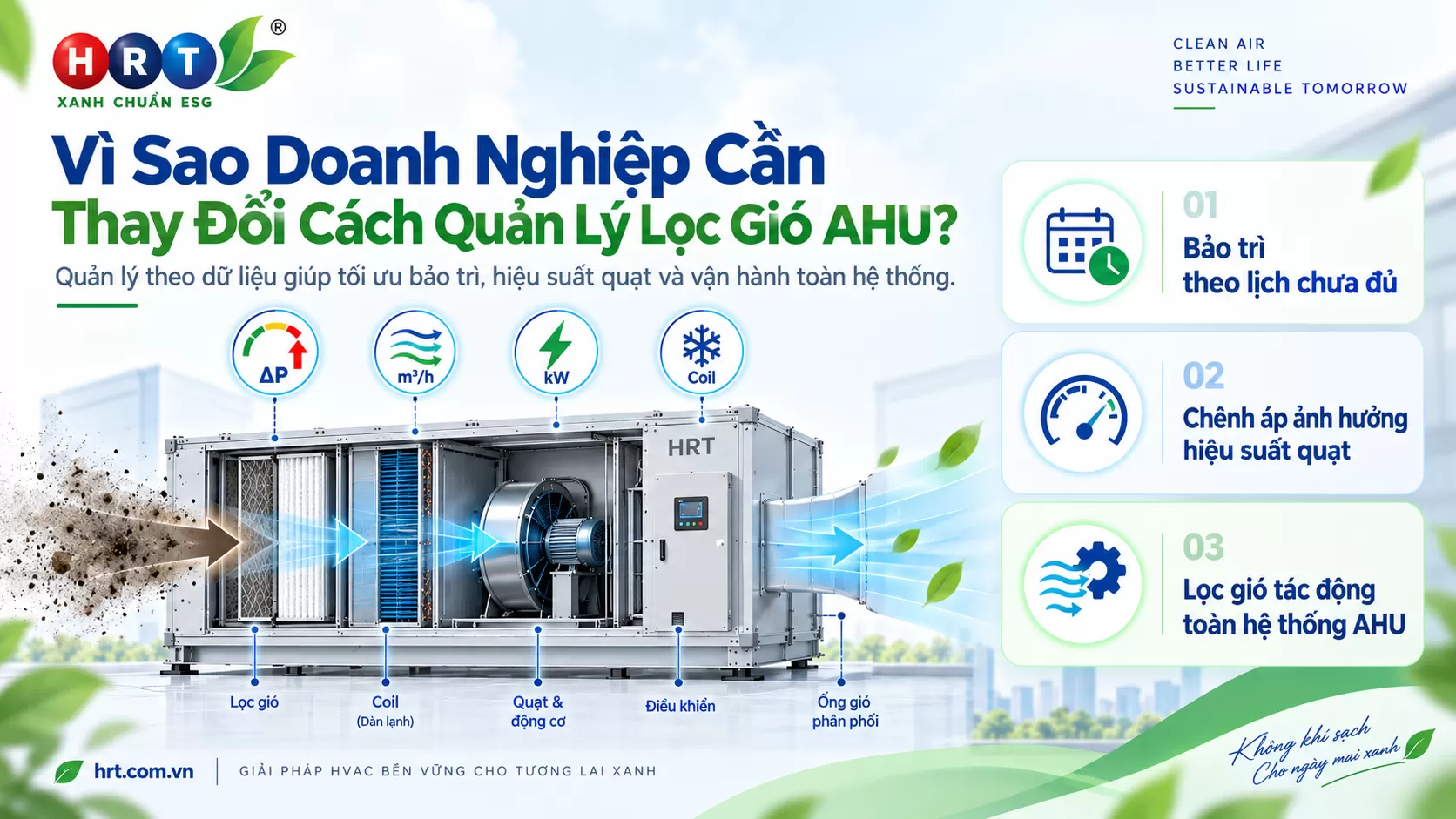
Fixed scheduled maintenance does not fully reflect the device's status
An AHU system in a manufacturing plant can operate for many hours per day and expose to large amounts of dust.
Meanwhile, AHUs at offices have shorter operation schedules and different inlet air conditions.
If both systems are applied the same filter change cycle without considering other conditions, the maintenance decision may not be optimal.
HRT recommends combining maintenance schedule with equipment condition-based inspection criteria.
These criteria should include differential pressure, airflow rate, required air quality, filter material condition, and manufacturer specifications.
Differential pressure air filter related to fan performance
When dust accumulates in the filter material, the air flow pressure loss usually increases at the same flow rate.
For fan systems capable of maintaining a stable flow rate, the controller can increase the fan speed to compensate for the additional pressure loss.
This can increase power consumption.
Conversely, in a fixed-speed fan system, increased pressure loss can reduce the actual airflow rate.
According to ASHRAE, filter pressure loss at defined flow rate and life-cycle cost are factors to consider in selecting and operating air purification equipment.
Air filter affects many other parts of the AHU
Air filter does not work independently.
When the filter is clogged, torn, not sealed or not in accordance with the design, other components may be affected:
-
Heat exchanger Cooling Coil.
-
Fan and motor.
-
Flow rate control system.
-
Ductwork and air outlet.
-
Conditions of temperature and humidity in the area of use.
Therefore, proper air filter management is also a measure to support the effective maintenance of the entire AHU operation.
4 Indicators to Monitor When Evaluating Air Filter AHU Performance
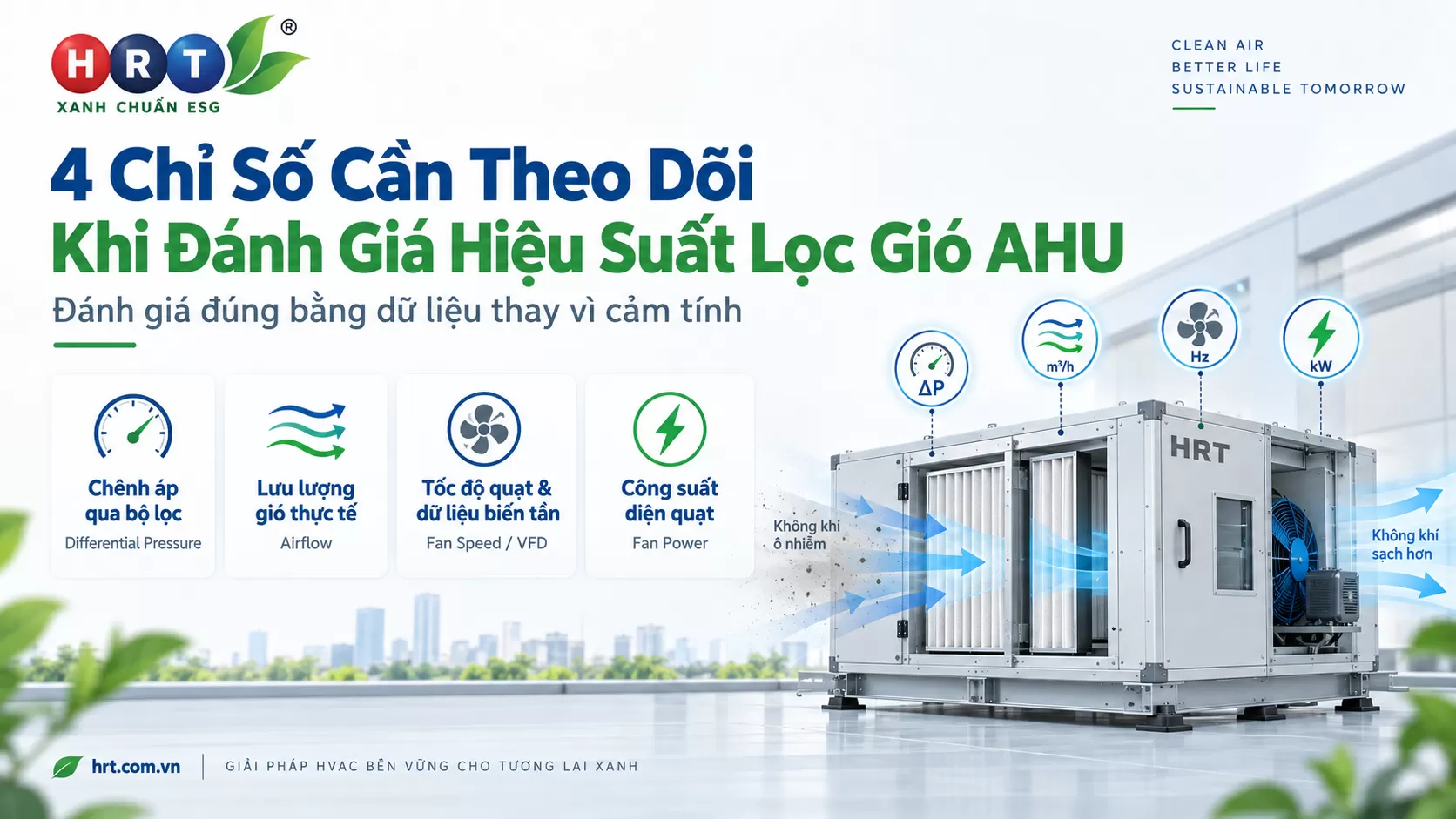
1. Differential Pressure through Filter – Differential Pressure
Differential pressure represents the static pressure drop level when air passes through the filter.
This parameter should be recorded at the specified flow rate, and compared with the limit of the filter and system requirements.
In particular, it is not recommended to conclude the filtering status from a single measured value.
2. Actual airflow rate – Airflow
Flow rate indicates whether the system is meeting air supply demand.
When flow rate declines, it is necessary to identify the cause from filters, coils, fans, damper, ductwork or controllers.
The simultaneous assessment of flow rate and differential pressure helps to limit misdiagnosis.
3. Fan speed and variable-frequency drive data – Fan Speed/VFD
For AHUs that use variable-frequency drives, frequency data, fan speed and control signals are useful.
For example, if the flow rate is maintained near the design level but the fan speed increases with differential filter pressure, it is necessary to check for an increase in system pressure loss.
All fan speed increases should not be due to dirty filtration by default, as control operation and load may also change.
4. Fan power – Fan Power
Electrical capacity is an important indicator to assess the economic impact of the system.
When sufficient reliable measurement data is available, HRT can compare electrical power between stages at equivalent operation conditions.
This approach helps move from sensory evaluation to data evaluation.
Constructing AHU Operation Base Line For Abnormal Detection
What is Baseline?
An operational baseline, or operational baseline is a set of parameters that are recorded when an AHU has been tested, calibrated and operated under well - defined conditions.
Typically, a data set may include:
|
Parameter |
Purpose of tracking |
|---|---|
|
Differential pressure filter cleaner |
Making comparison mold pressure loss filter |
|
Airflow rate |
Design Responsiveness Test |
|
Fan speed/frequency |
Control level monitoring |
|
Fan power |
Energy consumption assessment |
|
Static pressure |
Testing system conditions |
|
Temperature and humidity |
Compare operation requests |
Baseline should be set in representative operation modes, not just at any one time.
Why shouldn't data be compared against operational conditions?
Assume the AHU is controlled to change flow rate according to demand.
In low load mode, flow rate is reduced and differential pressure through the filter is also generally reduced.
If differential pressure is compared today with data from another day, the technician may draw inaccurate conclusions.
Therefore, when analyzing trends, it is necessary to consider periods with equivalent flow rate conditions or apply a proven standardization method.
Real Tracking Example
An AHU system is recorded the following illustrative values:
|
Indexes |
After filter change |
After operation time |
|---|---|---|
|
Airflow rate |
20.000 m³/h |
20.000 m³/h |
|
Differential pressure filter |
90 Pa |
170 Pa |
|
Fan power |
7,5 kW |
8,1 kW |
Example assumed to illustrate the method of monitoring, not the empirical data of HRT or the generally applicable threshold for filter change.
In this case, differential pressure increases by 80 Pa while flow rate remains constant. Fan power also increases by 0.6 kW.
This is a sign that needs further analysis of filter pressure loss and other system changes.
HRT viewpoint: Data helps detect problems. But only when we identify the cause, we have a basis for choosing the right action.
How To Set Up Differential pressure air filter AHU Alert On BMS
Warnings must be based on filter characteristics and flow rate
An effective BMS system does more than just show numbers.
The system needs technician assistance distinguishing normal operation status from changes that may affect performance.
For example, with a variable flow rate AHU, the differential pressure filter warning takes into account the current flow rate rather than just setting a fixed value for every mode.
ASHRAE Guideline 36 provides guidelines for setting differential pressure warning limits at design flow rates, which are determined from the filter manufacturer's recommendations.
Alert hierarchy to support action
HRT proposes to organize warnings at three levels of management, depending on the specific conditions of the work.
|
Alert Level |
Meaningful |
Actions |
|---|---|---|
|
Following up |
Trend of pressure loss changes abnormally |
Data check and operation conditions |
|
Need to check |
Value approaches the set warning limit |
Actual inspection and processing planning |
|
Need to process |
Achieve the allowable limit or appear problems affecting operation requirements |
Check the cause, repair or replace filter according to technical criteria |
This is a proposed management hierarchy, not replacing the manufacturer's maintenance limits and requirements.
Avoid fake alerts
An inappropriately installed alert system can be a nuisance to the operation team.
Common causes include:
-
AHU switches continuously between flow rate modes.
-
Sensor signal oscillates.
-
The pressure point is inappropriate.
-
Pressure signal tube leaks or clogs.
-
Warning is activated immediately during fan startup.
-
Limit value is not consistent with filter configuration.
Therefore, it is necessary to check the signal quality, activation conditions, warning confirmation time and control logic before putting into official operation.
Maintenance air filter AHU By Status: From Response to Proactive
Combine periodical testing with operation data
Condition-Based Maintenance, or conditional maintenance, does not mean eliminating the periodic maintenance schedule altogether.
Instead, the checklist is combined with data and device status to determine priority.
For AHUs and HRT, the orientation is as follows:
Technical Inspection: Confirm the status of filter, filter frame, gasket, sensor and airtightness installation.
Data analysis: Assess the trend of differential pressure, flow rate, fan speed and power.
Decision making: Clean filters that are allowed to be reused, replace disposable filters, or handle other causes of performance degradation.
Don't clean and reuse disposable filters if the manufacturer doesn't allow it.
When to check immediately instead of waiting for maintenance period?
Some signs that need to be prioritized include:
-
Flow rate level failed to meet operation requirements.
-
Differential pressure fluctuations abnormal.
-
The filter is damp, torn or deformed.
-
Abnormal dust appearance behind the filter frame.
-
Fan accelerates but wind supply capacity declines.
-
Repeated or prolonged BMS warnings.
-
The air quality does not meet the requirements of use.
Especially, for the works with strict hygiene and pollution control requirements, the filter change must also comply with regulations, air quality control procedures and standards applied separately to the work.
Life-cycle cost rating Air filter AHU Instead of Just Comparing Purchase Price
Low filter price does not necessarily bring low operation cost
When choosing a replacement filter, many businesses are first interested in the unit price of materials.
However, with the same filtration performance requirements, products may differ in initial pressure loss, dust holding capacity, service life and maintenance characteristics.
A filter has a low purchase price but significantly increases system pressure loss which can affect fan power.
Conversely, a higher - priced filter does not automatically provide better economics if the configuration is not suitable.
Comparison should be made based on total cost over the life cycle.
The costs to calculate
The total cost of ownership can be expressed as follows:
Where:
-
\(C_{\text{filter}}\): Cost of purchasing and replacing filters.
-
\(C_{\text{energy}}\): Electricity costs associated with the lifetime of the electricity.
-
\(C_{\text{maintenance}}\): Labor, inspection and troubleshooting costs.
-
\(C_{\text{processing}}\): Cost of collection and treatment of materials after use.
When changing the filter type, it must confirm the ability to meet the filtration performance requirements, flow rate and pressure limit of the AHU before evaluating the economic benefit.
Example of evaluating the incremental power
Suppose that after one operation period, the fan power increases by an average of 0.6 kW compared to the baseline, after comparing equivalent operation conditions.
With operation time 12 hours / day, 300 days / year:
If the electricity unit price is 2,000 VND/kWh:
ADDITIONAL ELECTRICITY COST – EXPLANATIONAL EXPLANATIONS
4.320.000 VND/year
This figure only illustrates how to quantify the impact if the power increase is maintained within an assumed time period. It is not possible to default to all additional power gains due to dirty filtration, nor can it be defaulted to filtering that will save this entire amount.
For HRT, energy analysis must be based on measurement data, equivalent operation conditions and post-treatment validation results.
6 Steps to Manage HRT-Oriented Air Filter AHU Performance
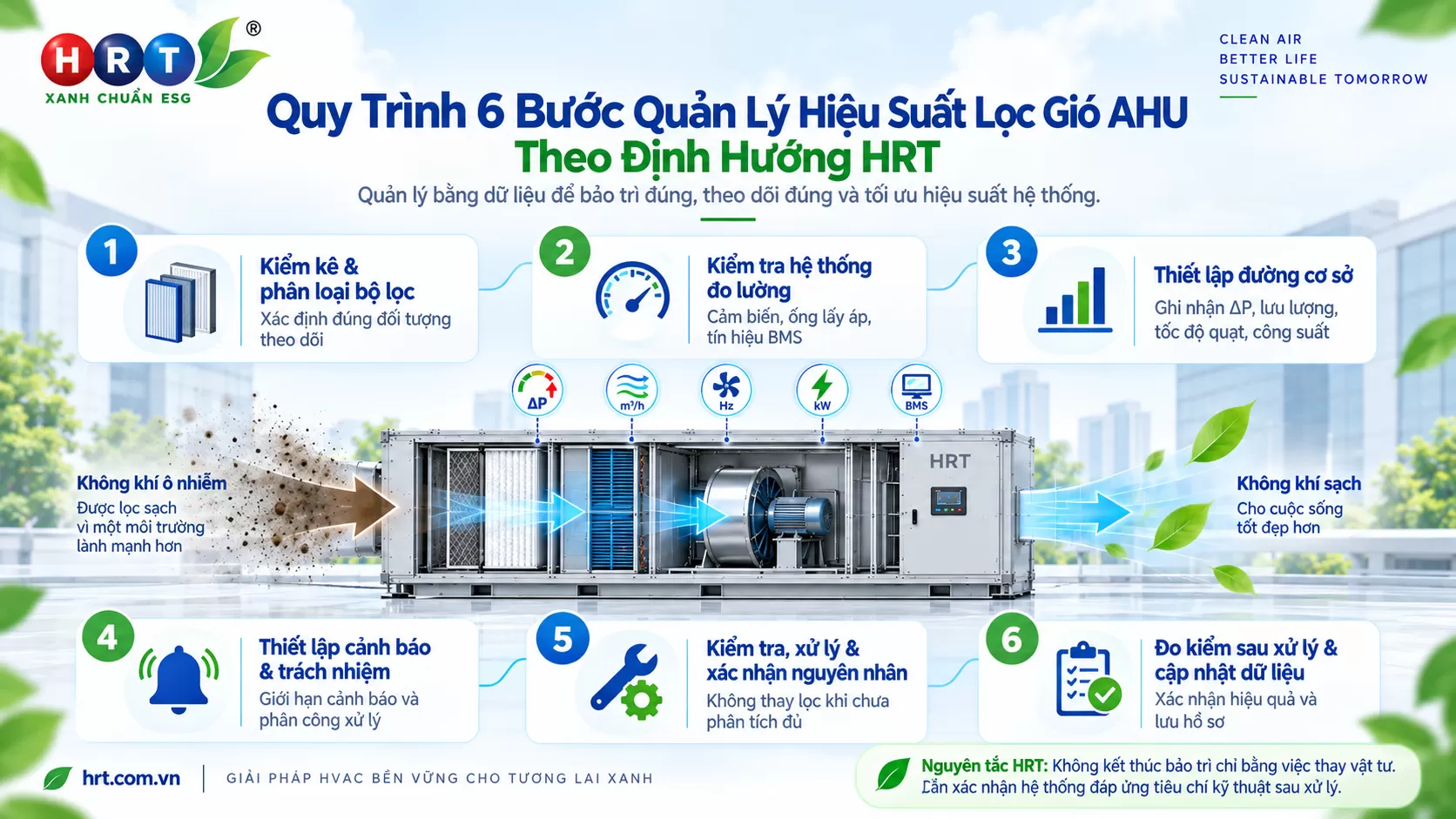
Step 1: Inventory and classify filters
Create a list of filters in use for each AHU.
Recording equipment code, size, filter level, manufacturer parameters, rated flow rate and hygiene requirements of the service area.
The goal is to identify the right people to follow.
Step 2: Check the measurement system
Check differential pressure sensor, pressure pipe, installation location and signal transmission to BMS.
When necessary, compare the sensor value with the appropriate measuring device that has been tested or calibrated.
Wrong data leads to wrong maintenance decisions.
Step 3: Set up baseline
After checking and confirming the system works properly, recording differential filter pressure, flow rate, fan speed, pressure and electric power in representative modes.
This data becomes the basis for tracking future changes.
Step 4: Set up alerts and assign responsibilities
Build alert limits based on technical data, system requirements and operation conditions.
Define the recipient of the warning, response time, inspection method and maintenance decision-making authority.
Step 5: Check, handle and confirm the cause
When abnormalities are detected, complete analysis is required before filter replacement.
If the cause is filter, perform maintenance or replacement accordingly.
If the cause is sensor, fan, coil, damper or air duct system, it must handle the right item that gives rise to the problem.
Step 6: Post-processing measurement and data update
After completion, re - measure and inspect under appropriate conditions.
Indicators that should be confirmed include differential pressure, flow rate, fan speed, ability to meet humidity and electrical conditions.
The results are added to the operation profile for further analysis.
Principle of implementation: Do not finish a maintenance job only by the minutes of replacement of materials. It is necessary to confirm that the system meets the technical criteria after processing.
Mistakes When Managing Differential Pressure AHU Businesses Need To Avoid
Only differential pressure monitoring, ignoring flow rate
Low differential pressure does not mean the filter is definitely clean.
If the flow rate decreases, the differential pressure value may also decrease. Therefore, it is necessary to evaluate the two parameters under the same operation conditions.
Replace filters but do not check the air supply capacity
After filter change, the system may still lack flow rate due to other causes such as dirty coil, inappropriate closing damper, fan performance deterioration or ductwork with large pressure loss.
Upgrade the filter without checking the fan's capacity
When selecting a filter with characteristics different from existing filters, it is necessary to check the filtration performance, initial pressure loss, end pressure loss, rated flow rate and the response ability of the fan.
Filter upgrades should not be based solely on filter grades, bypassing the technical limitations of the AHU.
No data storage after maintenance
If the technician only records the completion of filter changes without saving the parameters before and after, the business will lack grounds for effective evaluation.
This makes subsequent maintenances continually dependent on experience and subjective judgment.
CEO's Look Đoàn Văn Hoàng: HVAC Maintenance Must Create Testable Results

For over 20 years working with refrigeration and thermal engineering, I have noticed a common problem in HVAC system operation:
Enterprises invest a lot in equipment but do not pay adequate attention to data quality and operation efficiency after handover.
An AHU system can be equipped with modern sensors, variable-frequency drives and BMS. However, if the data is not tested, analyzed and turned into action, those technologies have not created sufficient value.
At HRT, I direct my engineering team to three principles:
Understand Correctly: Do not conclude dirty filter just because of a differential pressure value. Must understand equipment characteristics, flow rate conditions and actual causes.
Clear: Any proposal for maintenance, repair or replacement should have technical grounds, scope of implementation, cost and criteria for evaluation of results.
Dedication: Not only complete the replacement of materials. Need to check performance, guide operation and accompany customers during use.
I always ask the HRT technical team a question:
After each maintenance, can we prove that the system has operated better, more stable or reduced risks for customers?
If we don't have the data to answer that, we need to continue improving our management approach.
For me, the value of HVAC services is not only in the number of equipment to be maintained but also in the ability to maintain conditions, control risks and optimize costs in the long term.
That's how HRT makes its commitment:
Understand - Clear - Dedicated.
And step by step realize the mission:
Green Breath for All Buildings.
FAQs about Differential pressure air filter AHU management
Should I change AHU filters on a fixed schedule?
Fixed filter replacement schedules can be applied when suitable for operation, manufacturer or quality management processes. However, it is recommended to combine filter status testing and differential pressure data to limit unnecessary replacement or to filter overdue.
Can BMS automatically warn AHU air filters of contamination?
Yes. When the AHU is equipped with differential pressure sensor and suitable control system, the BMS can monitor and issue alarms according to the set limit.
Warnings need to be verified before a filter change decision is made.
Does replacing the AHU filter save electricity?
It is possible, if the old filter has produced adverse pressure loss that causes the system to consume more power to maintain flow rate.
The actual saving level depends on the fan characteristics, control method, operation time and system condition.
Should the filter have the lowest initial differential pressure?
Don't rely on one parameter.
The filter must meet the filter performance, flow rate, pressure loss characteristics, service life, use conditions and compatibility with the AHU.
How do I know if the AHU maintenance program is working?
It is recommended to monitor indicators such as design flow rate response rate, number of abnormal warnings, number of repeated incidents, power consumption and maintenance completion level.
The results should be evaluated under equivalent operation conditions.
Conclusion: Air filter management AHU is not just the right time to replace filters
Differential pressure air filter is a useful indicator, but the greater value lies in combining this parameter with system-wide operation data.
When enterprises manage differential pressure, airflow rate, fan speed and electricity, technical departments will have more grounds for proactive maintenance, cost control and early detection of abnormalities.
HRT orients to shift the maintenance of HVAC from handling when problems occur to data management, risk prevention and effective verification.
For buildings that are using AHUs, you should start by checking the measurement system, building base roads and reviewing existing warning criteria.
These are specific actions to improve operational quality, step by step towards efficient and sustainable HVAC systems.
Source: Publisher’s English edition · Vietnamese original on doanvanhoang.com