
Air Conditioner Condensate System: Causes of Water Flow and How to Treat It
Machine-translated from Vietnamese. Read the original in Vietnamese
Condensate systems are a small category but directly affect the safe operation of AHUs, FCUs and indoor VRV/VRF units. Just the wrong drainpipe slope, dirty water tray or P-trap improper operation, water can spill down to the ceiling, cause mold, damage to the interior and affect electrical equipment.
1. What is Condensate Air Conditioner System?
During the cooling conditioning, moist air passes through the low-temperature coil surface. When the surface temperature drops below the condensing condition, part of the water vapor in the air converts into water.
This water will:
Cold Coil →Condensate Tray →Exhaust →P-trap →Pipeline →Discharge Point
For those locations where the water is not high enough to flow by gravity, the system can use condensate pump to get the water to the right outlet.
Condensate usually appears at:
-
AHU has cold coil.
-
FCU.
-
Indoor unit cassette.
-
Concealed ducted indoor unit.
-
Indoor unit wall mounted.
-
Indoor unit VRV/VRF.
The amount of water generated varies with air humidity, cooling load, airflow rate, coil temperature and operation time.
2. Main components of condensate system
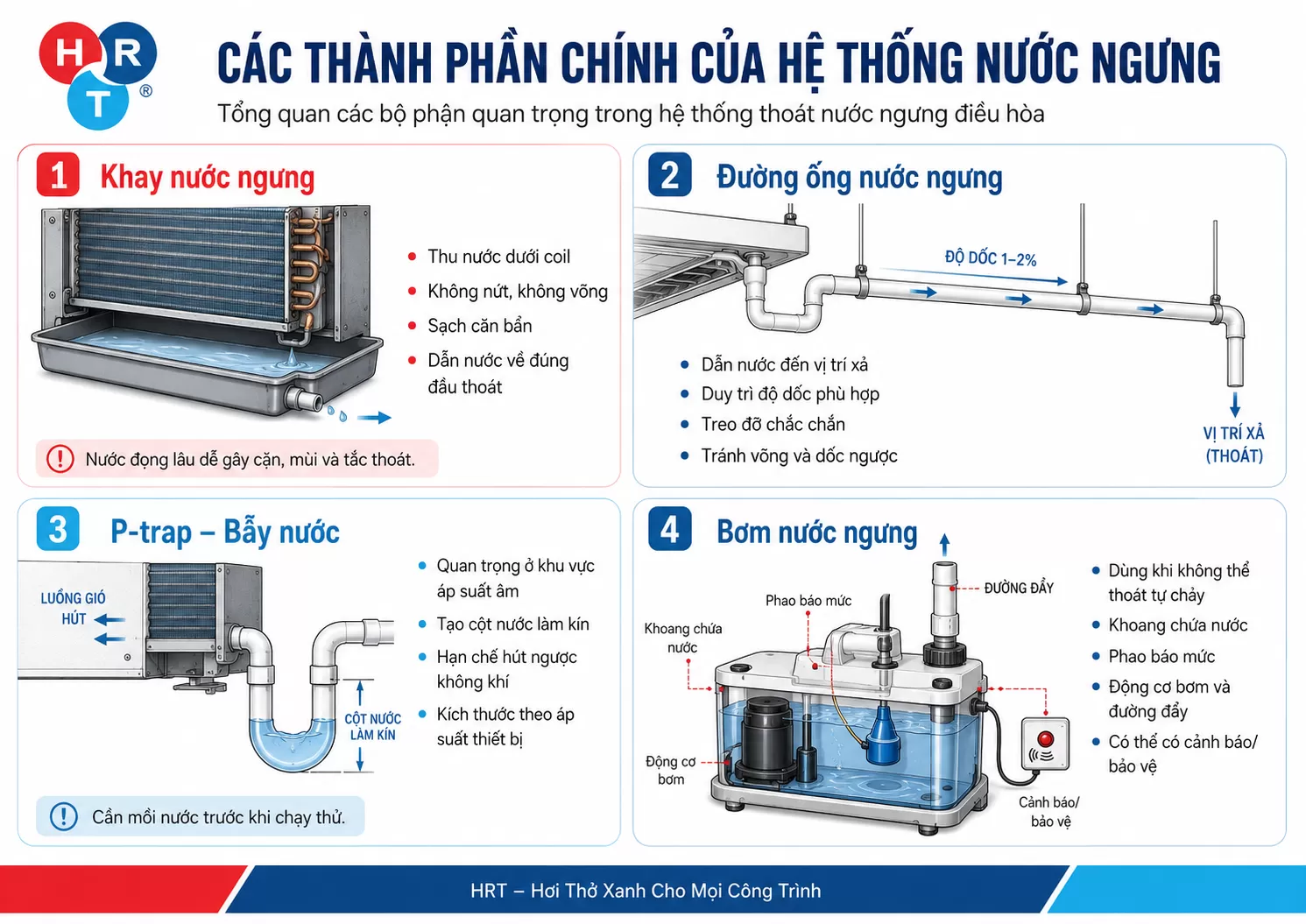
Khay condensate
The tray at the bottom of the coil collects water and guides it to the drain.
Tray Need:
-
No cracking or deformation.
-
No hammocks.
-
Clean the scum.
-
It's structured to help the water flow back to the right outlet.
If water is left standing in the tray, you increase the risk of residue, odor, and blockage.
Condensate pipeline
The pipe receives water from the tray and leads to the discharge site.
For natural drainage systems, the pipeline should maintain an appropriate slope, be firmly supported and minimize sagging or backward slope.
P-trap – water trap
P-traps are particularly important at AHUs or devices with outlets located in negative pressure areas.
When the fan is running, negative pressure in the device can suck up the air back through the outlet and prevent water from flowing out. P-trap creates a sealing water column to limit this phenomenon.
The P-trap size must be determined according to the pressure of the device, not a fixed size should be used for all systems. Traps also need to be water-primed before commissioning.
Condensate Pump
When gravity cannot drain the water, condensate pumps are used.
A pump assembly typically consists of:
-
Water tank.
-
Level buoy.
-
Pump motor.
-
Pushing line.
-
Warning signal or protection depending on the device.
3. Signs condensate system is having problems
Some signs to check early include:
-
small water indoor unit.
-
Water from the ceiling.
-
The ceiling will have stains or bulges.
-
There should always be standing water in the tray.
-
The water drains very slowly.
-
The drain is empty despite the equipment running.
-
Indoor unit area appears moldy smell.
-
Condensate pumps run continuously or do not run.
-
Condensate or overflow alarm device.
However, the water in the ceiling does not necessarily come from the inside of the pipe. If the insulation is open, moisture can condense on the outer surface of the pipe and drip downwards.
4. Common condensate conditioning errors
4.1. Condensate pipeline is clogged
Dust, residue from coils, bio-adhesive materials or foreign bodies may accumulate at trays, outlets and in pipelines.
When the exit cross section is narrowed:
Slow drainage → Water rising in the tray → Overflow
The treatment is to clean the tray, outlet and gland by proper method, then test discharge with clean water.
4.2. Pipeline slope wrong
This is a dangerous construction error because despite clearing the pipeline, water stagnation can still recur.
Common causes:
-
Wrong pitch setting.
-
The shelves are displaced.
-
Pipelines are locally raised or lowered.
-
MEP system renovation changes the route.
All pitches should be checked and corrected or reworked.
4.3. Sagging pipelines
A sagging horizontal pipe can create an unintended water trap.
Once the gland has a P-trap that continues to appear additional deflection points, systems can form double trap, causing air lock and making the outlet flow unstable.
The catheterization did not resolve this problem. The suspension and gland elevation should be adjusted.
4.4. P-trap is designed or installed wrongly
Some common errors:
-
The grip is too shallow.
-
Trap inappropriate pressure device.
-
No primer.
-
Wrong placement.
-
Gather multiple exits into the same trap that is not designed.
P-trap should be calculated based on the actual pressure condition of the device.
4.5. The water tray is dirty, cracked or deformed
Dirty trays make it difficult to get water back to the drain.
Cracked tray causes direct leakage.
A poorly balanced or sagging tray will cause water to pool in an area with no outlet and eventually spill out.
4.6. Condensate pump failed
Causes can come from:
-
Lost power.
-
Float jam.
-
The tank's dirty.
-
Thrusters are clogged.
-
One way valve fault.
-
Pumping insufficient pressure head.
-
The pump motor itself is damaged.
Do not replace the pump immediately. Check in turn from the power supply, float, pipeline to the actual operation ability of the pump.
4.7. Leakage of pipe connections
The drainage is normal but water may leak at a junction due to:
-
The joint is not suitable.
-
Construction is not sealed.
-
Mechanical impact.
-
The brackets put pressure on the joints.
After repairing must discharge test and check in operation condition.
4.8. thermal insulation not sealed
Thermal insulation open, tear or water seepage exposes cold surface to moist air.
The resulting condensate capacitor outside pipe, easily mistaken for a leaking condensate pipeline.
4.9. Indoor unit installed wrong balance
If the device or tray is tilted in the wrong direction, water can not flow to the outlet.
Do not arbitrarily tilt the indoor unit to “give water flow” when not checking the installation requirements of the manufacturer.
4.10. Coil freezes or water is swept through the coil
Too dirty air filter, dirty coil or inappropriate airflow rate can contribute to the freezing of coil under some conditions.
As the ice melts, large amounts of water appear in a short time and can exceed the system's capture - drainage capacity.
In this case, the inspection must also include:
-
Air filter.
-
Coil.
-
Fan.
-
Air flow rate.
-
Refrigeration system.
Condensate catheterization alone will not solve the root cause.
5. Procedure for testing condensate conditioning system
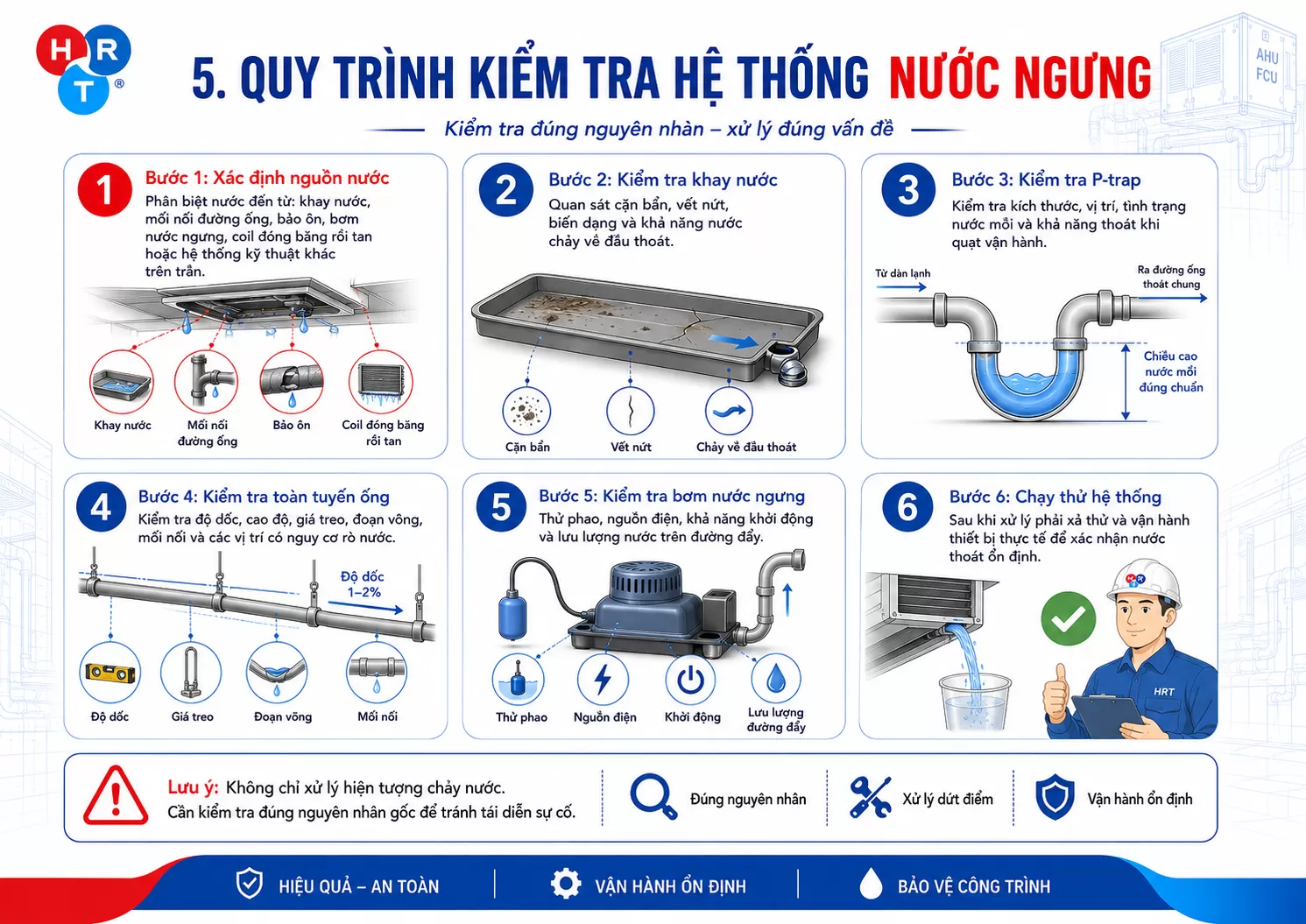
Step 1 – Identify the correct water source
First it is necessary to determine the country of origin from:
-
Water tray.
-
The coupling.
-
Pipeline.
-
Surface thermal insulation.
-
Coil freezes.
-
Other MEP equipment above the ceiling.
This is an important step to avoid making mistakes in the category.
Step 2 – Condensate tray inspection
Testing:
-
Dirt.
-
Standing water.
-
The crack.
-
Deformity.
-
Point the water toward the drain.
Can test the water according to the appropriate process to test the drainage ability.
Step 3 – Check P-trap
Rating:
-
The size.
-
The pitch.
-
Structure.
-
Baitwater.
-
Sealing ability.
-
Relation to equipment pressure.
Step 4 – Check the entire pipeline
Not just the nearest indoor unit.
Need to check:
-
The slope.
-
The pitch.
-
The rack.
-
Hammock point.
-
Upside down.
-
The coupling.
-
Gland consolidation point.
-
End discharge position.
Step 5 – Condensate Pump Test
If the system uses a pump, it is necessary to try:
-
Level buoy.
-
The ability to boot.
-
The ability to stop.
-
Pushing line.
-
High water warning.
-
Pumping capability at actual conditions.
Step 6 – Check for Causes from HVAC Systems
Finally check filter, coil, fan, airflow rate and refrigeration system to determine whether water arising abnormalities are related to operation or not.
6. How to treat condensate system according to the cause
The key principle is:
Don't treat it as a phenomenon - treat it as a cause.
If... pipe blockage: cleaning trays, outlets, through-lines and test discharges.
If... wrong slope: re-adjust the pitch or re-build the line.
If... sagging tube: realign the suspension.
If... P-trap sai: pressure test and redesign suitable trap.
If... damaged tray: repair or replace according to actual condition.
If... fault pump: check the power supply, float, push line and pumping capacity before deciding to replace.
If... thermal insulation damage: remove the wet thermal insulation part, dry the surface, check for leakage and re-wrap the seal.
If... Coil freezing or water rolling: processing of refrigeration system and air system simultaneously.
7. Mistakes to Avoid When Handling Water Flow Conditioners
Just vent and finish.
If the cause is a slope or deflection, the system will continue to recur.
Let's say the P-trap is as deep as possible
Inaccurate. Trap must match the pressure at the device.
No P-trap primer before commissioning
Drying the trap can cause air to travel backwards through the drain and affect drainage.
Disable the overflow alarm switch
This is a protective device. A shutdown can cause water to continue to rise and spill into the ceiling or an area with electrical equipment.
Fixed but not commissioning
Some errors only appear when the fan is operating, the pressure changes and the actual condensate amount increases. Therefore, after repairing, it is necessary to check the system under operation conditions.
8. When should condensate system renovation be done?
It is recommended to re-survey the entire system when:
-
The water leaks repeatedly.
-
Regular pipework outages.
-
Change the FCU or indoor unit position.
-
Replace your AHU, FCU or new VRV/VRF.
-
The old pipeline is degraded.
-
The aging bond.
-
Thermal insulation damage.
-
The system lacks sanitary location, door visit.
-
Pipeline conflicts with other MEP systems.
Especially, when replacing a new device, the old exit route should not be preserved by default. It is necessary to check the exit header, P-trap, altitude and responsiveness of the existing route.
9. Procedures for condensate testing and treatment at HRT
HRT approach condensate failure on the principle determine the correct cause before repairing.
Step 1 – Survey the current status
Determine the type of equipment, location of water generation, operation status and scope of influence.
Step 2 – Check the water source
Distinguish tray overflow, pipe leakage, condensation insulation, pump failure or water arising abnormally from coil.
Step 3 – Check the exit route
Rated water tray, P-trap, slope, elevation, rack, joint, pump and discharge point.
Step 4 – Check Related HVAC Systems
Check coil, air filter, fan and operation condition to avoid handling the tops.
Step 5 – Propose a plan
Depending on the current situation, it is possible to clean, clear the route, adjust the height, repair the joints, renovate the P-trap, repair the tray, check the pump or complete thermal insulation.
Step 6 – commissioning and confirmation
After treatment need to discharge water test and operation equipment to assess the drainage capacity in actual conditions.
With the spirit True – Clear – Dedicated, HRT aims to solve the right cause, limit temporary repair and optimize the HVAC system according to the actual conditions of each project.
10. Frequently Asked Questions
Why is the air conditioning unplugging and still running water?
Because the cause may lie in the slope, deflection pipe segment, P - trap, water tray, pump, insulator or coil rather than a pipeline blockage.
Is P-trap condensate required?
Depending on the configuration and pressure conditions of the device. Especially with the outlet located in the negative pressure area, P-trap plays an important role in maintaining drainage capacity.
Does condensate need insulation?
Segments with a risk of surface temperature lower than the dew point condition of the environment should be considered thermal insulation by design to limit condensation.
Should I use harsh chemicals to clear the drain?
It should not be used arbitrarily. Incompatible chemicals may affect pipe materials, joint glues, gaskets or related parts.
When to replace condensate pump?
Replacement should only be done after checking the power supply, float, cavity, propulsion path and determining that the pump is actually damaged or does not meet operational conditions.
Conclusion
Condensate system does not directly produce refrigeration productivity but greatly affects the operational stability of AHUs, FCUs and VRV/VRF indoor units.
A water run-off can stem from a variety of causes: pipe throttle, wrong slope, sagging pipe, inappropriate P-trap, tray failure, pump failure, thermal insulation opening or abnormal operation coil.
Therefore, the right solution is not to see water as a drain. It is necessary to check the entire system, identify the correct cause and commissioning after treatment to limit recurrence of errors.
HRT – Green Breath for All Buildings
Right From the Start – Clear To the End – Green Sustainable
Source: Publisher’s English edition · Vietnamese original on doanvanhoang.com