
Air duct leakage: five issues to resolve before handover
Machine-translated from Vietnamese. Read the original in Vietnamese

Duct leakage air conditioner causes energy loss, reduce HVAC performance. CEO Đoàn Văn Hoàng – HRT share 5 steps of inspection, processing and acceptance testing strictly technique.
Duct leakage conditioner: 5 things need to latch before acceptance testing
When receiving a report on air duct system repair, i want to see the clear answer: where the problem came from, how much work has been done and what the results are confirmed with.
A line that says “leak fixed" should include sufficient evidence to allow the manager to decide to put the system back into operation.
Duct leakage air conditioner Air flow is the condition where air passes through unclosed locations outside the design path. Depending on the differential pressure, air can escape from the pipe or be sucked from the surroundings into the system.
To manage this work, I put emphasis on five things: confirm the incident, determine scope, select a plan, verify results and hand over responsibility.
Each task should have a clear output before moving on to the next.
1. Correctly fixing the incident before deciding to repair it
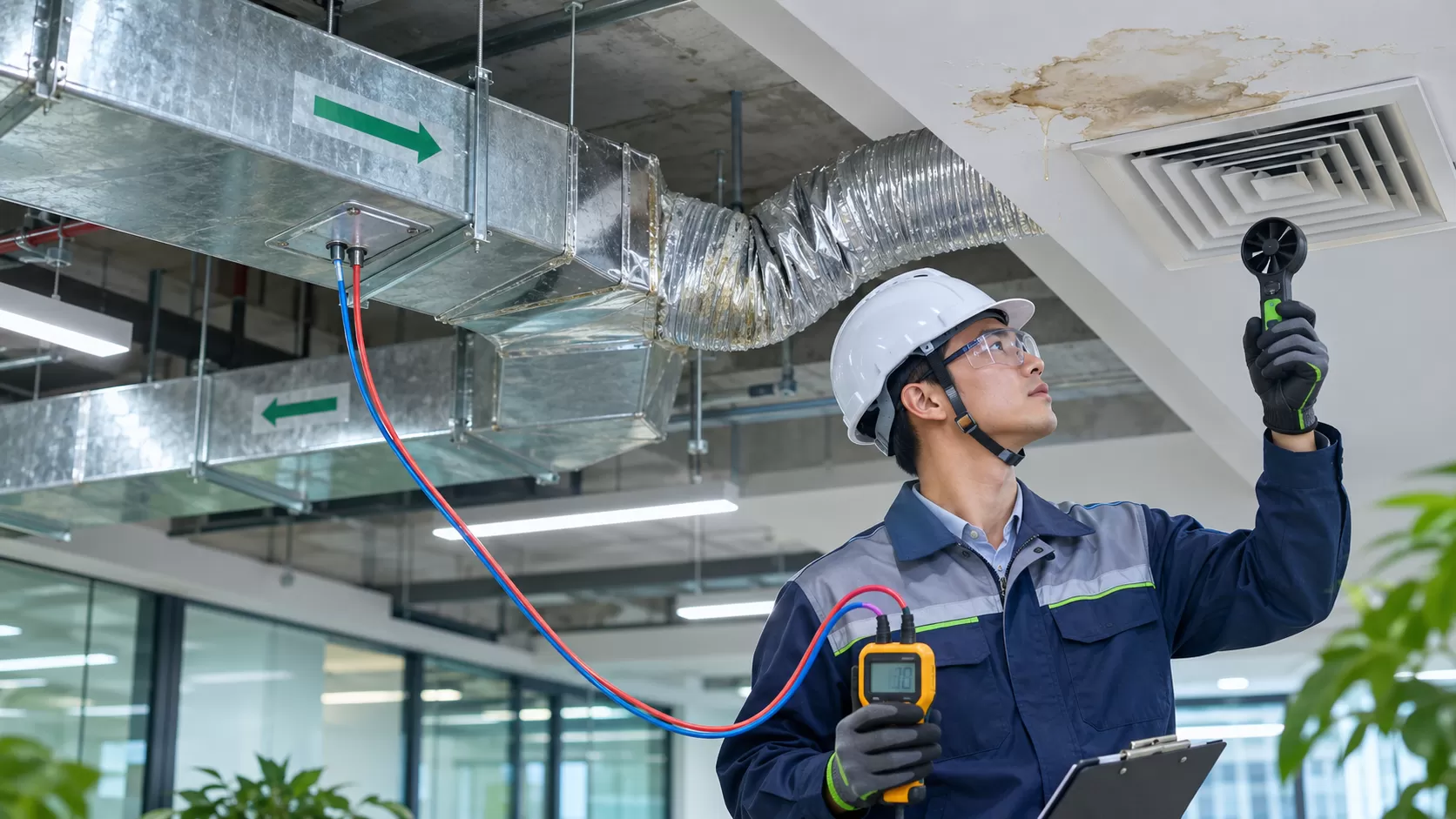
The first information from the scene is usually an indication: hot room, weak air terminal, damp ceiling or unusual noise.
The technical person's task is to convert that expression into a grounded conclusion.
Insufficient airflow room should be checked both distribution routes
Low flow rate at air terminal may be related to air leakage, but also due to dirty filtration, dust-causing heat exchanger, misplaced damper, folded flexible hose or inappropriate working fan.
Therefore, it is necessary to compare the condition of equipment, pipelines and adjustment parts before determining the cause. A folded section of flexible pipe may increase pressure loss; to conclude a gas leak must still find the actual gap or damage.
I'd like to report the scene, stating:
-
What areas are affected?
-
What operational conditions does the problem occur in?
-
What parameters have been measured?
-
What evidence leads to a conclusion about the cause?
This way of noting helps the validator understand the basis of the correction proposal.
Water stains on the ceiling must be traced back to the source
When water appears around the pipe or air outlet, it is necessary to simultaneously check the water source and condensation conditions.
Condensation occurs when the surface temperature is lower than the dew point of the exposed air. Meanwhile, leakage water can originate from condensate trays, sewer lines or another pipeline system.
Measuring surface temperature, temperature and air humidity helps assess condensation capacity. Observing the path of water helps trace generation sites.
Inlet and outlet routes should be considered separately
At a pipe section with a lower pressure than the surroundings, the gap may draw unintended air into the system. If the pipeline passes through a space with high dust or moisture content, return air quality may be affected.
Therefore, the survey should also record conditions outside the tube.
Work to be closed: Identify the name of the problem, location, evidence, and affected area before selecting a treatment.
2. Closing the scope of handling according to the impacts on the works
After confirming the error, the manager needs to decide the order of implementation.
I propose to organize the work in three questions: How will it affect, when can it be accessed and with whom?
| Situation at the work | Contents to be clarified |
|---|---|
| Areas of use that are lacking wind or do not meet the capacity | Scope of influence, temporary operation conditions and time of repair |
| Pipeline is about to be insulated or covered | Plan for checking, handling existing problems and confirming before the next work |
| Repeatedly Corrected Position | Causes of recurrence and extent of testing |
| Pipelines located in hard-to-reach areas | Plans for access, asset protection and return after construction |
For works in operation, the plan should clearly state the time of stopping the system, coordinating units and persons certifying working conditions. Before repairing, the construction team must take measures to isolate equipment, energy sources and ensure safety in accordance with the scope of work.
For new construction items requiring airtightness testing, it is necessary to arrange the test when the pipe section is completely installed and accessible, before thermal insulation, cover according to the applicable profile.
Carefully assess before accelerating the fan to compensate for insufficient airflow
The adjustment of fan speed should be based on the working point and the capacity of the equipment. According to the fan characteristics relation under similar conditions, increasing the speed can increase the required flow rate, pressure and power.
From there, the treatment direction I choose is to check airtightness, pressure loss and wind distribution before finalizing the adjustment plan.
If the fan mode must be changed, records should record the value before and after to serve the evaluation of results.
Work to be closed: - Which routes are to be processed, the time of implementation, conditions for stopping the machine and the person responsible for coordination.
3. Finalize the repair plan with acceptance criteria
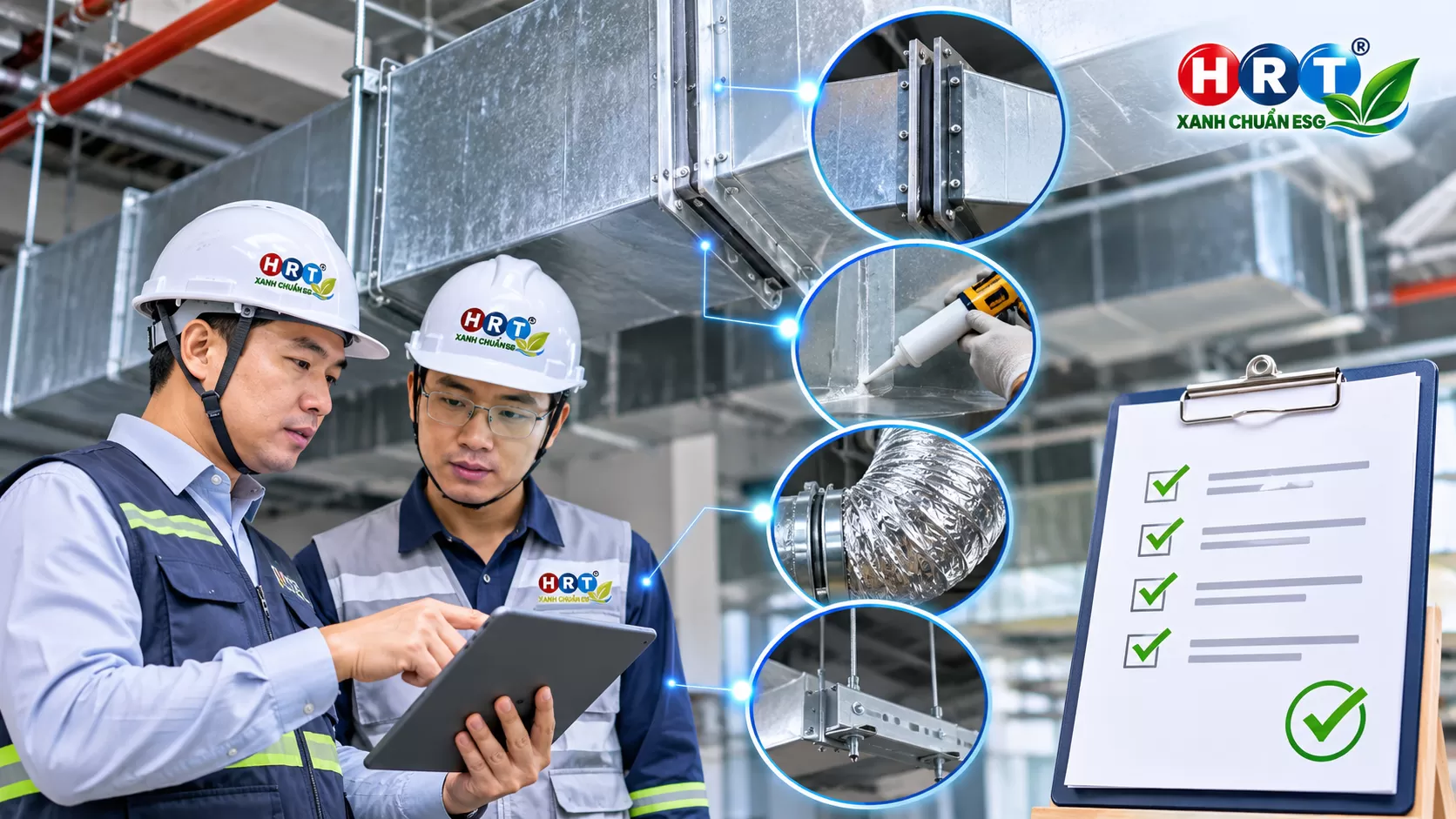
A good plan should explain why the fix is appropriate for the current state of the material and structure.
I want to see the connection between damaged form – handling measures – how to check after repair.
Choice of correction or replacement according to actual condition
| Status confirmed | Processing direction to consider |
|---|---|
| Deviated Flanges, Broken Gaskets, Liquid Bonding | Restore links, alignment and replace gaskets accordingly |
| The graft is open but the texture is good. | Surface preparation and application of compatible sealing materials |
| Corrosion, perforation or deformation of the tube body | Evaluate the possibility of reinforced repair or pipe replacement |
| Recurrent damage due to vibration, mounts or force | Fix mechanical causes before finishing airtightness |
These types of damage should be evaluated both in terms of airtightness and structural condition at the repair site.
In the cost proposal, I would like the implementing entity to clearly state the reason for choosing local repair or replacement. Accessibility, range of material degradation and accompanying reimbursement work should be considered.
Select material according to specific application
Sealants, gaskets, and tapes should be made in accordance with the substrate material, conditions for use, and manufacturer's instructions.
The construction surface must be prepared as required. Joints should be sealed before finishing the insulation; keep the temper continuous and avoid excessive compression.
I request the plan to specify the name of the material, location, construction conditions and time needed before re-testing. This helps the construction team, supervisor and acceptance testing party understand the same requirement.
With flexible hose, full test of grades
Flexible hose connectors need to be considered from the inner air conducting core, the fixed structure to the insulation layer and the outer vapor barrier layer.
After restoring the bonding and airtightness of the core, the remaining layers must be finished according to the product structure. Thermal insulation is tightly pressed or the vapor barrier layer is exposed which can facilitate the appearance of cold spots and condensation.
Unify the conditions as soon as approving the plan
The manager should know in advance:
-
Which position will be rechecked?
-
What methods are used?
-
What parameters should be recorded?
-
Which results are eligible for acceptance?
-
Who confirms the work completed?
Work to be closed: The technical plan, materials, scope of repair or replacement and acceptance testing conditions must be agreed before deployment.
4. Fasten the result by proper measurement
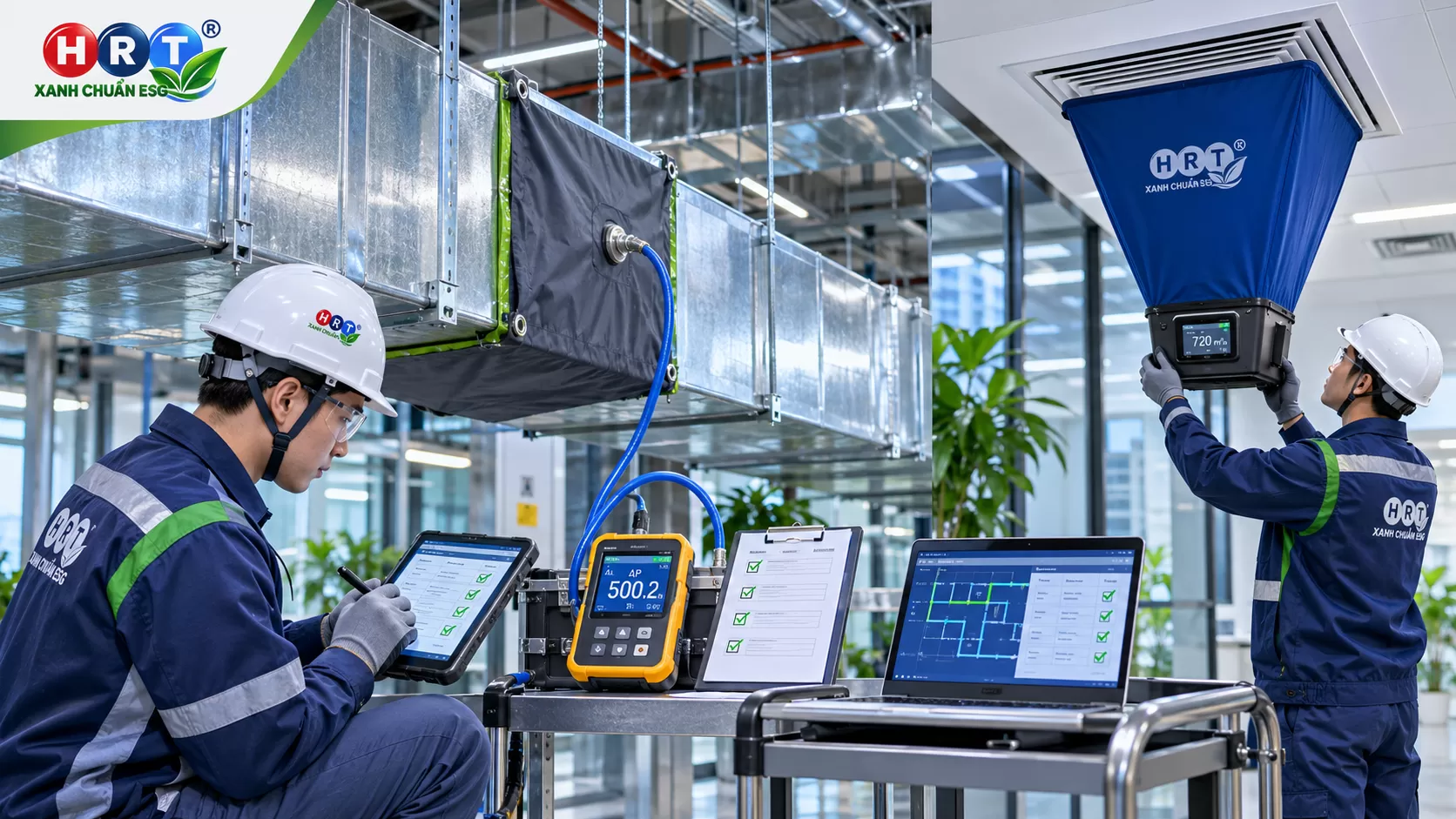
In acceptance testing, I separated two questions to evaluate:
Does the pipe meet the airtightness requirement?
Has the user area received the airflow rate requested?
These two questions need evidence that is relevant to the purpose of the test.
Airtightness test to confirm pipe passage quality
When quantitative testing is performed by pressure generation, the pipe section is isolated according to the defined range. The test equipment generates differential pressure and measures the leakage gas flow rate at that condition.
The test pressure must be consistent with the approved plan and not exceed the pressure level of the pipe section.
I want the record to clearly show the test range, pressure, flow rate leakage, measuring equipment and conclusions compared with the agreed criteria. The values should be written in consistent units such as Pa for pressure, L/s or m3/h for flow rate.
Acceptance limits must be grounded from project requirements. SMACNA also distinguishes sealing position requirements from leakage levels; the selection of criteria should consider pressure, composition and type of pipe. When equipment or fittings are within the test range, their leakage characteristics should be taken into account.
Measurement and air balancing to assess delivery capacity
After repair, it is necessary to check the flow rate at relevant locations and compare with design requirements.
TAB—measurement, adjustment and balancing—helps assess wind distribution, record results and system problems. The report should show which areas have met and which locations still need to be dealt with.
For meaningful before and after comparisons, I want the operation conditions recorded: fan mode, damper state, and changes made during processing.
The difference between the source flow rate and total air terminal flow rate should be interpreted carefully. To use that difference to conclude the leakage, it is necessary to control the scope, operation conditions and reliability of the measurement; TAB results are not usually automatically replacing the airtightness test.
Decide acceptance testing according to the collated results
I propose acceptance testing conclusions stating in detail the items reached, remaining existence and next actions.
If airtightness has been reached but an area still lacks wind, further work should be clearly assigned to the person in charge of assessing the remaining cause.
Work to be closed: There is evidence of airtightness within the required range and operational results in the affected areas.
5. Closing of handover dossiers and monitoring responsibilities

A useful set of records must help the recipient understand the work even if they are not directly involved in the repair.
I propose each group of bugs have a short record, consisting of:
-
Position: Linear code, floor, area or symbol on the drawing.
-
Status: Images and information recorded before processing.
-
Work done: Plans, materials, repairs and replacements.
-
Confirmation result: Measurement parameters, inspection conditions and comparison criteria.
-
Further responsibilities: Receivers, survivors should be monitored and rechecked if necessary.
The principles of pre-measurement, target identification and re-testing after sealing are also shown in DOE/PNNL's air duct system improvement guideline.
From a management perspective, I want records that allow me to access a repair location using code or images. This way of saving helps the operation team continue their work smoothly when shifts are changed, personnel are replaced, or other maintenance units are involved.
The monitoring should be associated with the actual state of the works. The locations where incidents have reoccurred, difficult to access or just affected by the renovation should be marked for inspection when appropriate conditions are available.
If new reflections arise, the manager may compare them with the data handed over before deciding to expand the scope of processing.
Work to be closed: Records can be searched, recipients are clear and exists are all in charge.
Frequently Asked Questions About Duct Leakage Air Conditioner
Air duct conditioning water stagnation is due to air leakage?
It should be checked to distinguish. Water may be from condensation on cold surfaces or from trays, drains and other sources. A combination of water tracing and measuring surface temperature, air temperature and humidity helps determine the direction of treatment.
Does air conditioning leakage duct increase electricity bills?
It is possible. Treated air leaking from the supply gland or unintended air entering the return gland can reduce operation efficiency. Properly sealing the pipeline can improve energy use efficiency.
To assess the savings at a work, it is recommended to compare data in collable conditions of use, and record changes in load, runtime and operation mode.
When should I repair the seal, when should I change the pipe?
The damage level, residual strength and ability to restore the connection should be based on. Errors at gaskets or joints may be considered for local repair; structural deterioration of pipes should be evaluated for reinforcement or replacement.
After repairing the leak, is it necessary to measure the airflow rate again?
The flow rate should be checked at the affected area and rebalanced as needed. The measurement results should be compared with the design requirements to confirm the ability to distribute wind after repair.
HRT: Clarify responsibilities from survey to handover
To me, the quality of repair should be expressed in a clear sequence of information: cause is confirmed, the plan is grounded, the results are verified and the operator has sufficient data to take over.
That's how I want to incorporate the three values of HRT into my daily work:
-
Understand Correctly: Go to the cause with surveys and evidence.
-
Clear: Unified scope, criteria and responsibilities.
-
Dedicated: Follow the work until the results are fully handed over.
If the building is in need of air conditioning duct leakage testing, prepare a pipeline diagram, describe the affected area, field images and operational data available to communicate with HRT about the survey scope.
Đoàn Văn Hoàng – CEO HRT
Right from the beginning – Clear to the end – Sustainable Green.
HRT – Green Breath for All Buildings.
Website: hrt.com.vn · doanvanhoang.com
Source: Publisher’s English edition · Vietnamese original on doanvanhoang.com