
Checklist for VRV system acceptance: Basis for handover
Machine-translated from Vietnamese. Read the original in Vietnamese
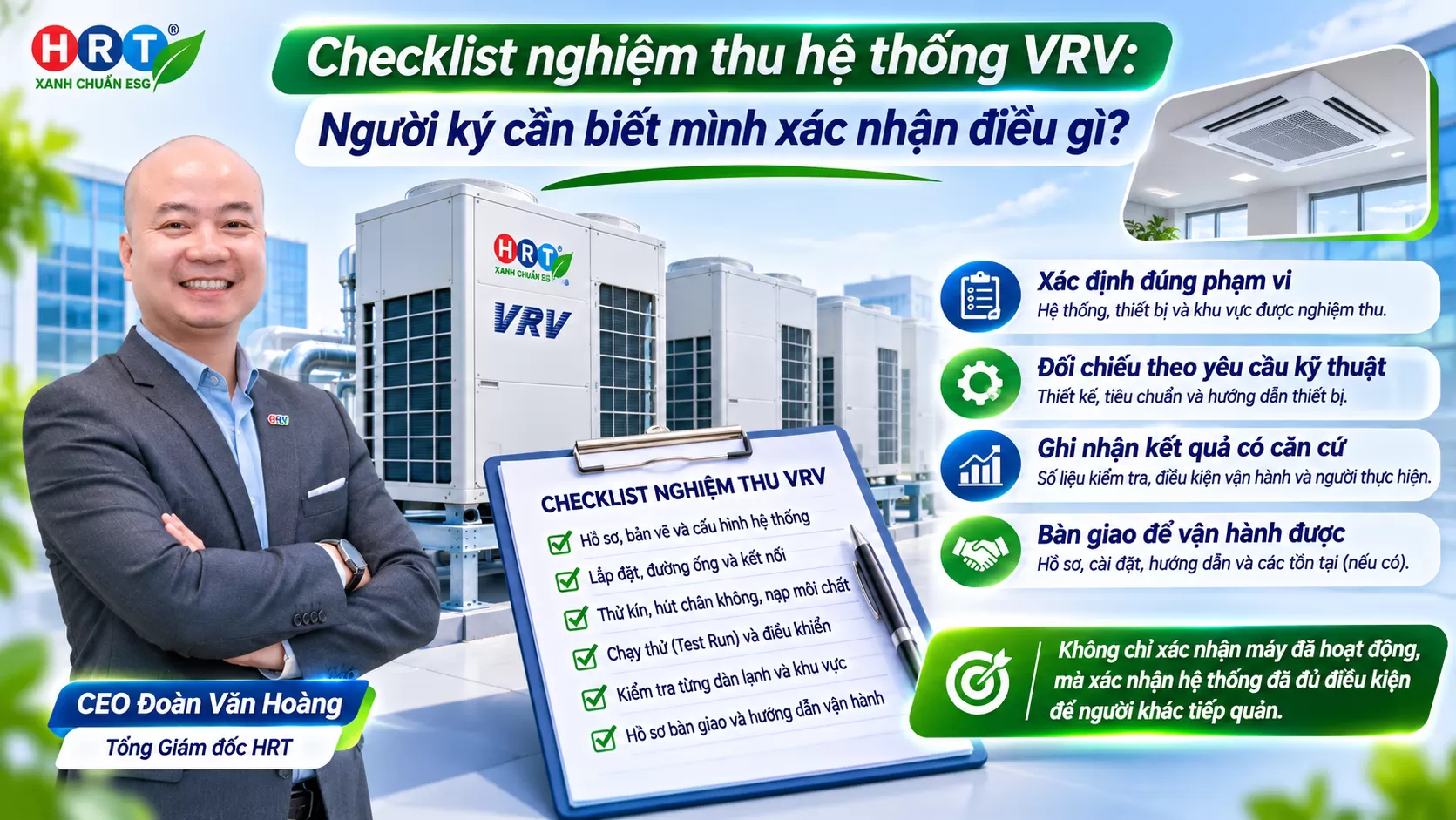
CEO Đoàn Văn Hoàng – HRT share how to use the checklist acceptance testing VRV system to control records, commissioning results and takeover responsibilities. Not only confirms that the machine is working, each handover conclusion needs evidence and reflects the correct scope of inspection.
Checklist acceptance testing VRV system: Signers need to know what they confirm
In a hypothetical situation, the project team prepared to hand over the air conditioning system to the new office floor. the outdoor unit had completed commissioning, and the rooms were starting to cool, with records neatly placed on the desk.
Before signing, the operation representative asked: “What indoor units is this meeting room controller managing?"
The answer is not consistent with the drawings. A device has changed its position during construction, but the room name on the control system remains the same as the old plan.
This is where I want the project team to pause to clarify: Are we confirming the device is functional, or are we confirming that the system is eligible for someone else to take over?
From an HRT operator perspective, I would like checklist acceptance testing VRV system help the signer understand the scope he/she is approving. Each conclusion should be connected to the equipment, technical requirements, test results and the person responsible.
This approach is in line with ASHRAE commissioning principles: to verify and recognize the ability of a project to meet its defined objectives and criteria. Therefore, work should not begin with the question “have enough signatures yet”, but with the question “has enough grounds yet”.
Before going to the scene, we need to know which system is acceptance testing
In the preparatory meeting, I suggested placing the schematic diagram next to the latest equipment catalog and use site.
The person in charge should indicate which outdoor units are connected to which indoor units, which indoor unit each serves and where the corresponding controller is located. The changed locations must be updated before using records for comparison.
I don't want the whole team to go through it, but each one is visualizing a different configuration.
Room name cannot replace device code
The room name may vary by interior or exploitation. So I suggest each device has a uniform identification code between the scene, drawings, inspection forms and control records.
For example, when detecting a room has not received the correct control command, the report must identify the relevant indoor unit. Write “problem meeting room” is not enough to assign and recheck.
For floor-to-floor or area-to-area handovers, clarify where the system is being validated and where it is not. I recommend that the engineer in charge assess connections and shared conditions before determining a separate test range.
Splitting the handover progress does not mean to be split technical conditions by itself.
Criteria must be attached to the correct configuration installed
A checklist template can be used as a management framework, but I do not agree to keep the parameters from the previous project and apply them to the new work.
Right in VRV IV+ documentation, Daikin notes that it is necessary to check the outdoor unit – indoor unit combination according to appropriate technical data; not every equipment combination is allowed to be connected to each other.
Therefore, the application dossier should identify the correct model, document version and actual configuration. If the design, quotation and equipment delivered to the site are not consistent, the difference must be resolved before conclusion.
At this step, I want the checklist maker to clarify which requirements come from the project dossier, which require that the manufacturer's instructions be compared, and which content is awaiting confirmation.
The parts that are about to be hidden should be checked before the handover date
I don't want the acceptance testing team to end up guessing the quality of jobs that are already covered in ceiling tiles.
According to the organization I propose, pipeline, insulation, suspension and connections should be checked and recorded at the time of observation. When it comes to the handover stage, the records must allow retrieval of those results.
Field images should have area or system codes. A close-up image of a site that is unknown but difficult to use for comparison.
The dossier must also reflect changes after the inspection.
Suppose one pipeline has been tested, then it must be adjusted to avoid conflict with another system. I suggest that the person in charge determine which parts of the results are still valid and which parts need to be re - tested.
Don't just keep it as complete because it was signed a while ago.
With the fluid path, compare the actual route with records of pipe diameter, splitter, length and height difference. The HRT manual also specifies these as contents to consider according to system configuration and equipment documentation.
At the scene, I want updated drawings to be used for inspection, not just added to the end of the profile.
The door must serve the future.
For ceiling-concealed indoor units, I recommend that the operator participate in accessibility testing before finishing.
Please specify how to open the electrical box, approach the drainage section and remove the filter. The FXSQ-A documentation shows different inlet, filter and maintenance layouts according to the installation configuration; so the access should be checked according to the specific scheme.
If there is no evidence for the part that has been obscured, state the correct condition. The engineer in charge should suggest an appropriate additional examination, rather than filling out a result that has never been confirmed.
A beautiful as - built drawing does not replace evidence of work done.
The test records must tell you what happened.

In the VRV acceptance records, I am particularly interested in leak testing, vacuum evacuation and additional solvent levels.
I don't want all three jobs to be just short lines like “tried”, “sucked” and “filled up".
In VRV IV+ guidelines, Daikin specifically provides for leakage and vacuum evacuation testing, including the ability to hold a vacuum after pumping is stopped. These are contents that have their own purpose and evaluation.
Replace general confirmation with collable data
For leak testing, I suggest the documentation showing the system being tested, the procedure applied, the recorded pressure, time and conditions of testing.
For vacuum evacuation, identify the measuring device, the value achieved, the time of recording and the result of the vacuum retention test according to the applicable instructions.
These numbers must be recorded by the unit and person responsible for recording. If clock images are used as evidence, they should be associated with the system and the time of inspection.
I also don't want a pump runtime to be used in place of the entire vacuum evacuation result. The report that needs answering is how the test request was met.
The amount of solvent to be compared with the actual configuration
With the referenced VRV IV+ series, the formula for calculating the amount of additional solvent uses the length of liquid pipe sizes and related configuration parameters. Therefore, pipeline data is part of the calculation basis, not information that can be ignored.
From there, I suggest that the spreadsheet and the loaded volume be saved with the system code. If the pipeline changes, the person in charge must determine whether the calculation needs to be updated or not.
Don't use the feeling of coolness in place of a document confirming the amount of solvent.
Test values, maintenance time and implementation methods must be obtained from the correct model documentation and project requirements. I do not set a common set of parameters for use on all VRV systems.
Commissioning conditions must be confirmed before the order is issued
Before commissioning, I suggest that we have a clue to summarize the parties' readiness.
Electrical team, installation team, control team and site manager need to know which part is complete, which part is still working. Do not let one team start the system when another team is still working on the device.
The commissioning pre-catalog of Daikin VRV IV+ contains the connection, power supply, grounding, protection, piping, thermal insulation and valve status. The document also warns against commissioning while working on connected indoor units.
I want a ready-to-use confirmation slip showing the examiner and the time of confirmation. Professional operations must be assigned to the right personnel, in accordance with safety measures and equipment instructions.
If there are unmet conditions, close the work to be completed first. The acceptance testing schedule should not become a reason to skip a necessary test step.
Test Run is completed but must go back to each indoor unit
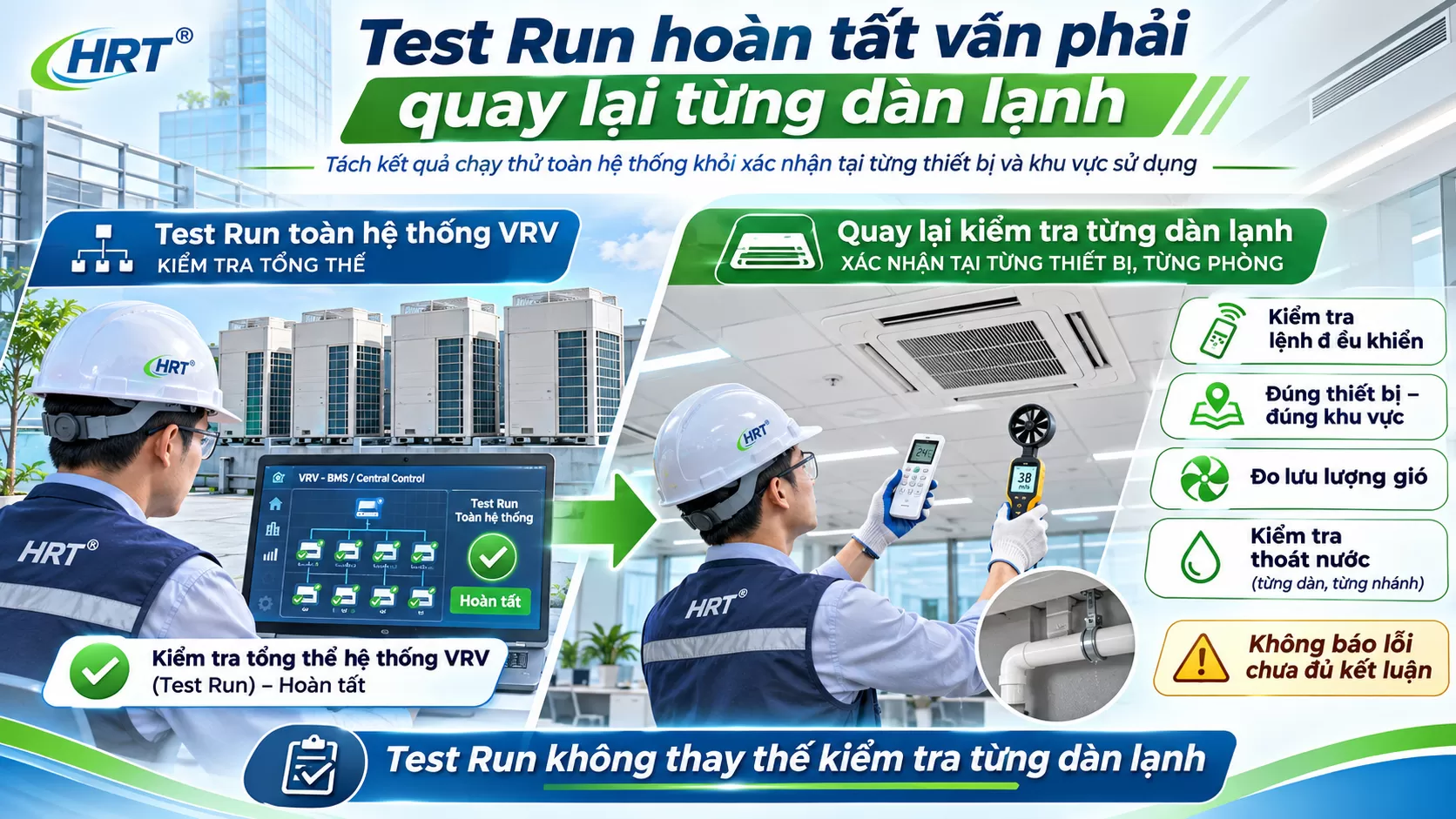
This is the point I want project owner to clearly distinguish when reading checklist acceptance testing VRV system.
Daikin VRV IV+ documentation notes that the full system Test Run cannot separately check for any abnormalities of each indoor unit. After this step, it is necessary to test each indoor unit by normal operation according to the respective instructions.
So in acceptance testing plan, I separate the commissioning result from the confirmation result at each device and area.
Check the control command to the correct device
So, back at the beginning of this, I'm going to ask you to check the relationship between the controller, the indoor unit and the room.
When switching on, off or changing modes, which device reacts? Does the display name match the actual location? Is the control group in the right range agreed?
If the project has central control or BMS, check that all functions are within the scope of handover. An icon appears on the screen that does not answer all questions about control.
I recommend that important settings be saved so that the operator knows the system status at the time of reception.
Wind and water line inspection at service area
With indoor unit connecting air duct, the FXSQ-A manual requires installing static pressure consistent with pipe network and calibrating air terminals according to design flow rate. The document also requires testing for drainage and leakage after condensate line installation.
In acceptance testing, I want the results to be associated with each tested location. If you have just measured an air outlet, write that location down. If you have only tested a drainage branch, do not extend the conclusion to the untested part.
The ventilation section should also have its own scope in the plan. The U.S. Department of Energy recommends checking the operating schedule, installation parameters and ability to provide ventilation that matches the needs of the user when commissioning HVAC.
A system that doesn't report errors doesn't mean every room is serviced as required.
Measurement results should be accompanied by implementation conditions
I do not want to receive a temperature table without knowing where the data was measured, when and in what mode.
In the report, record the conditions related to the assessment: door status, room finishing level, number of people or loads in operation, machine mode and time of obtaining data.
It is important not to write as much as possible, but enough to explain the result.
Don't turn a favorable try into a commitment to every situation
Assuming the meeting room is checked without personnel and equipment in use, I propose that the conclusion reflects that condition.
If the design task has situations that require further validation at a different level of use, include them in the next validation plan. ASHRAE also refers to the arrangement of delayed tests, seasonal tests or under appropriate seasonal loading conditions when they cannot be completed at the initial time.
This doesn't mean that every building has to wait at the same time to be tested. I want the project team to explain which parts have been validated, which have limitations and how to handle those limitations.
Specify that the test condition is to make the conclusion more reliable, not to weaken the report.
Do not use a tick to hide different states
In the internal monitoring table, I suggest to distinguish unsatisfactory results from untested contents. These two conditions require different treatment.
A work that has been inspected and detected deviations needs remedial measures. A work that is not eligible for inspection needs to determine the missing conditions and schedule for implementation.
Can organize the status as follows:
| Management Status | How to record and process |
|---|---|
| Tested, meet the requirements | Attach to the results, grounds and scope of confirmation. |
| Tested, not met | Stating the deviation, the remedyer and the contents to be re - examined. |
| Not eligible for inspection | Write the missing conditions, the person completing them and the expected time of verification. |
| Not applicable | Explain why the item is not in the configuration or scope in question. |
This is how I propose work management; acceptance testing decisions still need to be based on the project's application records and requirements.
A exist should only be closed after re-checking
In the commissioning process of FEMP, after implementing corrections or improvements, the work continues with retesting and monitoring the results. The completion of the intervention is not the end point of the verification process.
I apply that principle when assigning tasks: the handler reports completion, the person assigned to check and confirm the results, then update the status.
If adjusting a setting or a connection, specify which parts need retrying. Don't just delete old notes and keep the word “pass" in place.
With existence affecting safety or mandatory operational conditions, I do not accept the handling on behalf of an appointment in the minutes.
Handover must help the operation work
I want the handover to be attended by the operation itself, not just the receiver of the file.
They need to know which areas the system serves, how to use the controller, where to look up information and what to do if something goes wrong.
Daikin incorporates the transfer of documentation, user manuals, troubleshooting and maintenance into the contents handed over to users after commissioning.
Records should be organized in such a way that the takeover seeks information
I suggest we start with the system code to get a schematic, equipment catalog, test results and related settings.
Drawings must reflect the final state of affairs. The control dossier should match the name of the area in use. Open jobs must be put on a separate list with clear responsibilities and deadlines.
In the live tutorial, ask the recipient to re-execute operations within their scope. This is how I want to check that the content has been understood, rather than just confirming that the document has been sent.
I also suggest saving the initial data after commissioning as a basis for comparison for subsequent inspections. When changes arise, the person in charge can determine at what point the system differs from the time of handover.
Handover is not just about transferring assets. It's about transferring enough information and responsibility so that the assets are used properly.
CEO View Đoàn Văn Hoàng: The signature must reflect the right part of the proven
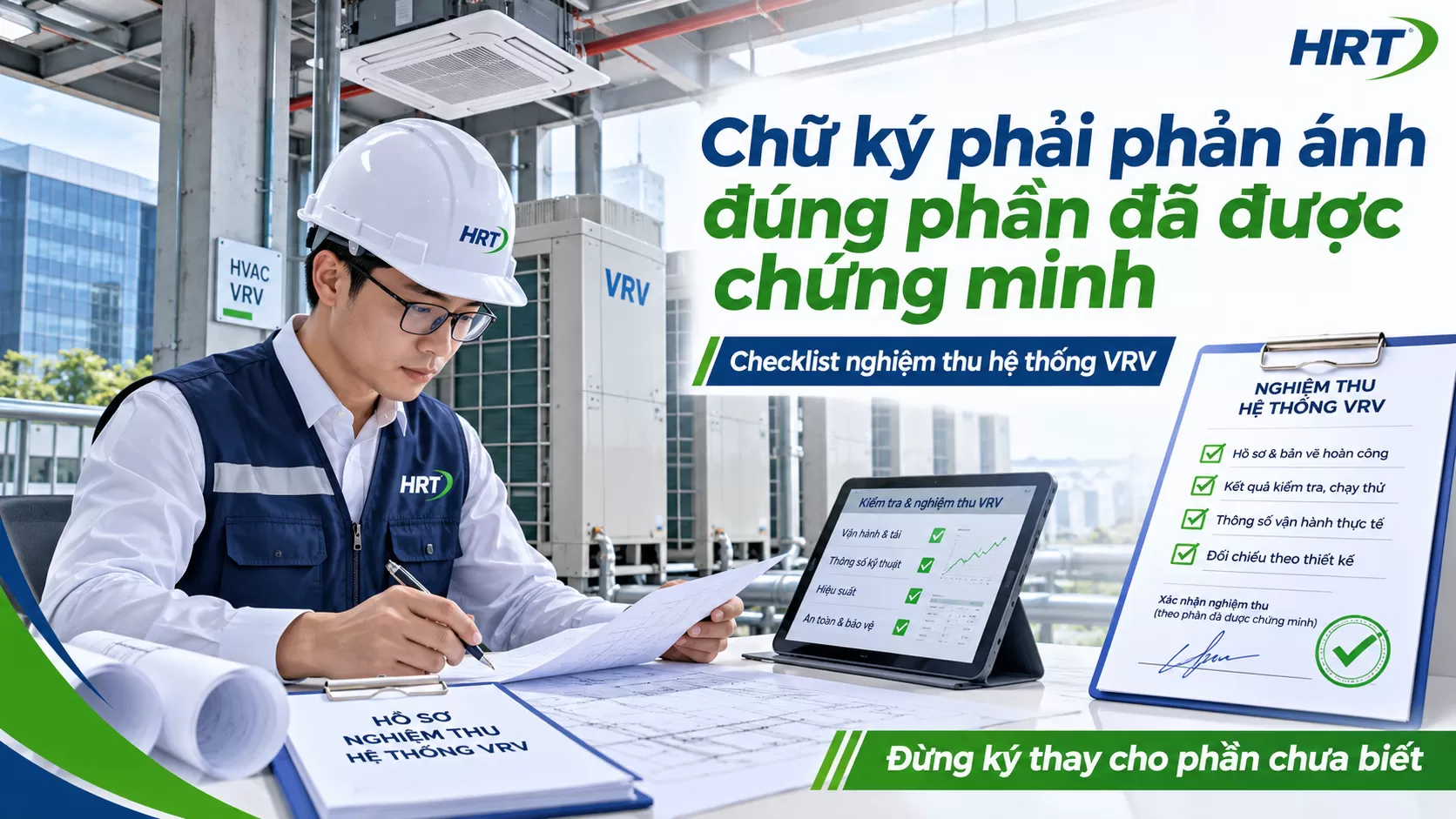
When I look at acceptance records, I don't judge the quality by the thickness of the document.
I want to know what the testers checked. How far the operator handled the deviations. How well the operation understood the system it was receiving.
An unknown result should be explained. A change should be updated. An unverified work should not appear in the report as if it were complete.
That's how I define the spirit. True – Clear – Dedicated.
Understand correctly tasks and configuration of the system.
Clearly on the bases, scope and responsibility for certification.
Dedicated follow up until corrective results and takeover are verified.
With... checklist acceptance testing VRV systemI don't want the signer to see just a row of marked boxes.
I want them to answer the question: After this signature, which systems are handed over, what conditions have been confirmed and what remains to be monitored?
Do not sign for the unknown part. Confirm the correctly grounded part.
Exchange with HRT before acceptance testing VRV system
When preparing acceptance testing, the project owner should gather system diagrams, model lists, current status drawings and test results.
If the work is in a category, specify the unconfirmed part, instead of just asking for “full inspection". From there, the parties can agree on the scope of review, additional data and conditions for further implementation.
Contact HRT: 0909 326 888. HRT
CEO Đoàn Văn Hoàng | HRT
Right from the beginning – Clear to the end – Sustainable Green.
Source: Publisher’s English edition · Vietnamese original on doanvanhoang.com