
Chiller liquid-level sensor faults: seven troubleshooting decisions
Machine-translated from Vietnamese. Read the original in Vietnamese

CEO Đoàn Văn Hoàng – HRT share 7 Chiller liquid level sensor fault handling decisions, help to make the right diagnosis, safe replacement and avoid recurrence of problems.
Chiller Fluid Level Sensor Error: 7 Decisions Before Approval for Replacement
An air-cooled chiller system serving the factory suddenly appears warning related to refrigerant levels. The device stops working, the operation department must quickly find a way to restore cold water.
The maintenance unit makes an initial proposal: change the liquid level sensor.
From an HRT operator perspective, I'm not in a hurry to approve this proposal.
I asked the engineering team to answer three questions:
-
Is the sensor signal really wrong or is the refrigerant level abnormal?
-
Excluded wiring, power supply, control board and related operation conditions?
-
After replacing the sensor, what data can we use to prove that the system has been fixed?
One sensor can be not too large in value compared to the whole Chiller system. But changing the wrong cause can prolong the machine downtime, affect production and incur additional costs.
For HRT, HVAC troubleshooting must follow one principle:
Have data before conclusion – Have evidence before replacement – Have test results before handover.
1. Distinguish liquid level warning from Chiller sensor damage
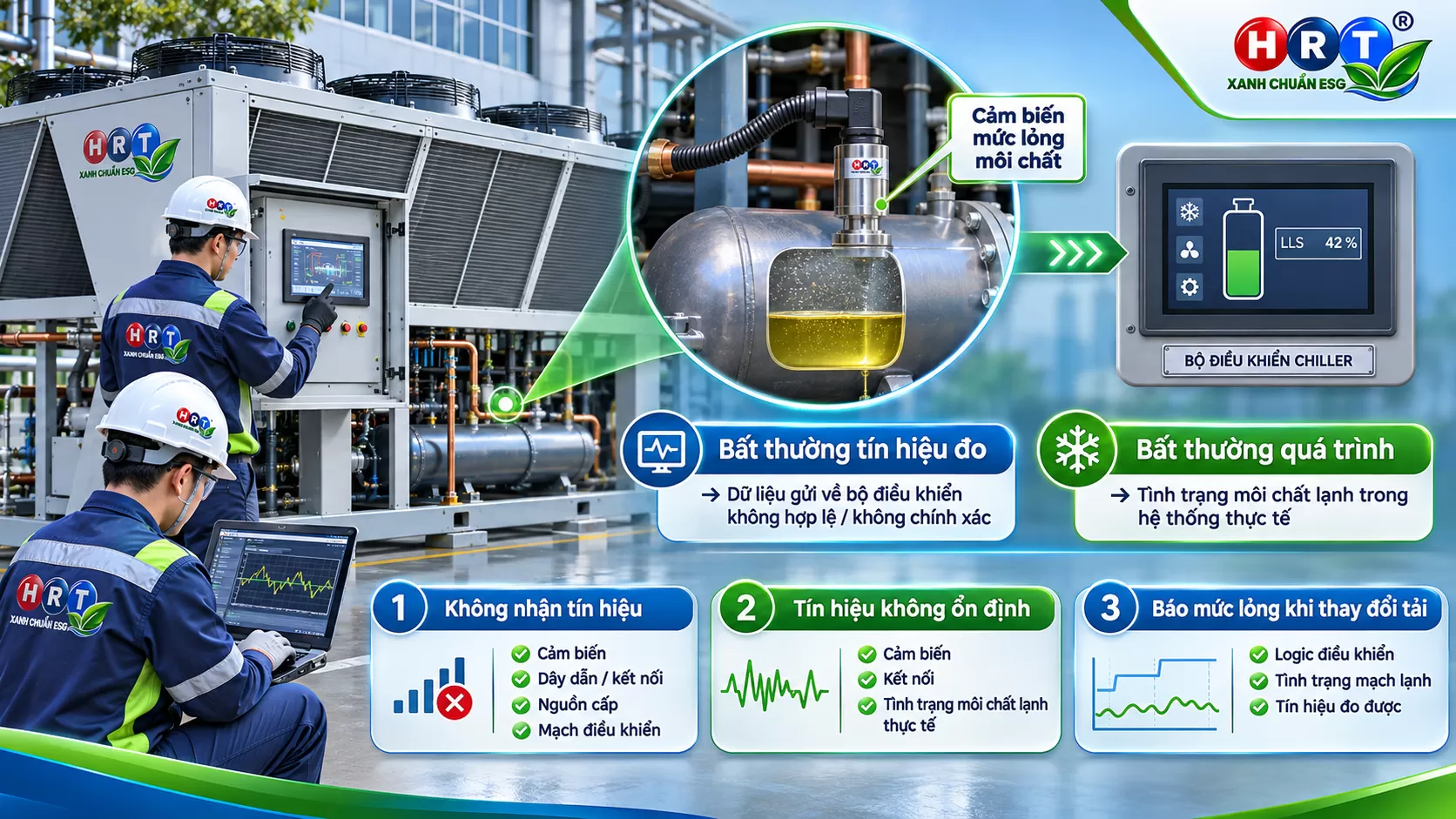
In some Chiller configurations, refrigerant liquid level sensor (Refrigerant Liquid Level Sensor) is used to determine the level status of the substance at the location designed by the manufacturer.
Depending on the model, sensor data can serve to monitor or control the operation process of the refrigeration system.
Sensors can be installed in a cluster of solvents, intermediate tanks or other specialized locations in the refrigeration circuit.
Not all air - cooled chillers use the same type of sensor or the same method of measuring liquid levels.
Three situations that are easy to confuse
| Phenomenon | Possibility to evaluate |
|---|---|
| Controller does not receive signals | Sensors, wires, power supplies or control circuits |
| Abnormal fluctuation signal | Sensor, connection or actual fluid state |
| Liquid level warning appears when load changes | Logic control, cold circuit status or measurement signals |
I want the engineering team to distinguish two concepts:
-
Measuring Signal Abnormalities: The data returned to the controller is incorrect or invalid.
-
Process Abnormalities: The actual refrigerant state does not meet the operation requirement.
If you confuse the two, changing the sensors may not solve your problem.
2. Decision 1: Determine sensor errors or operational conditions
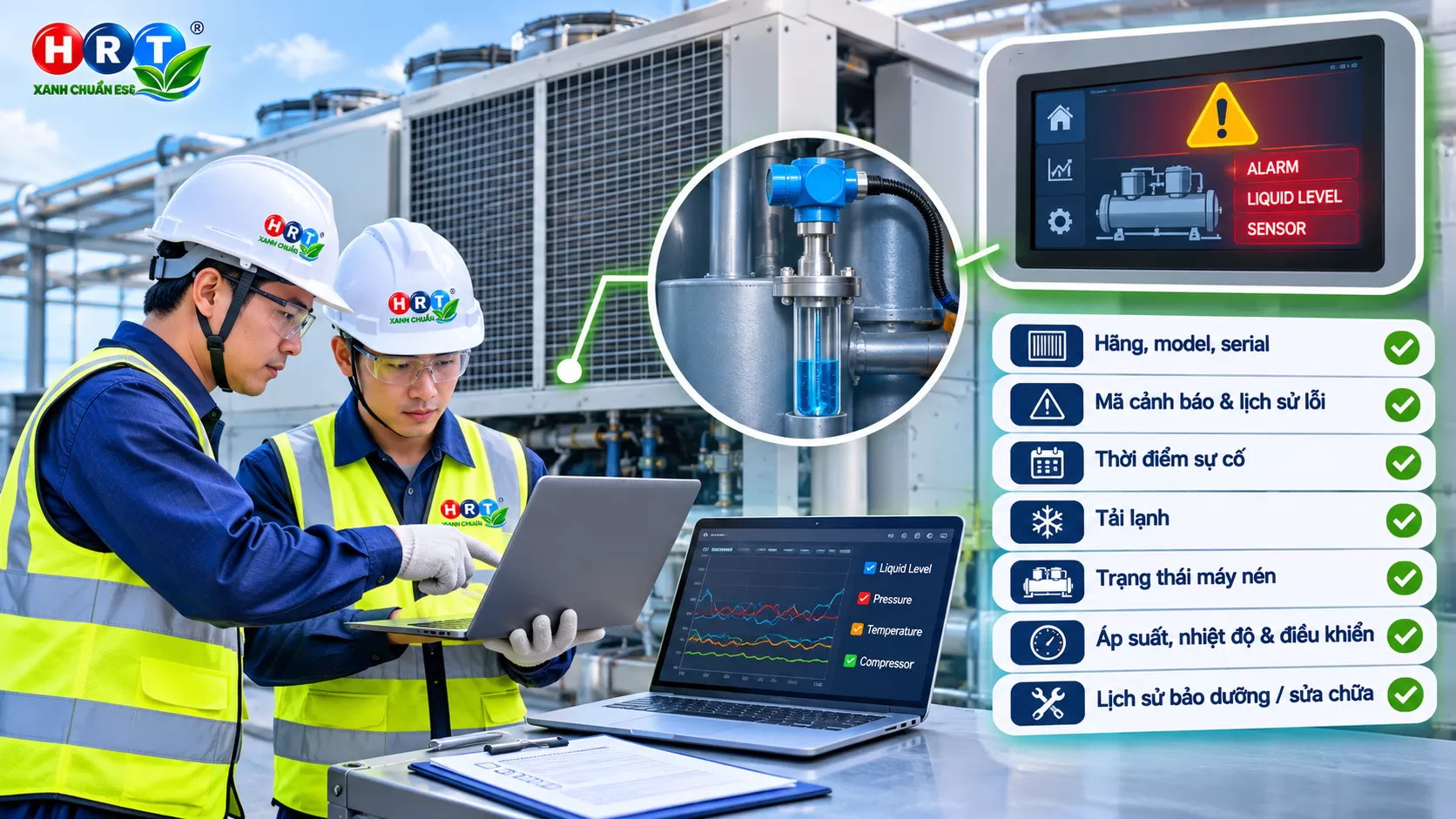
A warning code is just the beginning of the diagnostic process.
I asked the engineering team to reconcile the displayed information with the actual operational status before concluding.
What data to collect
-
Chiller's make, model and serial number.
-
Full warning code and fault history.
-
The time the problem occurred.
-
Cooling load at the time of arising.
-
Compressor operation status.
-
Pressure, temperature and related control parameters.
-
History of the last servicing or repair.
In particular, it is necessary to determine whether the error occurs randomly, repeated at startup or arises only at a certain load range.
HRT Decision
If there is not enough data to distinguish signal errors and process abnormalities, do not immediately switch to the replacement of components.
If diagnostic data is lacking, additional testing is preferred, not replacement.
3. Decision 2: Check the entire signal sequence before attributing errors to the sensor
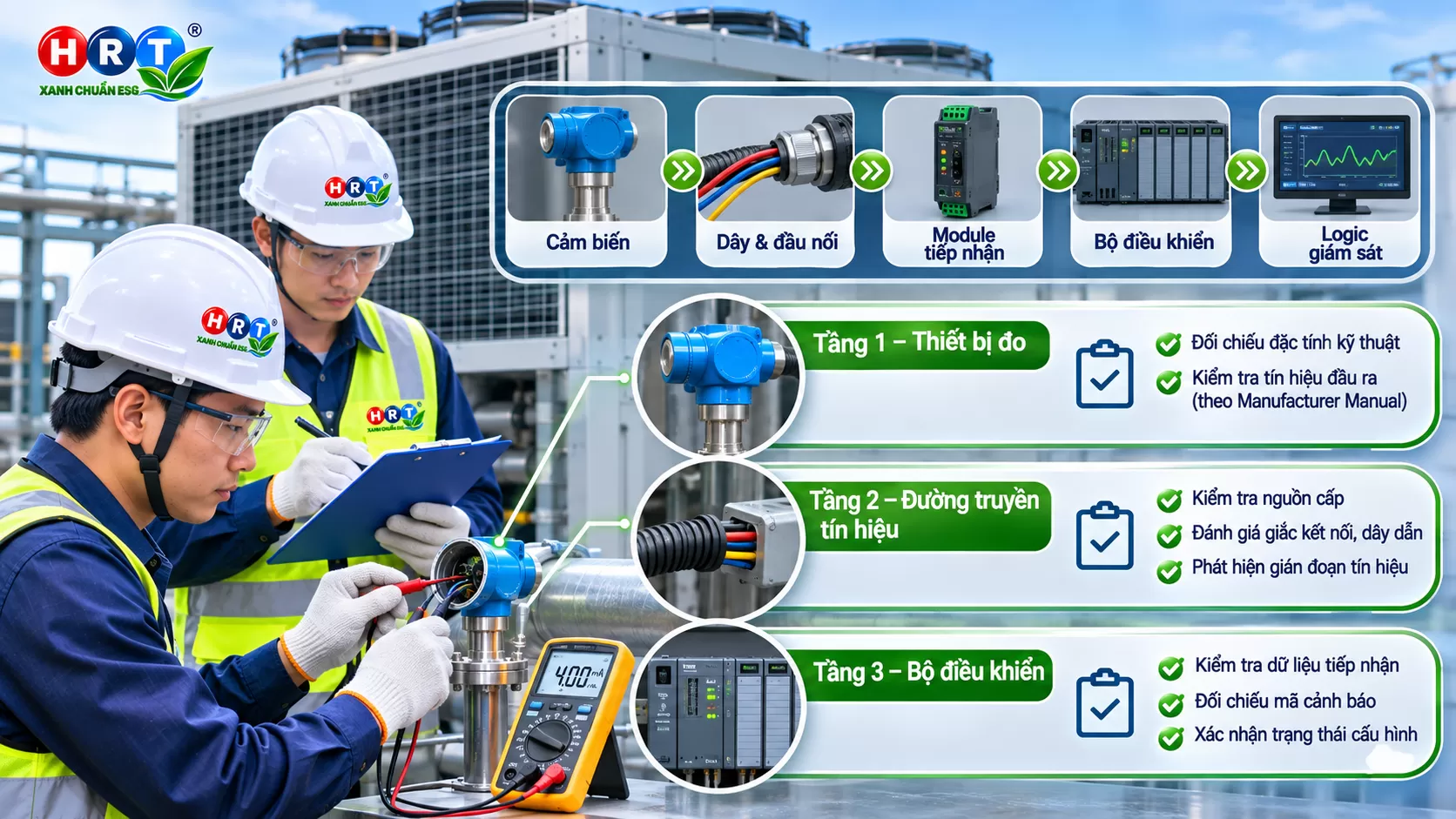
A measurement signal that goes from a sensor to a controller must go through multiple components.
Depending on the configuration, the signal sequence may include:
Sensor → Wire and connector → Receiving module → Controller → Monitoring logic.
An anomaly at one location in this sequence may cause the system to display incorrectly or not receive data.
Three-tier HRT test required
1st Floor – Measuring Equipment
Test the sensor according to the characteristics and test methods specified by the manufacturer.
2nd Floor – Signal Line
Assess the power supply, jack connection, wiring status and factors that may disrupt the signal.
3rd Floor – Controller
Check the data that the controller actually receives, the warning code and the associated configuration status.
One test result at the sensor end is not enough to confirm that the entire signal sequence is functioning correctly.
HRT Decision
Only add sensors to the list of components to be replaced when the Service Manual test results show that there are appropriate grounds.
Do not change the sensor to try your luck. Only change it when you know why.
4. Decision 3: Confirming the correct components and warranty scope
This is where I ask my engineering and procurement departments to work closely together.
The two sensors may be roughly the same shape but differ in their operating principles, output signals, working ranges, or controller compatibility.
Therefore, before approving the purchase of components must confirm:
-
Accurate spare part code or replacement code approved by the carrier.
-
Chiller model and configuration in use.
-
Sensor principle and signal characteristics.
-
Connector type, installation structure.
-
Requires software or control configuration.
-
Warranty policy and component origin.
Do not ignore the warranty record
It is necessary to distinguish the equipment that is still in warranty period from the equipment that is out of warranty period or damaged beyond the scope of commitment.
This affects component supply responsibilities, labor, costs, and approval processes.
HRT Decision
Do not order components based solely on similar pictures, sizes or descriptions.
The selection of components must be based on the spare part code and technical documentation of the actual model.
5. Decision 4: Safety control before system intervention
Chiller warranty relates to electrical equipment, controllers and refrigerant systems. Therefore, safety must be considered a mandatory condition before deployment.
Risks to be assessed
-
The device suddenly started.
-
Electrical energy is stored in the system.
-
Refrigerant pressure exists.
-
Risk of leakage of the solvent during disassembly.
-
The energy source or associated equipment has not been isolated.
The process of power isolation, locking and hanging the warning card (LOTO), safety status verification and residual energy control are required.
Especially, if the sensor is in direct contact with refrigerant circuit, the structure of installation assembly and the method of treating the solvent must be specified in Service Manual.
Do not remove the sensors when the system is still under pressure or safety conditions have not been confirmed.
HRT Decision
Intervention shall be permitted only when the person in charge, technical plan, safety conditions and specialized equipment are identified.
The repair progress is not at the risk of safety.
6. Decision 5: Replacing components does not mean the system is repaired
This is a point I especially note during the Chiller warranty.
Some devices require additional configuration steps or component declaration on the service software after replacement.
If the sensors are correctly fitted but the controller is not yet recognized or configured properly, warnings may continue.
HRT requests three-tier confirmation
1st Floor – Components
The correct code, the right location and the right installation structure.
2nd Floor – Signal
The controller receives valid data according to the characteristics of the sensor.
3rd Floor – Logic Control
The system identifies, processes and uses sensor data in accordance with operation requirements.
The technical team must compare the actual configuration with the manufacturer's documents, do not arbitrarily change the parameters to lose the warning.
HRT Decision
Do not switch to official commissioning without confirming that the sensors, signals and controllers are working properly.
The connection is completed and the installation is finished. Confirming the correct control is the basis for operation.
7. Decision 6: Verification of results in actual operation conditions
I do not consider the deletion of the error code to be sufficient evidence to conclude that Chiller was successfully repaired.
Equipment must be commissioning under conditions and sequence in accordance with the model's documentation.
What to follow
-
Status sensor signal reception.
-
The stability of measurement data.
-
The relevant warnings.
-
Compressor operation status.
-
Pressure and temperature of the solvent as needed.
-
Temperature chilled-water supply and return.
-
Control states related to the initial error.
If the work has interference with cold circuit, it must complete the requirements for airtightness test, cold circuit treatment and restoration of solvent according to the applicable procedures before commissioning.
Not just checking at a time
A Chiller can work normally immediately after startup but reappears warning when load conditions change.
Therefore, it is necessary to confirm within the operational conditions that acceptance testing procedure requires and allows.
HRT Decision
Do not hand over the device just because it has been running. There must be a proof that the error has been handled under appropriate testing conditions.
8. Decision 7: Close acceptance records before warranty ends
A professional repair operation must generate data for the management of equipment.
I require that the post-repair dossier not only contain a written confirmation of completion, but also clearly demonstrate the process of making technical decisions.
Five Groups of Evidence to Save
| Group of evidence | Content of request |
|---|---|
| Initial state | Error codes, conditions arising, parameters and related history |
| Diagnosis | Test results of sensors, lines and controls |
| Components | Spare parts codes, origins and replacement items |
| Verify | Signal results, configuration and commissioning |
| Handover | Record acceptance testing, responsibility and follow-up recommendations |
This profile gives the operations department a basis to check if the same warning comes later.
It also facilitates project owners to reconcile warranty liability and control long - term maintenance costs.
HRT Decision
Only confirm the completion when the work, test result and handover dossier meet the agreed scope.
Completing repairs is one thing. Proving correct repairs is the next responsibility.
9. Decision board: When to replace the Chiller liquid level sensor?
| Testing Status | Proposed Processing Direction |
|---|---|
| Sensors meet the right parameters | Continue to test the signal string or operation condition |
| Wire or connector fails | Connection fix, recheck the signal |
| Abnormal signal receiving power supply or module | Diagnose the acute circuit and control according to the carrier document |
| Actual solvent level showing abnormal signs | Evaluation of the causes in refrigeration systems |
| Sensor is confirmed damaged | Approval of compatible components and alternatives |
| Components replaced but controller does not receive | Compatibility testing and control configuration |
| No full test results | Continue verification, not concluded need to replace components |
The above table is the decision-making framework. The final technical conclusion must be established according to the model, Service Manual and actual test results.
10. Lessons from the operation of changing the Chiller sensor of HRT
According to information published in the technical article of HRT on 12/11/2026, the team of engineers completed the replacement of liquid level sensors on a Chiller system on November 6.
After the procedure, the device is recorded to work again normally.
However, the published information is not fully accompanied by the equipment model, component code and measurement results before – after repair.
So I do not use this case to give the general diagnostic parameters for other Chiller models.
What can be drawn are three important requirements:
Firstly: Do not conclude component damage without grounds.
Second: Perform work in accordance with configuration and technical documentation.
Third: Verify operation status after intervention.
This is also the direction I want HRT technical team to maintain in warranty, repair and maintenance activities of industrial HVAC systems.
11. Three HRT checkpoint verification in Chiller repair

Port 1 – Before approval of component replacement
The inspection results, the basis for determining damage, compatible component codes and handling plans are required.
Output: The repair proposal must have technical basis.
Port 2 – Before restoring operation
Confirm the safety requirement is completed, sensors mounted correctly, signals valid and control configurations are suitable.
Output: Confirm eligibility for commissioning.
Port 3 – Before signing the handover
Check commissioning results, alerts, operating parameters and technical records.
Output: Acceptance testing report and maintenance recommendations.
These three portals help to delineate responsibilities between the diagnostician, approver, deployment technician and operation management representative.
12. Checklist acceptance testing after changing Chiller liquid level sensor
Before signing the record of completion, the person in charge shall certify:
-
Confirmed the carrier, model and serial number.
-
Warning codes and conditions have been recorded.
-
The test results confirm the cause.
-
Replacement part codes have been collated.
-
Confirmed the warranty and repair scope.
-
Fully complied with safety requirements.
-
Power supply, connection and sensor signals checked.
-
Confirmed controller configuration as needed.
-
Cold circuit safety test was completed if intervention is required.
-
Commissioned under the applicable conditions.
-
Checked the warning and related parameters.
-
- The dossiers, measurement results and monitoring guidance have been handed over.
This checklist must be supplemented with specialized items according to the manufacturer's documentation and contract requirements.
13. FAQs about Chiller liquid level sensor failure
Does the chiller with liquid level sensor error have to be replaced immediately?
No. Abnormalities that originate from sensors, signal lines, controllers or actual refrigerant status should be identified before making a decision.
Does the liquid level sensor resemble a water level sensor?
No. Refrigerant level sensor and water level sensor have different purpose, structure and working condition.
Can I use a different sensor for my carrier?
Only if the components are confirmed compatible in terms of spare part codes, technical characteristics and control requirements, according to the conformity approval of the manufacturer or the unit responsible for the technique.
Does the Chiller Sensor Replacement Need Refrigerant Recovery?
Depends on the structure and location of installation. If the work is directly related to the containing part of the solvent, it must comply with the method of isolation and treatment of the solvent according to Service Manual.
Why do I change the sensor but the Chiller still gives me errors?
It may be that the problem is with the signal wire, power supply, control module, sensor configuration or actual operational conditions that have not been fixed.
How to confirm Chiller has been repaired successfully?
It is necessary to verify the signal, control, warning status and commissioning results according to the agreed criteria. The startup of the device is not sufficient to conclude the repair is completed.
How long is the Chiller Sensor warranty?
The warranty period and conditions depend on the manufacturer's policy, supplier's policy, contract and use conditions of each device.
14. Conclusion: Do not replace components without proof of cause
For Industrial Chiller systems, a liquid level warning should not become the reason for automatic sensor replacement.
From an HRT executive perspective, I want the project team to make seven decisions:
Status identification → Signal chain inspection → Selecting the right components → Safety control → Confirmation of configuration → proof commissioning → clear acceptance testing.
Because the goal of fixing Chiller is not just to handle a warning code.
The ultimate goal is to return the system to operation in appropriate technical conditions, limit recurrence of problems and control long-term maintenance costs.
CEO perspective Đoàn Văn Hoàng | HRT:
Do not approve based on feelings. Do not replace when there is no ground. Do not hand over when there is no technical evidence.
HRT – Right from the beginning – Clear to the end – Sustainable Green.
HRT – HVAC technical solutions for businesses
HRT Air Conditioning and Ventilation Company Limited
Consulting, designing, construction, maintenance, warranty and renovation of HVAC, VRV / VRF, Water Chiller and industrial air conditioning systems.
Hotline: 0909.326.888
Email: CEO@hrt.vn
Website: https://hrt.vn/
Address: No. 4, Lane 6, Miao Nha Street, Xuan Phuong District, Hanoi.
HRT – Green Breath for All Buildings.
Source: Publisher’s English edition · Vietnamese original on doanvanhoang.com