
Chiller system: Don't start with the machine
Machine-translated from Vietnamese. Read the original in Vietnamese

CEO Đoàn Văn Hoàng – HRT sharing how to understand Chiller system from cooling load, cold water, AHU/FCU to pump, cooling tower and control. The article helps project owner choose, operate and evaluate the system based on actual efficiency.
Chiller System: Don't Start From The Machine

When a project owner asks me: “How much RT does this project need Chiller?”, I usually do not immediately answer with a number.
I want to know where that cold water will serve.
How many loads does aHU need?
Which FCU operates overtime?
Does the plant have technological load or just comfortable air conditioning?
How does load change during the day?
That's where it starts.
Chiller system is not a chiller placed in the technical room. It is a series of equipment that performs the same task: taking heat from where it needs to cool, transporting heat to the machine station and discharging it into the environment.
The original article of HRT also defines the Chiller to create cold water or cooling load, then the pump system brings the cold source to AHU, FCU, PAU or heat exchange coils. Other VRV / VRF, refrigerant energy in the Chiller is distributed mainly by water instead of direct refrigerant to each indoor unit.
From an HRT operator perspective, I want the validator to see the entire system before looking at the Chiller's catalog.
Let's start where the building needs to be cold.
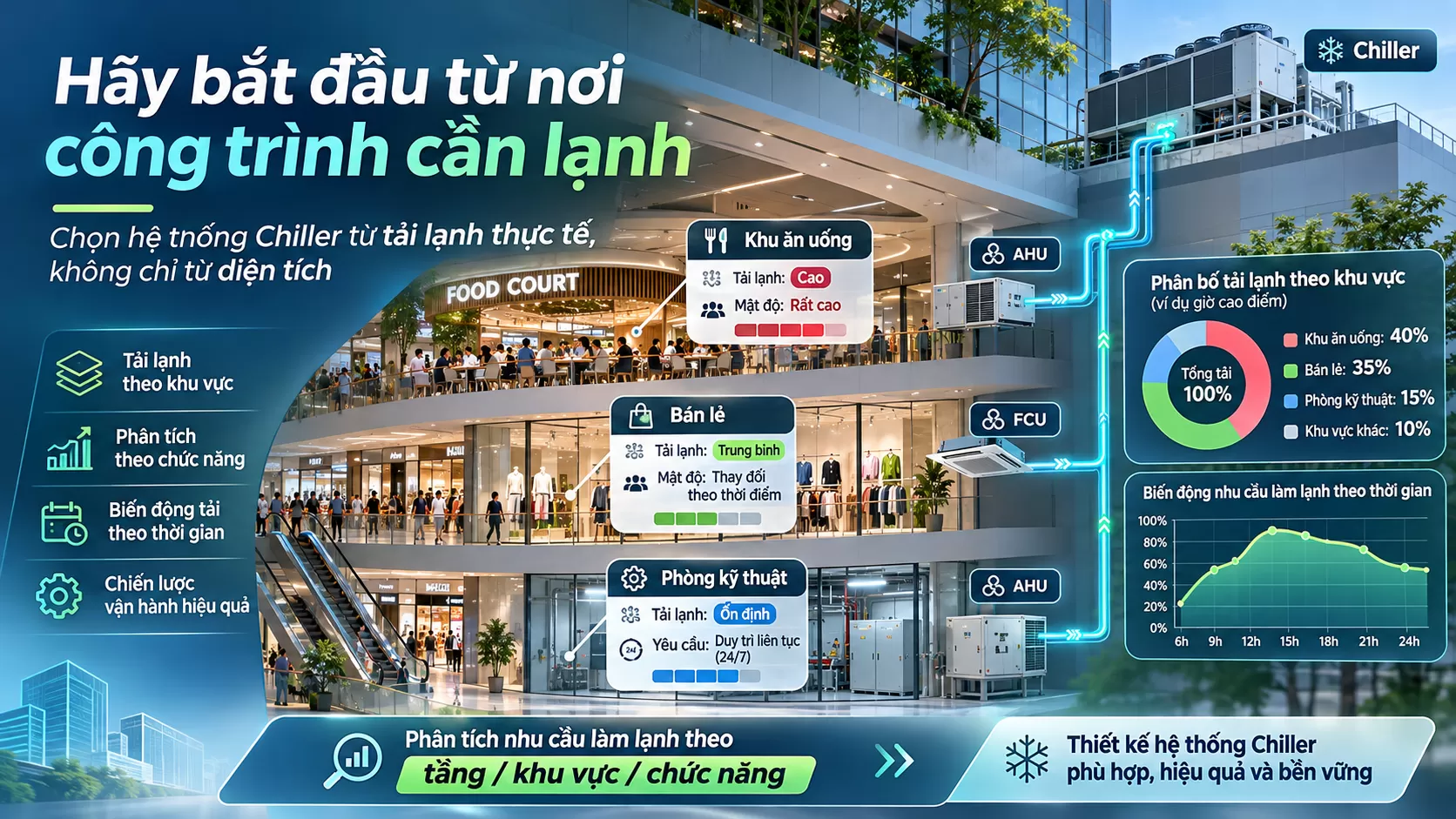
Imagine a mall on the weekend.
The dining floor is crowded. The retail area has a constantly changing number of guests. Some technical rooms still need cooling even when other areas are down loaded.
If we just add up the area and choose a machine with full power, we can solve part of the problem.
What I want the design team to show you is where the cooling load comes from and how it changes over time.
The work can be divided into layers, functional areas, AHUs or production processes.
Once that input is clear, we have a basis to determine the number of Chillers, how to divide capacity and operation strategy.
The original article HRT also stressed that it is not recommended to choose the capacity of the chiller only from the floor area. Cooling load is also influenced by the covering structure, glass, sunlight direction, number of people, equipment, lighting, outdoor air, utility, hours of use and technology load.
I don't choose Chiller from the area of the building. I choose the system from the task that the building has to perform.
After cooling load, follow the water flow
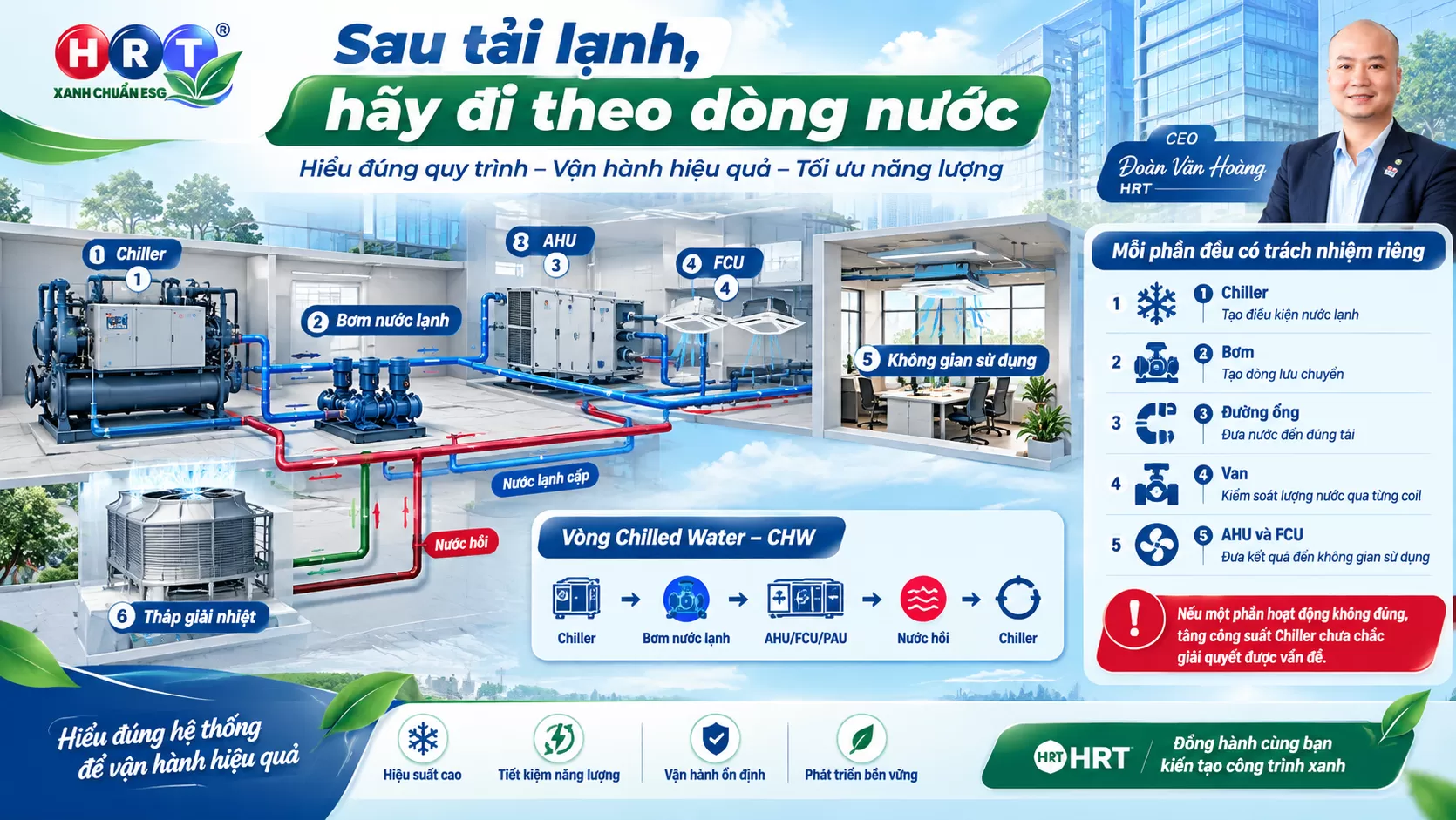
When the system is in operation, the chiller does not directly blow cold air into the room.
At the evaporator, refrigerant absorbs heat from the water. The cold water is then pumped through a pipeline network to an AHU, FCU or heat exchanger.
Air passing through coil transfers heat to water.
The warmer water returns to the Chiller and continues the cycle.
Can you imagine:
Chiller → chilled-water pump → AHU/FCU/PAU → Water recovery → Chiller.
This is the Chilled Water – CHW ring of the system.
What I want the operator to understand is that each part has its own responsibilities.
Chiller facilitates cold water.
Pumps create flow.
Pipelines bring water to the right load.
The valve controls the amount of water through each coil.
AHU and FCU take that result to the space of use.
If a part of your chiller is not working properly, increasing the power of your chiller may not solve the problem.
A room not cold enough is not sure because the Chiller lacks power
This is a situation I would like the engineering team to take special note of.
Suppose the Chiller is running steadily but one end-of-line AHU is not cold enough.
The first response should not be to lower the supply - water temperature or call in a chiller.
Please check:
Is the water getting to enough AHUs?
Is the valve open correctly?
Is the flow rate good?
Is Coil clean?
Is the airway distributed?
Does filtration cause a large pressure loss?
If the cause is on the distribution side, increasing central machine load may only make the system consume more energy.
The original article also warned that improper hydraulic design could cause a lack of flow rate at the distal branches, differential pressure and make the system difficult to balance.
Before concluding on the lack of cold, determine where the heat is being blocked in the transmission chain.
ΔT tell me how cold water is being used
In the chiller system, I am particularly interested in the temperature difference between return water and feed water.
Can perform:
ΔT = T water return – T water supply
About the principle:
Q = ṁ × Cp × ΔT
With the same thermal load, water flow rate and ΔT are directly related. However, it is not allowed to arbitrarily increase ΔT only to reduce flow rate; Chiller, coil, pump, valve and system must be designed synchronously.
When ΔT is abnormally low, I don't want to report only “Low ΔT”
I want to know why.
Is the water flow rate too high?
The control valve is not suitable?
Coil hasn't exchanged enough heat?
Is there an unnecessary bypass?
Actual load too low for operation mode?
A number is only valid when it leads to specific technical action.
Do not treat the pump as an auxiliary device
In many energy optimization meetings, people focus on the Chiller.
I often ask:
“How is the pump running?"
The water chiller can use many configurations such as constant flow rate, primary-secondary or variable primary flow. With variable flow rate system, variable-frequency drive and control valve can coordinate to change the flow rate according to the load, but still must ensure the operation conditions and minimum flow rate required through Chiller.
So fitting variable-frequency drives does not automatically create an optimal system.
It is important what variable-frequency drive receives.
Differential pressure is measured where.
Setpoints are adjusted according to what logic.
When the load drops, how does the system react?
When a distal branch is still deficient in water, further pump deceleration is appropriate.
Pumps are not just water transportation. Pumps are part of the whole station operation strategy.
Air-cooled chiller or water-cooled: I do not choose by a sentence “which one is more economical”

The two configurations have different heat discharge ways.
Air-cooled chiller transmits heat directly to the air.
Water-cooled chiller transfers the heat to the condenser water ring, then the water sends the heat to cooling tower to discharge into the environment.
With Water-Cooled Chiller, the system also has:
Condenser water pump.
Pipeline.
Cooling tower.
Treat the water.
Controls related.
This creates more optimal opportunities but also creates more operation and maintenance requirements. The original article HRT also noted that it is impossible to conclude a type is always better; the choice must consider cooling load, operation hours, climate, water sources, space, noise, initial investment, electricity and life-cycle cost.
I want the comparison table to answer three questions:
Does the building have conditions to arrange that type of system?
Is the operation team capable of managing?
What is the total cost over the years of operation?
The initial machine price was only part of the decision.
Cooling Tower is not a device that goes outside and then forgets.
With water-cooled chiller, cooling tower directly participates in the heat discharge capacity of the system.
If the tower is dirty, the water quality is poor or the heat exchanger deteriorates, the Chiller working condition changes.
That could affect the station's overall performance.
The original article stresses Water-Cooled Chiller needs additional management of water quality, scale, corrosion, heat exchange performance, pump and cooling tower.
Therefore, I do not want the Chiller maintenance plan only content compressor and solvent test.
Look at the heat pathway to the environment.
Heat does not disappear on its own. If the heat waste site works poorly, the whole system will pay a price.
The new AHU and FCU are where the work feels the results
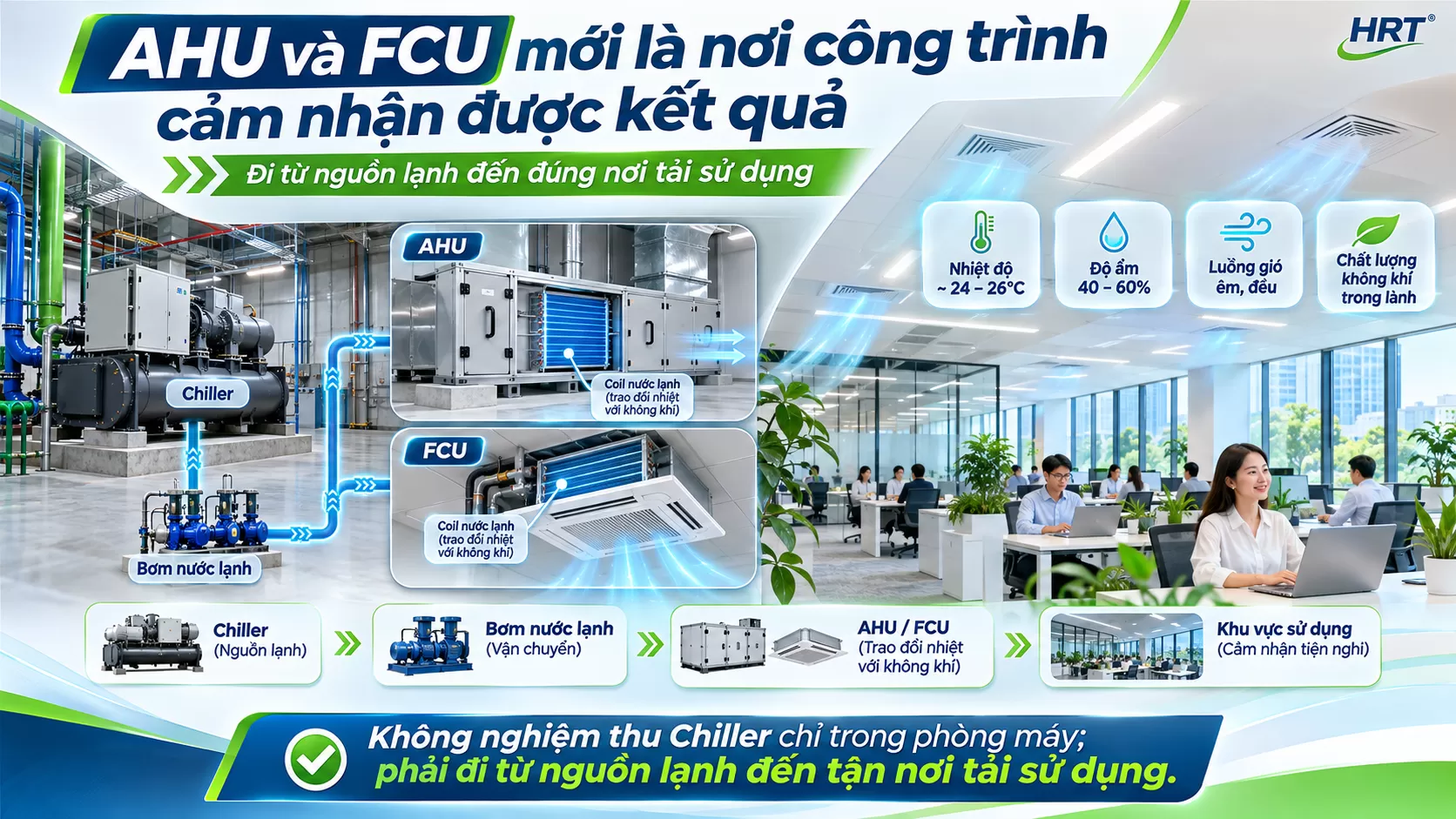
The chiller can produce water at the right temperature.
But the user isn't standing in the engine room to feel that.
They sense the temperature, humidity, airflow and air quality at the site of use.
AHUs and FCUs are devices that exchange heat directly with air. AHUs typically serve large flow rates and can integrate filtration, cooling, dehumidification, outdoor air and air return; FCUs usually serve smaller rooms or zones.
This led to a principle I've always reminded the project team:
No acceptance testing Chiller plant only in the machine room.
If the cold water has reached but the AHU is not enough flow rate, the work still does not receive enough results.
If the AHU is working but the wind has not reached the correct area, the user is still not served.
Must go from the cold source to the load used.
Water temperature 7°C is not a truth for every building
A very familiar number is the chilled-water supply of about 7°C and return of about 12°C.
HRT presents this as a typical design example with illustrative values. Actual water temperatures for each chiller depend on the load, AHUs and FCUs, temperature and humidity requirements, production process, flow rates, and energy strategy.
I want the designer to explain why he chose that setpoint.
If the chilled-water supply temperature is increased to save power, does the coil still meet the load?
Is the humidity controlled?
How does the pump and flow rate change?
If the water temperature drops too much, how much does the Chiller energy increase?
A good setpoint must have a reason.
Should not exist just because “previous projects run like that”
Chiller system is strong in large projects, but not every big is to use Chiller
Chiller systems are often considered in large offices, commercial centers, hotels, hospitals, factories, industrial parks and engineering facilities with large cooling loads or requiring cold water for technology.
But I'm not using the name of the building to replace the analysis.
A hotel can use Chiller for public areas and other solution for guest rooms.
A factory can use Chiller for technology but VRF for offices.
A building may need a mixed - use system.
The original article also indicated that in some projects Chiller and VRV/VRF can be combined instead of squeezing the entire building using one technology.
I didn't need a single solution for the whole project. I needed each system to do its job.
Look at the downloads for each part before choosing the number of machines
A station with a total load of 1,000 RT does not necessarily use a 1,000 RT Chiller.
My question is:
How much percent of the load does the work normally run at?
How many loads are left at night?
When maintaining a machine, how is the priority load served?
Is there a backup request?
The original article HRT noted the configuration of multiple Chillers that allow power split and organize the sequence of running the machine according to the load.
Therefore, I want to choose the machine option that comes staging strategy.
Which one goes first.
Which one comes next.
Any conditions for a call?
Which condition reduces the machine.
If a machine stops maintenance, what tasks does the system still perform?
This is the story of operations, not just procurement.
Chiller price is not the price of the Chiller system
A machine quotation can be very clear.
But the Chiller station also includes pump, pipeline, AHU/FCU/PAU, valve, sensor, controller, electricity, thermal insulation and in the water-cooled configuration also has cooling tower and water treatment system.
So when I compare these two, I want to see TCO – Total Cost of Ownership instead of just the device CAPEX.
Expenses to be considered include:
Initial investment.
Electricity.
Water.
Treat the water.
Maintenance.
Replacement supplies.
Human Resource Operation.
Scalability.
System downtime.
It is not recommended to call a “cheaper” option when comparing the prices of two machines but ignoring the different infrastructure.
I am particularly interested in maintenance gaps before signing Shop Drawing
Just because a device fits in the engine room doesn't mean that the engine room is well designed.
I would like to know:
Can the Tube bundle be withdrawn?
Does the motor have a drain?
Can the pump lift out?
Is the cabinet large enough for operation?
Is there a heat exchanger?
Is the large equipment transportation route kept to the end of the project?
The original article also included the lack of maintenance space in the group of common errors: equipment can fit but the latter does not have enough room to remove the heat exchanger, motor or components.
Maintenance gap is not an excess area. It is a part of the device.
TAB and Commissioning newly said the system has coordinated or not
When the installation is complete, each machine may be turned on.
But I haven't seen it done yet.
TAB and commissioning need to check and adjust water flow rate, airflow rate, temperature, pressure, control sequence, interlock and load modes of the system. This is also the HRT step that sets the acceptance testing and handover in the Chiller deployment process.
I want a commissioning session that answers real - world scenarios.
What pump runs a chiller?
How did Cooling Tower react?
How is the second machine called when the load increases?
When the load decreases, how does the system release?
How does an AHU close the valve, and how does the differential pressure change the water network?
What does BMS record and warn?
If the control sequence isn't right, no matter how good the device is, it won't make a good system.
BMS must help the operator see the station.
In large systems, BMS can connect Chiller plant to monitor and support optimal operation. The original post also defines control and BMS is part of the complete system.
But I don't want the screen to just have a lot of data.
I want the data to answer the question.
How much Chiller load is it?
What's ΔT doing?
What speed does the pump run?
Is Cooling Tower working effectively?
When did the power go up unexpectedly?
When a warning appears, who deals with it?
Good control must help the operation make decisions.
BMS is not a decorative display for the control room.
CEO's view Đoàn Văn Hoàng: I don't buy a chiller, I invest in a heat transfer system
When approving a Chiller project, I don't want the discussion to stop at the brand, COP or RT number.
I want to see the entire path of heat.
Where does the heat come from?
How do AHUs and FCUs remove heat from space?
How does water bring heat to the chiller?
How much energy does the pump use?
How does the chiller transfer heat to the condenser side?
How does cooling tower or condenser coil release heat into the environment?
And finally, what data does the operator control over that entire sequence?
That's how I apply the spirit True – Clear – Dedicated.
Understand correctly cooling load and duties of the work.
Clearly on the responsibilities of Chiller, Pump, AHU/FCU, cooling tower and controller.
Dedicated follow up until TAB, commissioning and operation data prove the system is truly responsive.
For me, the important question is not:
“How much RT does this Chiller have?"
It is:
“Does the whole system deliver the right amount of refrigeration to the right load, at the right time and with reasonable energy?"
Exchange Chiller system options with HRT
When preparing for investment, the project owner should provide the utility floor, expected cooling load, schedule of operation, temperature – humidity requirements, information on power and water sources, engine room and cooling tower location.
For works in operation or renovation, load data, power, supply-water temperature – return, flow rate, ΔT and abnormalities are added.
From there, the parties can evaluate the Chiller configuration, pump, AHU/FCU, cooling tower and control on the same task before deciding on investment or renovation.
CEO Đoàn Văn Hoàng | HRT
Right from the beginning – Clear to the end – Sustainable Green.
HRT Contact: 0909 326 888
Post Tags: Chiller system, What is a chiller, Chiller system principles, Water Chiller, water-cooled chiller, air-cooled chillers, AHU FCU Chiller, ΔT Chiller, Chiller plant, TAB Chiller, commissioning HVAC, CEO Đoàn Văn Hoàng, HRT.
Source: Publisher’s English edition · Vietnamese original on doanvanhoang.com