
Choose a VRV construction contractor | 5 steps to close the right partner
Machine-translated from Vietnamese. Read the original in Vietnamese
A decision on the selection of the contractor well there must be evidence. CEO Đoàn Văn Hoàng – HRT share how to organize VRV contractor evaluation with practical questions, scorecards and key tasks before implementation.
Choosing the right VRV contractor - 5 steps to close the right partner
Đoàn Văn Hoàng – CEO HRT | 20+ years of HVAC experience
When investing in central air conditioning, business owners often receive many quotes but it is still difficult to decide: which configuration is appropriate, which part of the job is missing, which unit is capable of fulfilling commitments?
The problem lies in the way the evaluation is organized.
If each contractor understands the work in a way, uses a set of assumptions and offers a different range, the price comparison table will be difficult to reflect properly the value received by the enterprise.
From a technical and operational perspective, I propose a principle: Each decision must be accompanied by evidence. Each commitment to implementation must have a responsible person.
Here are five steps that project owners can take when working with VRV contractors.
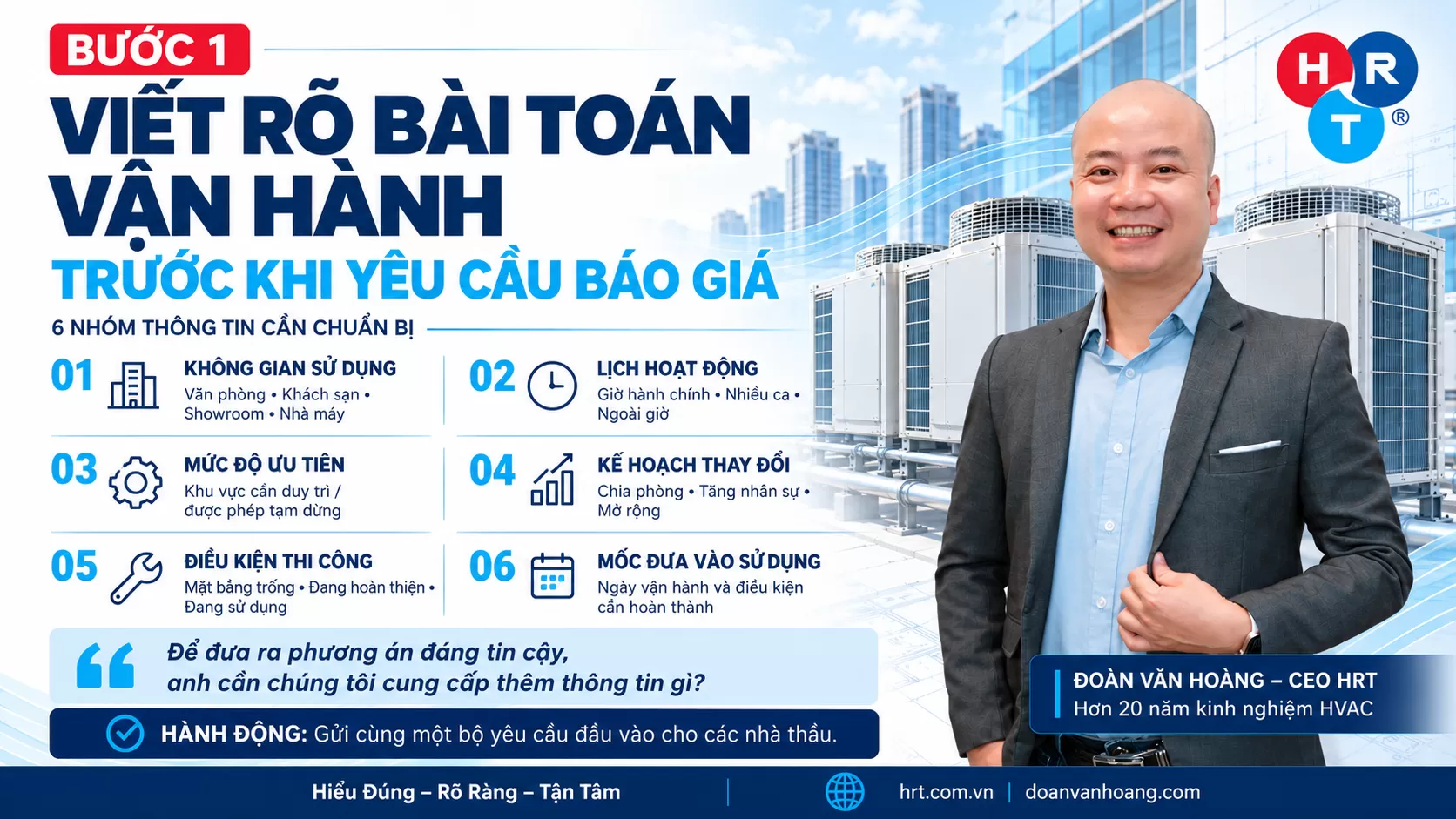
Step 1: Write down the operation problem before requesting a quote
A good investment request should help the contractor understand how the project will be used.
Take the time to determine what your business really needs from the air conditioning system after handover.
Make an input request on a page
Project owner can start with six groups of information:
-
Space Used: Office, hotel, showroom or factory auxiliary area.
-
Activity schedule: Office hours, multiple shifts or overtime use areas.
-
Priority Level: Which areas need to be maintained, which areas are allowed to be suspended.
-
Change Plan: Whether to re-divide rooms, increase staffing or expand the area.
-
Construction conditions: - The ground is empty, being completed or being put into business.
-
Mold put into use: Date of operation and conditions to be completed beforehand.
From this request, the parties agree on the data to be surveyed and the contents to be supplemented.
Ask the contractor to respond with missing issues
A helpful question to ask in the first session is:
“To give you a reliable solution, what information do you need us to provide?"
The answers help the project owner to know how deeply the contractor has understood. Unspecified points should be included in the clarification list, there is a person in charge and a deadline for response.
Action to be latched: Issue the same set of input requirements to the units participating in the bid offering.
Step 2: Organize a technical clarification session with the person in charge
The introduction helps to open the discussion. The person in charge of the new technique helps the project owner evaluate how the work will be implemented.
A 45 - minute work session can be held, focusing on three situations close to the building.
Situation 1: An area needs to operate overtime
Ask the contractor:
“When most of the buildings are shut down, how will this area be controlled?"
Ask them to present on the proposed zoning plan, system diagram or control configuration. Answers should specify responsiveness, limits and options that need to be decided by the project owner.
Through this, the enterprise evaluates the ability to convert demand into a specific solution.
Situation 2: The ground changes during construction
Ask the question:
“If the room or ceiling location changes, who checks the effect, who updates the drawing and when is the next construction?”
A clear approach should show the workflow:
Record changes → evaluate impacts → submit plan → confirm cost and progress → approve implementation.
Project owner should request clarification forms or change request forms that the contractor intends to use.
Situation 3: Need servicing equipment after finishing
Ask the contractor to point out on the drawings where access to equipment, doors and ways to take components out when repairs are needed.
The question to answer is: Where and how will the operation team operate?
Early identification helps parties agree on requirements with architectural, interior and operation management units.
Action to be latched: Make a minutes of the meeting, specifying each issue, solutions and deadline for completion.
Step 3: Bring quotations to the same range for comparison
A summary table with only the name of the contractor and the total amount is not enough to make a decision.
Project owner should require each unit to fill out a general reconciliation table, clearly marking it as included, unincorporated or requiring confirmation.
Check the intersections between contractors
Questions to be clarified include:
-
Where is the power delivered to?
-
Who carries out the supporting platform, drills through and returns the surface?
-
Where is condensate connected?
-
Is the BMS connector and central control device in the price offering range?
-
Has the cost of transportation to the installation site been calculated according to actual conditions?
-
How are re-inspections due to site changes handled?
Each task should have a party responsible for the main. For the remaining part of the survey, it should be clearly stated the temporary basis.
Compare costs after clarifying the missing part
Assumed example to illustrate, not HRT quote:
| Content | Option A | Option B |
|---|---|---|
| Initial Offer Price | 420 million VND | VND 448 million |
| Work to add to the same scope | 40 million VND | 0 million VND |
| Total value after reconciliation | 460 million VND | VND 448 million |
For example, suppose the alternatives have similar technical requirements and the same tax basis.
After the comparison, the new project owner has a basis to consider the price difference together with the performance capacity, payment conditions and responsibility after handover.
Action to be latched: Request an updated quote after the clarification, with version number and release date.
Step 4: Grade VRV contractors with evidence
To reduce emotional decision making, businesses can use the following scoring system.
This is the... suggested evaluation frame in post, adjustable according to the project; not mandatory standards or qualifications.
| Review Team | Weighting | Evidence should require |
|---|---|---|
| Understand the needs and processing of work problems | 25 | The request response, the zoning plan, the list of clarified issues |
| Construction Quality Control | 25 | Inspection plan, forms recording results, person in charge |
| Human Resources and Mobilization | 20 | List of expected personnel, mobilization schedule, responsibility assignment |
| Completeness of the commercial proposal | 15 | Compared quotation, exclusion list, confirmation mechanism arising |
| Ability to support operation unit | 15 | Training plan, handover list, supporting contact |
| Total | 100 |
Ways to give uniform scores
Each group is graded from 0 to 5:
-
0 points: No information available.
-
1 point: Just got a joint commitment.
-
2 points: There are documents but the applicability has not been clarified.
-
3 points: Meet the basic requirements of the project.
-
4 points: Full evidence, specific assignments.
-
5 points: Full evidence and convincing treatment of the situation of the work.
Conversion score = Evaluation score ÷ 5 × Weight.
The grading should be agreed upon before the evaluation and the reasons for each score should be stated. The project's requirements should be checked separately; a high total score does not replace meeting those requirements.
Deeply Test a Quality Form
Instead of asking if the contractor has a process, ask for a leak testing or vacuum evacuation record.
The expected form should help retrieve the tested system, measuring equipment, performance conditions, results, and validators.
Daikin's installation documentation provides specific guidance on piping, welding with nitrogen and drainage testing. When preparing a measure, the contractor should check the documentation for correct equipment; do not take parameters of a model that is defaulted to the entire system.
Action to be latched: Points shall be recognized only when relevant documents or explanations are available.
Step 5: Close the control landmarks before starting
Once you've selected a suitable partner, turn the contents you've agreed on into a follow - up plan.
Each landmark should have an output, validators and how to handle it if it doesn't meet the requirements.
Mold before placing the device
Confirm the model list, configuration, installation location and other issues that affect the purchase decision.
If the work has not enough data, it is necessary to determine the part allowed to deploy and the part that must wait for clarification.
Mold before covering the item
Unified inspection steps must be completed before closing the ceiling or obscuring the pipeline.
Project owner should request a check notification schedule so that the supervisory unit can join at the right time.
Mold before putting into use
Finalize commissioning plans, assessment conditions, participants and how to record existences that need to be dealt with.
The inspection results must be able to compare with the agreed requirements of the project.
Operation Receiving Mark
Organize a handover session so that users can practice manipulating, identifying equipment and know how to submit support requests.
One point to be clear about in exchange is response time, time of attendance and expected remediation time. These three contents have different meanings and should be agreed upon according to the actual service provision conditions.
Action to be latched: Create a log of your existence, specifying the handler and deadline for closing each task.
Three Questions CEOs Should Ask Before Approval
Before deciding to choose a VRV contractor, the head of the enterprise should ask the team in charge to answer:
-
What evidence are we choosing on?
-
What are unknown issues that may affect the budget or operation date?
-
Who is responsible for monitoring the commitments after signing?
If the answer is general, set aside an additional questionnaire.
A meeting with a specific outcome helps businesses be more proactive when deploying, especially in projects with many units to participate.
HRT: Understand the requirements, clarify responsibilities, follow up the results
In my approach, three values True – Clear – Dedicated need to be expressed by specific work.
Understand correctly start from asking enough and verifying the conditions of use.
Clearly expressed in the scope of work, technical records and testable commitments.
Dedicated be seen in how to monitor survival and support system recipients.
If you are preparing to invest in air conditioning, start by gathering the premises, demand, time of operation and the quotes available. This is the basis for discussing with HRT, identifying the points to be clarified and building an appropriate plan.
Survey enough. Close the range. Control each landmark. Follow closely to handover.
HRT – Green Breath for All Buildings
Website: hrt.com.vn
Expert view: doanvanhoang.com
Frequently Asked Questions When Evaluating VRV Contractors
Can non-technical project owners use a scoreboard?
Can be used to organize the evaluation and monitoring of evidence. The part of solutions, parameters and technical measures should have sufficient professional support for testing.
How to choose if two bidders have the same total score?
Let's see which group is most important to the work, then organize a round of clarification focusing on that group. Avoid adding a unit- biased criterion after knowing the results.
When should I ask for a re-quote?
When changing configuration, volume, construction conditions or responsibilities between the parties. The update should clearly show the changed contents to avoid misuse of version.
Should I use transcripts instead of a background check?
The transcript only supports summarization and comparison. the project owner still needs to check the authenticity of the information and the level of satisfaction with the specific requirements of the project.
Post Tags: VRV contractor evaluation, VRV construction contractor, HVAC contractor selection, VRV construction quotation, VRV construction agreement, central air conditioner, Đoàn Văn Hoàng, HRT
Source: Publisher’s English edition · Vietnamese original on doanvanhoang.com