
Choosing a VRV construction contractor: Clear capacity, clear responsibilities
Machine-translated from Vietnamese. Read the original in Vietnamese

Selecting a VRV contractor needs to start from the ability to do the work, not just from the total price offered. CEO Đoàn Văn Hoàng sharing how to review technical plans, compare scope, check implementation plans and clarify responsibilities for project owners to have a basis for decision.
Choosing VRV contractor: Clear capacity, clear responsibility

When choosing a unit to deploy central air conditioning, the project owner often receives many introductory records, equipment portfolio and commitment to quality.
But at the time of decision, important questions may still remain unanswered: Who is directly in charge of the work? What does the quotation include? How is the quality checked? After handover, who continues to be responsible?
From my perspective, choosing a VRV contractor is about choosing a team that can turn your investment requirements into concrete work and validable results.
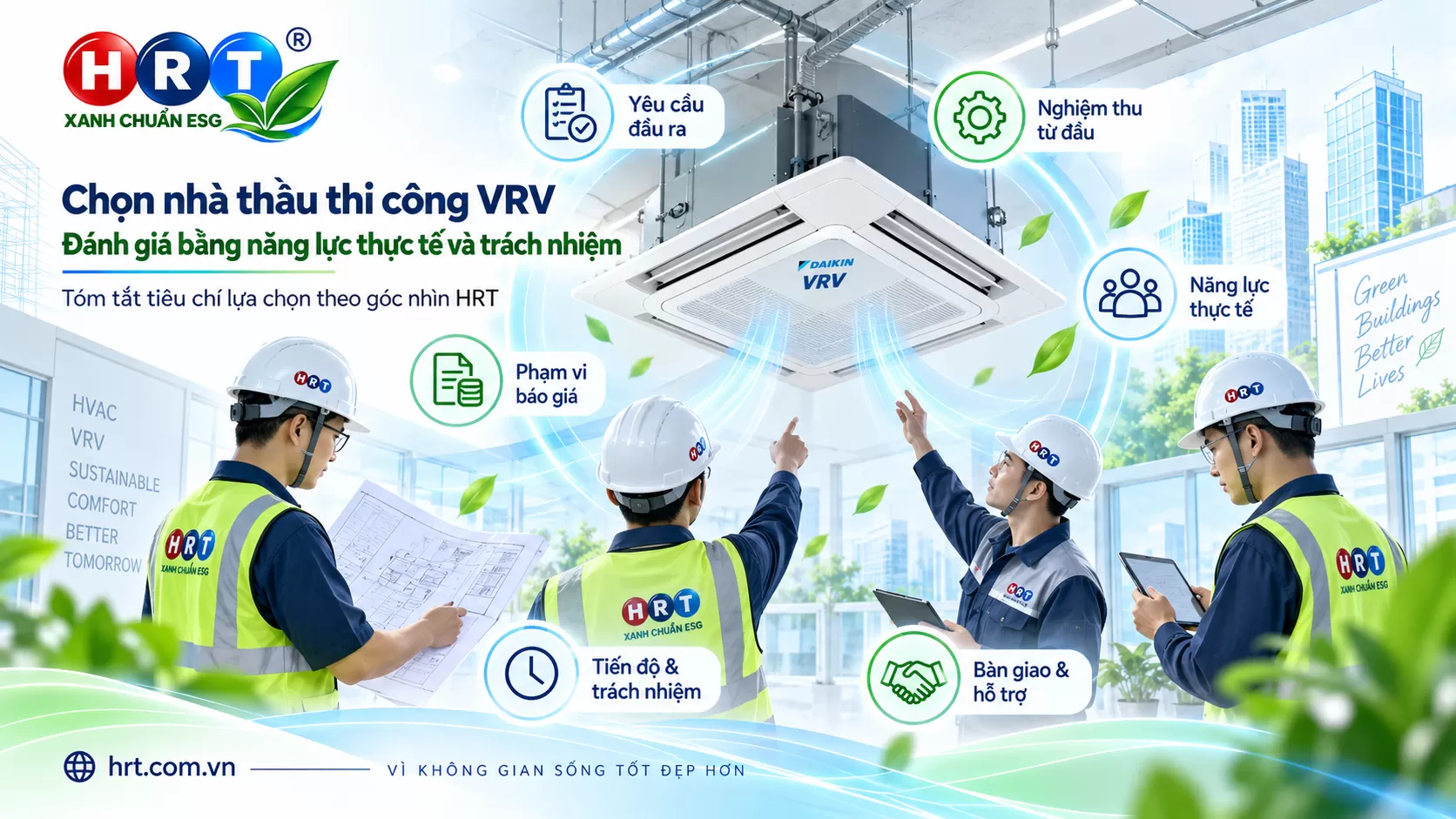
This capacity is not only in the installation of equipment. Depending on the scope of assignment, the contractor must also survey, deploy drawings, coordinate technical systems, control materials, organize commissioning and prepare handover documents.
So, before asking “How much more can be reduced?", let's clarify a more important issue: With this investment, what will the project receive and who is responsible for implementation?
Set handover request before reviewing total price
Determine which operation the system needs to serve
I suggest that the project owner start by describing the needs of the user instead of sending a list of equipment immediately for a quote.
An office that works by office hours, a hotel that is receiving guests and an area with its own operational requirements should be considered according to the conditions of that work itself.
The input document should clarify the functions, useful life, design requirements, architectural status and limitations during the construction process. At the same time, it is necessary to determine which part of the contractor is assigned: construction according to the available design, supply and installation or implementation of the design.
Outputs that are not agreed should not be considered as directly comparable options.
Thong most confirmed way to coughfrom the beginning
I don't want to get to commissioning day, when the parties are gonna start debating how it's done.
Right during the selection process, the project owner should request to present the expected acceptance testing contents, testing methods and proof documents.
For VRV systems, the inspection should consider items within the project scope such as equipment, pipelines, insulation, condensate, electricity, control, leak testing, vacuum evacuation, filling and commissioning. The conditions for implementation must be compared with the design and documents of the right equipment, not applying a common set of parameters to all systems.
A question to ask the contractor is: “What documents will you provide to confirm that this job is satisfactory?"
The answer should be more than a promise of quality.
Capacity assessment by contractor handling actual works
View similar experiences, not just project listings
When reading the portfolio, I prioritize finding out what the contractor has actually done in each of the projects presented.
Does the unit provide equipment, directly organize the construction or only participate in a part of the work? Does the team expected to arrange for the new project have appropriate experience? Previous conditions for deployment are similar to the premises under consideration?
In the evaluation - oriented HRT article, experience should be viewed along with the scope of work done, personnel and verifiable documentation; enterprise size should not be used in lieu of evaluating the ability to meet specific project requirements.
Ask the contractor to demonstrate their competence by doing similar work and the team that will perform, rather than just by showing pictures of the building.
Request an explanation of the equipment layout
A field discussion should help the project owner understand the reasons for each option.
For outdoor units, it is necessary to clarify the heating conditions, wind hazards, maintenance space, equipment support and vibration treatment options. For indoor units, it should consider the location for serving the used space, accessibility to servicing, condensate drainage and coordination with ceiling and related systems.
Instead of just asking “Is it okay to install here?", I propose to ask in depth:
“What evidence does this position match, and what content should be checked before closing?"
The contractor that does not have sufficient information is not necessarily a weak contractor. It is necessary to assess whether they can identify the missing part and provide a way to verify it.
Check the ability to manage the entire connectivity system
Project owner does not need to replace the role of engineer, but should ask the contractor to specify how to control important technical items.
The pipeline plan should be compared in size, length, height difference and splitter layout. The welding, leak testing, vacuum evacuation and filling of the liquid also need to have control methods suitable for equipment records.
From a management perspective, I want each content to answer three questions: Who does it? Who checks it out? Where are the results saved?
A plan is only truly ready to implement when the points to confirm have a handle and a person in charge.
Read quotes as a job delineation table
Do not let the total amount obscure the missing work
The two quotations may be “supply and install VRV system” but do not cover the same range.
One option has included transportation, lifting, control and commissioning; the other option may leave those parts out of the quoted price. Therefore, it is necessary to include quotations of the same configuration, volume and range before concluding which option has a cost advantage.
I propose the project owner to use a clarification table as follows:
| Working Group | Contents to be collated | Points to confirm |
|---|---|---|
| Equipment | Model, capacity, quantity and accessories | What configurations are included in the offer price? |
| Pipeline and insulation | Type, size, volume, scope of installation | Which part is defined, which part is provisional? |
| Electrical and Control | Power supply, wiring, communication, controller, BMS connection if available | Where do each sides go? |
| Supporting work | Transport, Lifting, Supporting, Piercing, Return | Who does it and who pays the cost? |
| Inspection and handover | Testing, commissioning, as-built documentation, operation manual | What documents must be delivered? |
| Support after handover | Equipment warranty, installation and maintenance if any | What are the specific conditions and responsibilities? |
The reconciliation table is not intended to make the profile more complicated. The goal is to help parties see the same range before agreeing on prices.
Handling of responsibility gaps before deployment
Example assumption: indoor unit needs to be approached for servicing, but profile has not identified which side layout and finishes the ceiling visit door.
In this situation, I will ask to clarify the location, unit and time of coordination as soon as reviewing the plan. It is not recommended for the construction team to come to the scene and negotiate each thing by themselves.
The principle I propose is: Items which have not yet been managed by units must be recorded as unfinished, not automatically considered as being in the price.
Subsequent changes should also be documented in terms of content, cost, and impact on progress.
Check deployment plans, not just hear the completion date
Clarify who will run the work at the scene
When evaluating the central air conditioning contractor, I want to know the technical manager, site coordinator and contact person working with the project owner.
These should be the people who are expected to be assigned to the project, not just the titles that appear in the profile.
Project Owners should ask contractors to present how to handle problems, check quality and confirm adjustments. A clear organizational plan should show who issues are reported to and how the decision is made to be forwarded to the construction team.
The person responsible must be identified before the work begins.
Mounting progress milestones with implementation conditions
A completion date is just a milestone. To assess the likelihood of achieving that milestone, it is necessary to consider the implementation process.
The progress of VRV construction is related to the provision of equipment, handover of premises, coordination of other items, inspection of occult work and commissioning time, handling of existence. With the work in operation, the plan to limit interruptions should also be considered.
I propose that each milestone should include a starting condition and a result to be achieved.
For example, before completing the ceiling area, the parties should agree on what contents above the ceiling must be checked. Before commissioning, it is necessary to confirm that commissioning conditions have been prepared.
This is how you can turn your progress from a commitment into a trackable plan.
Handover must help the operator continue to manage the system
In my view, handover should not be seen as merely the end of installation.
It is also the process of transferring information and responsibility so that the receiving team can use, monitor and coordinate in handling the system's problems.
Project owner should clarify as-built documentation, test results, manuals, scope of operation training and supporting contacts. At the same time, equipment warranty liability, construction warranty and maintenance service should be distinguished; it should not be defaulted that all are the same conditions apply.
I propose to put the support contents after handover into specific tasks: person receiving information, how to record incidents, time to respond as agreed and method of updating processing results.
Handing over the goods is not just about handing over all the paperwork, but also about helping the recipient know what to do and who to contact.
Close your selection with a record, not a sense of security
To support decision making, project owners can classify each evaluation item according to the three following states. This is a way of organizing reference information, not a tender scoring standard.
There are sufficient grounds: The contractor has presented the plan, provided necessary information and clearly certified the performer and the handover result.
Need to add before deciding: The plan has unclear points but the contractor has identified documents to be supplemented, person in charge and time limit for clarification.
Not met the requirements: - Important contents for which no appropriate solution has been worked out or the contractor cannot yet certify the capability of implementation.
I do not recommend eliminating a unit because the initial dossier is incomplete. But those contents that directly affect the scope, quality and deployment capabilities should be handled before finalizing the selection.
Don't make the unknown part of the day a responsibility for tomorrow's debate.
CEO's view Đoàn Văn Hoàng: Choose a partner who can take responsibility to the end

As a technician and HRT executive, I want the selection of contractors to start with mutual understanding of the work.
Project owner needs to know what the investment will produce. Contractor needs to understand the conditions and requirements to meet. The implementation team needs to know where they are responsible.
I set three values. True – Clear – Dedicated to that process by specific actions.
True Understanding: Do not draw conclusions instead of verifying
Before defending an option, check its utility, current status, and related records.
The part that is well - grounded should be explained. The part that is lacking should determine what to do next. I appreciate the proactive clarification of the problem more than a firm answer when the data is not enough.
Clear: Every commitment must be tied to the right thing to do
A meaningful commitment should show the scope, person in charge, time of implementation and way to confirm completion.
From quotation to handover, I want the parties to have a common understanding of the work. The content of change must be exchanged and recorded, not for each person to deploy in a separate way.
Dedication: Follow up on unfinished parts
Dedication is not just about counseling.
For me, it is also the active reporting of problems, updating processing progress, completing records and tracking the content that remains.
A good partner is not one who says it's easy, but one who clarifies the hard stuff and is responsible for solving it to the extent agreed.
Frequently Asked Questions When Choosing VRV Construction Contractor
If the design is available, is it necessary to exchange the plan at the scene?
Request the contractor to compare the documents with the actual conditions before closing the deployment. The goal is to identify the points to confirm the location of equipment, pipelines, accessibility and construction coordination. The scope of review or design adjustments should be clearly defined between the parties.
What should project owner prepare before requesting a quote?
The design documentation or existing status, requirements for use, construction conditions and expected scope of work should be prepared. Unspecified content should be clearly stated so that the contractor can present assumptions or propose additional surveys.
Should I choose a contractor who offers significantly lower prices?
It is necessary to check in advance whether the price includes the same configuration, volume and scope as the other options. In particular, clarify the exclusion, provisional calculation and conditions of application. Low prices are a factor to consider, not a substitute for performance evaluation.
How can post-handover support not stop at promises?
Ask to identify the contact point, warranty scope, agreed response time and how to update handling. At the same time, distinguish responsibility for equipment, installation quality and maintenance work provided separately.
HRT: Start from clear requirements to properly implement the work
HRT operates in the field of HVAC, with VRV/VRF central air conditioning solutions and maintenance, renovation and system optimization services. The orientation of HRT is to assess actual conditions, clarify the scope and select the appropriate plan for each project.
When preparing to invest or renovate a VRV system, start by gathering existing records, identifying use goals, and writing down problems to address with your HRT team.
Select VRV contractors by grounds. Unify the work in writing. Confirm the results by inspection records.
HRT – Green Breath for All Buildings.
Source: Publisher’s English edition · Vietnamese original on doanvanhoang.com