
Cleaning AHU coils: six decisions before sign-off
Machine-translated from Vietnamese. Read the original in Vietnamese
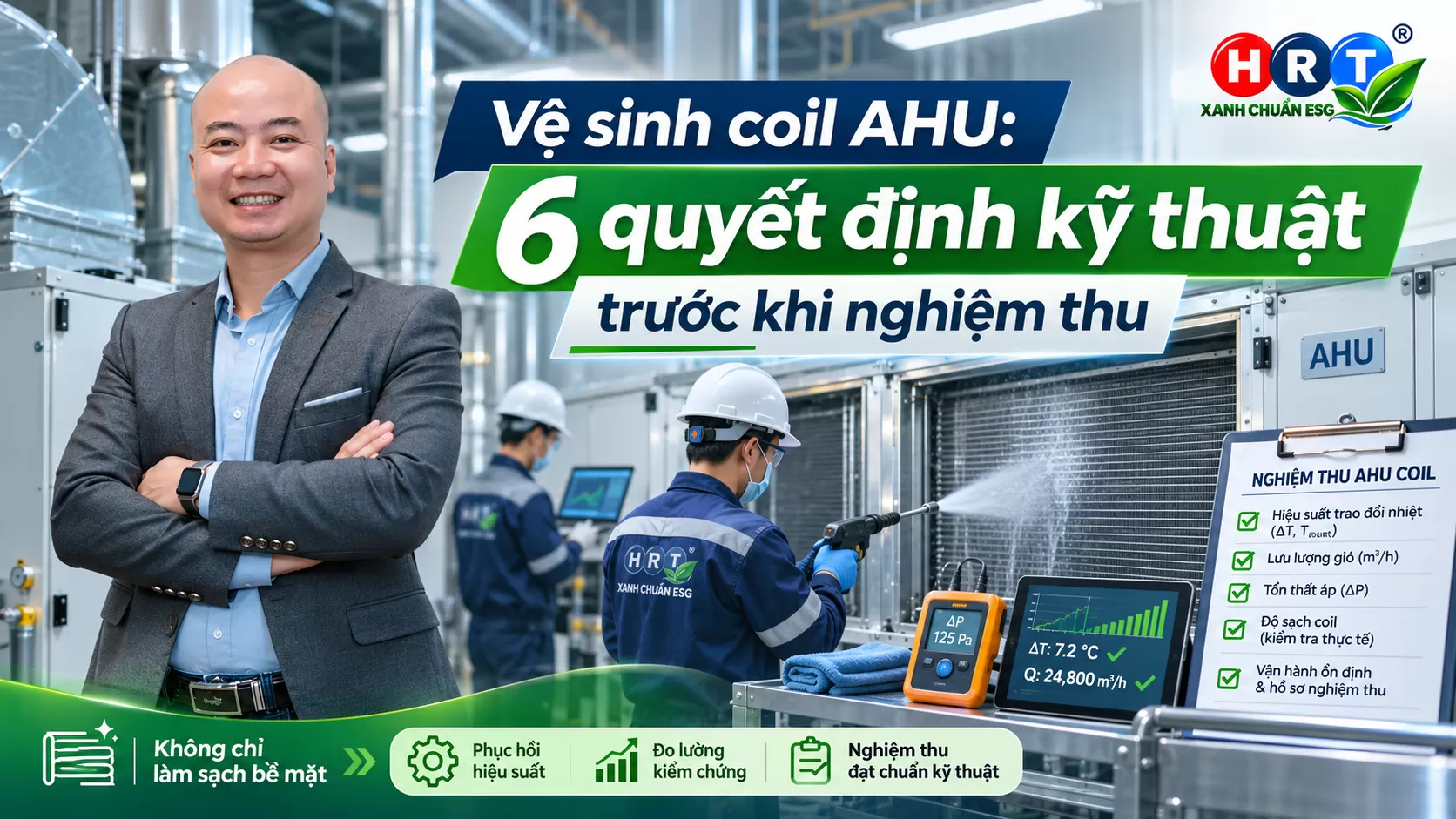
AHU coil cleaning is not just cleaning. CEO Đoàn Văn Hoàng – HRT share 6 technical decisions to help optimize performance, quality control and acceptance testing in accordance with standards.
Sanitation coil AHU: 6 technical decisions before acceptance testing
In HVAC system operation management, I am often interested in a question after each maintenance batch:
The equipment is cleaner, but the operation efficiency has really improved?
For AHU heat exchangers, this question is especially important.
A coil with a clean, bright surface is not sufficient to confirm the maintenance work successfully. If the airflow rate does not reach, differential pressure is abnormal, condensate drains poorly or the system appears after cleaning, the work still needs to be re-evaluated.
At HRT, I want to shift the focus from complete cleaning operation sang Control maintenance results with technical data.
To do so, your manager needs to make six important decisions.
1. Decide whether to clean the AHU coil immediately
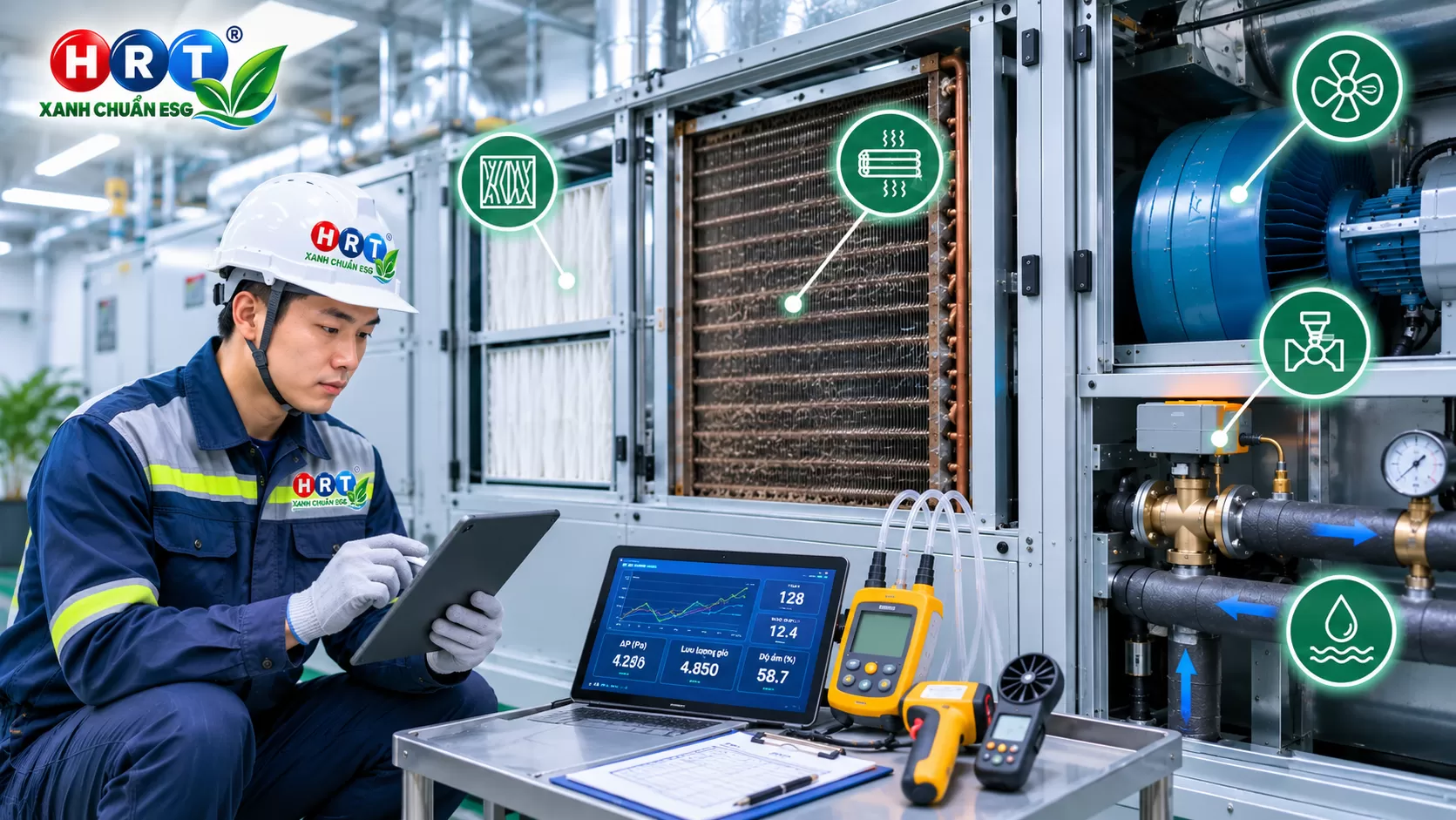
Not every poor cooling AHU is a heat exchanger cleaning.
That's the first rule I want the technician to understand.
Distinguishing Manifestations from Causes
An AHU with a higher air supply temperature than required may stem from several factors:
-
Dirt reduces the heat exchange capacity of coil.
-
Clogged air filters increase pressure loss.
-
cold water flow rate does not meet the requirement.
-
Cold water control valve malfunctioning.
-
Fan or control system is not working properly.
-
Actual thermal load conditions vary from design to design.
If these factors are not differentiated, cleaning the coil may not solve the main problem.
Prioritize data before making decisions
I'm asking the technician to check what parameters can be collected at the scene:
| Test Items | Purposes |
|---|---|
| Differential pressure air side through coil | Assess pressure loss trend |
| Airflow rate | Air Distribution Capability Test |
| Temperature, humidity before and after coil | Air Handling Status Assessment |
| Temperature chilled-water supply and return | Support water side heat exchanger analysis |
| Filter, Fan, Control Valve | Rule out related causes |
The data must be considered under the same operational conditions, not separated into independent conclusions.
For example, differential pressure through coil changes can be influenced by airflow rate. So, to assess the dirty level through differential pressure trend, it is necessary to compare in the condition of equivalent flow rate.
Decisions to be closed: Is coil cleaning an item to do immediately or must I deal with another cause first?
Output: AHU status assessment form and maintenance scope proposal.
2. Decide the scope of intervention to avoid omission of damage
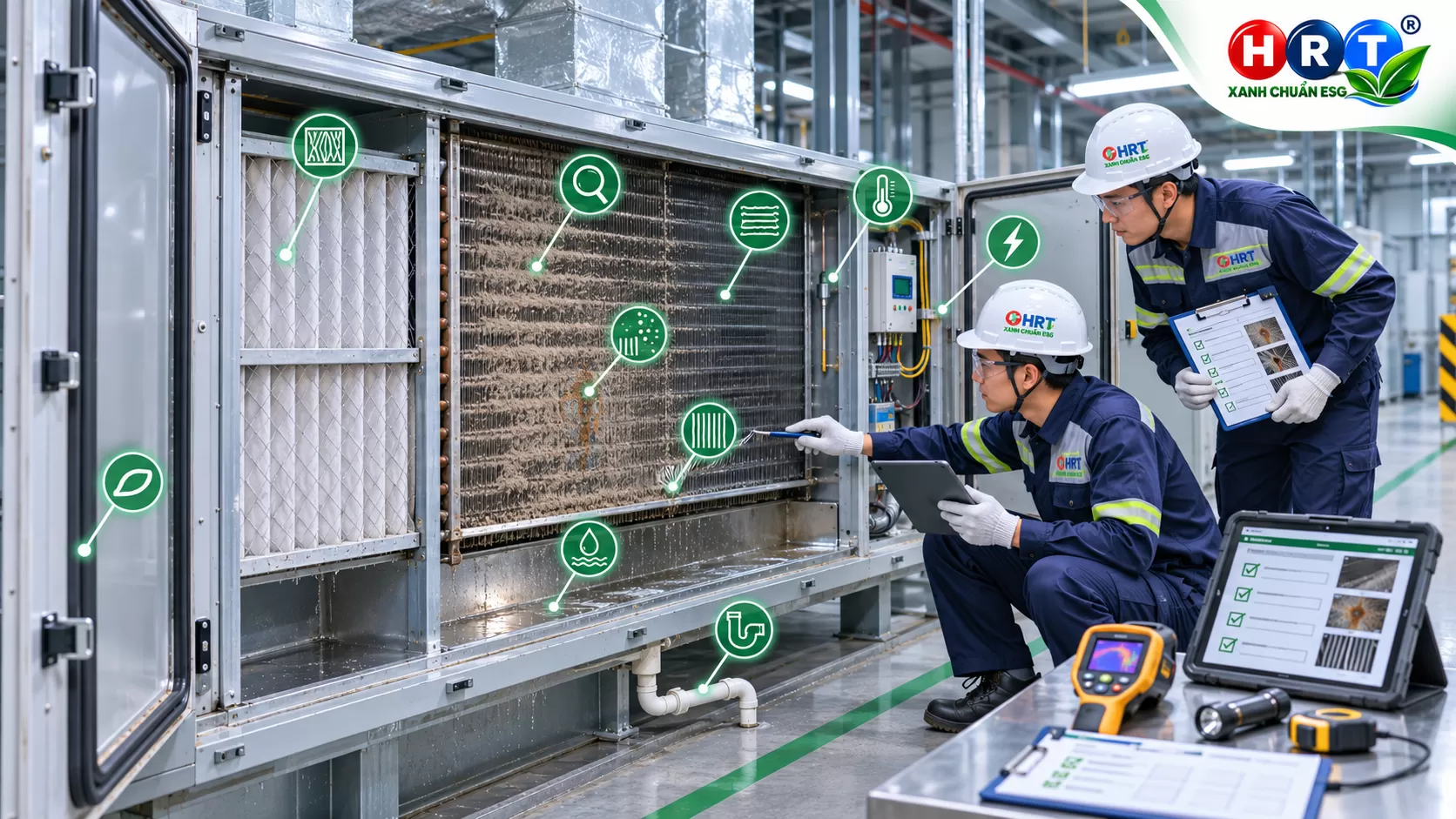
Once I've decided what to clean, my next question is not what equipment to use.
I would like to know: What parts of the body do we have to work on to solve the problem?
Evaluation of the whole heat exchange area
AHU heat exchanger usually has multiple rows of tubes and radiator blades. Dust can accumulate unevenly between positions.
If you only clean the visible surface, the deeper area may still have dirt.
The person in charge should survey the accessibility of the coil, the level of fouling and the limitations on operating space.
Do not ignore the relevant parts
I propose simultaneous testing:
-
Air filter front coil.
-
Collector and condensate drain.
-
The locations with signs of corrosion, damage to the coating.
-
The radiator blades are bent or deformed.
-
Put gaskets on doorways and other areas that might leak air.
-
Sensors, wiring and electrical components are located near the toilet area.
This will help you determine what cleaning, repairing, and existences need to be handled separately.
Work boundaries unified
A maintenance request should specify the scope of work to be done.
For example, if a coil leaks water at the junction, the job should not be automatically converted to a chilled-water system repair without a safety assessment and an approved plan.
Decisions to be closed: Cleaning range, inspection range and damages that need additional handling.
Output: Workload table and list of irregularities at the scene.
3. Decide the cleaning method according to the material and dirty level
I don't want a cleaning method that is applied the same to all coils.
A common aluminum wing coil, protective coating coil and corrosion-appearing coil should be evaluated according to different conditions.
Choose the cleaning way according to the condition
| Actual conditions | Plans to consider |
|---|---|
| Dry dust clings slightly | Vacuum Cleaner, Soft Tool |
| Deep dust | Suitable tools and cleaning methods approved by the manufacturer |
| Residue cling tightly | Controlled Wet Cleaning |
| Dirt Containing Grease | Material Compatible Solution if needed |
| Coil with special coating | Method according to the manufacturer's documents |
Do not choose the option just because of the fast construction speed.
Control the risk of deforming the radiator blades
The radiator blades increase the area of contact between the heat and the air.
When bent or flattened, the windway shape through the coil may be altered.
So, I asked the construction team to determine the pressure limit, spray direction and cleaning distance according to the equipment structure.
In particular, do not use high pressure sprayers on coils without confirming the allowable limit.
Control of Sanitary Chemicals
Chemicals must be selected based on the material, coating and type of contaminant.
Before use, check:
-
Chemical safety documents.
-
Coil manufacturer recommendations.
-
Phase concentration and exposure time.
-
Conditions for wastewater discharge and collection.
-
Means of protection for the performer.
Do not mix chemicals or use a solution that can cause inappropriate corrosion.
I prefer the option that is effective enough to minimize unnecessary impact on the device.
Decisions to be closed: Methods, materials, tools and safety conditions before implementation.
Output: The sanitation plan is approved.
4. Decide on safety conditions before permitting construction
In technical management, safety is not the last item to be inspected.
It is a requirement before the work begins.
Isolate the energy source
Before opening the AHU and approaching the coil, the engineering team must perform the sequence of stopping and isolating the energy source in accordance with applicable regulations at the work.
The risks that should be considered include:
-
Fan starts unexpectedly.
-
The rotary unit has not fully stopped.
-
Power is still available at the operation area.
-
Abnormal pressure or temperature in the water system.
-
Water or chemicals affecting electrical equipment.
The lockout and hang tag (LOTO) procedure must be carried out in accordance with the equipment and scope of work.
Protect sensitive parts
Motors, ball bearings, sensors, electrical cabinets, wiring and insulation should be protected from the risk of contact with water or chemicals.
The plan must take into account the place of collecting toilet water, the drainage capacity and the prevention of dirt from spreading to the clean compartment.
Control of work arising
If the cleaning process detects damage not within the original range, the person in charge must record and report.
Do not arbitrarily expand the work to remove chilled-water pipe, electrical treatment or change coil structure without approval plan.
Decisions to be closed: The work shall be performed only after the safety conditions and measures to protect the equipment are certified.
Output: - The written certification of construction conditions.
5. Decide on acceptance testing criteria before restarting the AHU
This is something I'm particularly interested in.
Cleaning does not mean the system is ready to hand over.
Two groups of results should be distinguished: cleaning quality and operation quality.
Post-cleaning quality inspection
Before closing the device, it is necessary to confirm:
| Category: | Contents of the review |
|---|---|
| Coil Surface | Cleanliness level at testable locations |
| Heat Sink Wings | No new deformation or damage |
| Protective coating | No abnormal effects |
| Condensate drain pan | Clean and drain on request |
| Electrical Parts | Dry, safe and protected |
| Filter, Door Visit | Complete installation, in place |
| Khoang AHU | No tools, supplies or residue left |
Irreparable abnormalities within the scope of work must be recorded separately.
Test operation conditions
After safety confirmation, the AHU is started according to the operation procedure.
Technicians should monitor parameters related to the issue recorded before maintenance:
-
Differential pressure air through coil.
-
Airflow rate.
-
Air temperature and humidity.
-
Fan status and control system.
-
Supply-water temperature and return for cold water coil.
-
Capable of condensate collection and drainage.
-
Noise, vibration and warnings.
Correct comparison of conditions is valuable
I'm not asking for a fixed improvement number for every AHU.
A heavily soiled coil can result in marked changes after cleaning. With a coil that only attaches light dust, the change can be minimal.
In addition, the air temperature level is influenced by thermal load, airflow rate, cold water flow rate and control state.
Therefore, the results before and after cleaning should be compared in equivalent operation conditions, or specify the different conditions.
Do not automatically attribute the entire change in power or cold productivity to coil cleaning.
Decisions to be closed: Has the equipment met safety conditions, cleaning quality and operation criteria agreed or not?
Output: The test record, parameter table and acceptance testing conclusion.
6. Decide the monitoring plan to limit recurrence of incidents
Maintenance should not end in an acceptance testing signature.
I want the data collected to be the basis for managing the device in the next cycle of operation.
Identify the cause of the quick coil dirty
If a heat exchanger is constantly dusty after a short period of time, it is necessary to check for the cause from the surrounding system.
Factors to be assessed include:
-
Filter efficiency and status.
-
Airtightness of the filter frame, visit door and AHU cavity.
-
Environment takes outdoor air.
-
Construction activities or dust sources near the area.
-
Actual operation time.
-
Condition of moisture and condensate drainage.
Increasing the frequency of cleaning without addressing the cause can further increase maintenance costs.
Build plans according to equipment status
The frequency of inspection must be based on the use level, environmental conditions, manufacturer's instructions and equipment history.
An AHU that runs continuously in a dusty environment may need more frequent inspections than a system that runs intermittently in a clean environment.
I recommend data management by AHU code for convenient comparison between maintenance times.
Profiles must help the operator make decisions
A valid dossier should include:
-
Code of equipment and installation location.
-
Status, images and parameters before maintenance.
-
Scope, method and materials used.
-
Post-cleaning test results.
-
Existing, recommended and persons responsible for monitoring.
From there, the operations department has a basis to decide on when to conduct further inspections or request additional repairs.
Decisions to be closed: Who receives the equipment, what indicators to monitor and what conditions trigger the next test?
Output: AHU maintenance records and monitoring plans.
7. Five management mistakes that make AHU hygiene ineffective
From an HVAC project management perspective, I think many existences can be prevented by the right control from planning.
Mistake 1 – Only handing out hygiene requirements without handing over the target
Without clarifying the problem to fix, maintenance teams have a hard time determining the proper level of work.
Actions: - To finalize the current status, objectives and scope of inspection before deployment.
Mistake 2 – Choose a routine cleaning method
Applying the same chemicals or spraying method to every coil can cause a risk of damage to the material.
Actions: Compare equipment documents and approve the plan according to actual conditions.
Mistake 3 – Failing to Record Initial Data
The lack of data makes the assessment of post-maintenance results mainly based on perceptions.
Actions: Prepare the test table and record operation conditions before stopping the machine.
Mistake 4 – Ignoring condensate drainage
Coil is clean, but a clogged drain or gutter can keep a damp problem from happening.
Actions: Drainage and AHU finishing capability test before handover.
Mistake 5 – Do not assign followers after acceptance testing
When abnormalities arise, lack of a person in charge may slow assessment and processing.
Actions: Hand over records, tracking indicators and the list of existing to the operation department.
8. Matrix quality control maintenance AHU according to HRT
For clear and easy maintenance, I propose using three decision gates.
| Verification checkpoint | Question Management | Transition Conditions |
|---|---|---|
| Gate 1 – Before construction | Have you understood the problem and ensured safety? | There is a status assessment, plan and safety confirmation |
| Gate 2 – After Cleaning | Is the coil cleaned properly, no damage arises? | Have visual inspection, confirm the status and handle existing |
| Gate 3 – Before handover | Does AHU have the right operation and sufficient documents to verify? | - Having the measurement and inspection results, written records and receivers. |
These three gates help separate the responsibility between the builder, the inspector and the approver.
In particular, it is not recommended to move to the next stage if inappropriate points affecting safety or acceptance testing conditions have not been handled.
9. FAQs about AHU sanitary acceptance testing
9.1. After cleaning the AHU coil, is differential pressure measurement required?
Differential pressure should be measured when it is related to the identified problem or acceptance testing criteria. The results should be compared at the equivalent airflow rate to avoid false conclusions.
9.2. Does clean AHU coil mean satisfactory refrigeration performance?
No. The heat exchanger capacity also depends on the airflow rate, cold water or fluid conditions, load and system control.
9.3. When to use AHU coil cleaning chemicals?
When the type of dirt needs chemical method to handle and the chemical is confirmed compatible with the material, coating and manufacturer's instructions.
9.4. Is the filter replaced after cleaning the coil?
Check the condition and replacement criteria of the filter. Not every cleaning coil is required to change the filter, but the unsatisfactory filter must be treated according to the maintenance process.
9.5. Does AHU coil cleaning help reduce power?
Possibly, if the dirty coil is increasing pressure loss or impairing heat exchange capacity. The actual saving level should be confirmed by data under comparable operation conditions.
9.6. Who should confirm the AHU acceptance testing results?
Personnel with workflow authority, usually including maintenance unit representatives and assigned operation or supervisory management departments.
10. HRT – AHU maintenance by data and responsibility
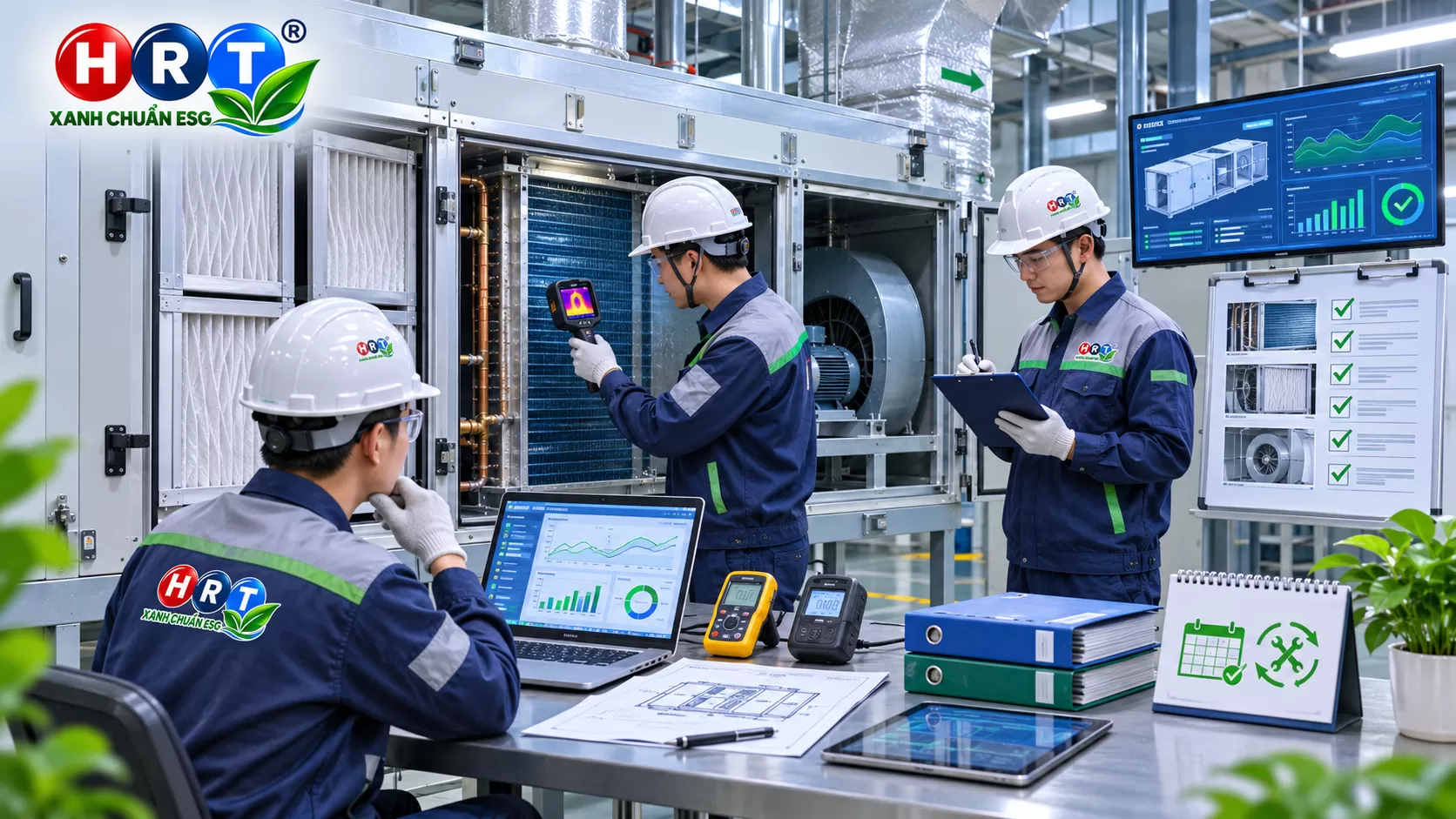
In the field of HVAC, I do not evaluate maintenance quality by the number of work completed.
What I need is safe equipment, verifiable results and a system that continues to meet operational requirements.
That's also how HRT implements three core values in engineering work.
YES
Determine the condition and cause before choosing a treatment.
CLINICAL
All jobs must have specific scope, acceptance testing criteria and evidence.
VISION
Monitoring of the remaining problems, supporting long-term equipment control operation unit.
HRT provides solutions for design, construction, inspection, maintenance and renovation of HVAC systems, including AHU/FCU, Water Chiller, VRV/VRF and industrial ventilation systems.
For the project needs to assess the status of heat exchanger AHU, the preparation of operation data, equipment records and maintenance history will help the survey process, determine the scope of work more accurate.
11. Conclusion: AHU hygiene must produce verifiable results
To me, maintenance only really matters when the manager answers three questions:
Before making: What's wrong with the device?
After making: What factors have been improved and what data have they been proven?
After handover: Who is responsible for continuing to monitor?
That's why six technical decisions need to be controlled throughout from survey, selection of options to acceptance testing and monitoring.
Cleaning coil is a technical job. But AHU sanitary quality management is responsible for the operation efficiency of the whole system.
Right from the beginning – Clear to the end – Sustainable Green.
Đoàn Văn Hoàng – CEO HRT
HRT – Green Breath for All Buildings
Website: https://hrt.com.vn/
Website CEO: https://doanvanhoang.com/
Reference Materials:
HRT – The procedure for cleaning the heat exchanger AHU is technically correct.
https://hrt.com.vn/quy-trinh-ve-sinh-dan-trao-doi-nhiet-ahu-dung-ky-thuat
The article was compiled from the perspective of management and acceptance testing quality, not replace the manufacturer's maintenance instructions or safety procedures applied at the work.
Source: Publisher’s English edition · Vietnamese original on doanvanhoang.com