
Common Errors When Charging VRV System with Gas & How to Handle It
Machine-translated from Vietnamese. Read the original in Vietnamese
Learn the common errors when refrigerant charging VRV system, causes, signs and processes to handle properly techniques to help the operation system stable, energy saving and limiting problems.
Common Errors When refrigerant charging VRV System And How To Handle
Systematic VRV is commonly used in offices, hotels, shopping malls, factories and many buildings that require air conditioning with a variety of different use areas.
Different from the conventional civil air conditioner, VRV system has complex structure with many indoor unit, outdoor unit, fluid pipeline and gas splitters. So the process refrigerant charging VRV should be made based on the actual specifications and configuration of the work.
Just miscalculate the amount of solvent, skip the leakage test step or vacuum evacuation improperly, the system may appear to be in a state of cold weak, cold irregular, faulty alarm or unstable operation.
Why refrigerant charging VRV should be done properly?
For VRV systems, the amount of refrigerant needed depends not only on the capacity of the outdoor unit.
Technicians must also consider:
- Model and configuration of the system.
- Type of refrigerant used.
- Pipe length.
- Pipe size and configuration.
- Number of indoor units.
- Gas splitter and pipe branch.
- The amount of solvent preloaded by the manufacturer.
- The amount of solvent to be added according to the actual system.
So, you know, should not refrigerant charging VRV based solely on cold sensation or a single pressure parameter.
An inadequate testing process can cause a system to run out of gas or excess gas, which in turn affects the operational capabilities and performance of the equipment.
9 common errors when refrigerant charging VRV system
1. refrigerant charging according to cold feeling
One of the most common mistakes is to see a weak air conditioning and immediately assume that the system is running low on gas.
However, Weak refrigeration VRV does not necessarily mean a lack of gas.
This condition may also be related to:
- dirty air filter.
- Indoor unit is dusty.
- Airflow rate is not enough.
- Sensors are not working correctly.
- Outdoor unit has a problem.
- Fluid pipeline.
- Thermal load in the room.
- Configure or install the system.
How to handle
Before refrigerant charging, it is necessary to check the overall system and determine the cause. If the lack of refrigerant is identified, the additional gas should be calculated according to technical requirements instead of charging until it feels cold enough.
2. Do not specify the exact length of pipe
VRV systems often have long pipelines and multiple branches.
During construction, the actual length may be different from the original design due to changing indoor unit position or pipeline route.
Without checking the actual pipe length, the amount of solvent added may not be accurate.
What should be checked?
- As-built drawing.
- Actual pipeline route.
- Pipe size.
- Gas splitters.
- Length of each branch.
- Specifications of the model.
This is an important basis for determining how much gas to add to your system.
3. refrigerant charging when the system is still leaking
If pipes or joints leak and refrigerant charging continues, the solvent may continue to lose during operation.
Then the system may appear to be in the state of:
Refrigerant charging → good air conditioning → some time after cold weak → continue refrigerant charging.
If this happens again, consider the possibility that the system is having a leak.
Solution
Don't just add more gas.
The proper process is:
Leakage inspection → locate → fix → re-check → vacuum evacuation → refrigerant charging → commissioning.
4. Vacuum evacuation has not reached
Vacuum evacuation is an important step when handling fluid piping systems, especially after installation or repair that interferes with refrigerant circuitry.
If in the pipeline there is still air or moisture that has conducted filling the solvent, the system may operate unstable.
Some people skip the vacuum test before moving on to the next step.
How to do it
The vacuum evacuation should comply with the technical requirements of correct model and manufacturer, instead of applying a fixed time to every VRV system.
5. Using the wrong refrigerant
Each VRV system is designed to use a certain type of solvent.
Therefore, before implementation refrigerant charging system VRV, it is necessary to check the information on the equipment and technical documents.
Misuse of the type of solvent or arbitrary mixing of solvents can affect the operation of the system.
Before loading need to check
- Model outdoor unit.
- The type of solvent.
- Specifications of the manufacturer.
- Label the solvent tank.
- Status of the loading device.
6. Do not use electronic scales to control gas volume
Some refrigerant charging cases rely on charging times or pressures rather than the actual volume of the refrigerant.
For VRV system, the control of the amount of the solvent by Electronic scale help technician know exactly how much gas has entered the system.
This information is also valuable when:
- Acceptance testing works.
- periodic maintenance.
- Troubleshoot the problem.
- Track repair history.
7. Misoperated valve or feed port
VRV system has many types of valves, service ports and operation methods depending on the model.
Incorrect opening or closing of valve, wrong use of filling port or application of other model's procedure can cause problems during filling and operation.
Note
Before the operation, it is necessary to specify:
- Service port.
- Stop valve.
- Open/Close Sequence.
- Loading method.
- Request commissioning.
It is not recommended to apply the same machinery process to every VRV system.
8. Do not recheck the system after loading
Another mistake is to assume that the system is complete as soon as sufficient gas is added.
In fact, it is necessary to re-check the system to detect possible problems.
The positions of concern include:
- The coupling.
- Van.
- Service port.
- The weld.
- Gas splitter.
- The area just repaired.
Then check the system's performance and any error codes.
9. Do not record the gas charged
This is a commonly overlooked but valuable step in later maintenance.
Without recording the amount of gas charged, technicians at subsequent maintenance will be difficult to reconcile the history of the system.
A set of records should include:
- Device model.
- The type of solvent.
- Pipe length.
- Calculated gas.
- The actual gas charge.
- Date of implementation.
- Test results.
- Commissioning results.
- Content of correction if any.
Signs that a VRV system needs gas testing
Not all abnormal phenomena of VRV are caused by gas. However, some of the following signs indicate that the system should be checked:
VRV weak refrigeration
Room temperature not reaching the set or prolonged cooling time may be a sign to check.
However, it is necessary to check both the indoor unit, air filter, thermal load, sensor and related parts before concluding gas shortage.
Irregular Refrigerant VRV
Some areas are normally cold while others are weakly cold which can be associated with a variety of causes.
Therefore, it is necessary to check each indoor unit and each zone.
Continuous system must refrigerant charging
If the system is constantly replenishing fluids, check for leaks instead of just refilling.
VRV error after refrigerant charging
When error codes appear after the loading process, it is necessary to accurately identify the error code and compare it with the technical documentation of the device.
Refrigerant charging should not be continued without identifying the cause.
Refrigerant charging VRV process technical correct
To help the system operate stably, refrigerant charging process should be carried out in a controlled process.
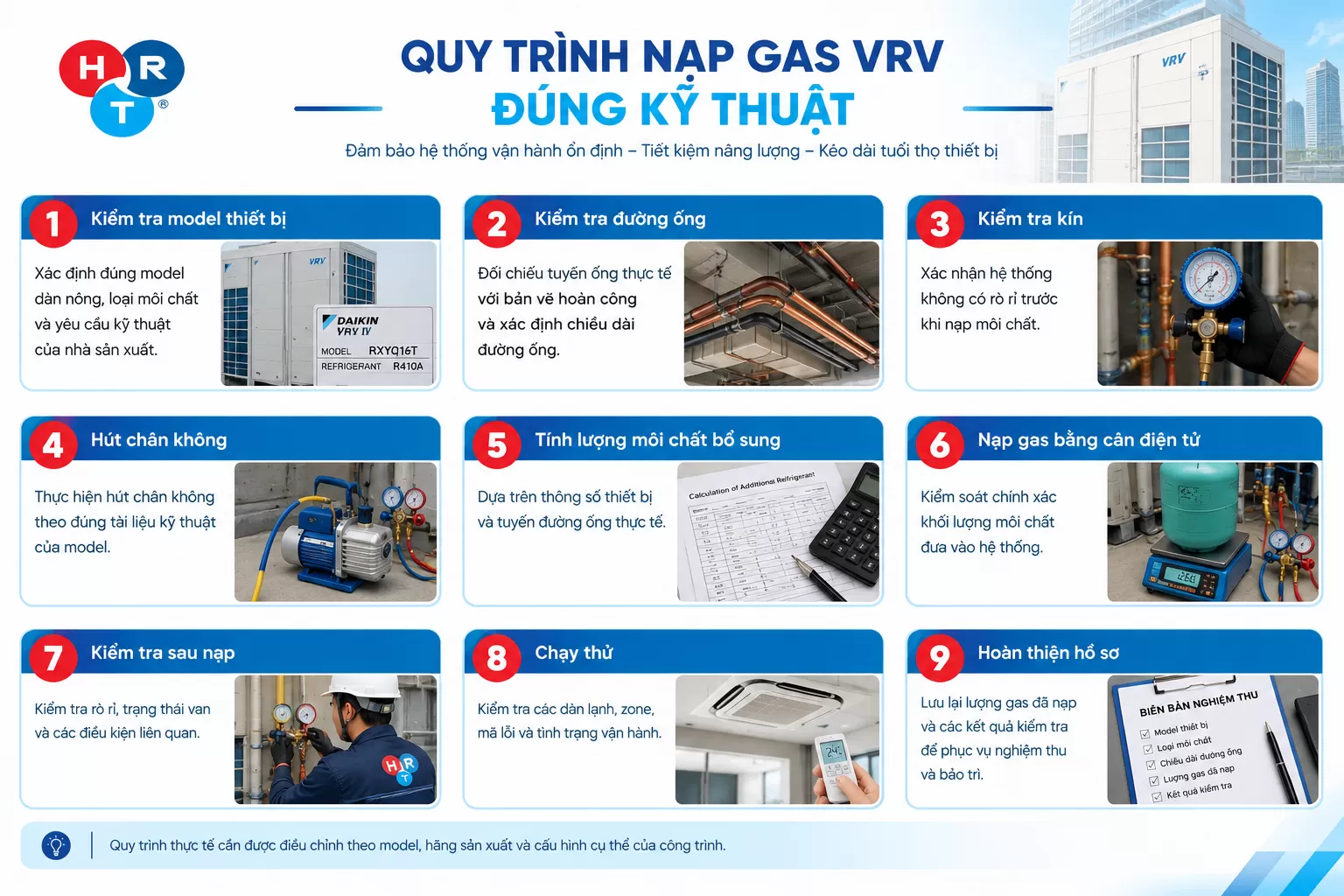
Step 1: Check the device model
Determine the outdoor unit model, type of solvent and manufacturer's specifications.
Step 2: Pipe inspection
Compare the actual pipeline with the as - built drawing and determine the required length.
Step 3: Check airtightness
Check the system to make sure there is no leakage before filling the solvent.
Step 4: vacuum evacuation
Perform vacuum evacuation according to the technical requirements of the model.
Step 5: Calculate the amount of additional solvent
Based on the actual equipment parameters and pipeline configuration.
Step 6: refrigerant charging by electronic scale
Control the volume of solvent introduced into the system accurately.
Step 7: Check after loading
Recheck leakage, valve and related conditions.
Step 8: commissioning system
Check outdoor unit, indoor unit, each zone, error code and operation status.
Step 9: Complete the application
Record the gas loaded and test results for acceptance testing and maintenance.
Note: The actual process should be adjusted according to the model, manufacturer and specific configuration of each building.
If VRV refrigerant charging is wrong, what should I do?
When the system appears abnormal after refrigerant charging, should not be treated with immediate gas refills.
Instead, it is necessary to check in turn:
Model → type of solvent → gas content → pipeline → leakage → valve → fault code → outdoor unit → indoor unit → operating parameters.
Identifying the right cause from the start will help prevent repeated repairs that may still occur.
Especially, if the system is constantly short of gas after each maintenance, it is necessary to prioritize the cause of loss of fluid.
Factors that determine the amount of gas to be fed to VRV
The amount of lip balm added should not be determined arbitrarily.
Usually it is necessary to consider simultaneously:
Device Type
→ Model outdoor unit and manufacturer's requirements.
Pipe Length
→ Total length and actual configuration of the system.
Pipe Size
→ Pipes of different sizes may have different solvent requirements.
System configuration
→ The number of indoor unit, gas splitter and pipeline layout.
Initial amount of solvent
→ The amount of solvent already available in the device.
Technical Parameters of Manufacturer
→ This is an important basis for determining the method and amount of solvent to be added.
HRT – Air conditioning and ventilation solutions for buildings
For constructions using VRV/VRF systems, installation, maintenance and troubleshooting should be carried out based on the actual status of the system.
HRT provides solutions related to air conditioning, ventilation and HVAC, serving a variety of buildings.
When the VRV system appears cold, errors, suspected lack of gas or needs post-maintenance inspection, the survey and assessment of the entire system will help identify the cause more accurately.
Frequently Asked Questions About Refrigerant Charging VRV
Refrigerant charging does VRV need to be calculated according to the pipe length?
Yes. Pipe length and configuration are factors that should be considered when determining the amount of the supplement, along with the specific requirements of the manufacturer.
Is a weak refrigerated VRV sure it is a lack of gas?
No. Cold weakness can come from many causes such as indoor dirty unit, air filter, sensor, thermal load, pipeline or other problems.
Should refrigerant charging VRV according to pressure?
It is not recommended to rely on a pressure indicator to determine the amount of gas to be loaded. It should be compared with the specifications and operation conditions of the system.
After refrigerant charging VRV what to do?
Need to check back system, check leakage, valve status, fault code and commissioning the indoor unit/zone before finalizing records.
Why does VRV have refrigerant charging but a period of time later becomes weak cold?
One cause to check is the possibility of leakage of the solvent. However, other elements of the system should also be checked before conclusion.
Refrigerant charging does VRV need electronic scales?
Electronic scales should be used to accurately control the loaded solvent volume and facilitate the recording of technical records.
Conclusion
Refrigerant charging system VRV is a high precision required jobDon't do this on a hunch or just because you have a cold.
Errors such as wrong gas count, no pipeline inspection, leakage bypass, vacuum evacuation failed, wrong solvent use, no electronic scales or commissioning after loading can affect the operation of the system.
So a good process starts with inspection equipment and pipeline, determine the correct amount of the solvent, perform controlled refrigerant charging and finish by commissioning, inspection and filing.
Source: Publisher’s English edition · Vietnamese original on doanvanhoang.com