
Energy Recovery Ventilation: HVAC Savings Solution
Machine-translated from Vietnamese. Read the original in Vietnamese

No outdoor air is essential, but improperly supplied outdoor air can significantly increase the air conditioning load. From experience in implementing HVAC, HRT Analyze how ventilation applications recover energy to balance air quality, operational performance and investment costs.
Ventilation Energy Recovery: Investing Right To Reduce Air Conditioning Loads And Optimize HVAC Operation
A good HVAC system not only provides efficient cooling. It also provides sufficient outdoor air, controls humidity, uses energy reasonably and maintains performance throughout the operation.
In many commercial and industrial projects, air conditioning systems are invested with large capacity but the outdoor air supply solution has not been calculated synchronously. As a result, equipment must additionally treat heat and moisture from outdoor air, increasing energy demand.
Ventilation for energy recovery is a worth considering approach. However, efficiency does not come from adding an HRV or ERV device, but from how the entire system is designed, integrated and operated.
From the perspective of CEO Đoàn Văn Hoàng – HRT, with more than 20 years of experience in the field of HVAC, the important principle is:
Do not start by selecting the device. Start with the actual operation of the work.
1. Why can the outdoor air supply system increase the cost of air conditioning?
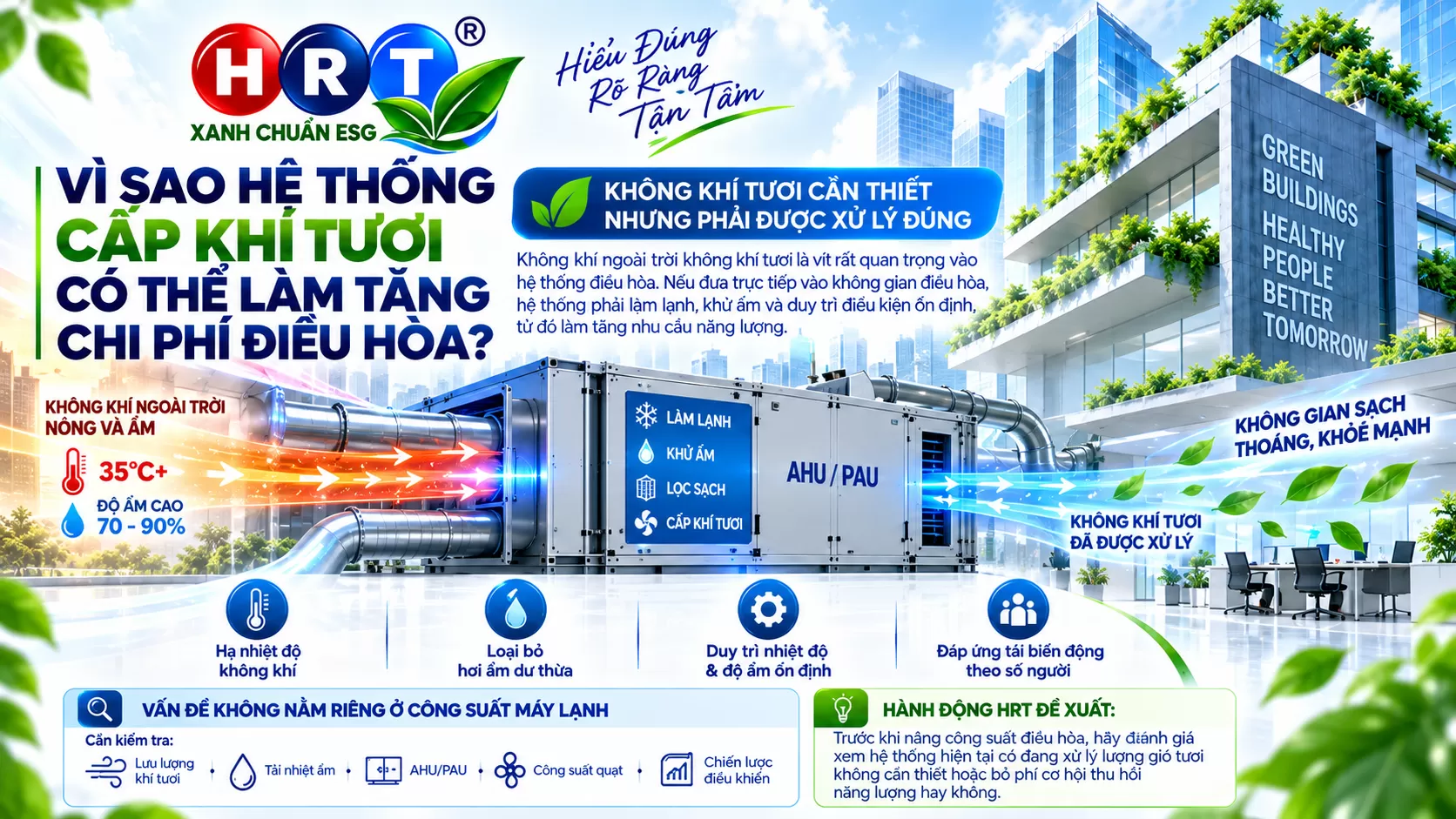
No outdoor air needed but must be properly handled
Offices, hotels, malls and many manufacturing areas all need outdoor air supplementation to meet ventilation requirements.
In Vietnam, outdoor air often has high temperature and humidity in the hot season. When put directly into air conditioning space, the system must consume energy to:
-
Reduce the air temperature to the required condition.
-
Remove excess moisture.
-
Keep the room at a comfortable temperature and humidity.
-
Meet the fluctuating load according to the number of people and modes of use.
If only thermal load is calculated but moisture load is ignored, the building may experience a condition where the temperature is satisfactory but the humidity remains high.
The problem is not just the air conditioning capacity.
A high - powered air conditioning system may not be working as well.
It is necessary to check the outdoor air flow rate, thermal load, handling capacity of AHU/PAU, fan power and control strategy.
HRT Actions Recommended: Before increasing air conditioning capacity, assess whether the current system is handling unnecessary outdoor air or wasting the opportunity to recover energy.
2. When Should I Invest in Energy Recovery Ventilation?
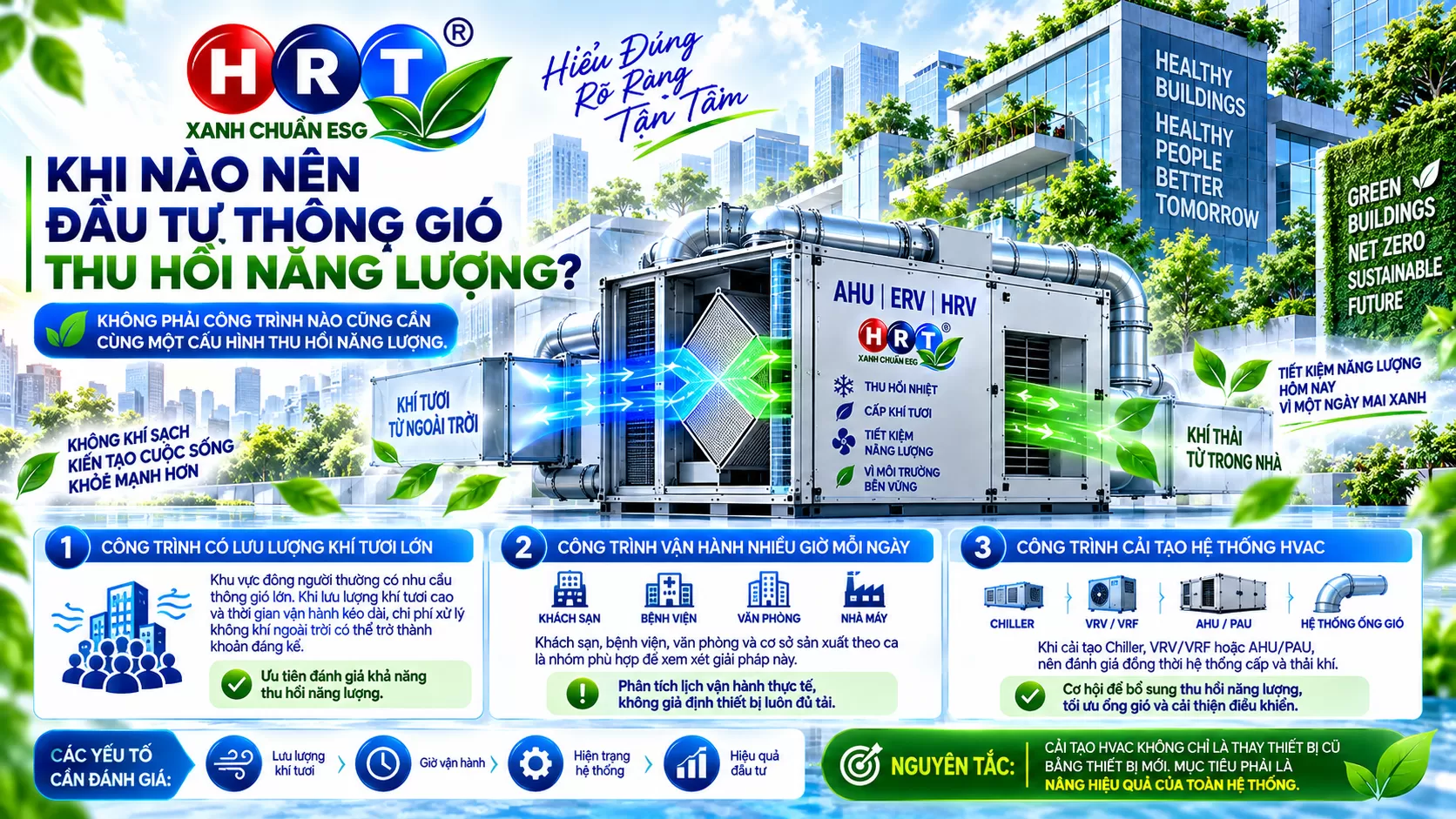
Not all buildings need the same energy recovery configuration.
Works with large outdoor air flow rate
Large gathering areas often have significant ventilation needs.
When outdoor air flow rate is high and operation time is long, the energy used to process outdoor air can become an important expense.
This is a group of projects that should be prioritized for energy recovery assessment.
Works operation many hours per day
Hotels, hospitals, office buildings with long operation period or production facilities with shift operation can facilitate the energy recovery solution.
However, an actual operation schedule should be analyzed rather than assuming the device is always running at full load.
HVAC system renovation works
When renovating Chiller, VRV/VRF or AHU/PAU systems, project owners should simultaneously evaluate the air supply and emission system.
This is an opportunity to consider the addition of energy recovery equipment, adjustment of flow rate, improvement of control and optimization of air duct system.
Principle: HVAC renovation is not just about replacing old equipment with new equipment. The goal must be to improve the efficiency of the entire system.
3. Five Steps for Assessment of Energy Recovery Solution at Works
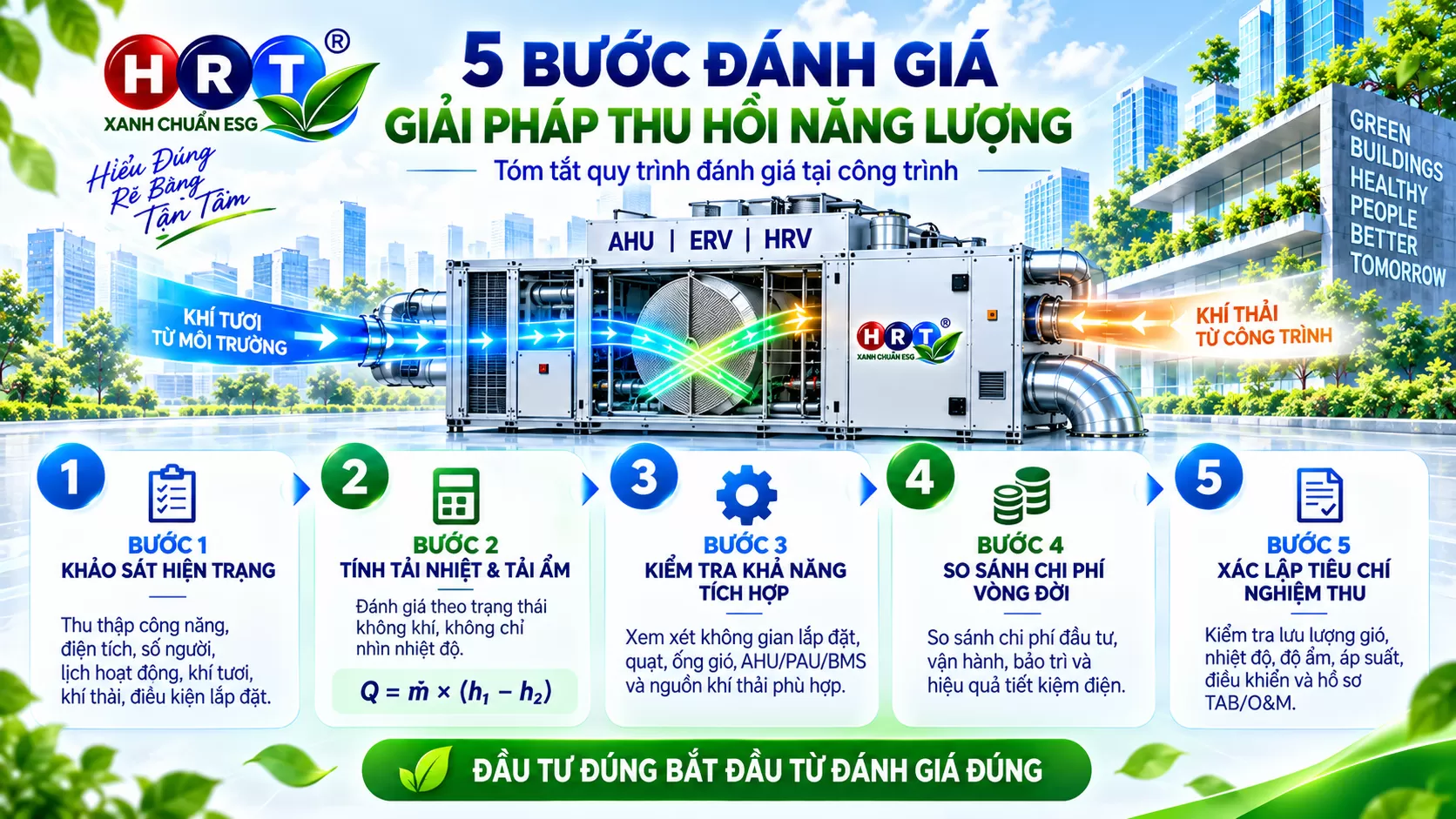
Step 1: Survey the current status and identify objectives
Technical team need to collect:
-
Function and area of each area.
-
Number of users and activity schedule.
-
Flow rate outdoor air according to design requirements.
-
Flow rate and emission characteristics.
-
Temperature, humidity design in and out of the house.
-
Installation space, pipeline and existing power supply.
The survey results must clearly determine what works should be prioritized: air quality, reduced air conditioning load, saving electricity or improving operational conditions.
Step 2: Calculate thermal load and moisture load
Assessment of the energy recovery ventilation system must be based on the air state, not just on temperature.
With outdoor air handling systems, the total thermal load can be estimated by:
Q = ṁ × (h₁ − h₂)
Where:
-
Q: Total heat exchange capacity, kW.
-
ṁ: dry air mass flow rate, kg/s.
-
h1, h2: Enthalpy of air in two states, kJ/kg dry air.
The result should be calibrated according to the actual performance of the equipment and operation conditions.
Step 3: Integration Test
A device that recovers energy is only as valuable when it's compatible with the existing system.
Need clarification:
-
Is the equipment have enough space for installation and maintenance?
-
Does the fan system meet additional pressure loss?
-
Do I need to change the air duct route?
-
Is it possible to integrate with AHU, PAU or central control system?
-
Is the emission source suitable for energy recovery?
In particular, it is forbidden to arbitrarily use exhaust gases from areas prone to pollution, odor or hazardous substances for energy exchange without assessing and controlling the risk of cross - contamination.
Step 4: Compare life-cycle cost
Investing in HVAC should not be based solely on the price of the unit.
Need to consider:
-
Equipment and installation costs.
-
Cost of pipeline renovation, electricity and control.
-
Power is reduced at the air handling system.
-
Extra power of fan and auxiliary equipment.
-
Cost of filter replacement, cleaning, maintenance.
-
Equipment life and replacement cost.
Step 5: Establish acceptance testing criteria
Before construction, it is necessary to agree on the parameters to be measured and tested and the method of assessment.
A system with good acceptance testing not only needs to run stably but also must demonstrate that the flow rate, air state, pressure and control functions meet the design requirements.
4. Economical Efficiency: Don't Mistake Energy Recovery With Electricity Savings
A device with high energy recovery does not mean that the entire building will save electricity in proportion.
Example illustration
Suppose a building has:
-
Flow rate outdoor air: 5.000 m³/h.
-
Assumed air density: 1.2 kg/m3.
-
The enthalpy difference between outdoor wind and exhaust air: 20 kJ/kg dry air.
-
The hypothetical total recovery efficiency: 60%.
With the above simplified assumptions, the mass flow rate is approximately 1.67 kg/s.
Estimated Energy Recovery Capacity:
Q ≈ 1,67 × 20 × 60% = 20 kW.
The number 20 kW represents the heat recovered at the assumed condition, not the electricity saved.
To evaluate the actual effect, it is necessary to further calculate:
-
Number of hours of operation at each load condition.
-
Performance of refrigeration system.
-
The fan's extra power.
-
Losses through pipes and exchangers.
-
Bypass mode when energy recovery is not beneficial.
Evaluate Payback Time
Preliminary formulas can be used:
Payback period = Increased investment capital / Annual net saving.
In which, the net savings value must include the increased operation and maintenance costs.
HRT recommends comparing at least two options: conventional ventilation and energy recovery, on the same design basis.
5. Mistakes When Implementing Energy Recovery Ventilation System
Select device only according to the nominal flow rate
Two devices with the same flow rate are not likely to be equally effective.
It is necessary to check the fan working point, pressure loss, recovery performance, air leakage level and manufacturer's testing conditions.
Uncontrolled balanced flow rate of feed and discharge
Inappropriate flow rate can reduce recovery efficiency, cause unwanted differential pressure or affect air quality.
Ignore maintenance capability
Equipment installed in hard - to - reach locations increases the time and cost of cleaning, filter changes, fan inspections, and exchangers.
No control design according to actual condition
Energy recovery is not always beneficial.
When outdoor air conditions are favorable, the system may need to switch to bypass mode or adjust operation strategy to avoid unnecessary energy consumption.
Do not measure after installation
Without TAB (Testing, Adjusting and Balancing), it is difficult to determine whether the system meets the flow rate and design workpoint.
HRT's view: Good equipment is a necessary condition. The right design, the right construction and the right operation create practical efficiency.
6. Energy Recovery Solution In VRV/VRF And Chiller
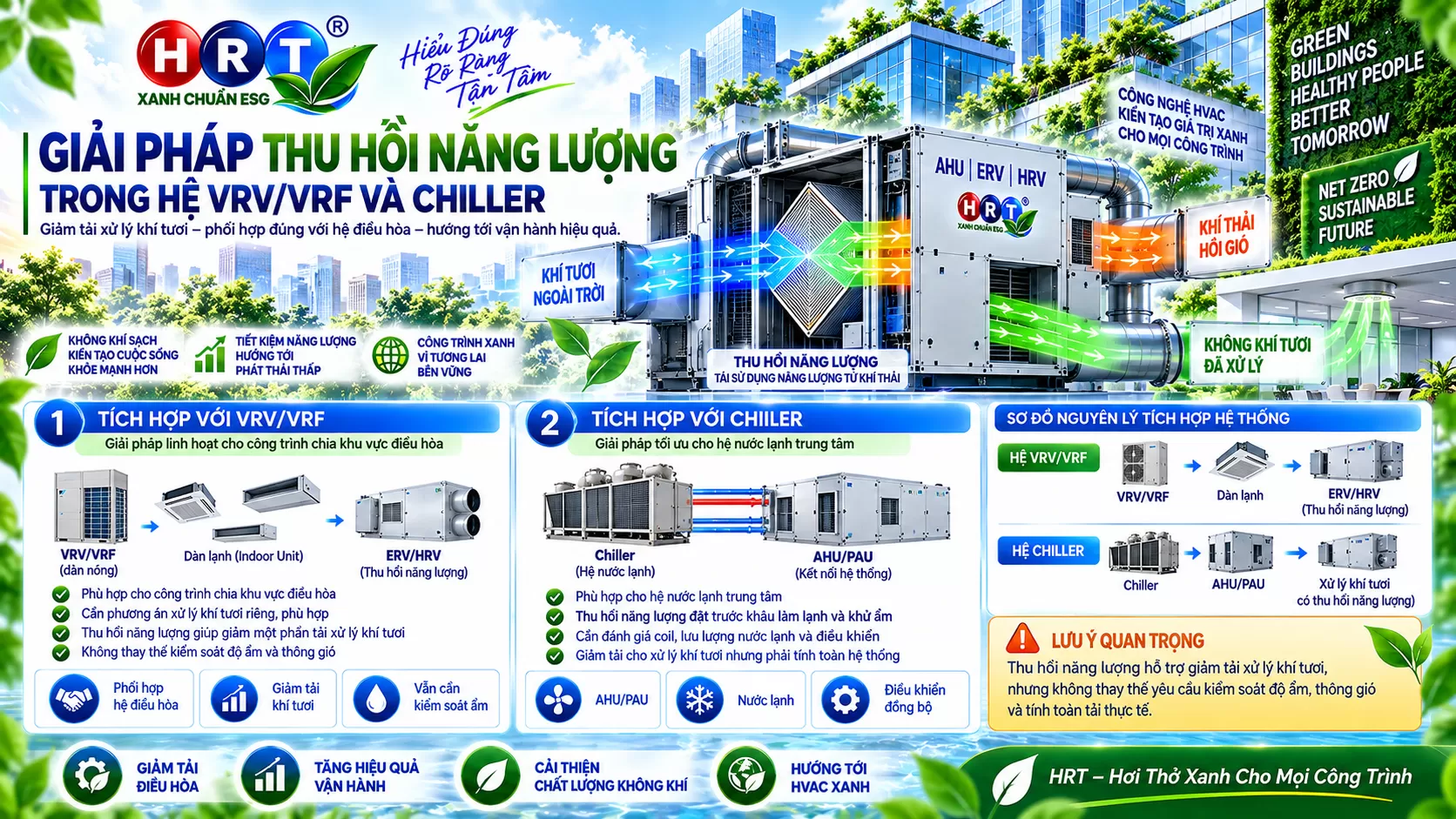
Integrated with VRV/VRF
VRV/VRF system mainly takes care of air conditioning in each area.
For the works with requirements for outdoor air supply, it is necessary to select an appropriate outdoor air treatment plan and check the ability to coordinate with the air conditioning system.
Energy recovery devices can help reduce outdoor air handling loads partially, but do not replace humidity control and ventilation requirements.
Integrate with Chiller – AHU – PAU
With chilled-water central system, energy recovery can be arranged at the outdoor air treatment system before cooling and dehumidification.
The solution should be evaluated along with coil capacity, cold water flow rate, control mode and air quality requirements.
The reduction of load at the coil does not automatically allow a reduction in Chiller capacity. The decision to choose capacity must still be based on simultaneous load calculation and the design conditions of the whole building.
7. Checklist acceptance testing Ventilation System Energy Recovery
Before handover, HRT recommends checking the following groups of items:
| Category: | Contents of the inspection |
|---|---|
| Flow rate | Measurement of feed rate, discharge and design reconciliation |
| Pressure rating | Test static pressure, pressure loss and fan working point |
| Humidity heat | Measuring temperature, humidity of air streams |
| Gas leakage | Check airtightness and cross-contamination risk |
| Controllers | Test sensors, interlock, bypass and alert |
| Hygiene and hygiene | Test filter, exchanger and accessibility |
| Profiles | As-built drawing, TAB, operation instruction, maintenance |
Specific acceptance testing values must be determined according to design documentation, applicable standards and technical data of the equipment.
8. CEO View Đoàn Văn Hoàng: Green HVAC Must Be Measured By Actual Efficiency

For over 20 years working in refrigeration and thermal engineering, I have always valued one principle:
A technical solution is only really valuable when it solves the customer's problem correctly and produces a verifiable result.
With energy recovery ventilation system, HRT focuses on three action orientations:
Understand Correctly: Understand the functions, outdoor air demands, thermal load humidity and operation conditions before choosing technology.
Clear: Transparent design scope, specifications, investment costs, expected efficiency and acceptance testing criteria.
Dedicated: Accompany from survey, design, construction to inspection, maintenance and operation optimization.
HRT does not aim to install the most equipment. We aim to have the system that best suits the actual needs and long-term goals of the project.
That's how HRT pursues orientation. ESG Standard GREEN HVAC: resource saving on the basis of technical, data and responsibility.
9. Conclusion: Ventilation Investment Energy Recovery Must Start From Survey
Energy recovery ventilation can help reduce outdoor air handling loads, improve operation efficiency and support the energy-saving goal for the building.
However, there is no one configuration that works for all projects.
Project owners should assess climate conditions, flow rate ventilation, thermal load humidity, emission sources, investment costs and operation strategies.
Correct survey – Correct calculation – Correct selection – Correct construction – Correct measurement.
It's the foundation to turn an energy-efficient HVAC solution into real value for business.
HRT Air Conditioning and Ventilation Company Limited
-
Specializing in consulting, designing, constructing and optimizing HVAC systems.
-
VRV/VRF, Chiller, AHU/FCU, PAU and ventilation solutions for energy recovery.
-
Website: https://hrt.com.vn
-
Email: CEO@hrt.vn
HRT – GREEN BATH FOR EVERY WORK
Đoàn Văn Hoàng – CEO HRT | Technology Engineer refrigeration and thermal engineering | Over 20 years of HVAC experience.
Source: Publisher’s English edition · Vietnamese original on doanvanhoang.com