
Energy Saving HVAC: Reduce operating electricity | HRT
Machine-translated from Vietnamese. Read the original in Vietnamese

CEO Đoàn Văn Hoàng – HRT sharing how to implement Energy Saving HVAC from reviewing operation schedules to verifying power saving results. Do not let the system run on a routine basis: each adjustment should be grounded, clear who is responsible and still meet the needs of the project.
Energy Saving HVAC: Don't let the system run out of habit
Imagine a situation: it is 21 o'clock, most of the staff leaves the office. Lights in many areas are turned off, the meeting room is empty, but some fans and air conditioning equipment continue to work.
When asked why, the operator replied: “This schedule is set from the previous overtime."
I won't be asking to shut down the entire device right away. First of all, it is necessary to determine which areas are still tasked with maintaining and which are just continuing an inappropriate installation.
That's the starting point I want to set for a project. Energy Saving HVAC.
Within the scope of this article, it can be understood Energy Saving HVAC is optimal energy use of heating, ventilation and air conditioning. One implementation approach is to find and correct inconsistencies in operations and controls, rather than having to replace the device by default. This is also the focus of the building operational correction methodology that the U.S. Department of Energy's FEMP program introduced.
From an HRT operator perspective, I want every single wattage used to be tied to a clear mission.
Who is the device serving, what conditions and why should it operate in the current mode?
If you aren't sure, do a follow - up survey before you decide to buy another solution.
Going to survey at a time when the work is small
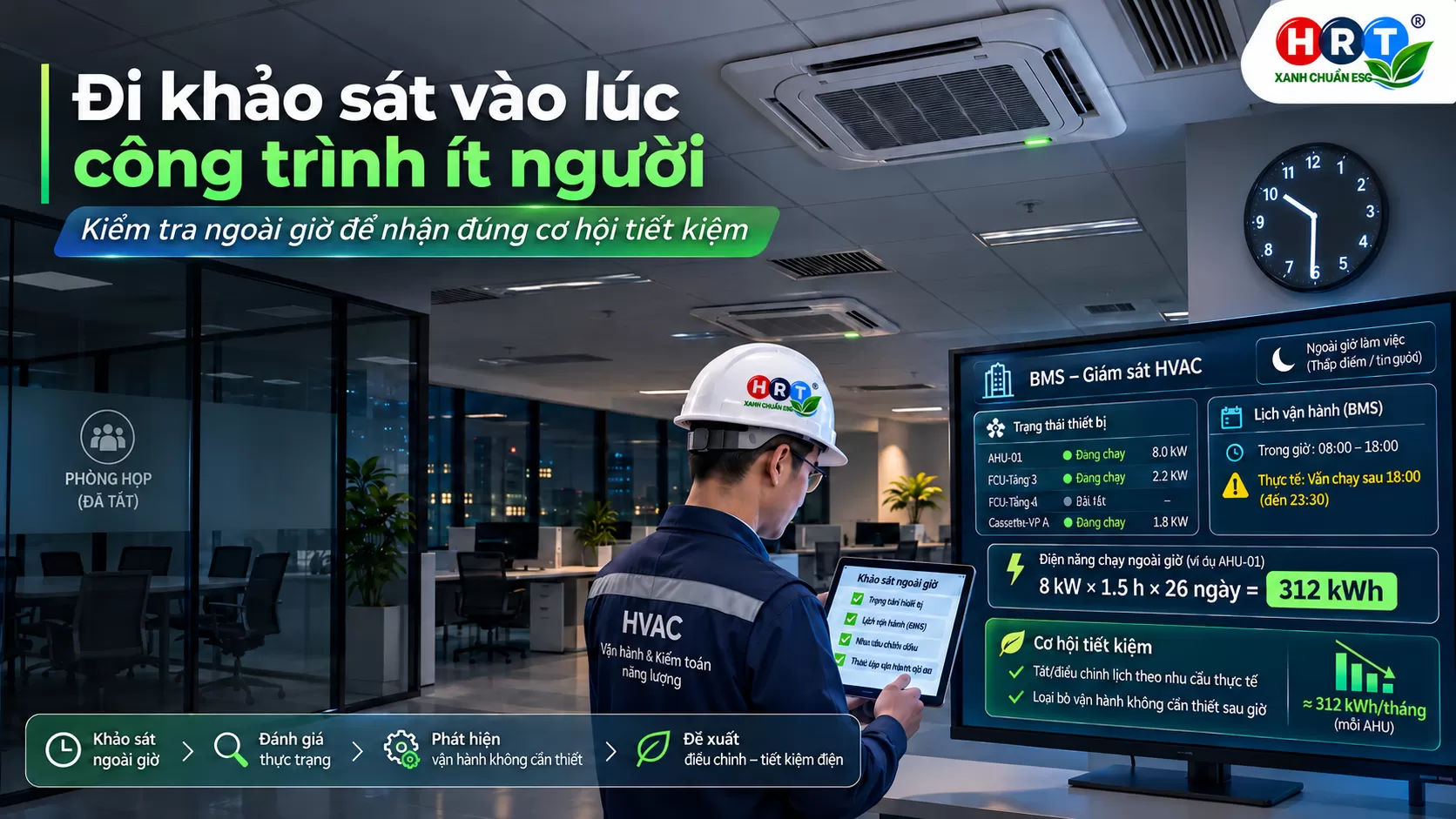
A survey during office hours shows how the system serves when the building works. I suggest adding time before opening hours, after working hours or when the building is only partially used.
ENERGY STAR recommends overtime testing to detect devices that are still running when they should not be. It also notes: good maintenance is not enough if the schedule and control strategy are still inappropriate.
In the survey, I want the engineer to accompany the operation representative and the person who knows the actual use history.
Maybe a room still needs constant cooling. Maybe an area still requires humidity control. Maybe the system is just running because no one has been assigned to update the calendar yet.
These cases should be distinguished before proposing adjustments.
Don't call all your overtime wasted.
I suggest the survey team write down the reasons for each group of devices still in operation.
If it is a technological requirement or storage condition, keep it within the scope of service. If it is just an expired overtime schedule, confirm with the user before making a change plan.
Assumed example, not HRT project data: a cluster of fans with an average measured electrical capacity of 8 kW, which continues to run for another 1.5 hours per day for 26 days. The power of that operation interval is:
8 kW × 1.5 hours × 26 days = 312 kWh.
This figure helps visualize the scale to be considered, not yet committed to savings. To record the decrease, it must confirm that the run can be eliminated and assess the associated effects, including the need for re-operation.
I want to report a verifiable opportunity not to turn simple multiplication into a conclusion for the whole system.
A good running schedule must bring the building to a ready state at the right time
After defining the unnecessary run, the next question is: when should the system start serving?
FEMP recommends adjusting the HVAC schedule to match the time of use and optimizing the boot mode, overtime operation. The goal is not only to reduce the number of hours of power on, but also to organize the schedule to meet the needs of the work.
At the project, I would like to confirm when each area should be eligible for use.
A meeting room with a private calendar does not necessarily entail the entire floor operating as usual. On the contrary, it should not be so shortened the preparation time that the user enters a space that has not met the requirements.
Replacement schedule must have someone confirm the need
I want every adjustment to be discussed with the operator, not just the system rep.
When meeting rooms have overtime events, it is necessary to know which areas are served, when the time ends and how to return to the regular schedule. When factory shifts, HVAC calendars must be reviewed with production requirements.
With VRV/VRF system, I suggest to compare the control group with the indoor units that actually serve the operating area. The change plan must be within the function and application instructions of the device, not using arbitrary power cut as a saving measure.
The operation schedule should reflect how the work is being used, not how it was used before.
When the building is crowded, reduce unnecessary load before reducing service level

During peak hours, the most common reaction is to lower the set temperature, speed up the fan, or call in more equipment when there is a hot reflection.
I want the tech team to check for causes before making those changes.
Part of the work can be outside the machine room. ENERGY STAR puts air leakage restriction, sun control through glass doors, air terminal ventilation, coil cleaning and damaged thermal insulation repair into the group of measures to improve operation efficiency.
That's why I proposed to survey the whole use of space.
Is the air conditioning area door frequently open? Does the interior cover the airflow? Has a recent site change been reviewed by the HVAC team? These questions should be answered with the status quo, not just with data in the control room.
Maintenance must address the part that is affecting operation
I don't want to report maintenance only at the sentence “cleaned the machine”
If work is done to treat insufficient airflow, appropriate post-cleaning inspection results should be obtained. If thermal insulation is corrected, correction of the damaged part and extent of repair should be confirmed. If a branch is re-calibrated, location and conditions for performance should be specified.
From a management perspective, I suggest that each job has a specific enough objective to evaluate.
When the results are not satisfactory, it is necessary to determine which part of the test should be further examined. Do not continue to increase the operation mode only to compensate for an unclear abnormality.
The load has decreased, why is the pump and fan still running the same?
By late afternoon, some areas may have reduced demand. This is the time I want to see how the system reacts.
With the right systems, adjusting the wind pressure according to demand is an optimal direction for fans. The PNNL's guidance suggests considering cases where the pressure parameters remain unchanged for a long time despite the load conditions have changed.
However, from the realization that “speed can be reduced” to a deployment plan still needs many grounds.
Variable-frequency drive needs a control task, not just an installation location
When receiving the additional variable-frequency drive proposal, I asked the compiler to explain which signals would control speed and which results showed the system was still responsive.
If the pump speed reducer, what devices depend on that flow rate? If the fan deceleration, where is the adverse area tested? When the control signal is not reliable, what state does the system go to?
For chillers, ASHRAE requires that the control strategy must take into account the minimum flow rate limit, temperature and permissible speed change. Therefore, it is not possible to reduce the pump speed only and then evaluate success by the power of the motor.
I want the protection and operation conditions to be clearly kept in the plan. The testing must be done by qualified personnel according to the applicable instructions.
Installation parameters must be evaluated at the system level
Increased chilled-water supply temperatures can reduce Chiller power, but in variable flow rate systems, the demand for water through coil and pump power can increase. The ability to control humidity also limits adjustment levels. Therefore, efficiency must be assessed on impacted equipment, not just at Chiller machines.
From this point on, I'm asking for a well - defined test cycle.
Know which parameters are changed, which devices to monitor and what conditions are forced to return to previous mode. If the results are only good at one load level, the report should be written with that limit in mind.
The power drop on one device is data for analysis, not conclusions for the whole station.
Outdoor Air still has mission in power saving project

When reviewing cooling loads, I disagree with the default that reducing external wind volume is the easiest way to save.
In HVAC commissioning guidelines, the U.S. Department of Energy requires checking running schedules, setting parameters, damper functions and ventilation supply capabilities. The power portion and space servicing portion should be considered together.
For specific construction, I suggest re-confirming ventilation needs by each area before adjusting.
If the air supply is inappropriate, find the cause. If the demand changes from time to time, there should be control plans and corresponding testing methods. Do not use a common reduction rate for every room.
Energy recovery should be assessed by real benefit
Energy recovery equipment can exchange heat and, depending on the type, moisture exchange between the exhaust gas flow and the outer gas flow. However, when evaluating must take into account pressure drop, fan power, cross-leakage capacity and maintenance work of the selected configuration.
So I want the proposal to clarify from which source the system is recovering, which winds it serves and what conditions the solution should be effective.
The energy reduced at the wind treatment stage should be placed next to the electricity and operation work generated. A recovery rate on the catalog that has not been replaced is assessed for the project.
If you don't have enough data, add surveys before committing.
A right handed command has an end time
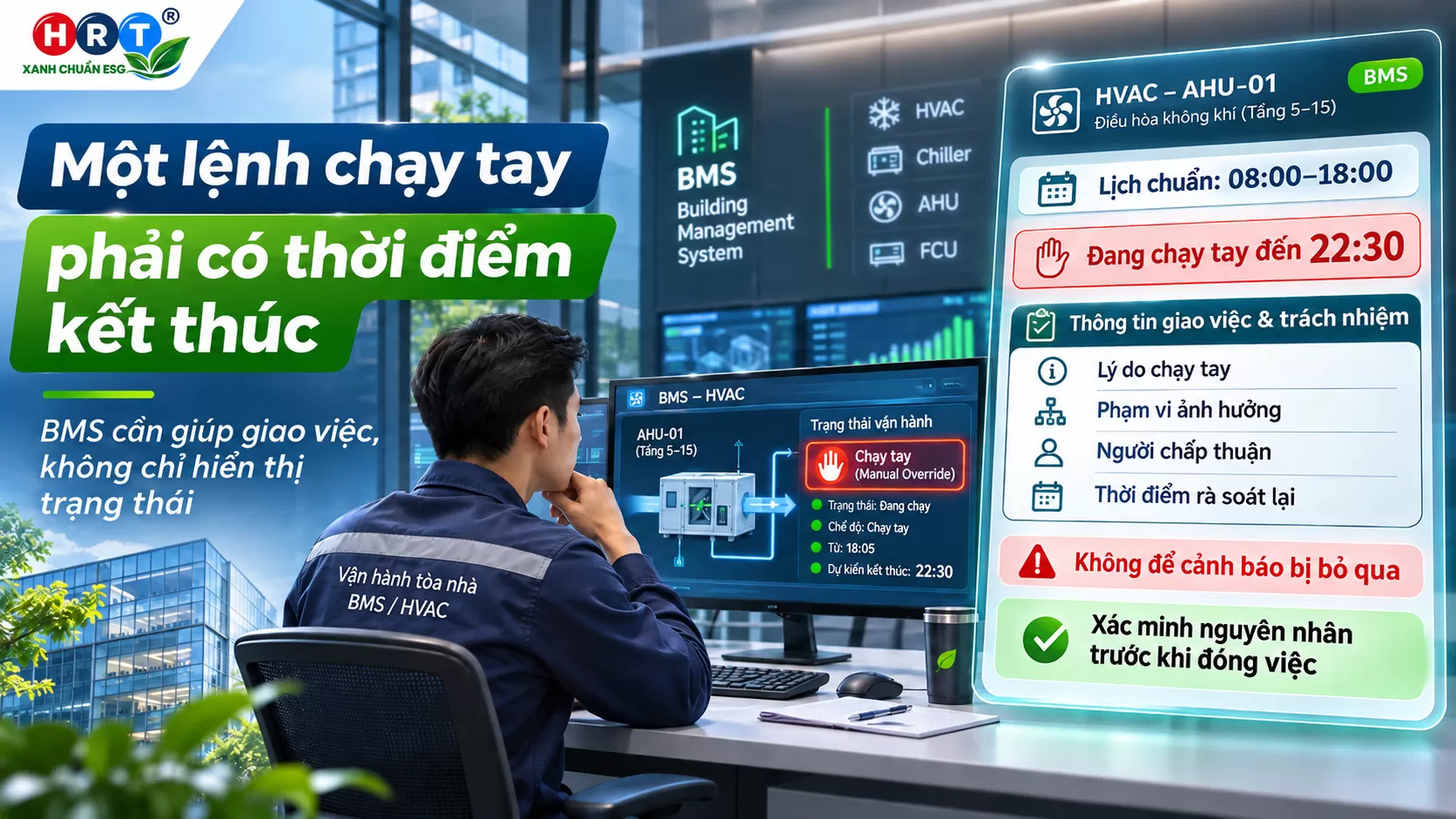
In the opening situation, the system continues to run not because of a lack of control. It is retaining an expired request.
This is the management responsibility part I want to clarify when implementing HVAC Power Saving.
ENERGY STAR recommends recording changes in settings, sensor location and control strategies. If the information is only in the memory of a few people, maintaining operation mode will be groundless when personnel change.
I suggest that each operation exception has a reason, scope of influence, approver and when to review.
For example, running extra to serve an event must accompany the responsibility of restoring the calendar. Switching to manual control for troubleshooting must be monitored until eligibility returns to normal mode.
BMS needs help with task assignments, not just status displays
In the plan I'm asking, data from the BMS building management system must lead to specific action.
If a device runs off-schedule, who checks? If control commands do not match the actual state, who verifies? If the reflected user is not qualified, what data should be collated?
I don't want a warning to be ignored just because it's been shown many times.
Also, do not want the work header to be closed as soon as the icon on the screen returns to normal. The person in charge should confirm that the cause has been dealt with or is only temporarily no longer present.
Automation is only valid in my case when the responsibility for processing remains clear.
When is the new investment really needed?
After understanding the schedule, technical condition and how to coordinate equipment, I wanted the project team to present a large renovation need.
This doesn't mean every project should keep the same system. I want to avoid both extremes: changing too soon when the problem is unknown, or continuing repairs when the current plan no longer meets the task.
ENERGY STAR recommends prioritizing cost-effective improvements and workload reduction first, as the demand after improvement will support the selection of a more suitable HVAC scale for the next investment.
Please put the options on the same request service
By comparison, I would recommend a fix to the existing system and an upgrade, if both are feasible.
Each plan must clarify the conditions to meet, the relevant work, the time of stopping and the responsibility for operation after deployment. The cost should not be just in the purchase price of the machine.
If the new plan has additional requirements on electricity, control, pipeline or maintenance, those contents must be expressed immediately within the scope.
I don't choose the option just because there is a higher forecast savings. I want to know what conditions the forecast is based on and whether the building can maintain those conditions.
The investment worth making must address the identified limitation, not just replacing an old device with a new one.
Confirm the electricity saving and hand over the result holder
Before making any changes, I ask that the data be consistent for comparison.
If measuring a cluster of devices separately, the conclusion must be limited to that range. If the whole building is used, changes related to weather, number of people, load and mining should be considered. FEMP's measurement and verification guidelines distinguish equipment, system and building level assessment options; the way to choose depends on the solution characteristics.
I want the report to show the portion of power reduced and the portion converted into costs separately. The measured data should also be distinguished from the forecast results for the next time.
Don't take a short test drive, under favorable conditions, to commit immediately to the savings for the whole year.
Acceptance testing is done, we still have to know who's watching.
When handing over changes, the operation team needs to receive a new schedule, new parameters, reasons for adjustments and applicable conditions.
If the work changes functions or resumes overtime, who is entitled to correct the schedule? When temperature or humidity reflections appear, who evaluates the return to the previous mode?
I suggest we include those answers in the operational document, along with the person responsible for monitoring.
In the periodic report, do not send only one power chart. Point out the abnormality, the section that has been checked and the decision to be made. If there is not enough grounds, specify the missing data.
For me, keeping the results after improvement is part of the job, not the extra work that comes after acceptance testing.
CEO's view Đoàn Văn Hoàng: Electricity saving must become the operation way
I don't want Energy Saving HVAC to be just a survey that ends with a recommendation report.
I want the manager to know which area to serve. The operator understands why the device is running in the current mode. The engineering team has data to explain the abnormality. The approver sees the ground before deciding to invest.
An old calendar needs to be updated. A hand - run command needs to be monitored. A parameter that has not proven effective needs to be re - tested. An investment that is unclear on task needs to be clarified.
That's how I define the spirit. True – Clear – Dedicated.
I do not require the system to use at least electricity at all costs. I require the system to be electric to properly perform the work required.
When tasks change, operation must be reconsidered. When solutions are implemented, results must be checked. When handed over, there must be someone to continue management.
Do not let the system run out of habit. Let each operation mode have its reasons, each change have its responsible person and each result have its basis.
Exchange Energy Saving HVAC with HRT
To begin surveying, project owners should prepare site history, existing power data, equipment catalogs and specific operational reflections.
If you have BMS, add a running schedule, time-based data and recent setting changes. For projects without adequate data, agree on the part that needs additional measurements before setting a saving goal.
Contact HRT: 0909 326 888. HRT
CEO Đoàn Văn Hoàng | HRT
Right from the beginning – Clear to the end – Sustainable Green.
Source: Publisher’s English edition · Vietnamese original on doanvanhoang.com