
Error E1-1 Daikin VRV: What needs to be clarified before replacing the board?
Machine-translated from Vietnamese. Read the original in Vietnamese

CEO Đoàn Văn Hoàng – HRT sharing how to control and handle E1-1 Daikin VRV errors, verifying causes, clarifying the grounds for replacing outdoor-unit control boards and verifying post-repair results.
E1-1 Daikin VRV error: What should be clarified before replacing outdoor-unit control board?
When receiving the report E1-1 Daikin VRV error with a proposal to replace the outdoor-unit control board, what I need first is not the delivery time of components. I need to know what the technical team has identified and what grounds lead to that proposal.
As the operator, I must balance the operational restoration requirements, repair costs and the responsibilities of the implementing unit. In order to make a decision, the technical report must explain why intervention is needed, where interventions are needed and how the results are checked.
I do not advocate delaying replacement when the device has been confirmed damaged. But I also do not approve of ordering components from just one line of error code.
The decision to replace the board should start with the diagnosis, not with the availability of the components.
Understand E1-1 error codes in the correct device range
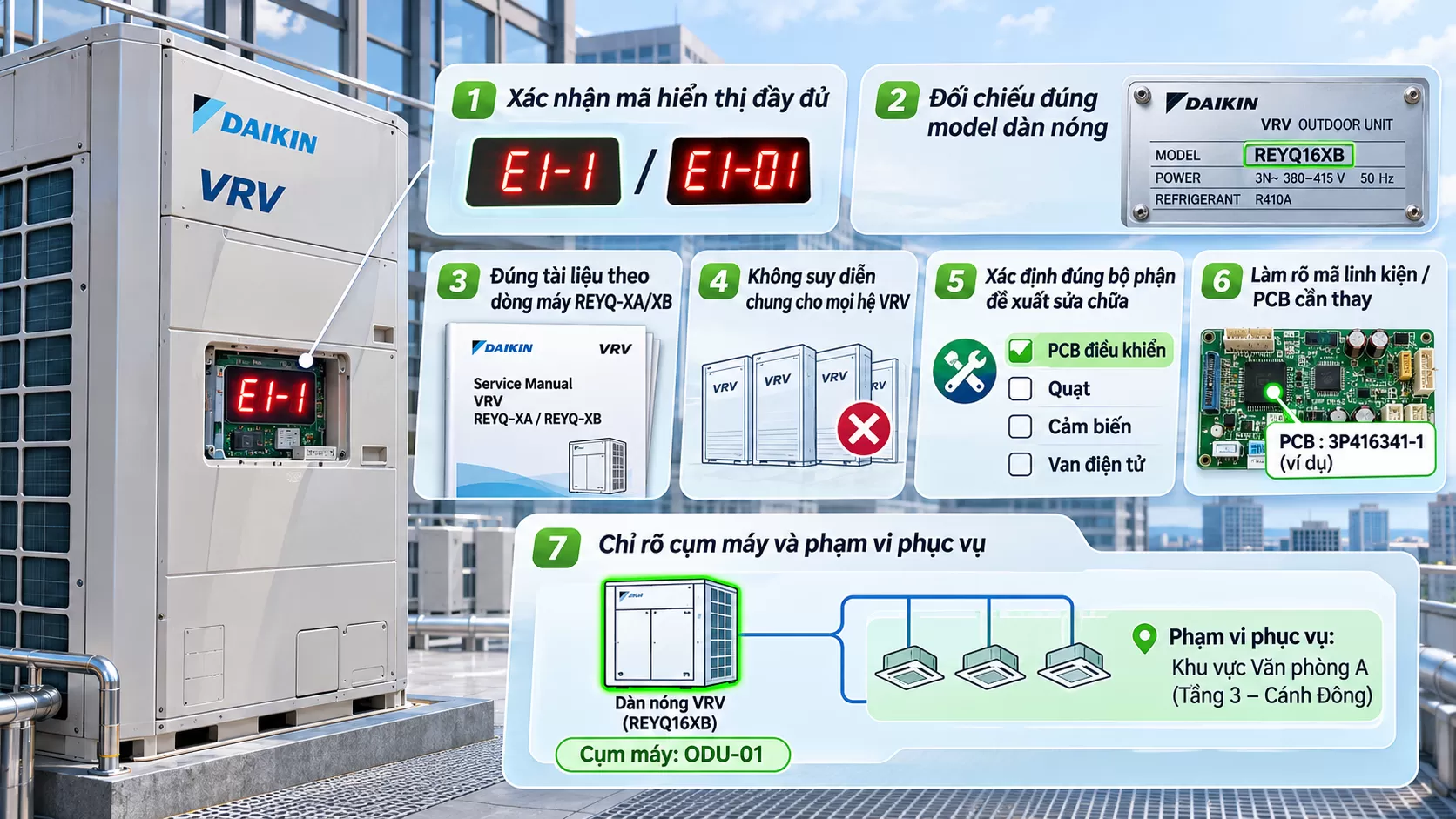
Keep the information displayed intact before interpreting the cause
In Daikin Vietnam's search panel, E1 is described as an outdoor unit PCB fault. The company also states the possibility of a faulty connection, loose or misconnected wiring. Therefore, this information guides the examination of both control board and related connections, not just the PCB itself.
When further collating Daikin service documentation for REYQ-XA/XB series, the detail code is written as E1-01, with the outdoor unit PCB fault description and diagnostic requirements according to flowchart E1. This is how it should be documented in that model's documentation; it is not recommended to manually convert every E1-1 message into the same conclusion for all VRV systems.
With the information reported as E1-1, I suggest that the person in charge confirm the full display code, outdoor unit model and the document being used for comparison.
A clear screenshot with the device label will help the conversation go to the right focus than the message “machine is faulty bo” If the building has many outdoor units, it is necessary to specify which ones are being tested and which areas are within the service scope of that cluster.
Call the correct part being proposed for repair
In the browser profile, I want the component name to be specifically specified.
The phrase “Daikin replacement kit” does not indicate which parts will be replaced, which component codes are proposed and the basis for confirmation of compatibility with existing equipment.
The technical manager should clarify this information before transferring the request to the purchasing department. Once the scope is determined, the sourcing and quotation comparison will be a basis for agreement.
The reviewer does not need to read the entire service document on behalf of the engineer, but must know the proposal is being applied to the correct device.
Actions before error should be retained
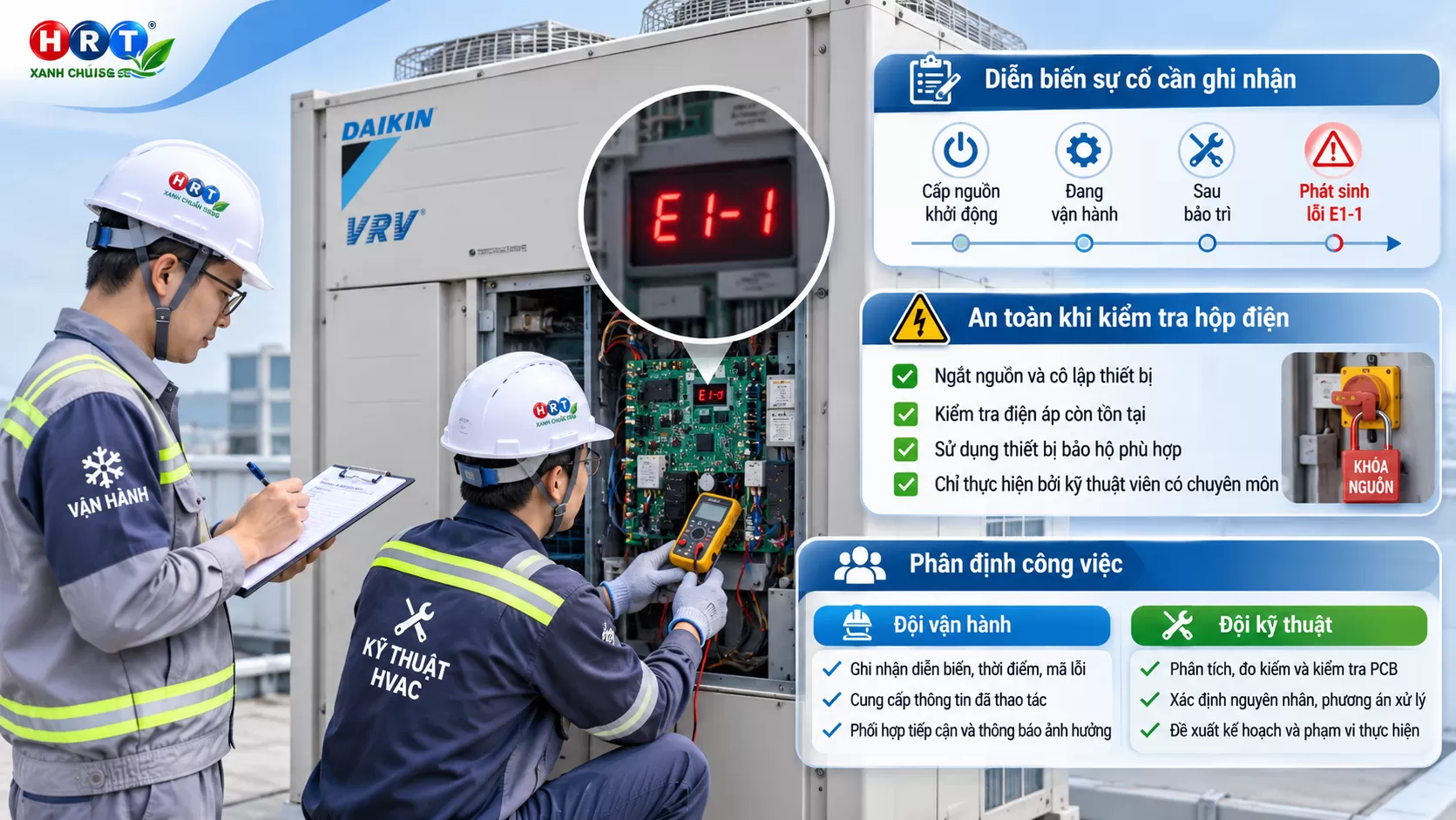
Do not let the incident record begin with the sentence “resetting machine”
When receiving the incident, I suggested that the operation team record the time of occurrence and system status prior to intervention.
I need to know if the error occurred when powering, while using or after a maintenance job. The code that came with, the previous stop and the content was manipulated should also be transferred to the engineer in charge.
This is a request for how information is organized. I don't want one person to have to make a diagnosis while another has changed the status quo but hasn't documented the work yet.
Illustration situation: The system appears to be warning after the maintenance team has finished working on the power box. This information is not enough to conclude the maintenance team caused the problem. However, I will ask to clarify the scope of their manipulation and pass that data to the tester.
The report should distinguish what happened from the statement being made. A remarkable development should not automatically become a conclusion about the cause.
Define what the operator is doing and what the technician needs
The inside of the electrical box must be inspected under safe conditions. Daikin documentation warns of the risk of electric shock, requires power disconnection and checks for voltage residue before interfering with the electrical part. Users should not manually remove or repair equipment without professional assistance.
From an executive perspective, I require that the processing plan specify the person in charge, the scope of isolation and the conditions for initiation of work.
Operations department is responsible for providing information, coordinating access to equipment and informing affecting the area of use. The work of testing, unconnecting or assessing PCB must be assigned to appropriate personnel.
Do not turn regulator restore pressure into a rush to check inside an unconfirmed system.
Bo failure conclusion must explain the tested part
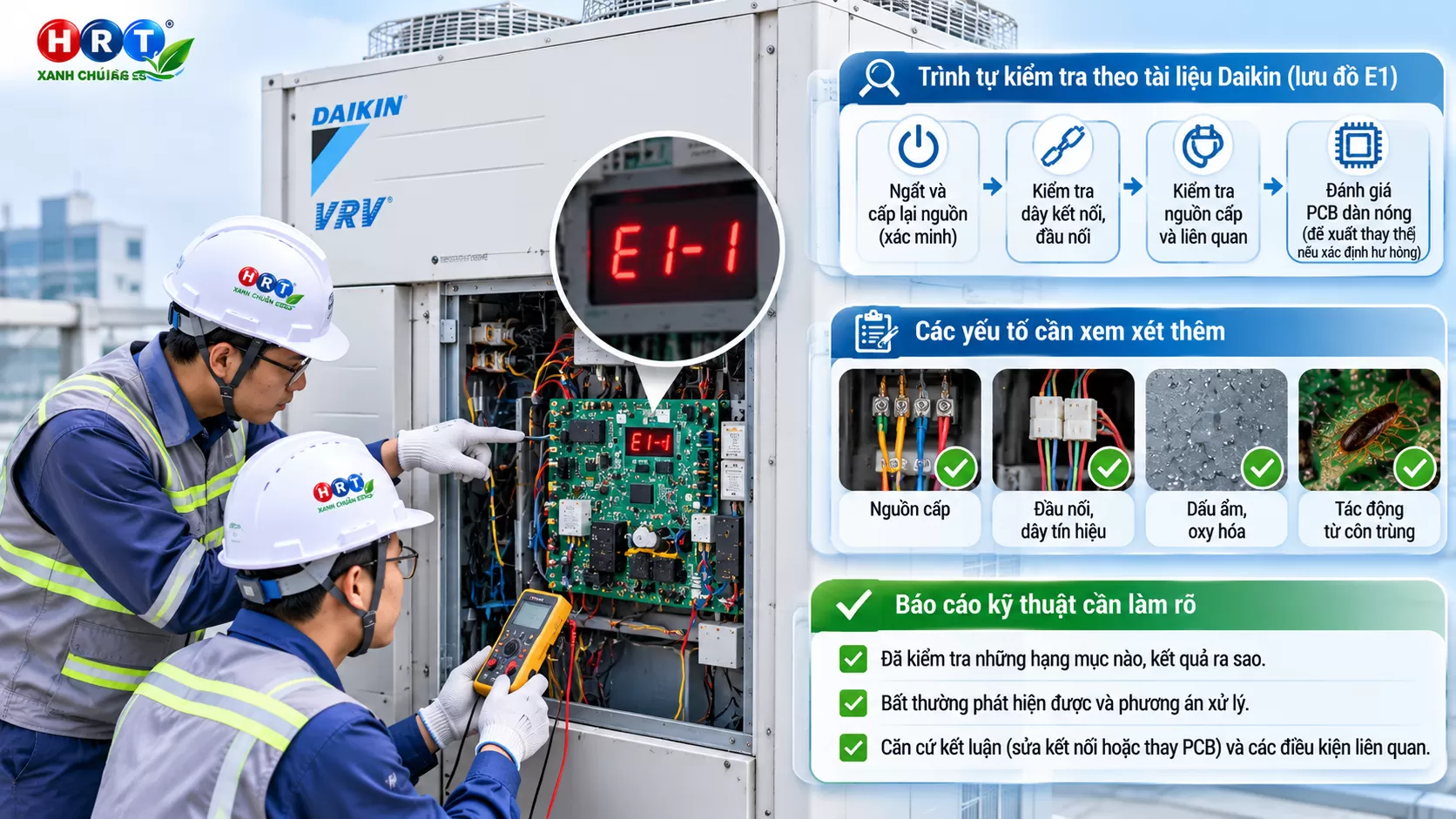
Distinguish abnormalities in connection with damage of PCB
In the RXTQ-TAVJU series service documentation, Daikin's E1 flowchart has a branch that checks wires and processes connections before going to the main control board replacement branch. The documentation also considers power interruption and resupply as a verification step in the diagnostic process.
From there, the question I ask when viewing the proposal is: what tests did the engineering team perform according to the model's documentation at work, and how did the results of each part lead to a conclusion?
I don't ask the person in charge to write a long report on every electronic component. I need them to specify the relevant test, the abnormalities detected, and the reasons for choosing a treatment option.
If a connection is found unsatisfactory, note the location and work to fix it. If the test result leads to a requirement for PCB replacement, indicate that ground in the record.
Where insufficient data should be properly recorded is continuing the diagnosis. It is not recommended to turn a doubt into a firm conclusion only to issue a quote.
Considering Conditions That May Affect Replacement Boron
The HRT manual notes the inspection of power supply, connectors and environmental impacts such as moisture, oxidation or insects. When damaged boards are detected, related factors should also be considered instead of just replacing components and then finishing the job.
In this report, I propose to separate the observed state and the cause that has been confirmed.
For example, the image of a damp mark in an electrical box is a data to be processed. However, to conclude that the damp mark caused a problem, the engineer must explain the connection by appropriate test results.
If the source or installation location conditions need to be corrected, the plan must clearly assign the party responsible. It should not be left out of quotation, unplanned and ultimately unimplemented.
Replacing the correct components is not enough to close the problem if the relevant conditions are not clear.
Approval for replacement of borrower is approval for a complete plan
Close the technical range before price comparison
When there are enough grounds to replace the outdoor-unit control board Daikin VRV, I would like to propose to show the entire work to be done.
Quotations should be attached to specific equipment, confirmed component codes, installation scope and post-replacement inspection. Contents on the origin, condition of components, warranty and handling responsibilities that arise should also be agreed before ordering.
I don't default to the lowest price or fastest delivery. I need to understand what each option includes and what conditions have not been confirmed.
A proposal with available components but not yet clarified the suitability is not enough for approval. On the contrary, when the plan has been fully confirmed, the operator needs to close resources and schedule the implementation so that the work does not continue to wait because of internal procedures.
Do not separate the replacement of components from installation requirements
When comparing additional technical instructions, the Daikin REYQ-XA/XB document contains the content of checking the PCB suitability and installation at the site after replacing the main control board. Specific requirements must be determined according to the machine model and components used, not applying a common installation for all VRV systems.
So in the approval plan, I suggested that the engineer clarify what to do after installing the board.
If installation or configuration confirmation is required, that part of the job must be taken care of by the person responsible and recorded in the records. The purchasing department should not have to decide on its own what contents are subject to this professional responsibility.
I also want the system downtime to be communicated with the user. The alternative schedule should include the test schedule and when the results will be updated, rather than just the time the technician is available.
The approved cost must be associated with the result to be handed over, not just with a component delivered to the work.
E1-1 error correction results should be confirmed after the intervention
Unify how to check before starting repairs
As soon as the plan is approved, I request the technical team to determine how to conduct post-implementation assessment.
The contents of the modified or replaced part must be correspondingly examined. The person in charge shall select a process suitable to the model, configuration and scope of intervention and clearly state the conditions for implementation.
I don't set a fixed commissioning time for all cases. I want the engineer to explain why the test conditions are chosen in accordance with the problem being handled.
In the report of results, specify which modes the system has been operating in, which areas are involved and the status recorded within that scope. If there is still content that cannot be verified, it must state how to continue monitoring.
A line “changed board, running machine” has not fully answered these questions.
Do not use run-out of error code to replace the entire conclusion
In Daikin's E1 diagnostic flowchart, the case that the system returns to normal after power is re-supplied can be considered in terms of external impact or interference. So, the return of the machine does not in itself prove that the PCB was previously damaged or needs to be replaced.
On the approval side, I'd like to conclude by sticking to the work and data that we have.
If the new technical team confirms that the system is operating under current inspection conditions, write this as such. If damage has been identified, replacement and complete inspection are agreed upon, the record should show sufficient grounds for such conclusion.
Clearly labeling my experience helps me decide what to take without having to guess what a phrase like “it's okay" or “I think it's okay" means.
Hand over information so next operation does not have to start again
After troubleshooting, I suggest the records be saved by system and device code.
The takeover officer should be able to find information about the initial condition, inspection results, work performed and components replaced when any problem arises. Adjusted settings must also be recorded on the same basis as applied.
I want to test the quality of my application in a simple situation: will another engineer who receives the system next month understand this processing?
If they still have to call each other back and ask what they changed, what they modified, and how far they checked, the handover is missing.
For content that needs further monitoring, assign a clue to receive feedback from the operator. The time of re-evaluation and responsibility for confirming completion must be agreed, not to survive into work without followers.
I also recommend using incident results to review maintenance plans. Items that have been found unusual should be put under appropriate scrutiny; unconfirmed hypotheses should continue to be documented with due certainty.
CEO view Đoàn Văn Hoàng: Browse fix by base, follow up to results
With... E1-1 Daikin VRV error, the operator's responsibility is not to replace the engineer to decide which control board is broken. It is the operator's duty to request sufficient information to approve the right thing and organize implementation until results are available.
I asked the technical team to report the confirmed part and the remaining parts to be checked. The purchasing department deployed only on clarified component requests. The operation team received the system with information about the verified scope and what to follow up.
When it is necessary to replace the board, do so on the basis of diagnosis. When there are relevant conditions that need to be corrected, hand them over to the handler. When reporting completion, indicate the results as a basis.
That's how I get my spirits up. True – Clear – Dedicated into HVAC repair decisions.
For works in trouble, the requirements should be set before approving the quotation are: “Please tell me why this board is replaced, what conditions must be handled and what results will be handed over."
Đoàn Văn Hoàng | CEO HRT
Right from the beginning – Clear to the end – Sustainable Green.
HRT – Green Breath for All Buildings
Source: Publisher’s English edition · Vietnamese original on doanvanhoang.com