
Daikin VRV fault codes E5-1, E5-2 and E5-3: five troubleshooting decisions
Machine-translated from Vietnamese. Read the original in Vietnamese
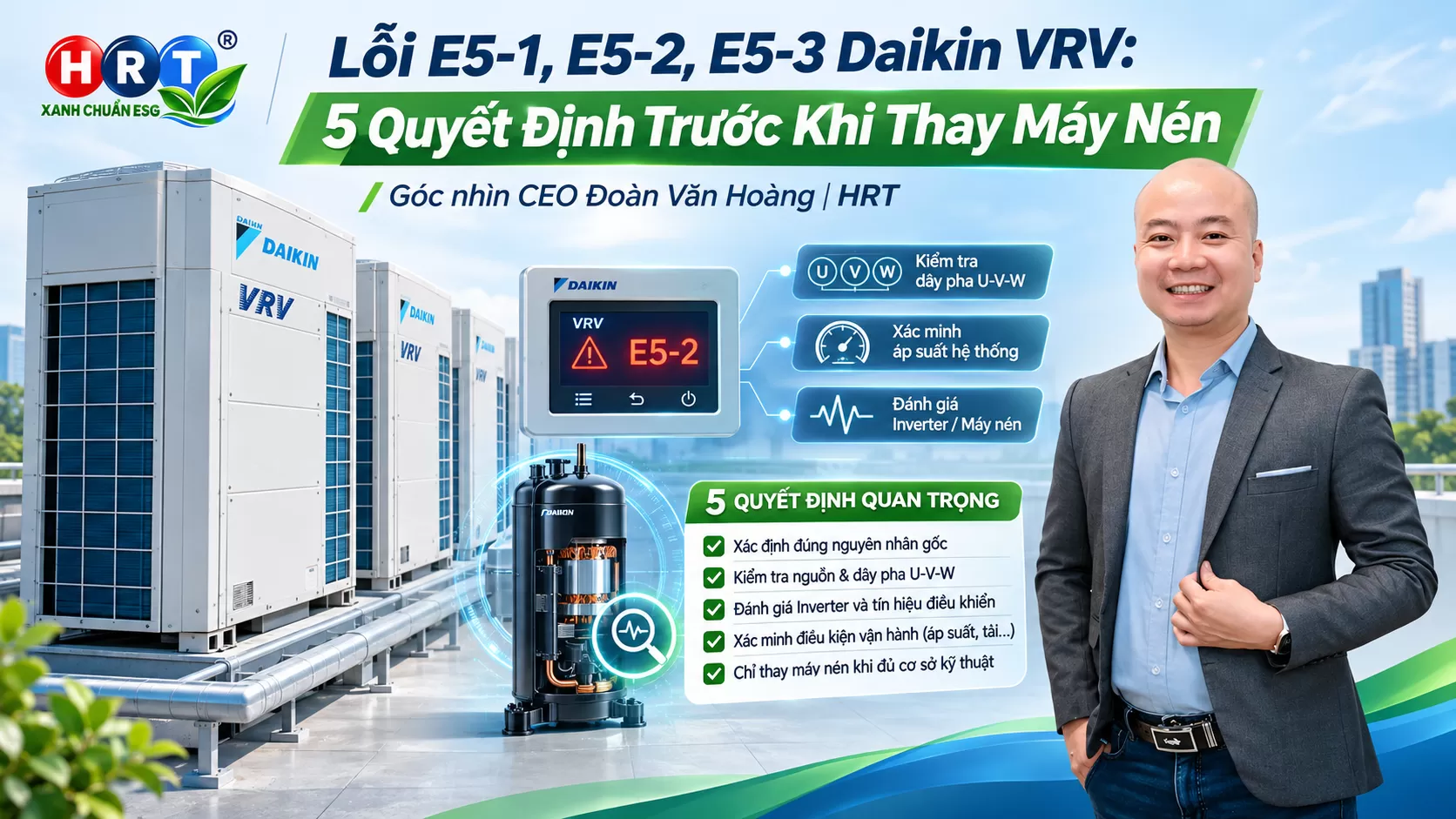
Error E5-1, E5-2, E5-3 Daikin VRV is the compressor broken? CEO Đoàn Văn Hoàng – HRT share 5 decisions that help diagnose correctly, handle safely and avoid changing wrong parts.
E5-1, E5-2, E5-3 Daikin VRV Errors: 5 Decisions Before Replacing Compressor
A Daikin VRV central air conditioning system serving the building suddenly stopped working. The controller responded with E5-2. Operations personnel contacted the maintenance team and received an initial statement:
“compressors may be stuck, need to prepare alternatives"
From an HRT operator perspective, I do not accept approval instead compressor based solely on such information.
I'm asking the tech team to answer clearly:
-
What outdoor unit module does the error code appear in?
-
Abnormalities located in compressor, electrical circuit or refrigeration system operation conditions?
-
What test results have been available to prove that the components need to be replaced?
A decision to lack data can cost a business large amount of money, but the system continues to report errors after repair.
With code groups E5-1, E5-2 and E5-3 on some Daikin VRV series, the message is related to abnormal overload or compressor motor locking. However, the cause may stem from compressor, U-V-W electrical connection, Inverter board or pressure condition, stop valve of refrigeration system.
1. Understand the E5 code correctly before making a repair decision
On some Daikin VRV IV+ series, E5 codes have subcodes to identify abnormal outdoor unit modules recorded at compressor M1C.
|
Code Show |
Module to be tested |
Common meanings |
|---|---|---|
|
E5-1 / E5-01 |
Main – outdoor unit |
Abnormal locking or overload compressor M1C |
|
E5-2 / E5-02 |
Sub 1 – outdoor unit 1st sub |
Abnormal compressor M1C at Sub 1 module |
|
E5-3 / E5-03 |
Sub 2 – outdoor second sub unit |
Abnormal compressor M1C at Sub 2 module |
This decoding must be confirmed according to the technical documentation of the correct model, VRV generation and outdoor unit configuration. By default, all Daikin systems use the same convention.
Why can't the compressor restart?
In the Inverter system, the control board controls the power supply to the compressor motor via U, V, W lines and monitors the signal related to the rotating state.
When detecting abnormal current waveform or compressor fails to work under the starting condition required by the controller, the system can record E5 error.
Daikin's diagnostic documentation also indicates possibilities such as mechanically locked compressor, high differential pressure, incorrect U-V-W connection, faulty Inverter board or unopened stop valve
This leads to an important principle:
The error code helps determine the test direction, not automatically confirming which components are broken.
2. Decision 1: Stop at the right time, do not reset the error continuously
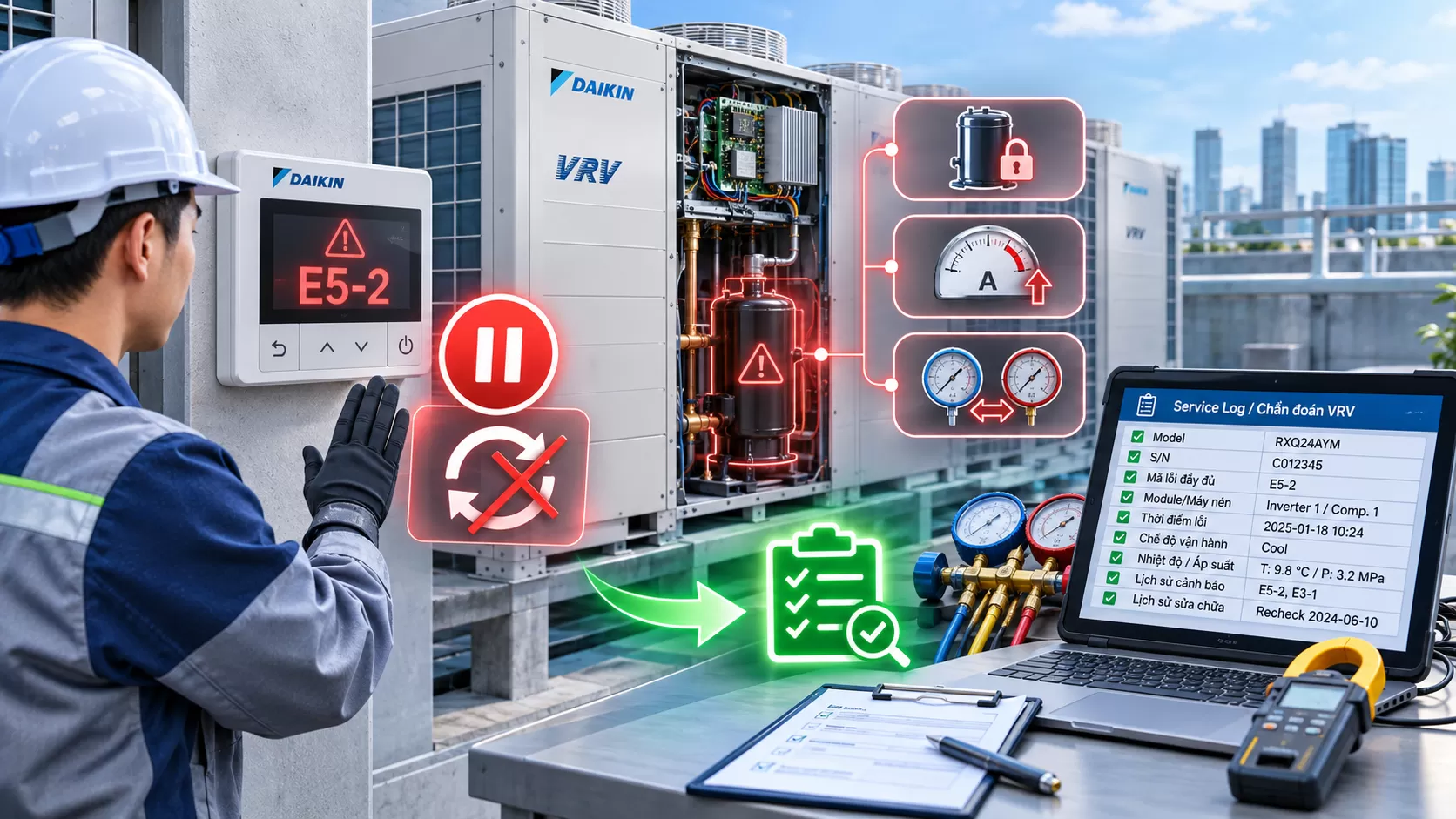
When E5 appears, the first response should not be to clear the error and then restart several times in the hopes of continuing the process.
If the cause is mechanical jams, abnormally high current or pressure differentials, attempting to start may increase the risk for compressor and Inverter power unit.
HRT requests status recording
Before intervening, the operation team needs to save:
-
Model and serial number of outdoor unit.
-
Full error code, including subcode.
-
The time of the incident.
-
Module and related compressor.
-
Cooling or heating mode is working.
-
Temperature, pressure data and accompanying warnings if available.
-
History of repairs and previous error occurrences.
In particular, it is necessary to distinguish a single error from a repeated error under the same operational conditions.
Decisions to Close
If the compressor fails to start and E5 code appears again, do not continue to try arbitrary boot.
Must switch from operation mode to controlled diagnostic mode.
Electricity measurements, capacity bo interventions and inspection of the fluid path must be carried out by competent technicians according to the safety process of the manufacturer.
3. Decision 2: Exclude the compressor external causes
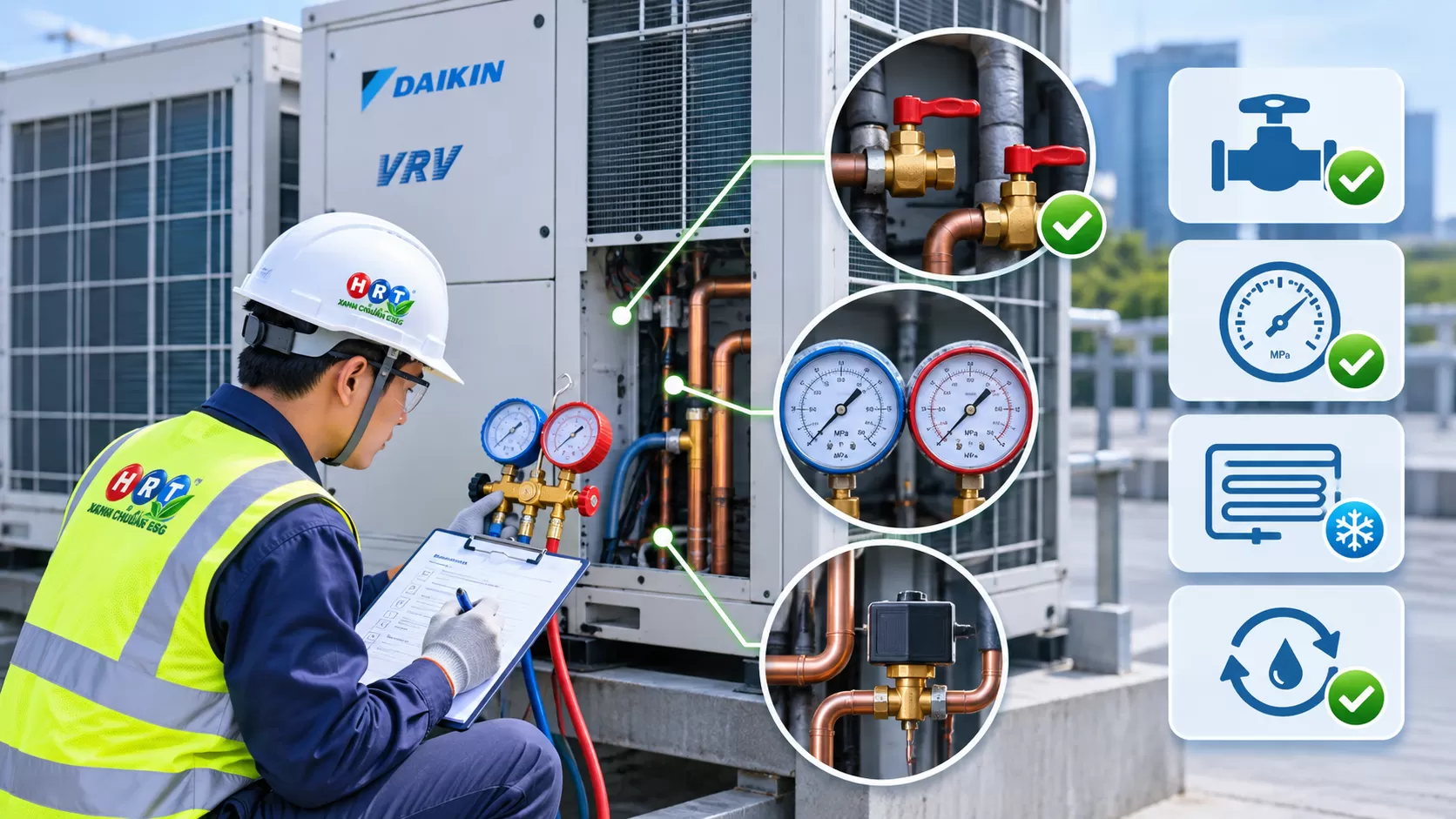
I always ask a question to the engineering team:
“Is there any evidence that the compressor is broken, or do we just know that the compresser cannot start?”
These two conclusions are completely different.
3.1. Check the status of the stop valve
The valve preventing the solvent from opening in the correct state may cause the operation condition to become abnormal.
The technical team must confirm the position of valves corresponding to the configuration and installation documents. Valve adjustment is only made when ensuring the safety conditions of the system.
3.2. Assessment of differential pressure
Compressor must start under suitable differential pressure condition.
If the difference is too large, the boot load may exceed the allowable.
In some Daikin VRV literature, high differential pressure from about 0.5 MPa is listed as a cause to be checked with E5 error. This is not a threshold that can be applied by default to every mo
The technician needs to assess factors related to fluid circulation, valve status, and operation history rather than just looking at an individual pressure value.
3.3. Inspection of conditions of the circuit
Depending on the configuration of the device, it is necessary to consider the possibilities:
-
Obstruction of the circulation of the substance.
-
Expansion valve or abnormal operation control valve.
-
The oil return condition is not suitable.
-
Refrigerant showing abnormal signs.
-
unbalanced pressure differential as required.
Do not add gas, discharge gas or change the system status without proper identification of the cause.
Decision objective 2: Eliminate system conditions that may cause compressor not to start normally.
4. Decision 3: Test Inverter circuit before conclude compressor failure
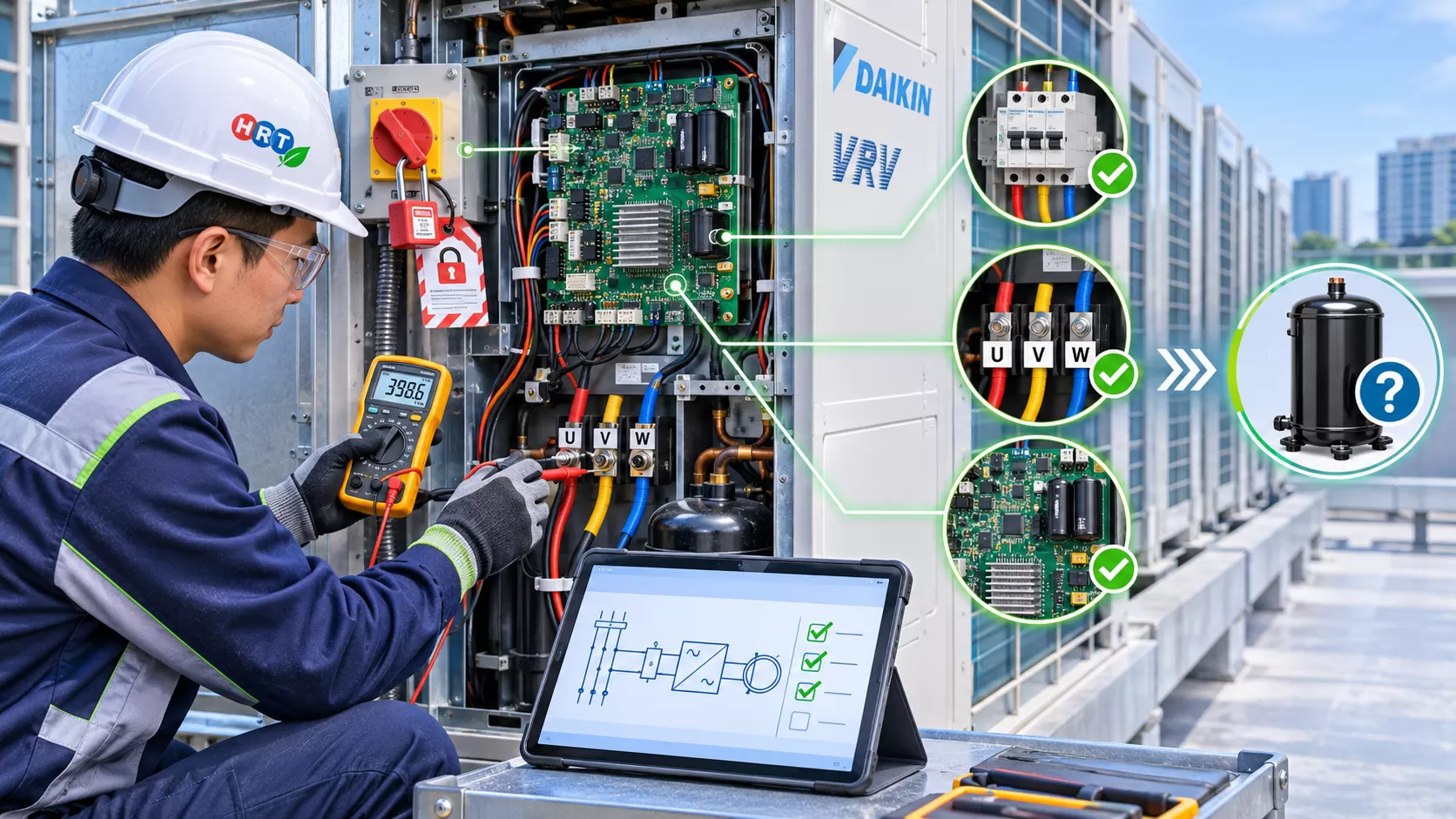
Inverter compressor depends on power board electrical control capability and integrity of connection lines.
Therefore, an inactive compressor is not enough to confirm the mechanical failure.
Three important test groups
Group 1 – Power Supply
The technician shall assess the power supply, status of protective equipment and relevant electrical warnings under the guidance of the correct model.
Group 2 – U-V-W Connection
Need to check the status:
-
Damaged or broken conductors.
-
Loose connector, poor contact.
-
Connection is off - chart.
-
Signs of superheat or insulation damage.
Group 3 – Inverter control board
Once external causes have been evaluated, continue to check the Inverter board according to the manufacturer's diagnostic procedure.
Daikin documentation requires that power is disconnected before connecting or removing the connector to avoid damage to components. For Inverter power circuits, power isolation procedures and electrical safety confirmation are also required before operation.
Processing principle
Do not reverse the U-V-W wire to test for errors.
Do not replace the Inverter just because the compressor does not start.
Do not check the insulation resistance on the circuit that is connecting to the board when the manufacturer's procedure does not allow it.
The right decision must be based on the test results and electrical diagram of the device, not on speculative experience.
5. Decision 4: When should I replace Daikin VRV compressor?
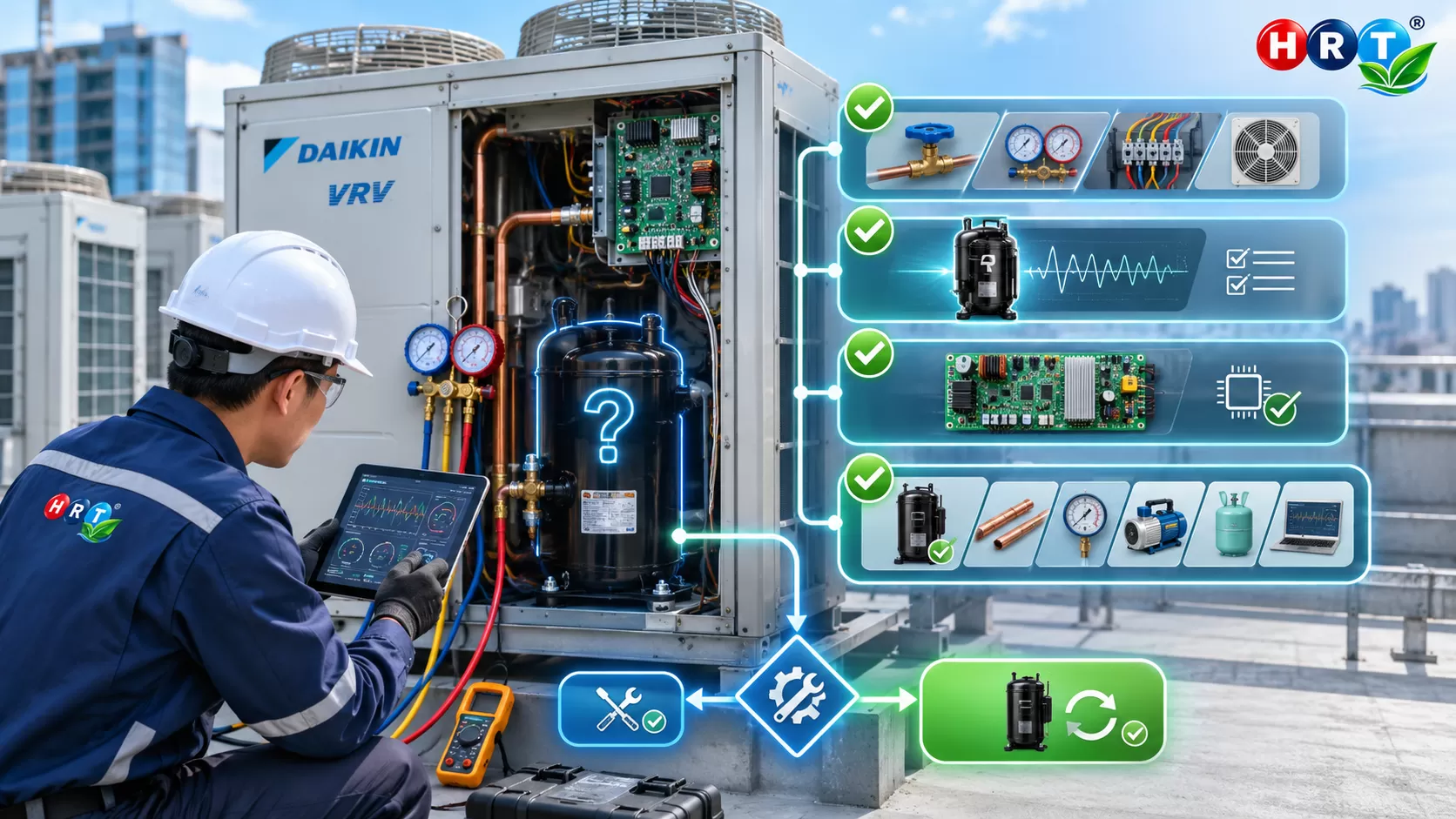
Compressor is often one of the component assemblies that have significant repair or replacement costs of VRV systems.
The decision to replace compressor not only affects the value of materials but also relates to system downtime, construction quality and operation risk after repair.
Four HRT conditions to clarify
Condition 1: Exclusion of external causes
Valve status, operation conditions, connection wires and related system factors were evaluated.
Condition 2: Have compressor diagnosis result
Technicians have performed appropriate tests according to Service Manual, sufficient grounds for determining electrical or mechanical damage.
Condition 3: Inverter board and control system reviewed
Do not mistake power board damage or connect to compressor failure.
Condition 4: Having plan to replace and restore the system
The plan must clarify the code of compatible components, construction conditions, cleaning the circuit of the liquid as needed, leak testing, vacuum evacuation, loading the liquid and commissioning inspection under the guidance of the manufacturer.
Repair Decision Board
|
Diagnostic results |
Decision Direction |
|---|---|
|
Detect damaged U-V-W wires |
Handle wires and connectors to the correct technique, re-check |
|
Invalid stop valve |
Troubleshoot the cause, verify startup conditions |
|
abnormal differential pressure |
Find and treat the cause in the refrigeration system |
|
Bo Inverter is confirmed broken |
Consider repairing or replacing the appropriate board |
|
Compressor is confirmed damaged |
Set compressor alternative |
|
Not enough evidence |
Continued diagnosis, no approval for large component replacement |
I do not ask the project team to choose the cheapest option. I ask for the one with the most technical grounds, risk control and total cost.
6. Decision 5: How to avoid recurrence of E5 errors after repair and verification?
Deleting the error code does not mean that the problem has been fixed.
Compressor booted once also has not proved stable operation system.
Therefore, the repair results should be verified under suitable operation conditions.
6.1. Boot confirmation
Test compressor start normally, no abnormal warning appears during commissioning according to the technical instructions.
6.2. Monitoring operating parameters
Depending on the model and monitoring capacity, it is necessary to evaluate:
-
Current and compressor state.
-
Pressure and temperature of the solvent.
-
Push line temperature.
-
Inverter control status.
-
Operating conditions of outdoor unit modules.
-
Warnings appear during commissioning.
6.3. Inspection under the appropriate load conditions
Not only observed in a short steady state.
It is necessary to assess the ability to operate under load conditions and control sequence in accordance with the acceptance testing process of the model, avoiding attempts to create operation conditions beyond the permissible limits.
6.4. Completion of technical dossiers
The repair record should show:
-
Error codes and related equipment.
-
Pre-intervention status.
-
Testing and measurement results.
-
The cause is confirmed.
-
Items repaired or replaced.
-
Commissioning results after processing.
-
Recommend follow-up, maintenance follow-up.
HRT principle: Do not hand over just because the error code disappears. There must be data showing that the system has returned to a satisfactory operation state.
7. Four administrative risks to avoid when the VRV system says E5
Risk 1: Misdiagnosing modules
For a combination of multiple outdoor units, mistakenly checking Main, Sub 1 or Sub 2 can prolong the processing time.
Actions: Confirm subcodes, module addresses and models before removing the test.
Risk 2: Replace parts without proof of cause
Costs arise but incidents may continue.
Actions: Request the diagnosis record with specifications and technical conclusions before approving the replacement.
Risk 3: Treat only manifestations that ignore the root cause
For example, if the compressor is affected by abnormal pressure or solvent conditions, replacing it without treating system conditions can cause problems to recur.
Actions: Check the relevant elements according to the model's procedure before restoring operation.
Risk 4: Lack of data after repair
No measuring records make maintenance, iterative fault assessment and maintenance planning difficult.
Actions: Save all repair results to the equipment management record.
8. Checklist HRT before signing acceptance testing fix E5 error
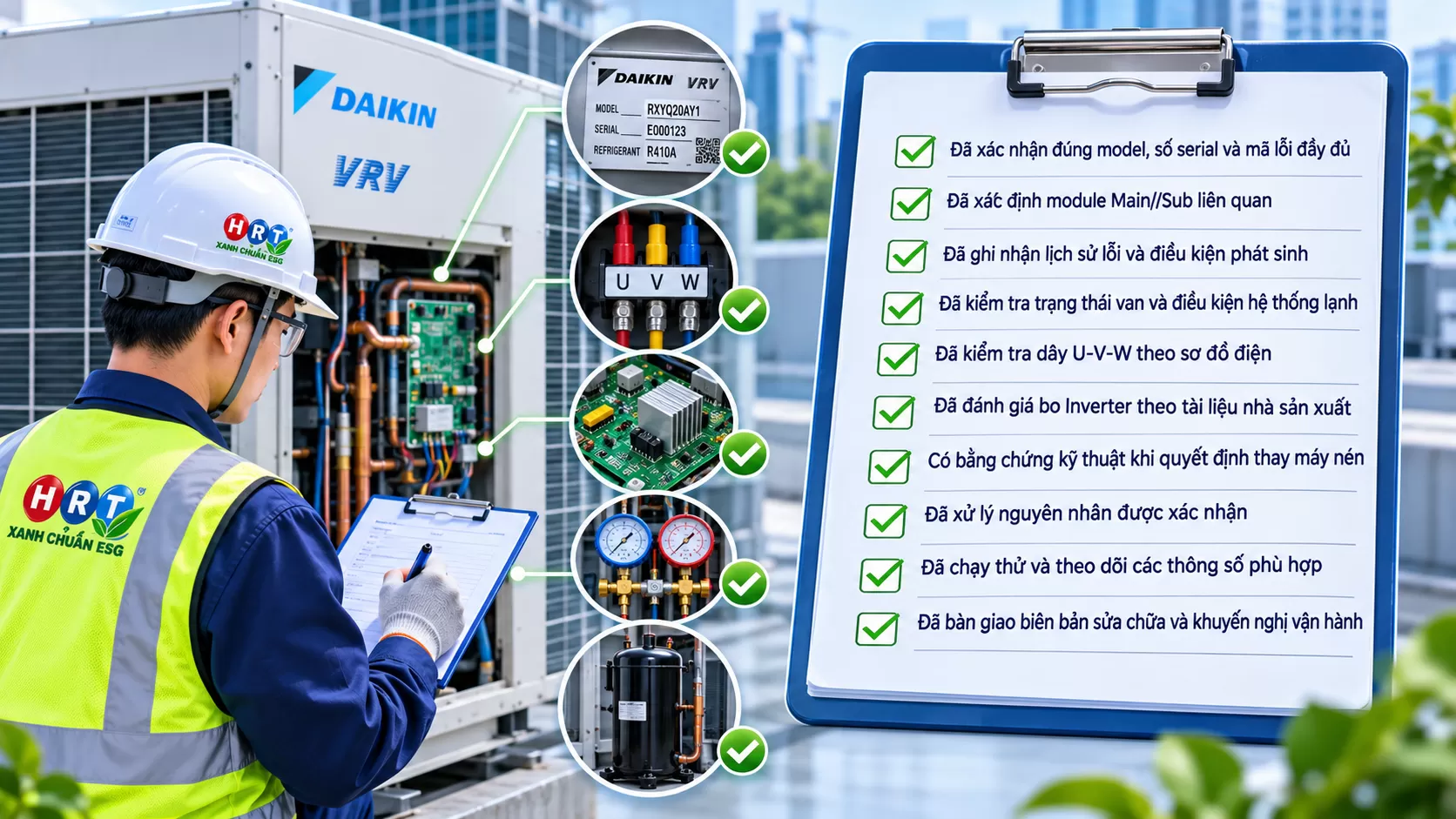
Pre-Delivery Control
0/10 items
This checklist serves to control work and acceptance records, not replace the procedures for checking electrical safety, chemicals and diagnostics specified in the Service Manual.
9. FAQs about E5-1, E5-2, E5-3 Daikin VRV faults
E5-1 Error Are Daikin VRVs Sure to Replace Compressor?
No. For models using the corresponding code, E5-1 error indicates abnormalities related to compressor at the main outdoor unit. Further inspection of electrical connection, refrigeration system conditions and Inverter bo before conclusion.
What is the difference between E5-2 and E5-3?
In some combination VRV systems, E5-2 identifies the problem at Sub 1 module, while E5-3 relates to Sub 2 module.
Can Daikin VRV E5 Error be caused by Inverter board?
Yes. Inverter board damage is one of the causes listed by Daikin in the E5 diagnostic literature. However, testing results are required before a replacement is decided.
Should I reset continuously when the VRV conditioner gives an E5 error?
Do not. If the cause is unresolved, repeatedly requiring the compressor to restart may create additional risks to the device.
After replacing compressor, does the system completely run out of E5 errors?
Cannot guarantee if not handled correctly the root cause. The replacement of compressor must accompany system conditions check and commissioning confirmation.
Can I fix E5 errors at work?
The operator can record fault codes and equipment status. Inspection of Inverter circuits, compressor and fluid systems should be carried out by qualified personnel, appropriate measuring equipment and full safety procedures.
10. Conclusion: Correcting the cause is more important than quickly changing components
For the E5-1, E5-2, E5-3 fault group on Daikin VRV, the most important question is not how much a new compressor costs.
What should be clarified is:
Why can't compressor boot on demand and what evidence confirms that cause?
From an HRT executive perspective, I ask the project team to comply with five decisions:
Stop at the right time → Exclusion of system cause → Inspection of electricity and Inverter → Only replace components when there is evidence → Pre-handover inspection.
This approach helps to limit misplacement, reduce recurrence risks and create a transparent basis between maintenance units, project owners and operation departments.
With HRT, HVAC repair is not just about getting the equipment working again. It's also about confirming that the equipment is qualified to continue serving the building.
Right from the beginning – Clear to the end – Sustainable Green.
Technical exchange with HRT
When the central air conditioning system VRV appears E5 error or warnings related to compressor Inverter, HRT can coordinate survey, assess the status quo and propose the treatment based on technical data.
HRT Air Conditioning and Ventilation Company Limited
-
Hotline: 0909.326.888
-
Email: CEO@hrt.vn
-
Website: hrt.vn
-
Professional: Design – Construction – Maintenance – Renovation of HVAC, VRV/VRF, Chiller and ventilation systems.
HRT – Green Breath for All Buildings.
Source: Publisher’s English edition · Vietnamese original on doanvanhoang.com