
Errors When Installing VRV
Machine-translated from Vietnamese. Read the original in Vietnamese
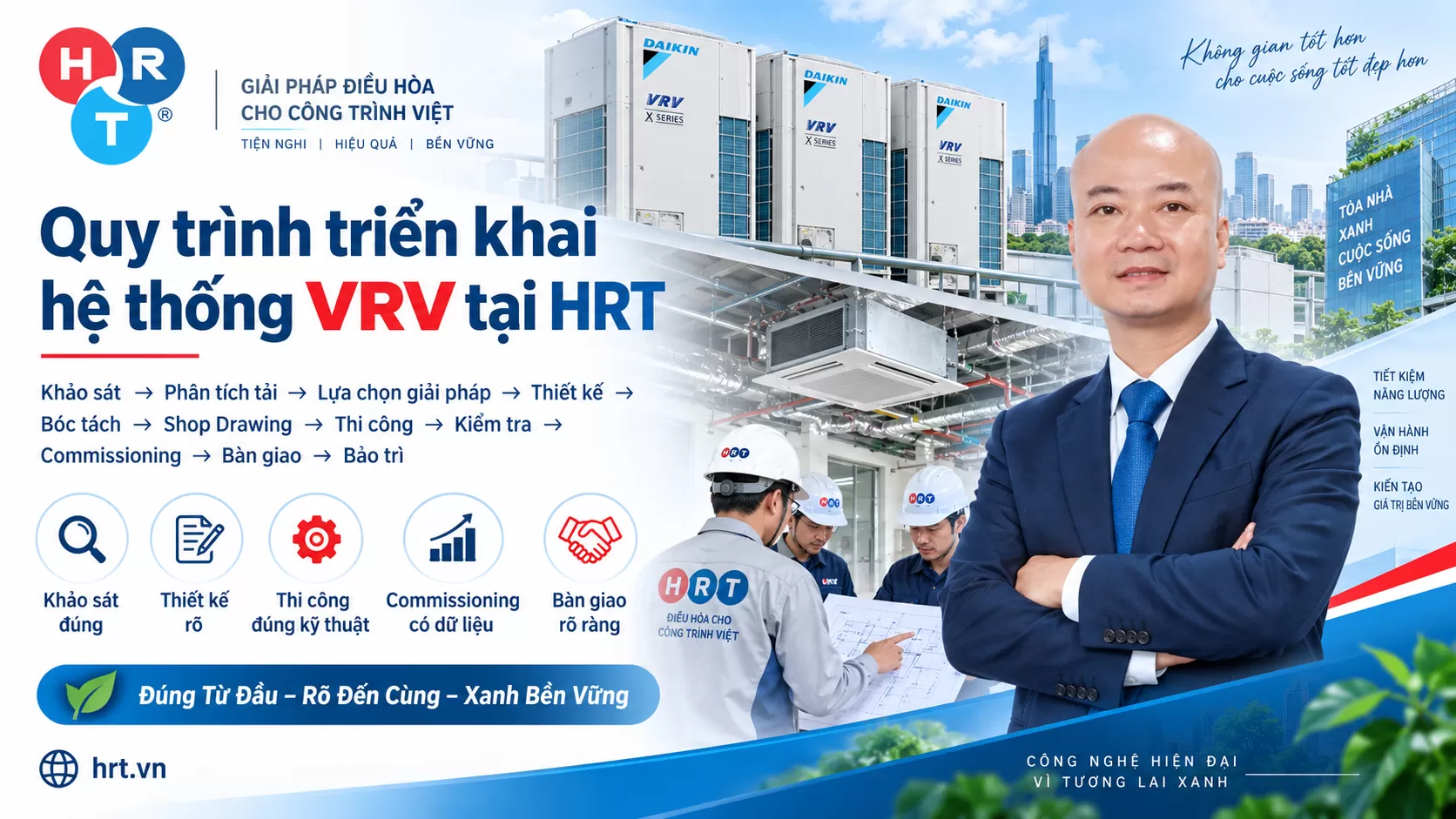
Why is it important to install VRV properly?
VRV/VRF is a central air conditioning system capable of adjusting capacity flexibly according to the actual needs of each area.
However, the effectiveness of the system depends not only on the brand of the device.
A VRV system that uses good equipment can still:
- Cooling slowly.
- Temperatures between rooms are uneven.
- High power consumption.
- Condensation and water runoff.
- There was a communication error.
- Operating unstable.
- Difficult maintenance.
- Reduces equipment life.
Causes often stem from errors in design, installation, inspection and commissioning.
Therefore, the right control from the beginning is the decisive factor in the quality of the whole system.
Contents
- Wrong at the stage of calculating load and selecting capacity
- Outdoor unit layout does not guarantee heating
- Indoor unit layout is not suitable for space use
- Refrigerant pipeline errors
- Refnet/Y-Branch fitting is not technically correct
- Thermal insulation non-sealed pipe
- Condensate lines are not guaranteed
- Electrodynamic and communication failures
- Leak testing and vacuum evacuation failed
- Refrigerant loading is not correct
- Commissioning is incomplete
- Lack of maintenance space
- HRT Process Control VRV System
1. False word counting cooling load and capacity selection
Many problems of VRV systems begin before construction.
One of the most common mistakes is choosing air conditioning power based primarily on room area.
This does not fully reflect the actual thermal load.
What factors should cooling load take into account?
When designing VRV should consider:
- Sunlight direction of the building.
- Glass area.
- Wall and roof structure.
- Number of people.
- Heat generator.
- Lighting system.
- Outdoor air.
- Room function.
- Time of use.
- Actual operation conditions.
For example, a 50 m2 meeting room with 25 people cannot load calculation like a 50 m2 workroom with only 5 people.
If the power selection is not suitable, the system may lack load or overload during operation.
Air conditioning partitions are also important
VRVs have a great advantage in their ability to control each area.
Therefore, it is necessary to divide the zone reasonably between:
Meeting room – office – corridor – leadership room – overtime work area.
Good partitioning makes the operation system flexible and avoids unnecessary energy consumption.
2. outdoor unit VRV layout not guarantee the ability to cool down
Outdoor unit is responsible for the release of heat to the environment.
If the outdoor unit is in a windy position or the space between units is not suitable, the hot air may be sucked back up.
Some common errors
- Outdoor unit placed too close together.
- The distance to the wall is not enough.
- Limited air intake space.
- The hot air that's blown out is recycled.
- Do not count the wind direction of multiple assemblies.
- No cleaning and repair space.
When cooling capacity declines, the system must operate longer to meet cooling load.
This can increase power consumption and affect operational stability.
Need Control
When arranging outdoor units, it is necessary to comply with:
- The manufacturer's technical distance.
- Intake and blow direction.
- Space maintenance.
- Anti-vibration.
- Drain the water.
- Safe approach.
3. Indoor unit layout is not suitable for space use
Indoor unit not only needs enough capacity but also needs to be placed in the right position.
Wrong location can cause one area to be subcooling while another area is not cold enough.
Common situations
- Cold wind blows directly on you.
- Indoor unit set away from the area with large load.
- The air supply and return were not arranged properly.
- Ceiling-concealed indoor unit without visiting door.
- There's not enough room to remove the filter.
- Do not check static pressure for indoor unit connecting air duct.
For concealed ducted indoor unit, the total pressure loss of:
Air duct + co co co quail + wind box + damper + air outlet + air filter.
If the total pressure loss is greater than the fan's capacity, the actual airflow rate may be reduced.
4. Errors in construction of pipelines
Fluid pipes are one of the most important components of VRV systems.
Each model has specific technical limitations.
Need Control
- Pipe diameter.
- Total length of pipe.
- Length from Refnet to indoor unit.
- High difference between outdoor unit and indoor unit.
- High difference between indoor units.
- Power connection ratio.
Do not change the pipeline without checking the technical conditions.
The copper tubing head should not be exposed
If the tip of the tube is open for a long time, dust, water and moisture may enter the inside.
These impurities directly affect the quality of refrigerant circuits.
Weld quality must be controlled
Common Errors:
- The weld is not sealed.
- Oxidation inside the tube.
- The tube is dented.
- Leakage at the flare end.
- Too many connections.
Piping quality should be checked during construction, do not wait until the ceiling is closed to check.
5. Refnet/Y-Branch fitting wrong may affect the distributor of the solvent
Refnet or Y - Branch is responsible for dividing the medium to the branches of the VRV system.
Some common errors include:
- Bad Refnet code.
- In the wrong direction.
- Do not ensure mounting position.
- The distance before and after the divider is incorrect.
- Change accessories that are not designed.
This can cause the ability to distribute the solvent between branches to be unstable.
As a result, some rooms reach temperatures fast while others take longer.
6.Thermal insulation is not sealed causing condensation and heat loss
Thermal insulation is not only responsible for covering pipes.
It also helps:
- Limit heat exchange.
- Limit condensation.
- Protect the pipe.
- Reduce the risk of dripping water onto the ceiling.
Common Errors
- Open thermal insulation splice.
- Thermal insulation is torn.
- Thermal insulation is thinly pressed.
- Accessories are not sealed.
- The thickness is not suitable.
- Close the ceiling before acceptance testing.
In hot and humid climate of Vietnam, only one opening can create conditions for condensate to appear.
Therefore, it is necessary to check the insulation before closing the ceiling.
7. Condensate lines are not technically correct and easily cause water runoff
Indoor unit water leakage is one of the common problems seen after the system put into use.
Common Causes
- Pipeline is not steep enough.
- The tube's sagging.
- The drain's clogged.
- The junction's leaking.
- Condensate pump is not properly fitted.
- Over the lifting height of the pump.
- Do not test the water before closing the ceiling.
Water test before acceptance testing
After the condensate line is completed, it should be checked:
Drainage capability → slope → leakage point → condensate pump → connection point.
This is a simple step but greatly reduces post-handover risk.
8. Errors in electrodynamics and VRV communication
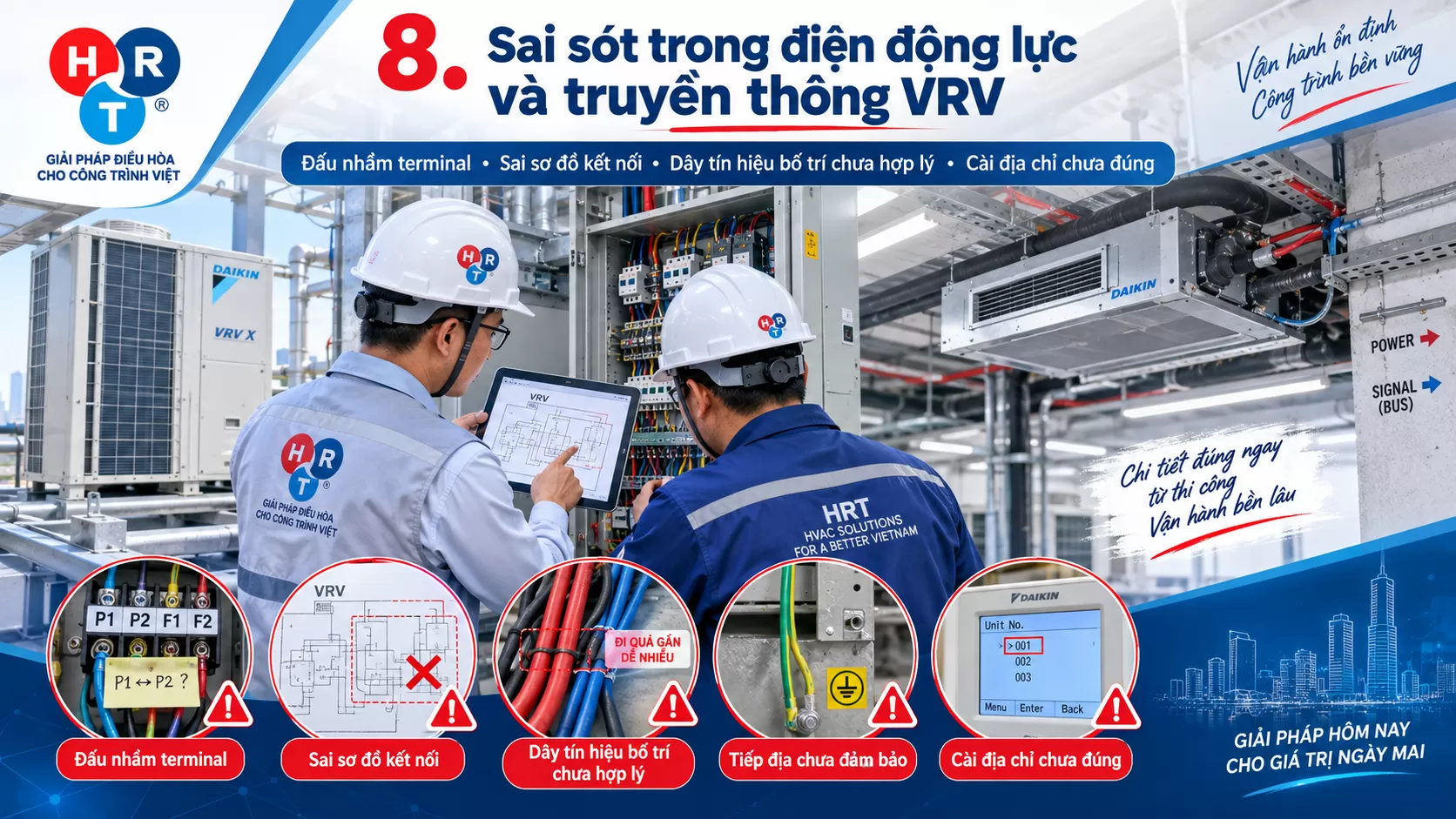
VRV uses communication system to connect outdoor unit, indoor unit and controller.
Electrical and communication failures can cause the device to disconnect or report an unstable fault.
Common Errors
- Wrong terminal.
- Wrong connection diagram.
- Use the wrong rope.
- The signal wire is too close to the motive wire.
- Grounding is not secure.
- Invalid address set.
- Do not fully test the indoor unit.
In particular, communication errors may appear intermittently, so it is difficult to find the cause if connection records are incomplete.
9. Leak testing and vacuum evacuation improper procedure
After completing the solvent pipeline, it is necessary to:
Leak testing → vacuum evacuation → Testing → Load additional solvent.
Leak testing
The goal is to detect leaks at:
- The weld.
- Flare.
- Refnet.
- Van.
- Outdoor unit.
- Indoor unit.
Don't skip or shorten this step.
Vacuum evacuation
Vacuum evacuation helps remove air and moisture from the fluid circuit before operation.
Don't use a fixed amount of time for every project.
Need to evaluate according to:
- Scale of the system.
- Pipe length.
- Configure the system.
- Measuring equipment.
- Manufacturer's process.
10. Refrigerator loading not in the design amount
Another flaw is refrigerant charging by feeling or just relying on pressure.
With VRV systems, the amount of additional solvent is usually determined based on:
- Device model.
- Pipe diameter.
- Length of each gland.
- Configure the system.
- Follow the manufacturer's instructions.
If the load is missing
The system can:
- Reduce cooling capacity.
- Run long.
- Some branches are not cold enough.
If Recharged
The system may also work beyond the expected conditions.
Therefore, the amount of additional solvent should be calculated, weighed and recorded in the record.
11. Commissioning can not be based solely on the “cooled machine”
One common mistake is to assume that turning on the monitor for cold winds has completed acceptance testing.
In fact, commissioning has to check the entire system.
Categories to evaluate
- Outdoor unit.
- Each indoor unit.
- Electrical system.
- Media.
- Condensate.
- Vibration.
- Noise.
- Controls.
- Wind temperature.
- Ability to respond to loads.
- Operating parameters.
Commissioning has data that helps detect issues before handing over to the project owner.
12. Not Leaving Space Maintenance Is An Error Often Overlooked
VRV system can operate well when handed over but will become very difficult to handle if there is no maintenance space.
Ceiling-concealed indoor unit needs enough space to:
- Remove the filter.
- Check the fan.
- Check the control board.
- Check the condensate pump.
- Repair the connector.
- Remove the device as needed.
Outdoor unit also need to make sure technician can:
- Clean the coil.
- Check the fan.
- Check the compressor.
- Check the electrical system.
Maintenance space should be calculated right from the design.
VRV system can still reduce performance after handover
Even a properly constructed system can be inefficient if maintenance is not appropriate.
Common causes:
- dirty air filter.
- Coil indoor unit dust proof.
- Outdoor unit is dirty.
- Set the temperature too low.
- Air conditioning works in unused areas.
- Room functions change.
- The interior impedes the airflow.
Therefore, VRV performance should be maintained by periodic inspection and maintenance.
Checklist of VRV construction control
Before construction
- Check the cooling load.
- Confirm your device model.
- Check the pipeline diagram.
- Check the length limit.
- Check the height.
- Confirm the location of outdoor unit and indoor unit.
- Coordinate architecture, ceiling, electricity and fire protection.
During construction
- Seal the end of the tube.
- Check the welds.
- Check the Refnet.
- Check the insulation.
- Check for condensate.
- Check the wiring and communications.
- Set up a gate.
Before handover
- Leak testing.
- Vacuum evacuation.
- Get lip balm.
- Check your device's address.
- Commissioning.
- Check for condensate.
- Check for noise and vibration.
- Complete as-built documentation.
Process of deploying VRV system at HRT
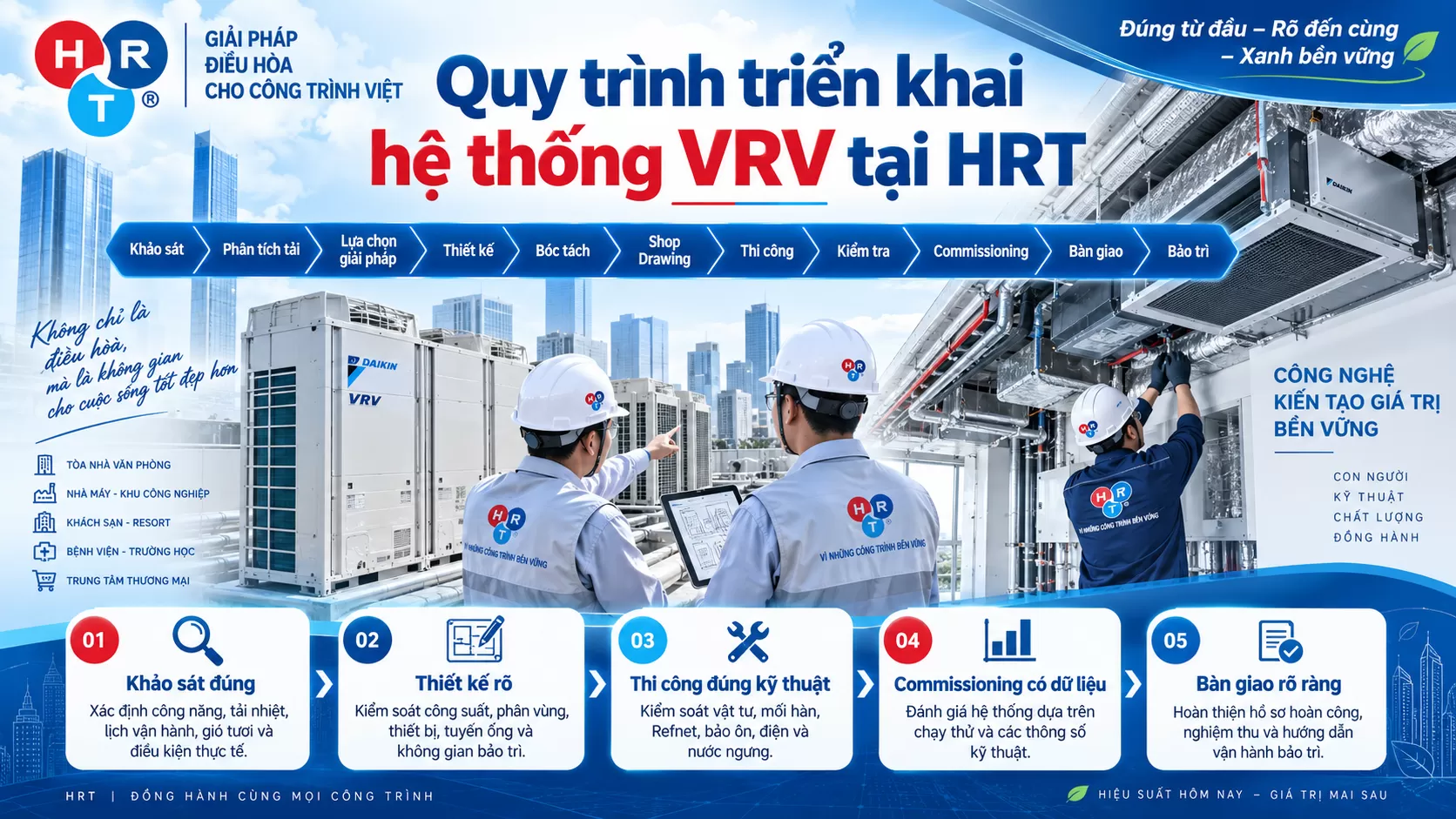
HRT control VRV system by series:
Survey → Load analysis → Solution selection → Designing → Separation → Shop Drawing → Construction → Inspection → Commissioning → Handover → Maintenance
Correct survey
HRT surveys the function, thermal load, usage history, outdoor air and actual conditions of each area.
Clear Design
Controlled factors include:
- Capacity.
- Partitioning.
- Device model.
- Pipeline.
- Condensate.
- Electrical control.
- Space maintenance.
Proper technical construction
HRT Control:
Materials → Piping → Welding → Refnet → thermal insulation → condensate → Electricity → Control.
Commissioning with Data
It's not just about the cold.
The system should be checked by commissioning results and actual operating parameters.
Clear handover
HRT Finishing:
- As-built drawing.
- Acceptance testing report.
- Equipment records.
- Commissioning results.
- Operation manual.
- Maintenance instructions.
HRT – VRV/VRF solution for construction
An effective VRV system does not just need good equipment.
More important is the right control from survey, design, construction to commissioning and maintenance.
HRT provides HVAC solutions:
Consulting → Design → Supply → Construction → Commissioning → Maintenance → Renovation
for many types of constructions such as:
- The office.
- Factory – Industrial Park.
- Hotels – resorts.
- The mall.
- Showroom.
- The villa.
- Kho logistics.
- Commercial and industrial buildings.
HRT aims to do:
True – Clear – Dedicated
and control the works in the spirit of:
Right From the Start – Clear To the End – Green Sustainable.
Website: hrt.vn
Conclusion
The... error installing VRV can start from small details but directly affect the performance of the whole system.
An error sequence such as:
Load calculation is incorrect → equipment layout is not reasonable → pipeline is wrong → thermal insulation is open → condensate is not reached → electrical communication error → commissioning is missing
may result in:
Cold poor → power consumption increase → multiple breakdown → high operation cost → reduced system life.
The best solution is not to fix the bug after handover, but rather Right control right from design and construction.
Source: Publisher’s English edition · Vietnamese original on doanvanhoang.com