
Factory HVAC systems: an integrated approach to energy efficiency
Machine-translated from Vietnamese. Read the original in Vietnamese
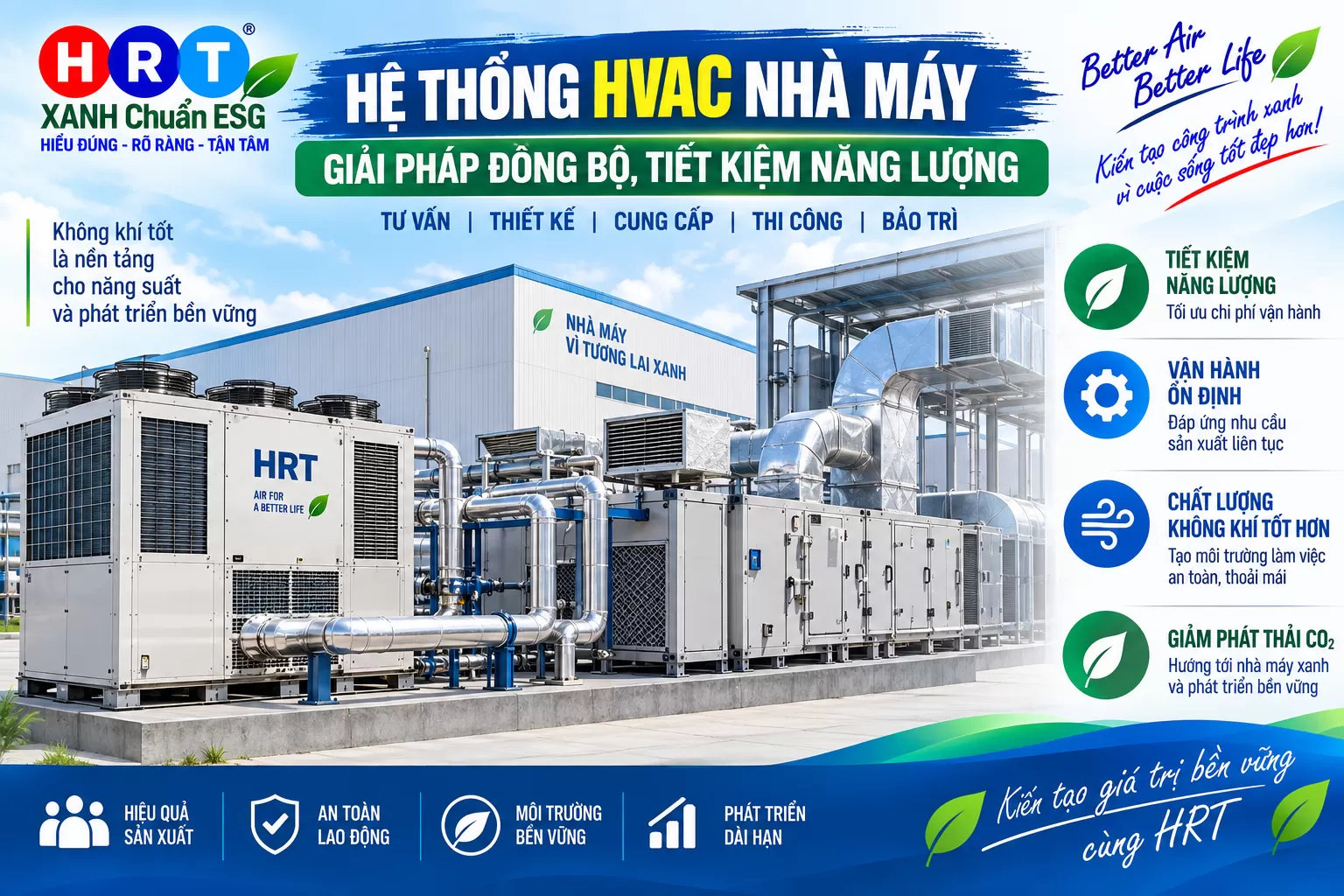
Factory HVAC systems are not just cooling problems
When it comes to HVAC for factory, many people often start with the question:
“How much air conditioning capacity does this factory need?"
But for industrial construction, that's only part of the problem.
A complete factory HVAC system must also handle simultaneously:
- The temperature.
- Moisture.
- Outdoor air.
- Suctioning waste.
- Wind compensation.
- Dust and smell.
- Air quality.
- Pressure between areas.
- Control the device.
- Consume energy.
- Long-term maintenance capability.
So the right approach is not to pick a device first and then figure out how to put it together.
Need to start from:
Production demand → Environmental condition → actual load → System solution → Equipment → Control → operation
An effective factory HVAC project must be looked at as an overall system, instead of multiple individual items.
SEO Post Main Image: Use the image featuring CEO Đoàn Văn Hoàng, the factory HVAC system, and a heading about HRT’s HVAC procedures or solutions.
Why factory HVAC is more complicated than conventional air conditioning?
In the office, cooling load usually comes from:
- Humans.
- Illuminate.
- Office equipment.
- Solar radiation.
- The air is outdoors.
In the factory, in addition to the above factors may appear:
- Machinery manufacturing.
- Motor.
- Compressor.
- A heater.
- The chain.
- Hot products.
- Steam.
- Chemicals.
- Dust.
- Oil.
- Smells.
- The doors are open frequently.
Therefore, the two plants have the same area but HVAC requirements may be completely different.
Area is not the only basis for selecting HVAC power.
A factory HVAC system needs to solve 3 problems

Conditions for production
Each industry has different requirements.
Have area just ventilation.
There is an area for temperature control.
There are areas that must be controlled both:
- The temperature.
- RH.
- Cleanliness.
- Room pressure.
- Airflow direction.
- Dust concentration.
- Environmental stability.
For example, a typical production area may not need to air - condition the entire plant, while a separate technology room needs constant environmental stability.
So, HVAC partition is a very important step.
Working environment
The factory can have hundreds of workers and many exothermic machines.
If only air conditioning is installed without proper wind organization, the factory can still:
- Secrets.
- Smells.
- Heat buildup.
- High humidity.
- Large temperature differences.
A correct system needs coordination:
Cooling + Fresh Air + Ventilation + Exhaust
In addition to cooling, control must be given to both the air flow in and out of the plant.
Long-term operation costs
Factory HVAC is typically operated for several hours a day.
A plant running 16 hours or 24 hours per day will have huge HVAC electricity costs if the system:
- Wrong power selection.
- Overload.
- Inappropriate controls.
- Air leakage.
- poor thermal insulation.
- Unbalanced flow rate.
Therefore, the design should simultaneously consider:
CAPEX – Investment Cost
and...
OPEX – Operational Cost
The cheapest option at purchase is not necessarily the most economical in 10–15 years of operation.
Overall picture of a factory HVAC system
A synchronous HVAC system can be visualized in series:
Cooling → Fresh Air → Ventilation → Exhaust → IAQ → Control → Energy
Each layer is directly related to the other.
For example:
If outdoor air is increased without increasing heat and humidity handling, temperature or RH may not be reached.
If the exhaust is increased without additional wind compensation, the factory may suffer from negative pressure.
If the cooling capacity is increased but the wind distribution is not good, the area near the air outlet is deeply cold while the far area remains hot.
So HVAC needs to be designed synchronization from the beginning.
Air conditioning systems commonly used in factories
Water Chiller
Chillers are usually suitable for the following projects:
- Cooling large load.
- Many cold use areas.
- There is a need for concentrated operation.
- Use an AHU, PAU, or FCU.
A typical configuration:
Chiller → Pump → Chilled Water Pipe → AHU/FCU → Return Water → Chiller
Chiller efficiency depends not only on the refrigeration itself, but also on:
- Pump.
- AHU.
- FCU.
- Cold water heating difference.
- Hydraulic balance.
- Controls.
- Actual load.
VRV/VRF
VRV/VRF is typically suitable for:
- Factory office.
- Meeting room.
- The administration area.
- Technical dept.
- Functional room.
- Areas need independent control.
The advantage is the ability to flexibly partition.
However, using VRV/VRF for the whole large workshop needs to carefully assess thermal load and environmental conditions.
Packaged
Packaged can fit to:
- The factory.
- Kho.
- Production area.
- The space needs to be aired through an air duct system.
The equipment is in the form of a whole cluster to help arrange the system relatively compact in some types of works.
Rooftop
Rooftop is often considered when:
- Have a suitable roof area.
- The workshop has large space.
- Can organize centralized air duct system.
It is necessary to simultaneously take into account roof load, ductwork, vibration and maintenance capability.
What role do AHU, PAU and FCU play?
AHU
AHU – Air Handling Unit – handles and distributes air for large areas.
AHU can perform:
- Cooling.
- Dehumidify.
- Air purification.
- Wind level.
- Windswept.
PAU
PAU – Primary Air Unit – is typically used to handle outdoor air.
Outdoor winds can be:
- Filter.
- Cooling.
- Dehumidify.
before granting into space.
This is an especially important solution in hot and humid climates.
FCU
FCUs typically serve smaller spaces.
In the Chiller system, FCU receives cold water to treat the air in each area.
Outdoor air factory must be charged with cooling load and moisture load
Outdoor air is essential but not arbitrary.
In Vietnam's climate, outdoor winds often carry:
Heat + Humidity
If the outdoor air is put directly into the air conditioning area, the refrigeration system must handle additional load.
So, we need to calculate simultaneously:
- Outdoor airflow.
- Outdoor temperature.
- Outdoor humidity.
- Number of people.
- Room pressure.
- Suctioning waste.
- Wind compensation.
- Cooling load.
When appropriate, it may be considered:
HRV/ERV – heat recovery/energy
to partially reduce the outdoor wind handling load.
Factory waste suction is not only choose large capacity fans
This is a common mistake.
A sewage system should be approached in series:
Generating source → Collecting → Piping → Processing → Fan → Waste discharge
If dust or odor is present at a particular point, it is preferable to collect it at the source.
Need to consider:
- Position the suction.
- Arrest velocity.
- Flow rate.
- Pipe diameter.
- Pressure drop.
- Fan pressure.
- Filtering equipment.
- Discharge position.
- Wind compensation.
Increasing fan power while the wrong suction mouth is not likely to improve the effect.
Temperature and humidity control in the factory
A plant that reaches 24 degrees is not necessarily a good environment.
If RH is too high, the building may still encounter:
- Condensation.
- Moisture the material.
- Corrosion.
- Product effects.
- Mold.
- Feeling uncomfortable.
So, the design should distinguish:
Sensible Load – thermal load current
and...
Latent Load – Downloads offline
Special attention should be paid to moisture load when:
- Outdoor large airflow.
- Doors are frequently open.
- The production process generates steam.
- Factory specific RH requirements.
Controls actual efficiency decisions of HVAC
The factory usually has many areas with different schedules of operation:
- The zone runs 24/7.
- The zone runs on shifts.
- The office building.
- Kho.
- Server room.
- Production area.
- Auxiliary sector.
If your entire HVAC system is always running in the same mode, it's wasteful.
Parameters that can be used for control include:
- Temperature.
- RH.
- CO₂.
- Pressure.
- Airflow.
- Water Flow.
- Schedule.
- Equipment Status.
Depending on the scale, HVAC can be integrated into the system BMS for centralized monitoring and management.
HVAC factory and energy saving problem
Energy savings do not start with buying a device labeled “save electricity”
It starts with:
Design the right load.
The optimal sequence should be looked at as a whole:
Load → Equipment → Distribution → Control → Operation → Maintenance
Design the right load
Oversize devices are not always safe.
Too large capacity can:
- Increase your capital.
- Increase the size of the system.
- Make low load running equipment.
- Reduces actual performance.
Reasonable partitioning
Air out only where necessary.
Don't waste energy on areas that are not in use.
Controls on demand
Fan, pump, Chiller and other equipment can change capacity according to load when system allows.
Reduce energy loss
Need Control:
- Air leakage.
- Water leak.
- Thermal insulation.
- Heat bridge.
- Dirty coil.
- Filter dirty.
- Sai flow rate.
- Sai setpoint.
periodic maintenance
A system can still run when it is dirty or out of balance.
But the amount of electricity consumed can increase over time.
Hence:
Maintenance is part of Energy Efficiency.
6 Common Errors When Deploying Factory HVAC

1. Select the air conditioner only by area
Two plants of the same area do not necessarily have the same cooling load.
The heat source from the line can make a huge load difference.
2. Only interested in cooling
The workshop may be cold but still:
- Secret.
- Moisture.
- Smells.
- Lack of outdoor air.
3. Suction exhaust but forget wind compensation
If suction is more than level, the workshop may suffer from negative pressure.
Outdoor air will be drawn in through:
- Door.
- The gap.
- The path.
4. Outdoor air supply but not moisture load
This is a common cause of poor control of RH.
5. Installation is complete but not calibration
If the machine is not running, the system is running correctly.
6. No space maintenance
If it can not be easy:
- Thay filter.
- Clean the coil.
- Remove the motor.
- Check the valve.
- Maintenance fan.
then the system performance will decrease gradually.
What does the factory HVAC design need to calculate?
Cooling load
Do not calculate factory HVAC in m2.
Total load can be viewed as follows:
Qtotal = Qbuilding + Qpeople + Qlighting + Qequipment + Qfresh air + Qprocess + Qinfiltration
In many factories:
Qequipment + Qprocess
can account for a very large proportion.
Airflow rate
Flow rate should be determined based on:
- Thermal load.
- Outdoor air.
- ACH if applicable.
- Suctioning waste.
- Pressure.
- Production requirements.
Pressure drop
Fan should be selected according to:
Airflow + External Static Pressure
Losses may come from:
- Air duct.
- Co.
- Numbness.
- Van.
- Filter.
- Coil.
- Air outlet.
- Negative.
Water flow rate
With Chiller system to control:
- CHWS.
- CHWR.
- ΔT.
- Water Flow.
- Pump Head.
Space maintenance
Right from the design stage must determine the maintenance service space.
This is a commonly overlooked but very important factor for long - term investment.
Process of deploying factory HVAC system at HRT

HRT approaches projects in series:
Surveying → Analysis → Designing → Breaking down → Construction → TAB/Commissioning → Handover → Maintenance
Step 1: Factory survey
Collect:
- The ground.
- Functional.
- Production line.
- Number of people.
- Operating time.
- Heat - generating machinery.
- Dust source.
- Source of smell.
- It's a little hot.
- It's a little damp.
- The system exists.
Step 2: Analyze the requirements of each area
Set up parameters:
Temperature – RH – Airflow – Fresh Air – Exhaust – Pressure – IAQ
From which classify:
- The area needs air conditioning.
- Area needs ventilation.
- The area to be decontaminated.
- Areas under special control.
Step 3: Calculate and select a solution
Engineer Calculation:
- Cooling load.
- Moisture load.
- Outdoor air.
- Suctioning waste.
- Wind compensation.
- Water flow rate.
- Pressure head.
- Equipment capacity.
Then compare the plan to:
Engineering + Investment + operation + Lifecycle
Step 4: System design
Deployment:
- HVAC equipment.
- Air duct.
- Chilled-water pipe.
- Copper tubing.
- Condensate.
- Electrical control.
- Sensors.
- BMS.
- Space maintenance.
At the same time, coordinate with:
- Structure.
- Electricity.
- PCCC.
- Technology line.
Step 5: Construction and QA/QC
Control:
- Supplies.
- Airtightness tube.
- Thermal insulation.
- Hanging.
- Rung.
- Noise.
- Condensate.
- Sensors.
- Maintenance capability.
Step 6: TAB – Commissioning
Don't just check that the device is running.
Need to measure:
Airflow – Water Flow – Temperature – RH – Pressure – Current – Noise
TAB and Commissioning help confirm the operation system close to the design values.
Step 7: Handover and training
The transfer dossier comprises:
- As-built.
- Equipment documentation.
- Operating parameters.
- Setpoint.
- Maintenance schedule.
- Operation manual.
Step 8: maintenance and optimization
After factory operation, continue to monitor:
Energy → Temperature → RH → Airflow → Equipment Performance
Realistic data helps determine the next optimal opportunity.
When should the factory renovate the HVAC system?
Survey should be conducted when signs appear:
- Lack of cold.
- Subcooling, overheating.
- RH cao.
- Condensation.
- The secret workshop.
- The smell is hard to get rid of.
- Electricity bills rise.
- The machine runs continuously.
- Fan's not getting enough air.
- Devices frequently report errors.
- Factory change line.
- Increase production.
- Change your functions.
The important thing is:
Not all problems require a replacement.
Many systems can be significantly improved by:
- Adjust.
- Renovation of windways.
- Adjust your setpoint.
- Upgrade the controls.
- Fix thermal insulation.
- Clean the coil.
- Balance the water.
- Air balancing.
What kind of factory is suitable for HVAC synchronization solution
HRT can deploy HVAC solutions for many groups of projects such as:
- Electronics factory.
- Components factory.
- Mechanical plant.
- Food factory.
- Pharmaceutical factory.
- Plastic factory.
- Packaging factory.
- Textile factory.
- Industrial warehouse.
- Logistics center.
- FDI factory.
- The workshop has high thermal load.
- HVAC renovation works.
- Energy saving and ESG oriented plant.
It is not recommended to apply a same configuration to all plants.
Each construction needs a separate design based on the actual load and requirements.
Towards Green HVAC ESG Standard
A Green HVAC system is more than just replacing an old one with a high - performance one.
Need to optimize the whole sequence:
Load + Equipment + Distribution + Control + Operation + Maintenance
Possible solutions include:
- High performance equipment.
- High performance chiller.
- Variable-frequency drive for pump/fan.
- Load - driven control.
- HRV/ERV.
- Optimize setpoints.
- Partitioning.
- Balance the water.
- Air balancing.
- BMS Manager.
- Maintenance according to data.
The ultimate goal is to:
reduce energy but not reduce the quality of production environment.
HRT – HVAC solution for long-term investment
A factory HVAC contractor should not only be on duty to provide equipment.
HRT aims to service chain:
Survey → Consulting → Design → Separation → Supply → Construction → acceptance testing → maintenance → Optimization
With three values:
CORRECT – CLEAR – CONSCIENT
HRT towards an HVAC system:
- Right for the job.
- Right load.
- Be stable.
- Easy operation.
- Easy maintenance.
- Save energy.
- Suitable for long-term investment.
HRT – Green Breath for All Buildings
ESG Standard GREEN HVAC
Source: Publisher’s English edition · Vietnamese original on doanvanhoang.com