
HRV and ERV – Comparison, Principles and How to Choose
Machine-translated from Vietnamese. Read the original in Vietnamese
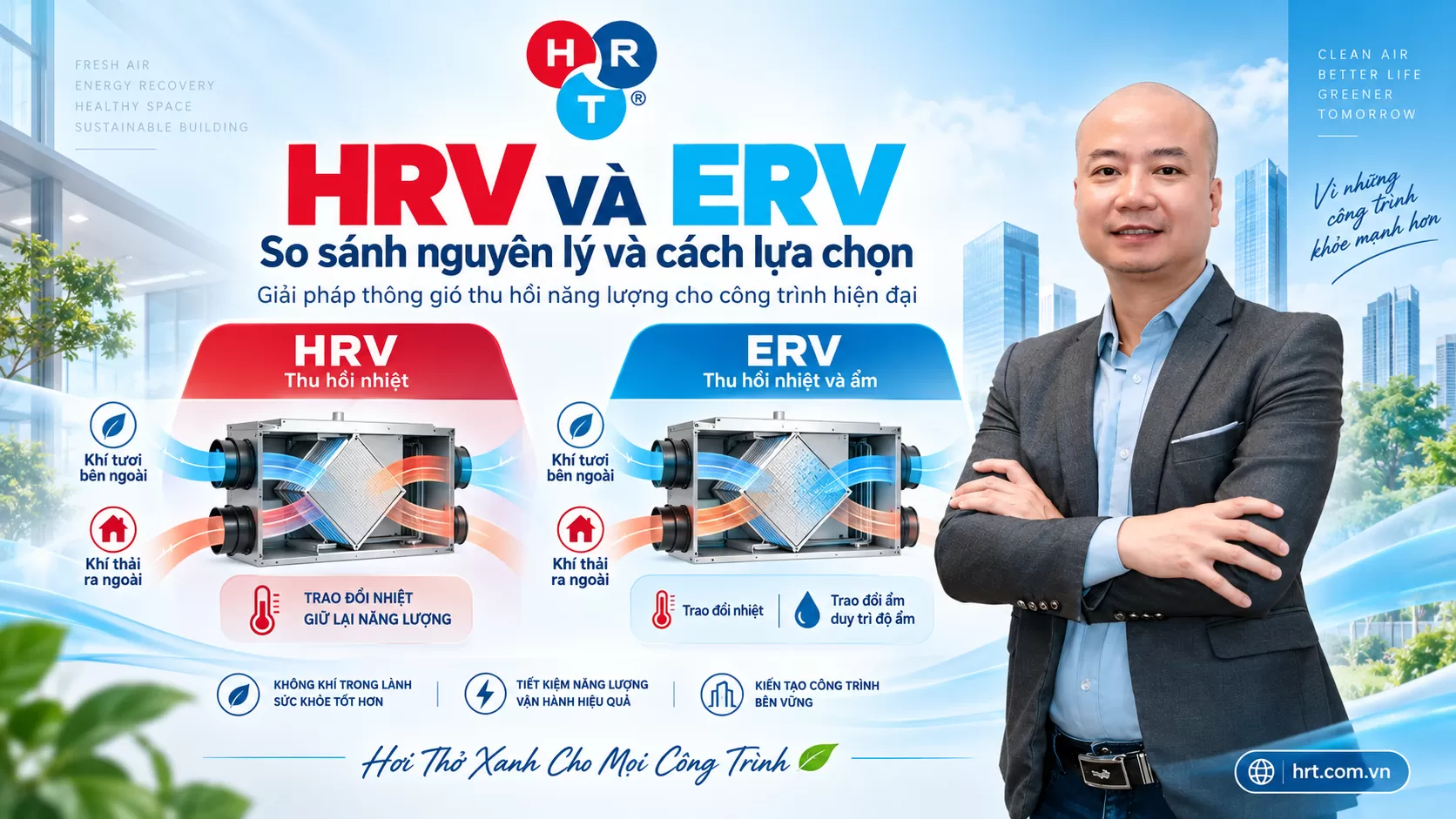
HRV and ERV are two energy recovery ventilation technologies that help supply outdoor air and reduce the load on air conditioning systems. HRV focuses on heat recovery sensors, while ERV can exchange both heat and moisture. HRT analyzes the differences, practical applications and how to choose the right equipment for Vietnamese climate conditions.
HRV And ERV – Comparison of Principles, Energy Recovery Capabilities And How To Choose
In modern buildings, the supply of outdoor air not only improves indoor air quality but also directly affects the cooling load and operational cost of the HVAC system.
Especially in Vietnam, where there are many times of high outdoor temperature and humidity, the introduction of non-outdoor air directly into the building can cause the air conditioning system to consume more energy to process.
HRV and ERV Ventilation and Recovery are two energy-saving solutions that help take advantage of a portion of the energy from exhaust air flow to pretreat outdoor air before it is supplied to the building.
However, not all devices are suitable for all climates and use needs.
So how are HRV and ERV different? What solutions should be chosen to ensure air quality and energy efficiency? Let's analyze HRT under the viewpoint of HVAC engineering.
Why does HVAC System Need Energy Recovery Ventilation?
In the air conditioning system, the addition of outdoor air should meet the ventilation needs of the building.
However, outdoor air often has different temperature and humidity conditions than indoor air.
For example, in summer, hot, humid outdoor air delivered directly into a conditioning office increases thermal load and thermal load latency.
In this case, the air conditioning system must consume more energy to cool and handle the humidity of outdoor air.
Energy recovery ventilation helps reduce this processing load by taking advantage of the temperature, humidity difference between the feed air and the exhaust air.
Benefits of energy recovery ventilation
-
Support to maintain outdoor air flow rate as designed.
-
Partial reduction of thermal load due to outdoor air.
-
Optimal support for the power of air conditioning system.
-
Improve overall energy efficiency.
-
Contribute to the implementation of green building and sustainable operation goals.
The efficiency of saving depends on the airflow rate, humid heat conditions, equipment performance and fan power consumption.
See more: Checklist acceptance testing Full VRV system from A–Z
Where Do HRV And ERV Differ?
Although using the same principle of energy recovery from exhaust gases, HRV and ERV have important differences in heat and moisture exchange capacity.
HRV – heat recovery
HRV (Heat Recovery Ventilator) is ventilation heat recovery equipment, mainly exchanging inductance heat between outdoor air and exhaust air.
When two streams of gas pass through the heat exchanger, energy is transferred between them without direct mixing.
In hot seasons, cooler exhaust streams can assist in reducing outdoor air temperature before supplying to buildings.
In contrast, in the cold season, HRV can take advantage of heat from exhaust air to preheat outdoor air.
HRV is not normally designed to significantly exchange moisture between two streams of gas.
ERV – heat recovery and moisture exchange
ERV (Energy Recovery Ventilator) is a ventilation device that recovers energy, capable of exchanging inductance heat and partial moisture.
In addition to preliminary adjustment of temperature, ERV can also support to reduce moisture load brought by outdoor air into the building under suitable conditions.
This is a notable advantage in hot and humid climates.
However, ERVs are not specialized dehumidifiers and can not completely replace AHUs, PAUs, or air conditioning systems.
HRV vs ERV Comparison Table
| Criteria | HRV | ERV |
|---|---|---|
| Full name | Heat Recovery Ventilator | Energy Recovery Ventilator |
| Heat recovery felt | Yes | Yes |
| Moisture Exchange | Usually negligible | Yes, customized |
| Reduce cooling load induction | Can you... | Can you... |
| Support moisture load reduction | Not direct | Can you... |
| Independent humidity control | No | No |
| Energy Efficiency | Depends on operation conditions | Depends on operation conditions |
Core differences: HRV is primarily heat recovery inductive, while ERV can recover both heat and partial latent heat through moisture exchange.
The Working Principle Of HRV And ERV
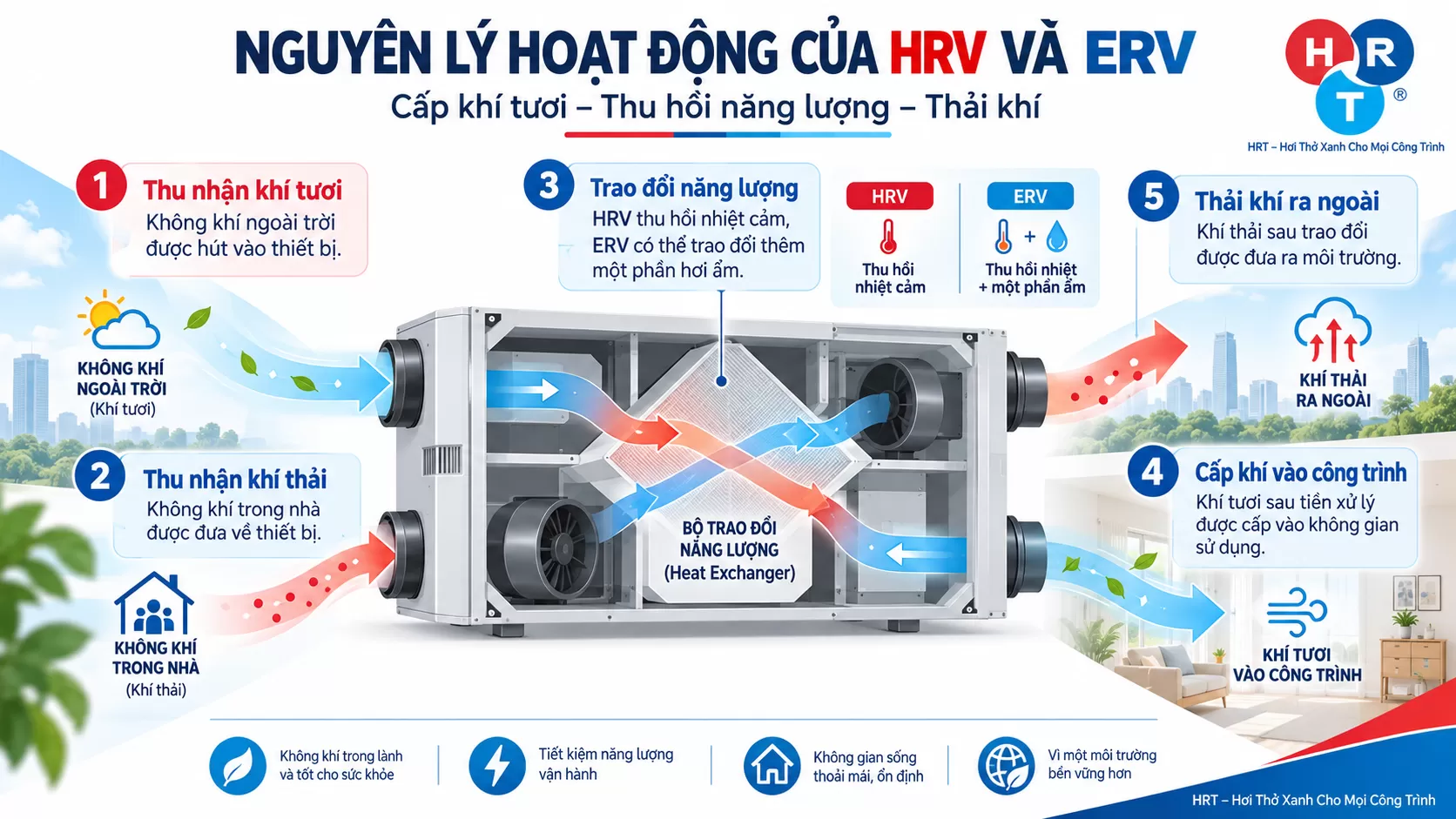
Both devices organize two air streams that pass through the energy exchanger.
The first line is the outdoor air that is brought into the building. The second line is the exhaust air from the inside that is brought into environment.
Process Air Exchanger
The system usually operates in five stages:
Step 1 – Acquisition of outdoor air: Outdoor air is drawn through the intake and fed into the unit.
Step 2 – Emission capture: Air from inside the building is fed to the exchanger through the waste pipeline.
Step 3 – Energy Exchange: HRV transmits inductance, while ERV can transfer some moisture between the two streams.
Step 4 – Air supply to the work: Outdoor air after being pretreatment continues to enter the air distribution system.
Step 5 – Exhaust air: The flue gas flow after energy exchange is brought to the environment.
Two common gas streams are conducted in separate lines. However, the possibility of leakage or cross-contamination still needs to be assessed according to the equipment structure.
Should Choose HRV or ERV For Works In Vietnam?
The selection of equipment must be based on climatic characteristics, cooling load, humidity requirements and actual operation method.
Works in hot and humid areas
In areas with high outdoor temperature and humidity, the air conditioning system must simultaneously treat inductive thermal load and latent thermal load.
Under these conditions, ERVs can benefit from their ability to exchange both heat and moisture.
Especially with large outdoor air flow rate, the ability to reduce moisture load can support energy saving.
The building has its own humidity control system
For constructions using PAU or AHU with dedicated humidity treatment function, HRV is also a plan to consider.
If the existing system has handled moisture load well, it is necessary to compare the additional benefits of ERV with the investment and operation costs.
Works with special environmental requirements
At factories, technical rooms or areas with strict temperature and humidity requirements, both inductive thermal load and latent thermal load should be calculated.
HRV or ERV only serves as an energy recovery aid, not a replacement for the primary environmental control system.
It should not be assumed that ERV is always better than HRV. The right solution is the one that offers the best net energy efficiency under specific use conditions.
See more: What Is Rooftop Unit? Construction, Principles And Applications
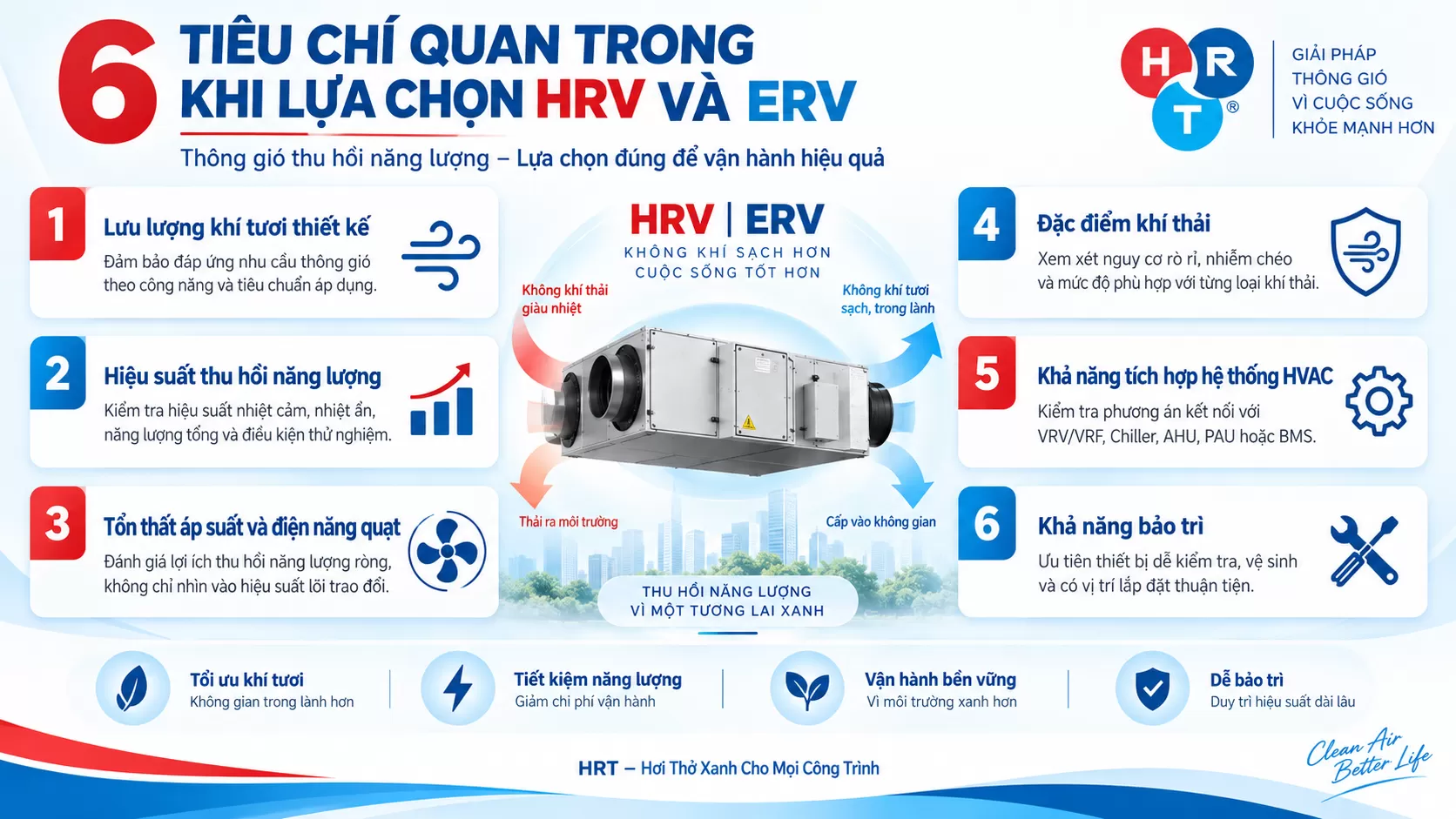
6 Factors Determining the Effectiveness of HRV And ERV
Flow rate outdoor air
The equipment must meet the outdoor air flow rate according to the ventilation requirements of the building.
Selecting a flow rate that is too low may not meet your needs, while an equipment that is too large may increase your investment and fan power.
Energy recovery performance
Need to consider the parameters:
-
Performance heat recovery sensor.
-
Performance latent heat exchanger.
-
Total energy recovery efficiency.
-
Testing conditions.
-
Flow rate and operation temperature.
It is not recommended to compare two models based on only one performance indicator when the testing conditions are different.
Pressure drop and fan power
Heat exchanger, filter and ductwork all create pressure loss to the air flow.
Large pressure loss can increase the fan power.
Therefore, efficiency evaluation must take into account the energy recovery benefits after considering additional power consumption.
HVAC system integration capabilities
HRV and ERV can be studied in integration with systems:
-
VRV/VRF.
-
Chiller.
-
AHU and PAU.
-
Outdoor air supply system.
-
BMS/BAS control.
The synchronous design helps to manage flow rate and operation mode accordingly.
Safety and maintenance
For exhaust gas flows containing hazardous chemicals and pollutants or requiring cross - contamination control, it is necessary to carefully assess the ability to use energy recovery units.
At the same time, it is required to arrange a cleaning space for filters, exchangers and fan systems.
See more: HVAC System Improvement
HRV And ERV Application In Constructions
Offices and commercial buildings
HRV/ERV can be used in outdoor air supply systems to reduce the load of outdoor air handling.
For high density buildings, special attention should be paid to the outdoor air flow rate and the ability to coordinate with air conditioning systems.
Hotels and service areas
Hotel buildings often have ventilation needs for many different areas.
The selection of energy recovery equipment should be based on the function of each space, humid heat conditions and exhaust gas flow characteristics.
Factory and Industrial Zone
In the factory, HRV/ERV can be considered for office areas, work rooms and other spaces with suitable emissions.
For areas generating hazardous industrial emissions, chemicals or dust, safety assessment is required before energy recovery is applied.
Residential and civil buildings
For closed designs, frequent use of air conditioners and need mechanical outdoor air supply, HRV/ERV may be considered.
Equipment should be selected according to flow rate ventilation, installation space, noise level and sanitary capacity.
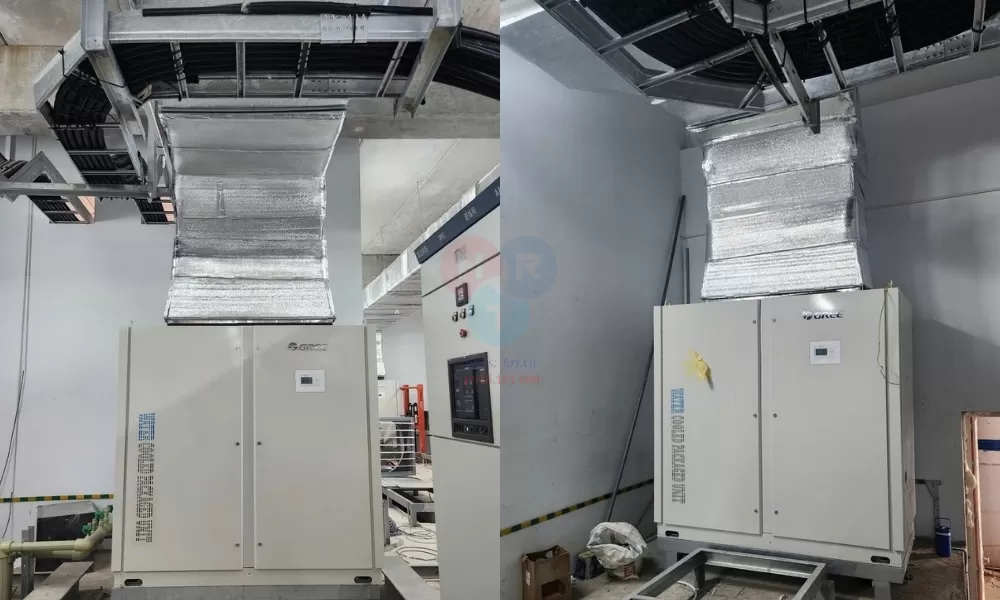
Common Mistakes When Investing HRV/ERV
Some mistakes can reduce the efficiency of the system:
Selection by published performance only: No fan power and actual pressure drop calculation.
No moisture load rating: Select HRV or ERV without analyzing thermal and humidity conditions of the building.
Wrong design flow rate: The device does not meet ventilation requirements or operates inconsistently with actual load.
Ignoring Emission Quality: Do not check for leakage and cross-contamination risks between gas streams.
Periodic maintenance missing: Dirt attachment filter and exchange core impair workability.
To limit the above problems, it is necessary to conduct surveys, calculations and selection of equipment configuration according to actual requirements.
See more: Central air conditioner VRV
See more: Central air conditioner VRF
See more: Air conditioner Chiller
HRT – Ventilation solution for Energy Recovery
Air Conditioning ventilation Co., Ltd HRT Providing consulting, designing, supplying, construction and optimization of air conditioning and ventilation systems for civil, commercial and industrial projects.
With a background in refrigeration and thermal engineering, HRT focuses on evaluating the demand for, operation conditions and investment efficiency before proposing solutions.
HRT Solutions Provided
-
Ventilation heat recovery system HRV/ERV.
-
Outdoor air supply system.
-
AHU, FCU, PAU system.
-
Central air conditioner VRV/VRF.
-
Chiller system.
-
Design and construction of air duct.
-
BMS control.
-
Renovation and optimization of HVAC energy.
With our core values True – Clear – Dedicated, HRT aims at suitable technical solution, cost control and long-term operation.
FAQs About HRV And ERV
Does HRV and ERV replace air conditioning?
No. These are ventilation devices that recover energy, often in coordination with air conditioning or air handling systems.
Does ERV help to control humidity better than HRV?
Under the right conditions, ERVs can assist in reducing moisture load from outdoor air. However, they do not replace dedicated humidity control systems.
Is HRV or ERV more suitable for hot and humid climates?
ERV is often worth considering when moisture load from outdoor air is large. However, overall efficiency, fan capacity and operation cost should be compared before choosing.
Does HRV/ERV save electricity?
Energy can be saved through heat recovery from exhaust air flow. The actual savings depend on humid heat conditions, flow rate and system configuration.
Can HRV and ERV connect BMS?
Some models support BMS/BAS connections. Communication protocol and control functions of the device should be confirmed.
Conclusion – Choosing HRV or ERV to Optimize HVAC System?
HRV and ERV are two energy recovery ventilation solutions capable of supporting outdoor air handling load reduction and improving energy efficiency.
HRV is suitable for applications that prefer heat recovery inducers, while ERV can provide additional benefits due to its moisture exchange capacity.
However, investment efficiency must be assessed based on climate, airflow rate, thermal load, recovery performance and power consumption.
The right equipment selection at the design stage is the basis for the project to maintain air quality, optimize costs and towards sustainable operation.
HRT – GREEN BATH FOR EVERY WORK
CORRECT – CLEAR – CONSCIENT
HRT Air Conditioning and Ventilation Company Limited
Contact HRT for advice on selecting HRV / ERV and ventilation solutions to recover energy suitable for the project.
Source: Publisher’s English edition · Vietnamese original on doanvanhoang.com