
HVAC construction: Maintain quality under schedule pressure
Machine-translated from Vietnamese. Read the original in Vietnamese

CEO Đoàn Văn Hoàng – HRT share HVAC construction management, change control and acceptance testing organization to protect quality against schedule pressure.
HVAC Construction: Keeping Quality In Progress Pressure
HVAC Construction Entering the finishing phase is also when the operator has to make difficult decisions: which areas are ceiling-closed, which equipment is powered, which parts qualify for commissioning and what existences must be dealt with before handover.
At those times, I didn't want to receive a report that just said “basic completion".
I need to know if the finished part has been checked, where the results are, and what else might affect the next job. A high completion rate doesn't help a manager decide if there are unclear issues behind that number.
From my executive perspective, HVAC quality control must be directly tied to the way construction sites are organized. The person in charge should see problems early enough, assign the right person to handle and confirm the results before moving on to dependent work.
To protect your progress, make the conditions for completion clear rather than just pushing for a date.
A progress report should indicate how ready the work is
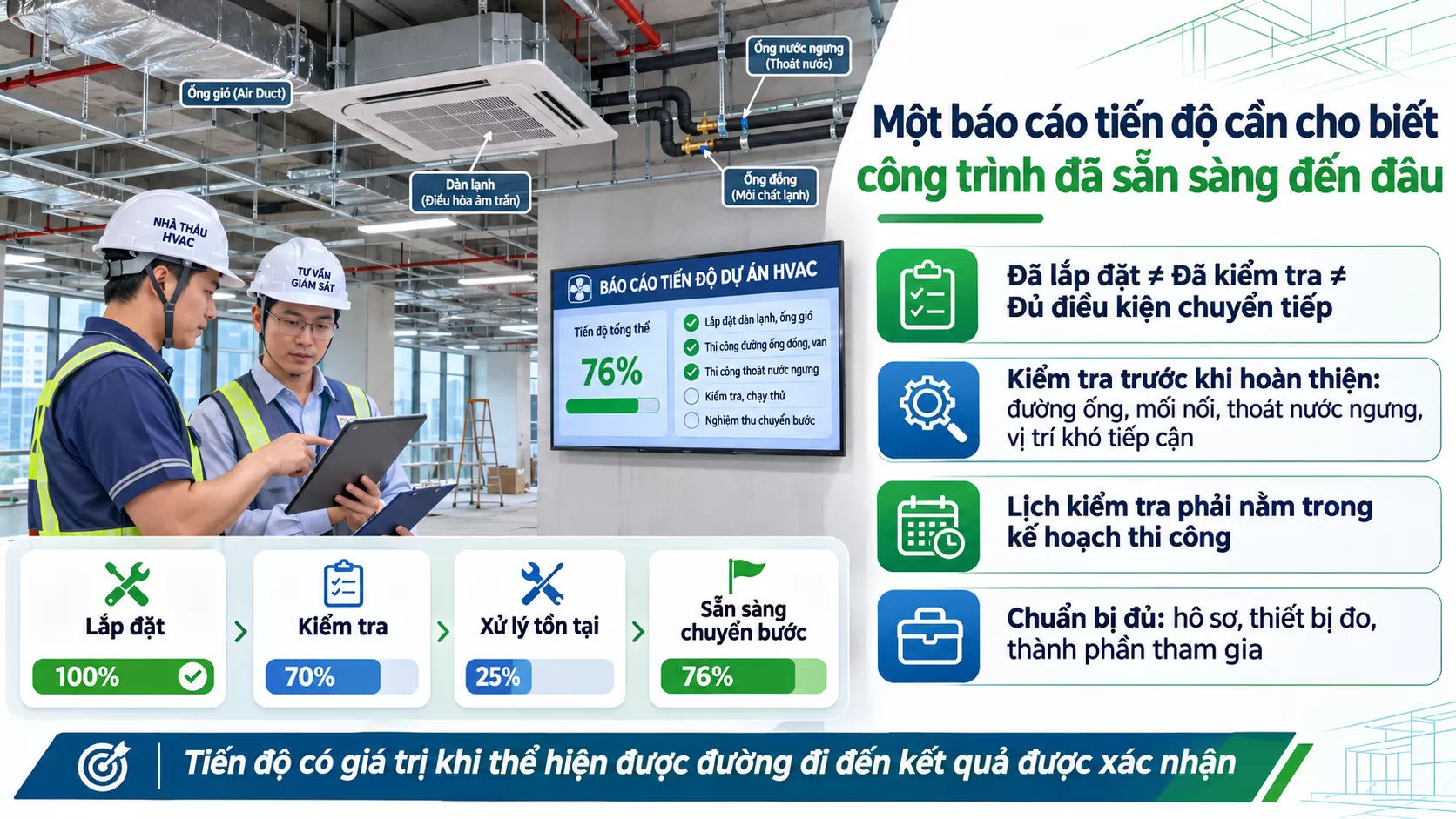
Distinguish installed volume from verified workload
Imagine an office floor that is about to close its ceiling. the indoor unit is hanging, the pipes are gone, and the air outlet is waiting for fitting. From the ground level, the air conditioning seems almost finished.
But suppose a condensate branch is still waiting for inspection, a valve position has no accessibility plan and the pipeline test results have not been assembled. In this situation, the “almost installed" information is not enough to decide on handing over the site to the finishing team.
The items that will be hidden should be inspected according to the project requirements before completion. The contents of inspection must be consistent with the system and actual location, especially for pipelines, joints, condensate drainage and parts difficult to access later.
I suggest the site report demonstrating the difference between the installed part, the tested part and the transitional eligible part.
This reporting method helps the manager to make more specific decisions. The area that has been met shall be organized for the next task. The area that remains in trouble shall be determined according to the scope to be retained, avoiding a general conclusion obscuring the situation of each task.
Incorporate the inspection into the site's production plan
When setting the pace, I want to see time spent testing, processing existing and re-confirming results.
If the plan only shows the date of installation and then moves immediately to the ceiling closure, the person in charge will have to find space for the verification work himself. I do not want the quality to depend on the time left over.
The inspection schedule should be discussed with the construction schedule. The person in charge must actively prepare documents, measuring equipment and participants in accordance with the requirements of the item.
For areas with quick finishing milestones, I prioritized clarifying transition conditions from the beginning. Then, the construction team knew how much they had to complete, and the inspection team knew when to be present.
Progress is valuable when it shows the path to confirmed results, not just to the date of installation completion.
Technical problems should be solved at the right level of responsibility

Do not push the design decision down to the person directly installing
In a situation where an air duct intersects with a cable chute, the installation team can see how to shift to continue the work. However, I don't want them to have to decide for themselves if a change is beyond the assigned scope.
Managers should bring matters to the right focal point for consideration. Proposal for handling must be compared with relevant subjects and clarified impacts before implementation.
What I was interested in in the collaboration meeting was not which side presented more difficulty. I needed the meeting to end with a responsible person and clear time for response.
If it is not possible to close immediately, the operator must know which parts of the work are affected and can organize manpower to another area. I do not want the construction team to continue to wait without a deadline, nor do I want them to handle themselves just to keep working rhythm.
Track your progress until you get results, rather than stopping at assigning tasks
In quality management, the existing track record has the role of recording the problem, the party responsible and the situation of handling. This is also a basis for tracing the decisions made during the implementation.
From that principle, I suggest that each problem has a follower throughout. This person does not necessarily do the whole work, but must know where the problem is and who needs to be involved in solving it.
A “passed on" response to technical support is not the final result. I would like to see that the plan has been agreed upon, work has been done and the affected part has been rechecked as requested.
In your next report, update the results instead of repeating the first name.
Every change at the site should be evaluated before approval
Supply convenience is not enough to decide on equipment replacement
Assume the approved model cannot be delivered on schedule, while the supplier suggests another device available. This is when the operator needs a clear enough exposition to consider.
I don't want to make a decision based solely on the recommendation of “equivalent capacity” or “the same brand”
Replacement documentation should be compared with design requirements and system-related conditions. Review of equipment documentation during commissioning also focuses on alternative proposals, discrepancies and the ability to coordinate between connected components.
From a management perspective, I ask the person submitting the plan to explain which parts are left unchanged, which parts must be adjusted and who is responsible for the work that arises.
If a new selection needs to modify drawings, add accessories or change the inspection plan, those must appear in the proposal. The reviewer needs to see the full implementation plan, rather than just seeing the equipment being delivered sooner.
Evaluate the cost of the whole disposal plan
When considering a change, I want the project team to take into account the work that needs to be done and the parts that might need to be redone.
A proposal with a lower purchase price may not be suitable for the project's objectives if many related items must be adjusted. On the contrary, a plan with a higher initial cost may still be worth considering if it solves important problems and fully meets the requirements.
This is a problem that needs to be solved, not concluded emotionally.
I also suggest separating the technical evaluation from the commercial balance. The person in charge of expertise shall certify the responsiveness; the operator shall consider the cost, resources and progress on the basis of such results.
A change decision should only be made when the reviewer understands both the benefits and the part of the work that is to be followed.
No accumulation of the quality of the entire system on commissioning date
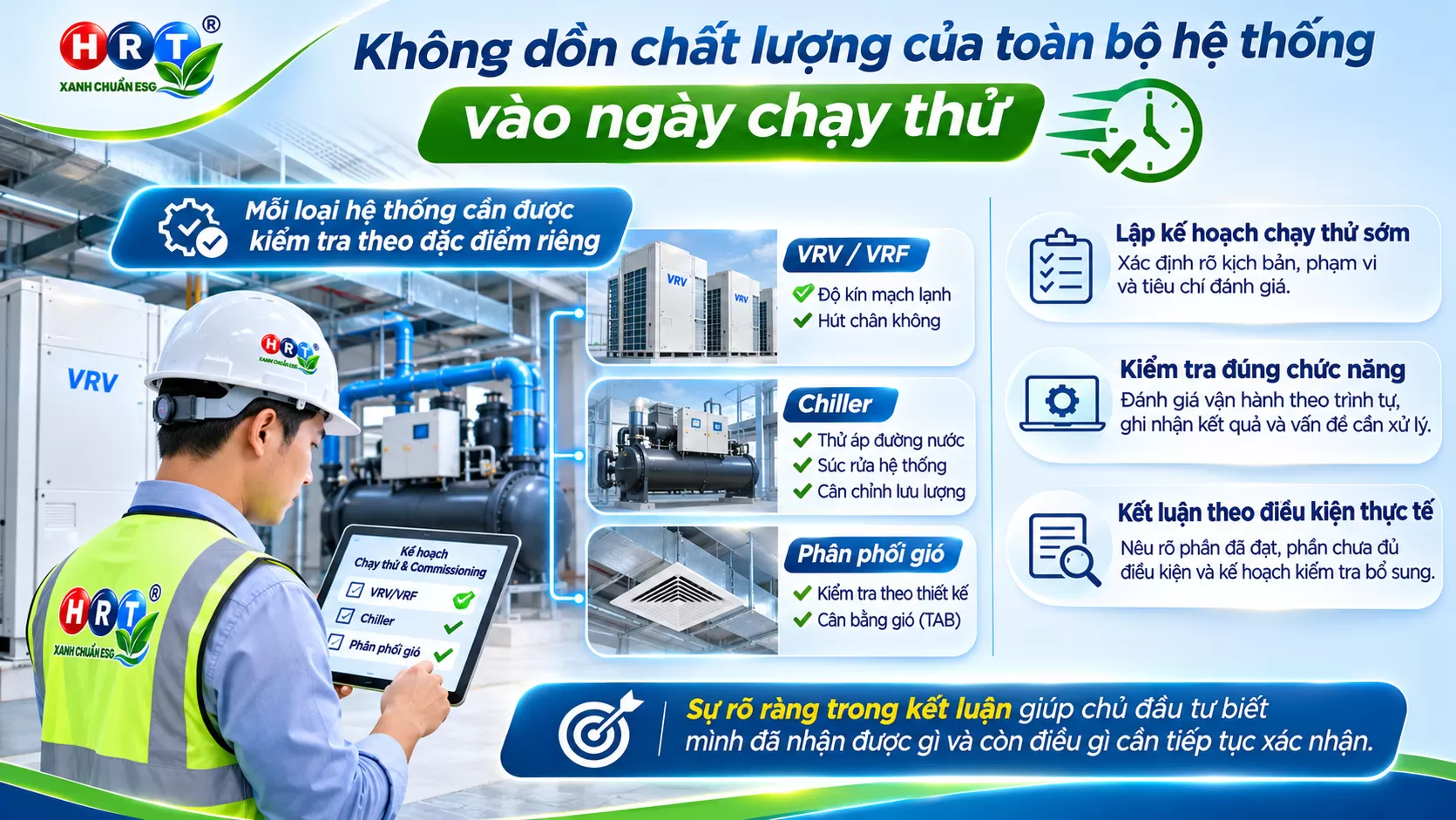
Each type of system needs to be tested according to its own characteristics
VRV/VRF has testing requirements related to refrigerant circuits, including airtightness and vacuum evacuation. Chiller system has its own contents on water, pressure testing, rinsing and adjusting flow rate. The wind distribution system should be tested according to the design requirements and air balancing capability. The test parameters must be based on the application records, do not use a common set of values for all configurations.
So when watching HVAC construction processI do not judge the quality by the length of the form. I want to know if the form helps the examiner make a conclusion for the right item being done.
A checklist with full cells but failing to identify the location, system code or inspection conditions will be difficult to serve the comparison.
I suggest that the record be organized in a way that others can review: looking at the results must know which parts of the work it is under and under what conditions. If there are subsequent adjustments, the person in charge should determine the contents to review.
Commissioning needs to reply if the system is functioning properly
Commissioning is the process of verifying and recognizing the ability of a system to meet requirements throughout the project phase. Its scope is wider than starting equipment at the end of the installation process.
From this approach, I want commissioning plans to be built before the date the site announces operation readiness.
The project team should agree on the situation to be tested and evaluated. For systems with coordinated control, the functional testing must consider the reaction of the system in the specified operation order, and record the results and problems to be overcome.
In the review meeting, I need to hear conclusions associated with specific scope. What areas have been checked? Which regimes have met? What contents still have to be handled?
I don't want a generic state like “normal machine” instead of this exposition.
Conclusion must reflect the verified conditions
There are tests that cannot be completed at the intended time of handover because of lack of loading conditions or suitable seasonal conditions. Commissioning guidelines take into consideration additional testing to confirm modes that have not been fully verified.
In that case, I suggest to specify the limits of the existing results and agree on the completion plan as required by the project.
The person in charge should indicate the remaining work, implementation conditions and the party responsible for monitoring. The next decision must be considered on the actual dossier, not using the results of the achieved part to broaden the entire system.
The clarity of the conclusion helps the project owner know what he has received and what needs to be confirmed.
Handover quality must be seen from the operator side
Invite the takeover to join before the construction is finished
I want the operations department involved when usability and maintenance issues are still communicable.
The early introduction of operation teams into the project process is an orientation mentioned by ASHRAE in operation and maintenance management. This involvement is associated with the need to receive documentation, organize asset management and prepare for the use phase.
During the review, I asked the supervisor to directly compare the field equipment with the records. They needed to be able to answer questions that would arise when the construction was in operation, rather than signing up for only one document on the last day.
I also want the tutorial to be based on the actual configuration of the project. The operator needs to understand which areas the system serves, how to use the agreed modes and contacts when support is needed.
Handing over information in a usable way
The way the organization proposes it, the code to the equipment on the scene should be a starting point for looking up relevant records.
When the operator finds a device, he or she should have access to the corresponding drawings, documentation, and test results without having to probe through multiple unconventional folders.
I don't judge a portfolio by its page count. I care about whether the recipient gets to use it.
For open content, hand over the status and monitoring mechanism. The operator needs to know which parts are being handled by the contractor, when it is possible to check again and who will confirm completion.
In my opinion, this is a way of keeping constant responsibility from the construction site to the mining stage.
CEO's View Đoàn Văn Hoàng: Protecting Progress with Well - Grounded Decisions

In Operating HVAC constructionI want the project team to report on the problem as soon as there's time to fix it.
A well - defined problem helps the manager choose a solution. A poorly informed report only makes decisions based on speculation.
When the progress is stressed, the manager's responsibility is to deal with the conditions that are hindering the work: finalize the pending plan, allocate appropriate resources and coordinate the parties in a feasible plan.
I don't want the pressure of handover dates to be a reason to skip the necessary vetting. If a milestone doesn't qualify, the project team has to explain the cause and suggest how to proceed, rather than just continue to commit.
With the project owner implementing air conditioning and ventilation systems, I suggest starting with a specific request in the nearest meeting: - To report clearly which areas have been eligible for step - change, which areas are still in difficulties and who are responsible for settlement thereof.
From there, progress and new quality can be managed on the same canvas.
Đoàn Văn Hoàng | CEO HRT
Right from the beginning – Clear to the end – Sustainable Green.
HRT – Green Breath for All Buildings
Source: Publisher’s English edition · Vietnamese original on doanvanhoang.com