
HVAC Duct Leaks: Signs, Causes, and Fixes
Machine-translated from Vietnamese. Read the original in Vietnamese

Leaks in flanges, joints, doorways, flexible junctions or VAV Boxes can cause HVAC system flow rate loss even though the AHU and fan are still running. Checking for the right cause helps restore efficiency and limit energy waste.
HVAC leakage duct: Causes, Known Signs And Effective Remedies
1. Overview of HVAC leakage duct phenomenon
In HVAC systems, ductwork plays a role in transporting and distributing air to each area of use. However, during construction or operation, the phenomenon of duct leakage HVAC can occur at sites such as joints, flanges, inlets, soft junctions or tube bodies.
Leakage not only reduces the efficiency of wind supply, but also directly affects the ability to control temperature, humidity, air quality and energy consumption of the whole system.
This is one of the issues that should be checked during the acceptance testing, TAB HVAC and maintenance ventilation air conditioning system.
2. The warning signs that the air duct system is leaking
The location of a leak is not always easy to see with the naked eye. Some common signs include:
Actual airflow rate lower than design
When the pipeline is exposed to air loss, the wind volume reaching the end areas of the line may not be satisfactory.
Common manifestations:
- The room was not cold enough despite constant air conditioning.
- The air supply is weak.
- The area near the AHU is subcooled but the far area is lacking in wind.
Difficulties in the process of air balancing TAB
During TAB HVAC, the technician needs to adjust the damper to distribute flow rate as designed.
However, if the system has a leakage point:
- Damper opens large but flow rate is still missing.
- Measurement results are unstable.
- The calibration takes longer.
Static pressure abnormal changes
Leakage changes the operation characteristics of the system.
If only checking pressure without evaluating pipe airtightness, it can lead to misconceptions such as:
- Fan's not working.
- AHUs are weak.
- Filter or coil clogged.
Appearance condensation area ceiling engineering
When cold air is released at the leakage site, it can combine with high humidity environments and cause:
- Water stagnation on the surface of the pipe.
- Insulation layer damage.
- There are stains on the ceiling.
- Impact surrounding equipment.
3. What does HVAC leakage duct affect?
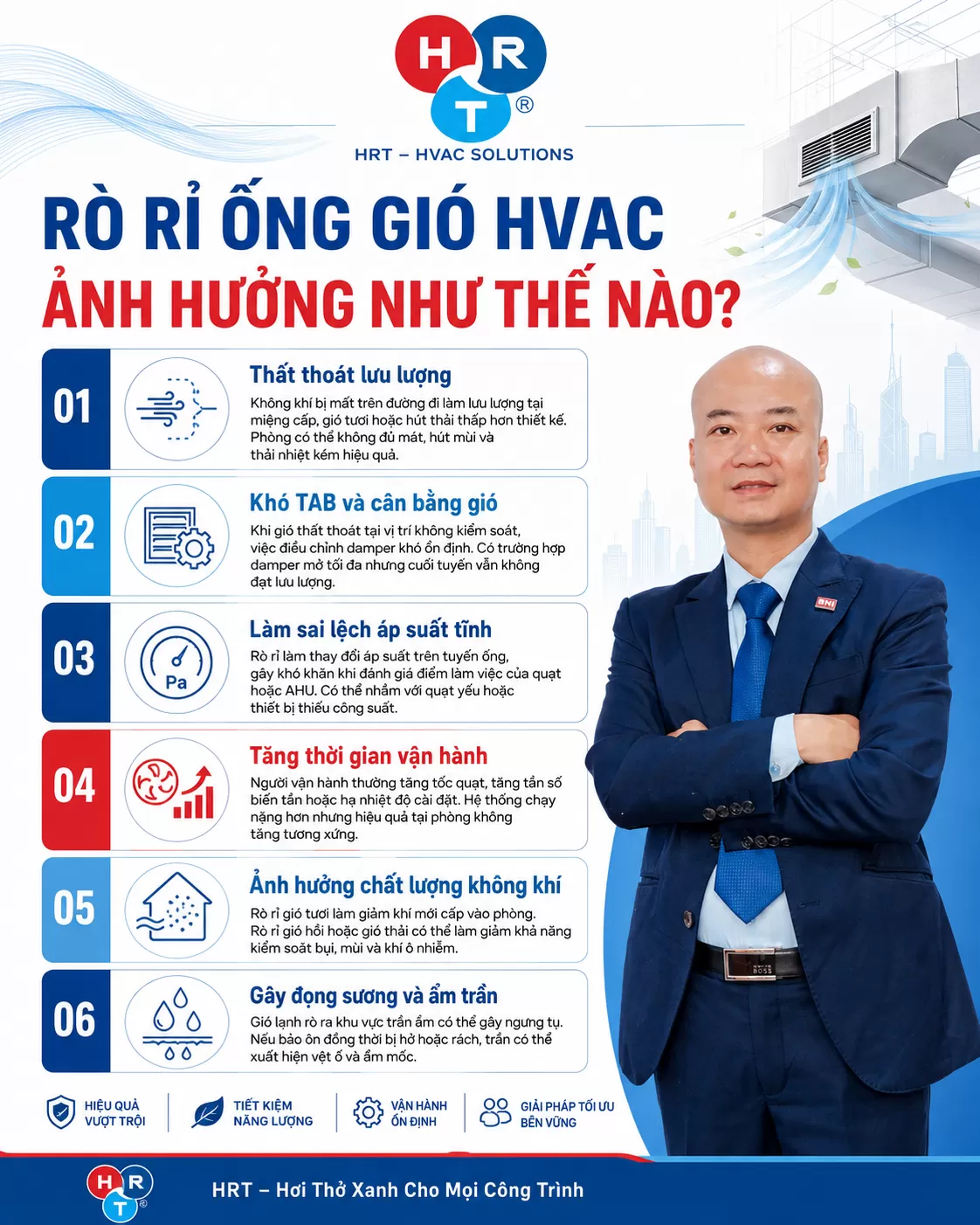
Reduce air distribution efficiency
Air is lost before reaching the area of use, causing the system to not reach the design flow rate.
This reduces the effectiveness of cooling, ventilation and controlling the environment in the room.
Increase operation costs
When airflow rate is lacking, the system should usually:
- Increase fan speed.
- Increase the operation time.
- Adjust the temperature lower.
This causes energy consumption to increase but the improved efficiency is disproportionate.
Effects indoor air quality
For outdoor air lines, leakage reduces the amount of clean air brought into the room.
For return air or exhaust air lines, leaks can cause:
- Vacuum up dirt.
- Spread the smell.
- Reduce the ability to control contaminated areas.
4. Common causes of HVAC leakage duct
4.1 Joints and non-sealed flanges
This is the most common cause.
Possible errors include:
- The gasket is in the wrong place.
- Airtight sealant is not guaranteed.
- The bolts squeeze unevenly.
- The angle of the graft is exposed.
4.2 Damaged tube body
During transportation, installation or coordination with other MEP systems, pipelines can:
- It's dented.
- Perforated.
- Cross section deformation.
With perennial system, vibration and humid environment also make the material degraded.
4.3 The soft splicing segment is faulty
Soften the connector at the AHU, fan or gas treatment device that is supposed to reduce vibration.
However, if:
- It's torn.
- The clamps aren't tight.
- Deflection fitting.
- Aging of materials.
This can become a major point of air loss.
4.4 Accessories on the non-closed route
The locations to be inspected include:
- The door.
- Damper.
- VAV Box.
- The wind box.
- Terminal Box.
- Air outlet.
4.5 Improperly renovating construction
When changing pipelines to avoid electricity, water, fire protection or structures, new connection points if not sealed treatment will increase the risk of leakage.
5. HVAC leakage duct test procedure
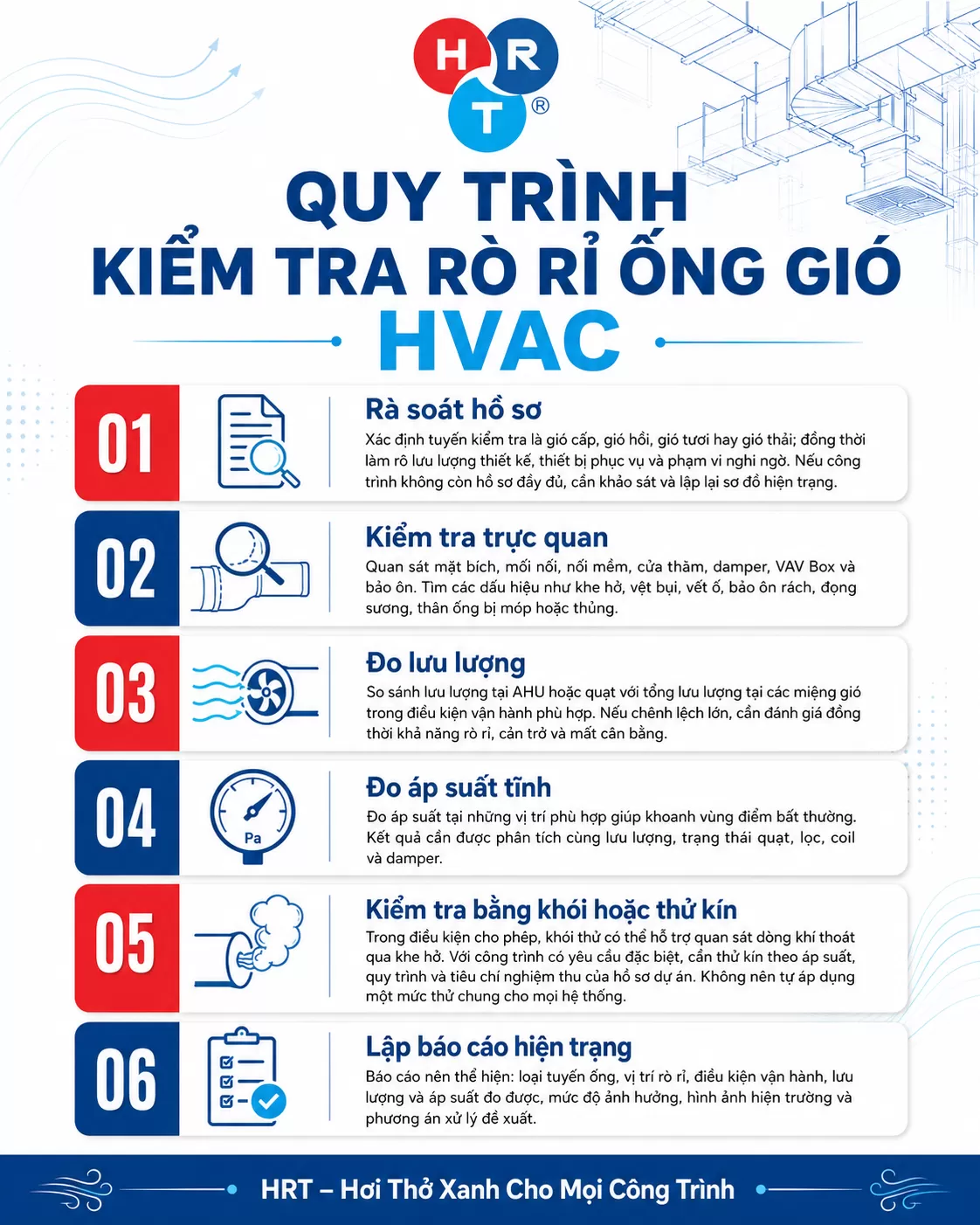
Step 1: Check the design documentation
Determine:
- Type of wind line.
- Flow rate design.
- Scope of inspection.
- Operation conditions.
Step 2: Surveying the current status
Direct Test:
- Flanges.
- The coupling.
- Soften the connection.
- The door.
- Thermal insulation.
- The tube body.
Signs to pay attention to:
- The gap.
- Dust trails.
- Condensation.
- Tear material.
Step 3: Measure flow rate and pressure
Compare:
- Flow rate at AHU/fan.
- Total flow rate at air outlets.
- Pressure on the gland.
The results should be evaluated with the same state of fan, filter, coil and damper.
Step 4: Test by leak testing method
Depending on the project requirements may apply:
- Smoke check.
- Measure leakage by pressure.
- Leak testing according to acceptance testing standard.
Step 5: Make report and propose handling
The report should show:
- Leakage location.
- The extent of the effect.
- Crime scene images.
- Operation conditions.
- Fixing solution.
6. HVAC leakage duct limiting solution
In order to operate the system stably, it is necessary to pay attention right from the design and construction stage:
- Execute according to the approved drawings.
- Use the right materials and accessories.
- Splice quality control.
- Continuous sealed thermal insulation.
- Check airtightness before acceptance testing.
- Perform TAB after completion.
See more:
Industrial Air Conditioner VRV
Industrial Air Conditioner Chiller
VRF Industrial Air Conditioner
Conclusion
Duct leakage HVAC is technical failure that can reduce operation efficiency, increase energy cost and affect environmental quality in the building.
The test of pipeline airtightness, correct evaluation of causes and treatment from the beginning help HVAC systems achieve the right design capacity, stable operation and long-term energy savings.
HRT – professional HVAC general contractor providing survey, design, construction, TAB and HVAC system operation optimization solutions for commercial and industrial buildings.
Source: Publisher’s English edition · Vietnamese original on doanvanhoang.com