
HVAC Energy Savings For Existing Buildings
Machine-translated from Vietnamese. Read the original in Vietnamese

HVAC energy saving solutions for existing buildings need to start from Energy Audit, baseline and operation data. HRT optimizes Chiller, VRV/VRF, AHU/FCU, pump, fan, BMS, VFD and Retrofit in the right direction, properly measured, properly analyzed, properly optimized and effectively verified.
HVAC energy savings should not start with replacing equipment
When the power of a building or factory is high, the common reaction is to immediately think about replacing Chiller, VRV / VRF system or invest in equipment with higher efficiency.
However, with existing construction, old equipment may not be the main cause.
An HVAC system can still consume a lot of electricity even if the equipment works well if:
- The operation schedule is no longer relevant.
- Setpoint set too low.
- Chiller running in the wrong load zone.
- Pump and fan are always running 100%.
- AHU or FCU is dirty.
- Valve and damper are not working properly.
- Sensor's off.
- BMS is not optimized.
- System operation overtime needed.
- Actual load has changed from the original design.
So the principle of HRT is:
Correct measurement → Correct analysis → Correct optimization → Re-measurement of efficiency.
5 groups of causes of high HVAC power consumption
Instead of viewing HVAC as an individual device, it is recommended to break the problem down into five groups.
Equipment
Includes:
- Chiller.
- Cooling Tower.
- VRV/VRF.
- AHU.
- FCU.
- Pump.
- Fan.
- Compressor.
- The engine.
Equipment may suffer performance degradation due to age, fouling, abrasion or no longer be suitable for current loads.
Distribution System
Chilled-water system or wind line may operate improperly designed.
Common problems include:
- Flow rate is too high.
- Flow rate is missing.
- An imbalance.
- ΔT is low.
- Excess pressure.
- Airflow is wrong.
Controllers
A good system but inappropriate control logic can still waste energy.
For example:
- Multiple Chillers running simultaneously at low loads.
- Pump runs 50 Hz continuously.
- AHU does not reduce flow rate when load is low.
- Setpoint is not load - reset.
- The device is still operating overtime.
Operation and maintenance
Dirty filters, dust-causing coils, wrong sensors or inappropriate maintenance schedules can all reduce performance.
Actual load
The building's function may have changed significantly over the years.
A system designed for 100% load should not default to operating in 100% mode when actual load is only 50–60%.
To save electricity, you must set up a baseline first.
One of the steps that is often overlooked is identifying Energy baseline.
The baseline is the state of reference energy consumption prior to optimal or retrofit implementation.
Without a baseline, it is difficult for businesses to answer the question:
How much did the renovation actually save?
What data should the baseline include?
May need to consider:
- Total HVAC power.
- Chiller power.
- Pump power.
- Fan power.
- Time of operation.
- Cooling load.
- Uses.
- Weather conditions.
- Number of users.
- Major changes in the building.
It is not recommended to compare only two electricity bills between two different months if operation conditions are not equivalent.
Energy Audit HVAC helps find where electricity is being wasted
Energy Audit is more than just checking your electric bill.
More importantly, the goal is to identify:
What device – what time – what operation mode is causing waste.
Documents to collect before survey
Useful data include:
- Electricity bills.
- HVAC drawing.
- Equipment catalogue.
- Design specifications.
- Operation log.
- Maintenance schedule.
- Trend BMS.
- Machine schedule.
- The errors have already occurred.
Parameters to be measured at the scene
Depending on the system, HRT may consider:
- kW of electricity.
- The current.
- Water temperature.
- ΔT.
- Water flow rate.
- Airflow rate.
- Pressure.
- Room temperature.
- Moisture.
- Pump speed.
- Fan speed.
- Valve status.
- Damper state.
- Setpoint.
When you have the data, the optimization moves from sensing to quantification.
Should optimize operation before investing large Retrofit
Not all energy - saving solutions require large CAPEXes.
HRT usually prefers to split the solution into three tiers.
1st Floor – No or little investment
Test Priority:
- Schedule.
- Setpoint.
- Sequencing.
- Sensors.
- Filter.
- Coil.
- Van.
- Damper.
- Balance the water.
- Air balancing.
This is a group of solutions that can create efficiency quickly if the previous system operation is not good.
2nd floor – Renovation of controls and auxiliary equipment
Considerable:
- VFD.
- BMS.
- Sensors.
- Controller.
- Load - driven control.
- Reset setpoint.
- Demand Control Ventilation.
3rd floor – Retrofit main equipment
When the device is no longer suitable can assess:
- Thay Chiller.
- Retrofit Chiller.
- Thay VRV/VRF.
- AHU renovation.
- Replace the pump.
- Replace the fans.
- Add HRV/ERV.
- Upgrade the control system.
The principle is:
Don't change the most -- change the right ones.
Optimal Chiller Must Look Whole System Chilled Water
A common mistake is to look at only the COP or kW/RT of the Chiller.
A high performance Chiller can still be in a poor operation system if:
- Pump consumes large electricity.
- Cooling Tower is not optimal.
- ΔT is low.
- The chiller is running at the wrong load.
- AHU requires too high water flow rate.
- BMS logic is not consistent.
Therefore, we need to look at the whole:
Chiller → CHWP → CWP → Cooling Tower → AHU/FCU → BMS
Optimize Chiller operation quantity
If multiple Chillers run at the same time but each machine only carries a low load, total plant efficiency may decrease.
Need to evaluate:
- Lead/Lag.
- Start/Stop.
- Sequencing.
- Load Sharing.
Track ΔT cold water
ΔT too low can increase pump flow rate and reduce the possibility of exploiting system capacity.
The cause may lie in:
- Van.
- Coil.
- Flow rate.
- Load.
- Hydraulic balance.
- Logic controls.
Optimal Cooling Tower
The condenser water temperature directly affects the working conditions of the chiller.
Therefore Chiller and Cooling Tower should not be optimized independently.
VFDs can save electricity, but they're not just a simple fixture.
VFD is particularly suited to variable loads.
Common applications include:
- Chilled-water pump.
- Condenser water pump.
- AHU fans.
- Cooling Tower Fan.
- Ventilation fans.
As demand decreases, motor speed can decrease.
However, the actual effect depends on:
- Profile loading.
- Number of hours of operation.
- Speed range.
- Hydraulic system.
- Wind system.
- Sensors.
- Logic controls.
Therefore, it is not recommended to advertise a fixed savings rate for every VFD project.
AHUs and FCUs can cause waste that is not easily recognizable
AHUs and FCUs typically operate for many years but are little reevaluated as a whole.
Dirty Filter
Filter increases pressure loss causing the fan to work more.
Dirty Coil
Thermal transfer capacity decreases, resulting in:
- Larger opening valve.
- Longer running time.
- Heat treatment capacity decreased.
Airflow rate sai
An AHU that runs mechanically well may still have unreasonable power consumption if the actual flow rate exceeds demand.
Control valve is not working properly
Valves may be:
- Stuck.
- Leak.
- Bad signal.
- The controls are unstable.
These errors are usually better detected when combining BMS trend with actual measurement.
Energy saving VRV/VRF should start from operation
With VRV/VRF, high catalog performance does not guarantee low actual power.
The system should be tested according to:
- Schedule of activities.
- Setpoint.
- Partitioning.
- Outdoor unit.
- Indoor unit.
- Filter.
- Refrigerant.
- Central control.
- Load used.
An area that is uninhabited but where an indoor unit still runs all day is a very obvious source of waste.
BMS is the foundation of long-term energy optimization
BMS has the greatest value when the system not only displays the status but also saves and analyzes the data.
Points to follow include:
- The temperature.
- Moisture.
- CO₂.
- Pressure.
- Flow.
- Machine status.
- VFD frequency.
- Van.
- Damper.
- Alarm.
- Runtime.
- Setpoint.
- Electricity.
From data trends, operation teams can detect:
- The machine runs overtime.
- Unusual setpoints.
- Sensor drift.
- The device is running too long.
- Chiller staging is not reasonable.
BMS is therefore an important tool of HVAC OptimizationBut it only works if the control logic is designed right.
Energy savings not at the expense of air quality
One way to reduce cooling load very quickly is to reduce the amount of outdoor air.
But that's not the right solution if it leads to indoor air quality deterioration.
The goal should be:
Enough outdoor air – at the right time – on demand – with reasonable energy.
Demand Control Ventilation
DCV can adjust the amount of outdoor wind according to actual needs at the appropriate application.
HRV and ERV
HRV/ERV can recover a portion of the energy from exhaust air flow to assist in outdoor air treatment.
This is the solution worth considering for:
- The hotel.
- The office.
- The factory.
- Hospital.
- The project has large outdoor air requirements.
Mistakes when implementing HVAC energy saving projects
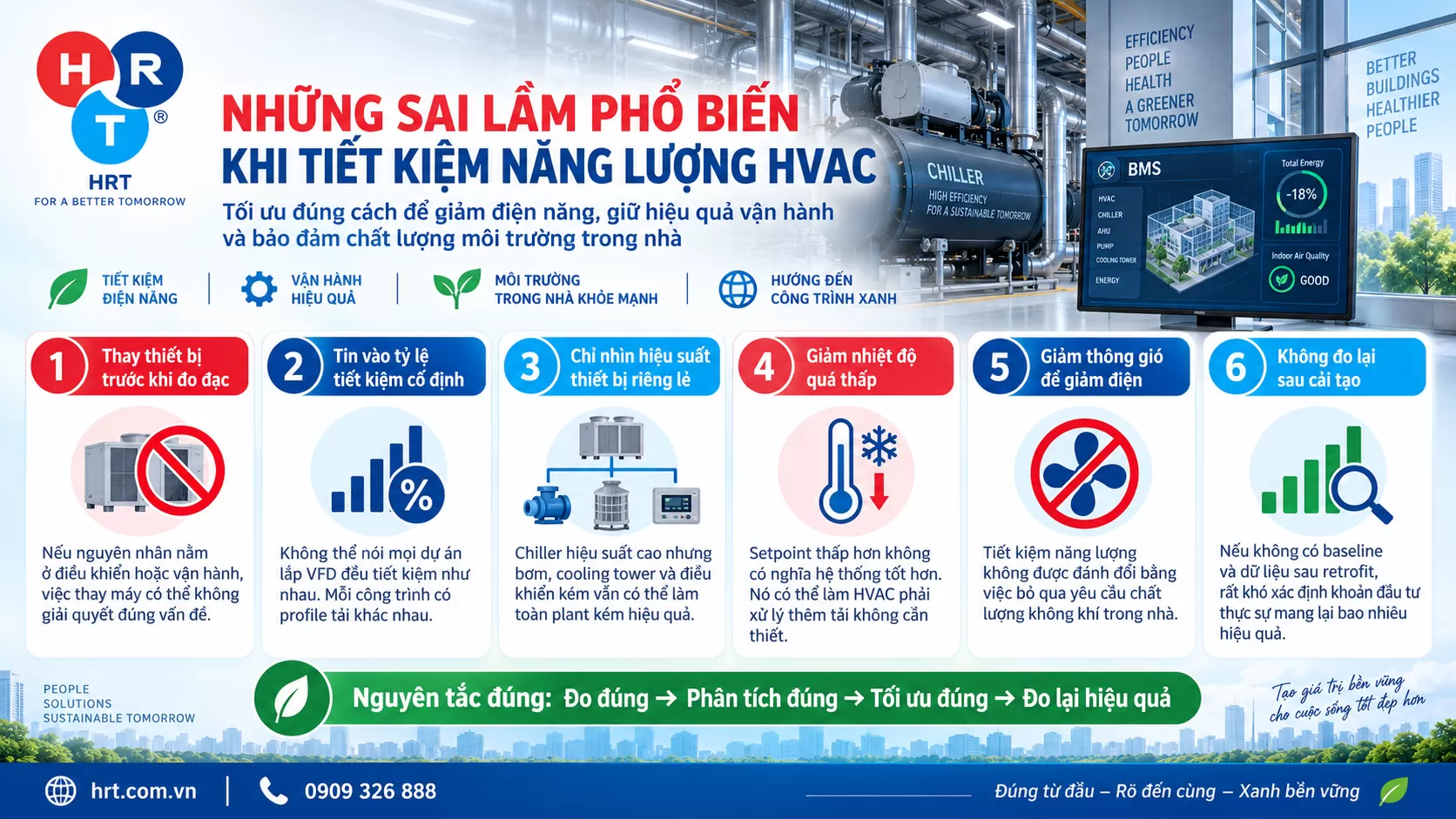
Replacement of equipment before measurement
If the actual problem is with the controls, replacing the chiller may not solve the root of the problem.
Believe in a fixed savings rate
It is not recommended to assert:
“VFD installation will save 30%"
The result must be based on the actual load profile.
Only look at the performance of each device
The HVAC system is a chain link.
Optimizing a Chiller but letting the Pump or Cooling Tower operate poorly can still make total plant efficiency low.
Setpoint too low
Lower temperature does not mean better system.
It can make Chiller, VRV or AHU handle extra unnecessary loads.
Reduce ventilation to reduce power
Don't save on electricity by sacrificing the quality of your home's environment.
No re-measurement after renovation
Without baseline and Measurement & Verification it is difficult to prove investment efficiency.
HRT process optimizes HVAC energy for existing buildings
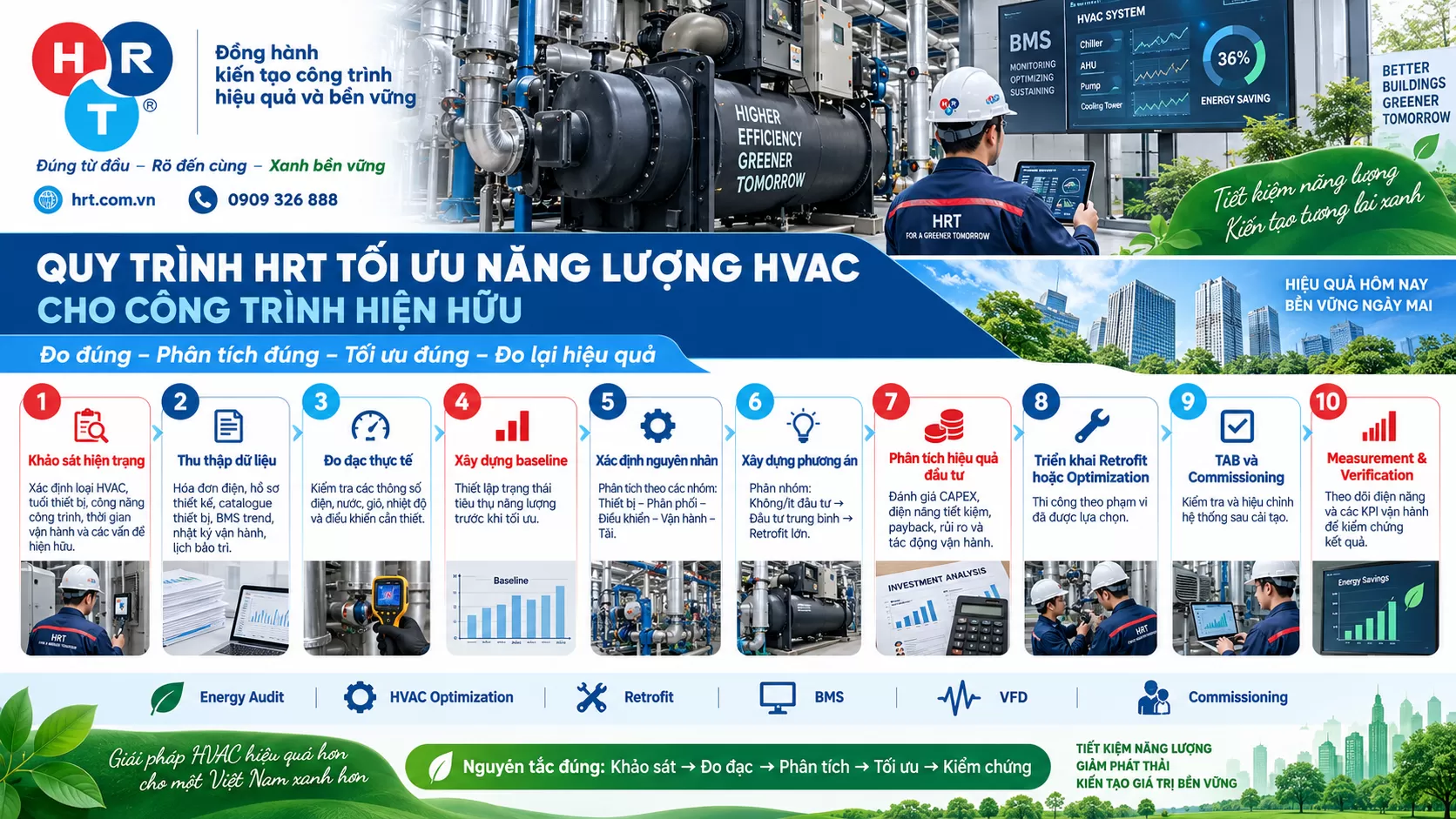
Step 1: Surveying the current status
Determine:
- HVAC architecture.
- Equipment age.
- Works function.
- Time of operation.
- The problems are there.
Step 2: Collect data
Gather electricity bills, drawings, catalogues, BMS trends and operation logs.
Step 3: Actual measurement
Measure electricity, water, wind, temperature and control parameters.
Step 4: Build a baseline
Set the state of energy consumption before optimization.
Step 5: Identify the cause
Analysis by five groups:
Equipment – Distribution – Control – operation – Load.
Step 6: Developing plan
Divided into:
Less investment → Average investment → Great retrofit.
Step 7: Analysis of investment efficiency
Rating:
- CAPEX.
- Power saving.
- Payback.
- Risky.
- Impact on operation.
Step 8: Implement Optimization or Retrofit
Execute according to the selected solution.
Step 9: TAB and Commissioning
Check, balance and adjust the system after renovation.
Step 10: Measurement & Verification
Track data to verify actual savings results.
Low CAPEX is not necessarily the best solution
When evaluating Retrofit projects, it is necessary to look at the life cycle instead of just comparing the initial price.
A solution should be evaluated according to:
CAPEX + OPEX + Energy Saving + Reliability + Maintenance + Lifetime
Simple Payback
Can be used:
Payback period = Investment cost / Annual savings
For example:
Retrofit Cost: 500 million VND.
Expected reduction in electricity value: VND 200 million/year.
Simple Payback Period:
500/200 = 2.5 years
However, this is only one of the criteria.
The benefits in addition to saving electricity
A good HVAC Optimization project can also bring:
- Reduce the incident.
- Increase your reliability.
- Increase the life of your device.
- Improve your amenities.
- Reduce hot and cold complaints.
- Reduce maintenance costs.
- Improve your management.
- Support ESG targets.
- Reduce indirect emissions from electricity.
Therefore, the kWh figure does not reflect the total value of the project.
KPI should be monitored after optimization
After Retrofit, HRT recommends monitoring KPIs instead of just looking at the total bill.
Chiller Plant
Trackable:
- kW.
- RT.
- kW/RT.
- COP.
- Load %.
Chilled Water
Follow up:
- Supply Temperature.
- Return Temperature.
- ΔT.
- Flow.
Pump
Follow up:
- kW.
- Hz.
- Pressure.
- Flow.
AHU
Follow up:
- Airflow.
- Static Pressure.
- Supply Air Temperature.
- Return Air Temperature.
BMS
Follow up:
- Runtime.
- Schedule.
- Setpoint.
- Alarm.
- Trend.
Data help assess whether the system is effective after months.
When should Retrofit instead of continuing repairs?
Retrofit should be seriously evaluated when:
- The equipment is too old.
- Low performance.
- Repair costs increase.
- Components are hard to find.
- No load response.
- BMS incompatibility.
- No more scalability.
- High risk of system stop.
- Equipment using old technology.
In this case, further repairs may be cheap in the short run but more expensive over the lifetime.
What HRT offers the optimal HVAC solution?
HRT provides consulting and implementation solutions for existing commercial and industrial HVAC systems, including:
- Energy Audit.
- HVAC Optimization.
- Retrofit HVAC.
- Chiller.
- Chilled Water.
- VRV/VRF.
- AHU.
- FCU.
- Cooling Tower.
- Pump.
- Ventilation.
- VFD.
- BMS.
- HRV/ERV.
- TAB.
- Commissioning.
- Measurement & Verification.
The transparency principle is:
Correct measurement → Correct analysis → Correct optimization → Re-measurement of efficiency.
HVAC Energy Saving FAQs
Does it need to replace the old chiller to reduce power?
No, no, no.
First need to determine the system is consuming high power due to Chiller or pump, Cooling Tower, load, control or operation strategy.
Are VFDs sure to save electricity?
There is no fixed rate for every building.
Efficiency depends on actual load and control.
Does BMS cut power right away?
BMS is a monitoring and control tool.
Economical efficiency depends on the logic, sensors and operation strategies built on BMS.
How long does the Retrofit project payback?
There's no common number.
CAPEX, energy saving, electricity price, operation hours and related benefits should be calculated.
Which projects should implement Energy Audit HVAC?
Especially suitable for:
- The factory.
- The office.
- The mall.
- The hotel.
- Hospital.
- Data Center.
- School.
- The building has a large chiller.
- VRV/VRF operation works for many years.
Do you need to measure again after Retrofit?
Yes, I'm.
Measurement & Verification is the key step to confirm the actual results and detect if the system has drifted from optimal state over time.
Conclusion
Save HVAC energy on existing buildings is not just about buying newer, more efficient appliances.
An effective project should answer four questions:
How much is the system consuming?
Where is the power being wasted?
Which solution brings the best effect?
How much did the renovation save practically?
Therefore, the proper sequence should be:
Energy Audit → Baseline → Optimization → Retrofit → Commissioning → Measurement & Verification.
With Chiller, VRV/VRF, AHU/FCU, pump, fan, ventilation and BMS systems that have been in operation for many years, synchronous optimization often brings better value than replacing individual equipment.
HRT – HRT Air Conditioning and Ventilation Company Limited
Website: hrt.com.vn
Hotline: 0909 326 888
Right From the Start – Clear To the End – Green Sustainable.
Source: Publisher’s English edition · Vietnamese original on doanvanhoang.com