
HVAC system maintenance: Control costs, reduce operational risks
Machine-translated from Vietnamese. Read the original in Vietnamese

CEO Đoàn Văn Hoàng – HRT chia share Ways to tell maintain System HQ HVAC to check control chi fee, Reduction risk ro and... term Buildup Cockroaches paragraph HQ onions.
HVAC system maintenance: Active cost, operation protection
When considering the budget maintenance HVACI don't want the conversation to be about the price of cleaning each piece of equipment or how many times the contractor goes to work.
What I need to understand is what issues are in control of the business after the expense. Is the critical area monitored properly? When will the abnormalities be dealt with? Does the operator have enough information to decide to continue using it, set a time for repairs or prepare an alternative?
Imagine a building that has just completed servicing. The records are full of cleaned machines, but one area is consistently reflecting a failure to meet cooling requirements. If the report does not explain this situation and does not identify what to do next, I do not consider it a clear enough basis for system management.
From my executive perspective, maintenance needs to help businesses be more proactive in operational decisions.
Maintenance budgets should be tied to the risks to control and the results to validate, rather than just the number of equipment that has been dealt with.
Prioritize maintenance from the level of impact on the operation of the work
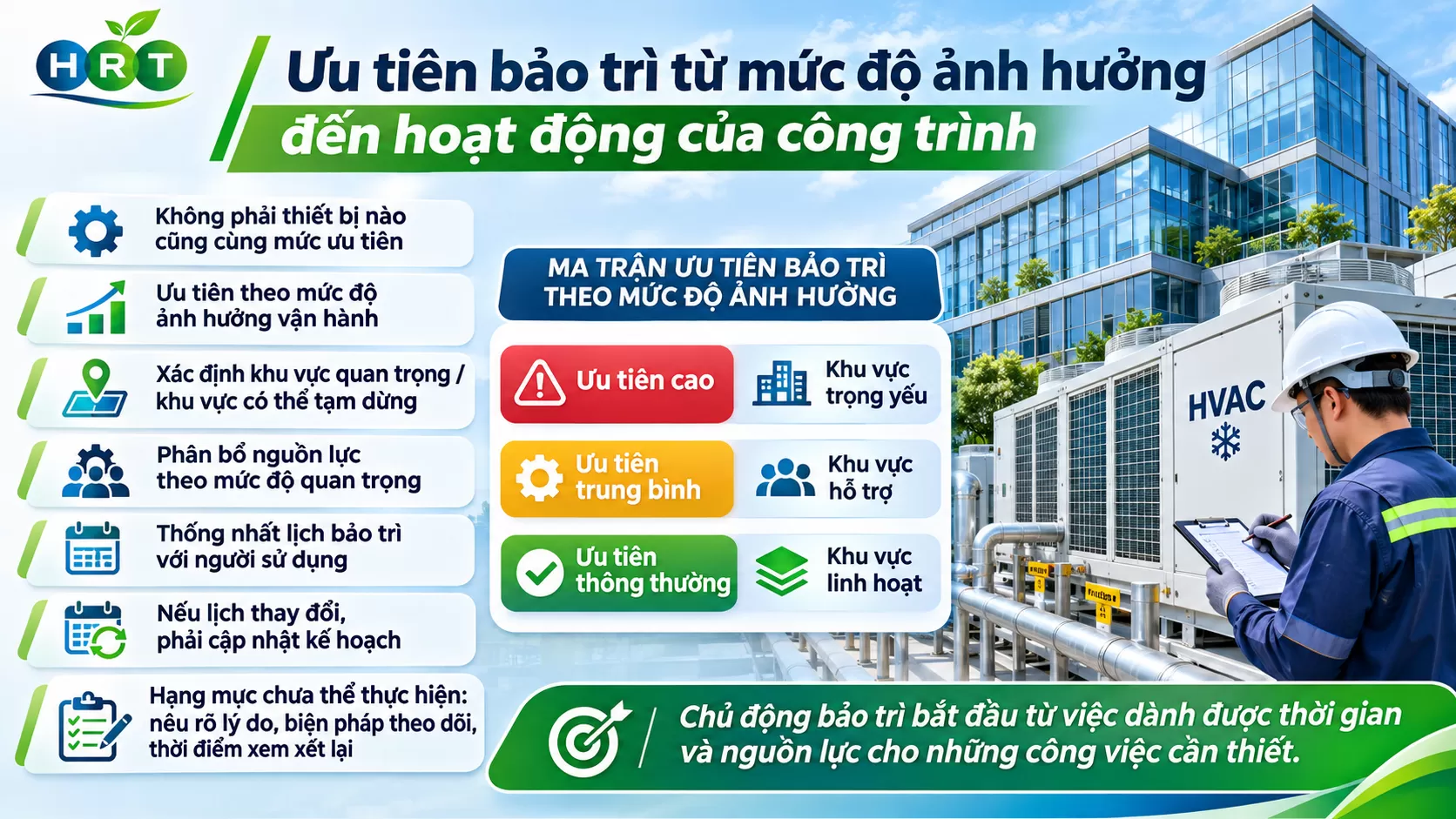
Not all devices need to be managed at the same priority level
Before I approve the plan, I want the engineering team to explain what the system is doing for the business.
A site that may be temporarily suspended for repairs will need to be organized differently from one that must maintain environmental conditions throughout the shift. Therefore, priority should not be determined solely by machine capacity or equipment value.
Reliability-based maintenance approaches consider the function of an asset, the consequences of its interruption and the actual conditions under which it is used to select the appropriate option. Resources are allocated in a critical order, rather than uniformly applied to every device.
In the management of the project, I suggest to put the list of equipment next to the ground for exploitation. The person in charge should specify a stopping system will affect which areas and whether the enterprise has alternative service plans or not.
From that information, determine which sections to closely monitor, which sections to prepare supplies for and which sections can be arranged into the usual servicing schedule.
I don't want a critical device to be left behind just because it hasn't had a recent repair.
Maintenance schedule should be agreed with users
A technical plan may be implemented only when the project is arranged and conditions for implementation are met.
I would like the operation and user to join in closing the schedule. The downtime should be discussed first, with the scope of impact and the restoration conditions.
If the mining schedule changes, the person in charge must update the plan instead of letting maintenance work be backed up several times without a clear decision.
For the unimplementable item, I suggest specifying the reasons, monitoring measures during the waiting period and the time to reconsider. The continuation of operation must be evaluated by a qualified person; no default that the device has not stopped may delay any intervention.
Proactive maintenance starts from saving time and resources for the necessary work.
The servicing cycle must be explained by the usage status

Scheduled arrival is a baseline, but does not yet reflect the entire demand
Maintenance frequency is usually built from manufacturer guidelines, applicable requirements and operational conditions. Actual inspection data should also be used to review the relevance of each job and duration of performance.
So when you get a proposal servicing central air conditionerI want to know why the engineering unit chose that cycle.
If the same schedule is applied to the entire building, the person submitting the plan should explain how they have considered the differences in environment, time of use and equipment condition.
I'm not asking for a mechanical increase in maintenance. I'm asking for a plan that can be changed when there's evidence that the current approach isn't working.
If an irregularity repeatedly appears between two servicing periods, the technical team needs to re-evaluate the inspection method or related causes. The continuation of the same schedule must have professional reasons, not just because the contract is stating such.
Follow up between two sessions so as not to forget open issues
I recommend that the post-maintenance report indicates what information the operator needs to continue to record.
For example, if the engineer needs to monitor an infrequent occurrence of a warning, clearly instruct the data to be saved and when to report it. If an item is waiting for supplies, it is necessary to determine who monitors the condition and who is responsible for notifying when changes appear.
The operations department should not have to guess the severity of a general comment like “continue monitoring".
In the way I proposed, monitoring should serve a purpose: to gather more grounds for further decisions. The person in charge should know when to pass on information to the engineer in charge, rather than waiting for the next maintenance visit.
Repeated error needs to be made into a problem to solve
Do not just confirm the device has been back to work
Suppose an indoor unit frequently appears drip water. Unit maintenance handles to equipment operation back, but after a while the phenomenon continues to appear.
In this situation, I want the records of the next processing to be compared with the previous one. The engineer needs to know where the intervention was made, how the results were checked and under what conditions the phenomenon recurred.
I don't want to start every visit to the site by collecting information that we've already had.
Another example is a suspected low-fluid VRV/VRF system. The addition of the fluid should not be considered the default job during each servicing period; it is necessary to check the cause and follow the manufacturer's instructions.
From an executive perspective, I would like to separate the recovery process from the unfinished cause evaluation. These two parts should be properly stated so that managers know what responsibilities to follow up on.
A recurring error requires an updated conclusion, not just a new processing record.
Considers the operation, instead of just finding errors on the device
The equipment being servicing may still be inappropriately operated if the running schedule or control settings no longer match the demands of use. ENERGY STAR notes that temporary demand servicing changes may be retained without an operation review process. ENERGY STAR
So I want these reflections on HVAC to be looked at along the way the building is working.
If a floor is converted to overtime work, a room changes functions or uses to adjust environmental requirements, that information should be reported to the technical person.
When suggesting changes to the installation, the engineer should explain the purpose and conditions of application. The results after adjustment must be checked, and updated to the operator.
I do not want the system to be managed with changes that only one individual remembers, while other shifts continue to follow the old guidelines.
Maintenance contracts need to clarify what the business will receive
Compare ranges before price comparison
When viewing HVAC maintenance quotes, I suggest the team in charge clarify the output of each proposal.
A plan that only includes routine cleaning should not be placed next to a plan that includes additional measurements, assessments, and support for abnormalities without differentiation.
The approver needs to know which part of the work is being paid for. How are consumable materials calculated? What mechanism should be approved for arising repairs? What results must be included in the handover dossier?
These questions should be addressed before signing, rather than waiting until the problem arises.
I also want to separate the time of receipt of the request, time of being at the work and the expected time of restoration of operations. When negotiating, ask the service unit to present the conditions that come with each commitment.
Businesses need a coordinated mechanism that can be implemented, not just a “quick support” in the price offer.
Close followers for unfinished tasks
In the management I propose, each exists after maintenance needs a clue to receive and monitor business.
If the work is awaiting approval of funding, the report must show the proposal that needs to be decided. If the plan is awaited for the contractor to provide, there must be a time to respond. If the correction is completed, it is necessary to arrange inspectors within the assigned scope.
I don't want a content trail between us because we both think we've transferred information.
Interventions involving electricity, solvents, pressure or moving parts must be made by appropriate personnel, after identifying and controlling hazardous sources according to the applicable procedure. Progress requirements do not replace safe working conditions.
Maintenance efficiency should be evaluated by the results can be compared

No conclusions save electricity only from lower bills
The energy consumption should be considered in the same weather, operating time, usage and actual load. When determining the savings, measurement and verification methods must consider these changes to make a baseline comparison.
For example, if maintenance months have fewer business days, I do not approve of attributing all the reduced electricity to servicing.
The evaluating unit should state the measuring scope, data used and the assumptions still existing. If there is not enough information to determine the saving level, write the limit of results.
I still want to acknowledge the proven improvements, but not turn an observation into an economic commitment for the whole year.
Reports must serve subsequent management decisions
With the periodic report, I prioritize seeing the change over the last one.
Has a warning expired or is it still recurring? Has an area that was previously unsatisfactory been re-checked? Is the pending item handled as planned?
These help me determine what to promote and what expenses to consider.
I don't require every building to have a complex tracking system right away. What we need to do first is to choose the information that really serves management, agree on how to record and maintain up-to-date responsibility.
A valid maintenance report must help the recipient decide what, on what grounds.
Separate servicing needs from repair and replacement decisions
When budgeting, I want proposals to be purpose - specific.
The planned maintenance work should be presented separately from the irregular repairs. Items to be renovated or replaced should have appropriate documentation, not implicitly included in an “maintenance incurred".
The selection of equipment management plan should consider service requirements, importance, costs and consequences when equipment fails to meet. These are also factors mentioned by ASHRAE when assessing maintenance strategy.
From there, I propose each alternative proposal to clearly explain the continued usability of existing equipment and the conditions under which the new plan will work.
I don't choose to replace the machine just because the device is old. Nor do I want to constantly browse for repairs without reviewing the entire cost history and operational impact.
If the project is to be continued, specify what needs to be done and how it will be monitored. If replacing, specify the scope of investment, time for implementation and how the project will be serviced during the transition period.
The decision should be made while the business is still able to choose, rather than just when the system has stopped.
CEO's view Đoàn Văn Hoàng: good maintenance must help businesses be more proactive
In Management maintenance HVAC systemI want every round of work to add to my understanding of the state of the building.
The operator needs to know what has been confirmed. The engineer needs to point out the unconfirmed content. The operator needs to see the pending decision and the consequences of further delays.
When proposing a budget, tie the expenditure to a specific goal. When an abnormality is detected, assign a follower until results are available. When evaluating efficiency, use data that matches operational conditions.
For businesses preparing maintenance plans, I suggest starting by reviewing the most recent batch: What are the issues that have not been addressed, who is in charge and when should they be decided?
The answer will help to define priorities for the next stage more clearly than a portfolio copied from the previous year.
To me, the value of maintenance lies in its ability to help businesses better prepare, use a well-grounded budget and hold accountability throughout the operation.
Đoàn Văn Hoàng | CEO HRT
Right from the beginning – Clear to the end – Sustainable Green.
HRT – Green Breath for All Buildings
Source: Publisher’s English edition · Vietnamese original on doanvanhoang.com