
HVAC System Renovation: When Should You Invest? | HRT
Machine-translated from Vietnamese. Read the original in Vietnamese

HVAC renovation is not just about replacing old equipment with new equipment. HRT sharing method to determine the time of investment, select priority items, control risks and evaluate renovation efficiency by actual data.
HVAC System Improvement: Investing at the Right Time, Controlling Costs and Improving Operation Efficiency
A central air conditioning system that has been in operation for many years does not necessarily need a complete replacement. On the contrary, a normal cooling system is not necessarily working effectively.
This is a problem that many project owners, building management and manufacturing enterprises face when the cost of electricity increases, equipment deteriorates or the demand for the use of the work changes.
HVAC Retrofit is the process of selectively assessing, adjusting, repairing, upgrading or replacing components of air conditioning and ventilation systems to better meet current operation requirements.
It's not just how much money you invest, it's what it solves, how long it lasts, and what metrics it can test.
From the CEO's perspective Đoàn Văn Hoàng, HRT approaches HVAC renovation as a technical investment decision that needs to be evidenced by data.
Why Do You Need to Reassess Your HVAC System?
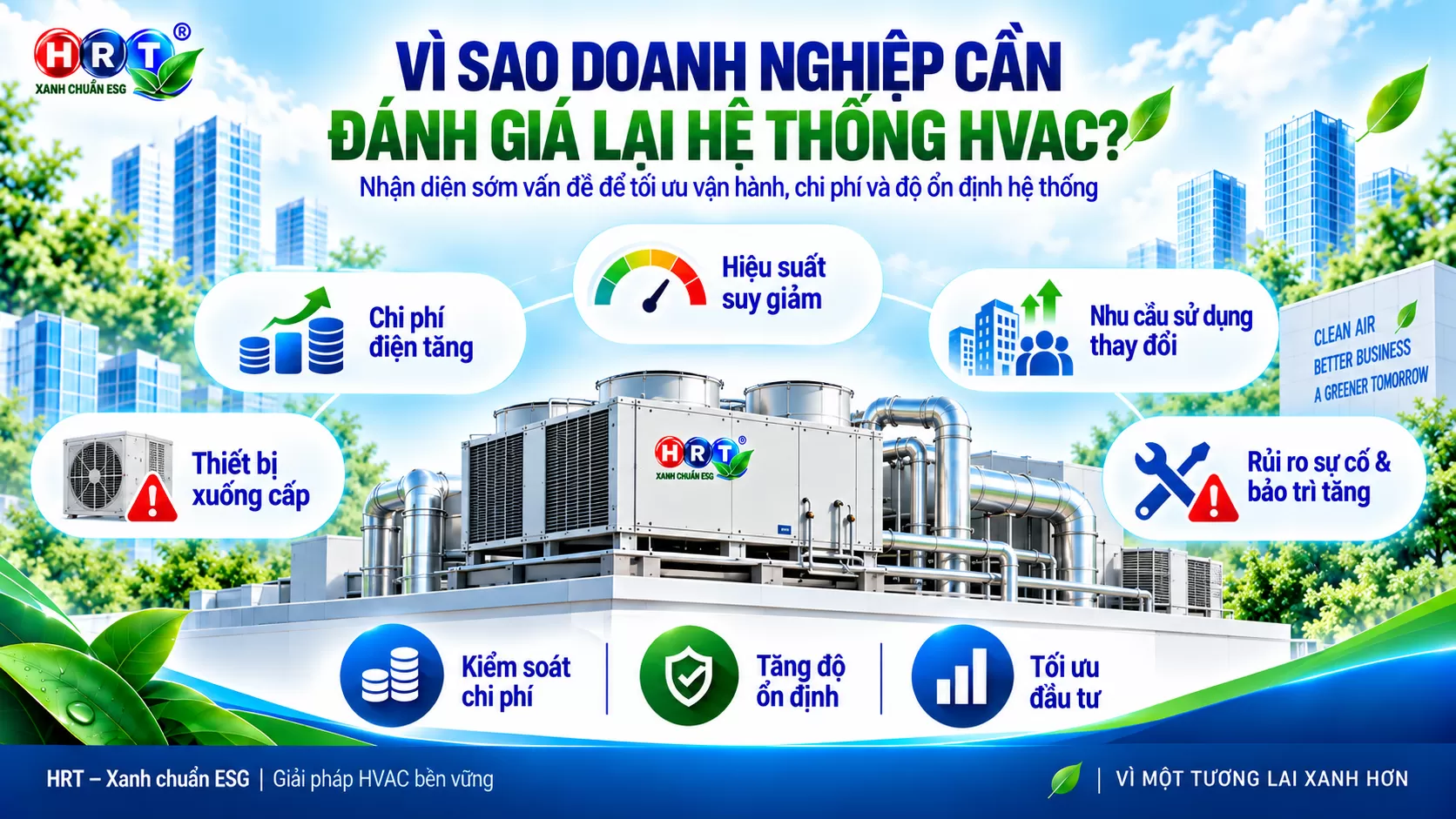
The device is still running but the efficiency may have declined
In fact, many HVAC systems continue to operate despite the appearance of abnormal signs:
-
Power consumption increased despite no significant change in lifetime.
-
Some areas may not reach the required temperature.
-
Chillers, pumps or fans operated for prolonged periods of time under conditions not yet optimal.
-
Devices that frequently report errors or require repair.
-
Temperature and humidity between areas are uneven.
-
The control system is no longer suitable for actual use.
-
Increased maintenance costs and unplanned downtime appear more frequently.
Each of these can have a variety of causes.
For example, high power consumption of chillers is not necessarily due to compressor degradation. The cause may lie in inappropriate water flow rate, dirty heat exchanger, high water condenser temperature or the way of coordinated operation between equipment.
If you replace the chiller without addressing the system causes, the investment efficiency may not meet expectations.
The work function changes making the original system no longer suitable
An office building designed for a certain density of use can be converted into a flexible workspace with a higher density of people and equipment.
Similarly, an additional plant production line may generate additional thermal loads, ventilation requirements or humidity control.
These changes have a direct impact on:
-
Actual cooling load.
-
Supply airflow and outdoor air.
-
The need for humidity control.
-
Room pressure.
-
Time of operation.
-
The responsiveness of the control system.
Therefore, HVAC renovation should begin from the redefinition of demand, not only based on the condition of the device.
When to Renovate HVAC Systems Instead of Continuing Repairs?
There is no one age-old device that fits every HVAC system.
The decision on renovation should be based on the technical status, reliability, ability to provide components, requirements of functions and future operation costs.
Three situations that need to prioritize renovation assessment
Situation 1: System malfunctions frequently
If the repair costs increase continuously, the waiting time for components is prolonged or the problem affects the business operation, businesses should evaluate the replacement plan of each part or the entire assembly of equipment.
Situation 2: Operational costs are no longer reasonable
When data shows an abnormal increase in power consumption after adjustment to load, weather and operation schedule, actual performance should be tested to determine the possibility of improvement.
Situation 3: The system does not meet the new requirement
If the building changes function, expands area or lifts environmental control requirements, renovation may be necessary even if the equipment has not reached its service life.
Not all items need to be replaced
HRT recommends classifying items in four processing directions:
|
Status of the |
Action Direction |
|---|---|
|
The device is still good but the operation is not optimal |
Adjustment and correction |
|
Devices with fixable errors |
Repair, maintenance |
|
Equipment is no longer suitable for the needs |
Upgrade or replace |
|
Items still meet the requirements |
Continued use and follow-up |
The principle is to invest only when you have identified the problem and the expected return.
Five HVAC Improvement Solutions Businesses Should Consider
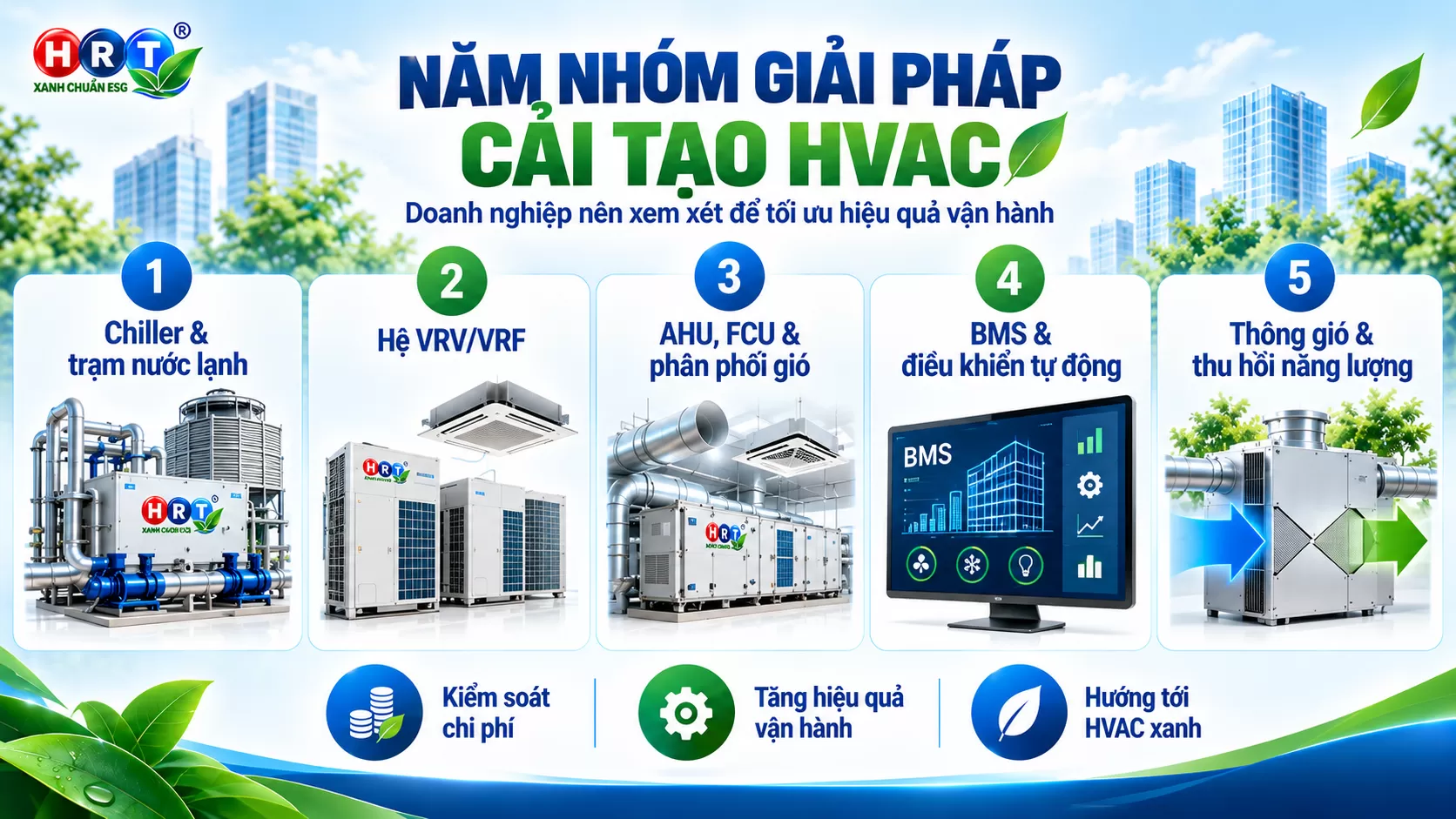
1. Upgrade Chiller system and cold water station
For central air conditioning systems using cold water, operation efficiency depends on the entire equipment assembly, not just Chiller.
The items to be considered include:
-
Replace Chiller that is degraded or not suitable for load.
-
Renovation of chilled-water pump and condenser water systems.
-
Check and adjust the water flow rate.
-
Upgrade cooling tower system.
-
Optimize the sequence of multiple Chiller operation.
-
Check control valves, sensors and piping systems.
-
Improved power monitoring and performance.
The choice of new chillers should take into consideration performance at actual operational loads, design temperature conditions and the ability to integrate with existing infrastructure.
Do not rely on the nominal power or initial purchase price alone.
2. Renovation of central air conditioning system VRV/VRF
For constructions using VRV/VRF, renovation plans can focus on:
-
Replace the broken outdoor unit or indoor unit.
-
Check the refrigerant pipeline for reusability.
-
Evaluate compatibility between old and new equipment.
-
Upgrade the central control.
-
Adjust the partition used.
-
Check condensate drainage.
-
Improve ventilation and heat exchange conditions of outdoor unit.
It should be especially noted that not every old pipeline or indoor unit can be combined with a new generation of equipment.
Reusability must be confirmed according to the manufacturer's instructions, actual condition and relevant safety requirements.
3. Upgrade AHU, FCU and air distribution system
A large enough cooling capacity air conditioning system may still be unsatisfactory if the air distribution process is inefficient.
Items to be inspected include:
-
Supply airflow and return air.
-
Pressure drop ductwork.
-
Filter and heat exchanger status.
-
Fan and motor performance.
-
Ability to air balancing between areas.
-
Air outlet position and uneven distribution phenomenon.
-
Thermal insulation conditions and condensation risk.
Depending on the survey results, enterprises may choose to replace fans, add speed control, renovate ductwork or implement system balance.
4. Upgrade BMS and automatic control system
One of the renovation directions worth considering is to optimize control logic before investing in large equipment replacement.
Functions that can be deployed include:
-
Schedule operations according to their functions.
-
Adjust the temperature setting point according to the conditions of use.
-
Monitor device status.
-
Error warnings and troubleshooting history.
-
Coordinate Chiller, Pump, Fan and Auxiliary Equipment.
-
Collect power data.
-
Analyze operation trends to detect abnormalities.
However, BMS does not automatically guarantee power saving. Efficiency depends on sensor quality, control logic, integration capabilities and post-implementation calibration.
5. Improve ventilation and energy recovery system
For projects with large outdoor air demand, it is possible to evaluate solutions such as HRV/ERV, demand-driven ventilation control or improve fan efficiency.
When choosing, it is necessary to take into account:
-
Outdoor airflow requirement.
-
Thermal load visible and hidden load.
-
Air humidity.
-
Pressure differential.
-
Pressure drop through device.
-
Risk of cross-contamination between airflows.
-
Ability to maintain, clean and change filters.
Each solution must be evaluated in terms of specific climate and operation rather than the default that adding energy recovery equipment always brings economic efficiency.
Evaluate HVAC Investment Efficiency By Life-cycle Cost
Why does the purchase price of equipment not reflect the total cost?
When comparing two renovation options, many project owners often focus on the total initial investment.
However, the actual cost also includes:
-
Power consumption.
-
Periodic maintenance costs.
-
Repair and components costs.
-
Cost of downtime due to malfunction.
-
Personnel operation costs.
-
Future replacement costs.
This is why it's important to consider life - cycle cost (LCC) or total cost of ownership (TCO).
A lower - cost device may not be a more economical option if it consumes a lot of electricity or incurs high maintenance costs over its lifetime.
Calculation examples of HVAC renovation efficiency
Assume a work has electricity data and renovation plan as follows:
|
Targets |
Assumed value |
|---|---|
|
HVAC power current |
600,000 kWh/year |
|
Expected power drop |
15% |
|
Energy Saving |
90,000 kWh/year |
|
Assumed average electricity price |
2,200 VND/kWh |
|
Electricity savings expected |
198 million VND/year |
|
Total investment capital for renovation |
600 million VND |
Simple Payback Period:
In this example, the payback period is about 3 years.
This is just an illustration, excluding fluctuations in electricity prices, changes in maintenance costs, capital costs, taxes and the time value of money. The 15% savings are not committed to efficiency for every project.
With the actual project, HRT recommends formulating at least three scenarios: cautionary, baseline and positive.
Six-Step Process For Controlled HVAC Deployment
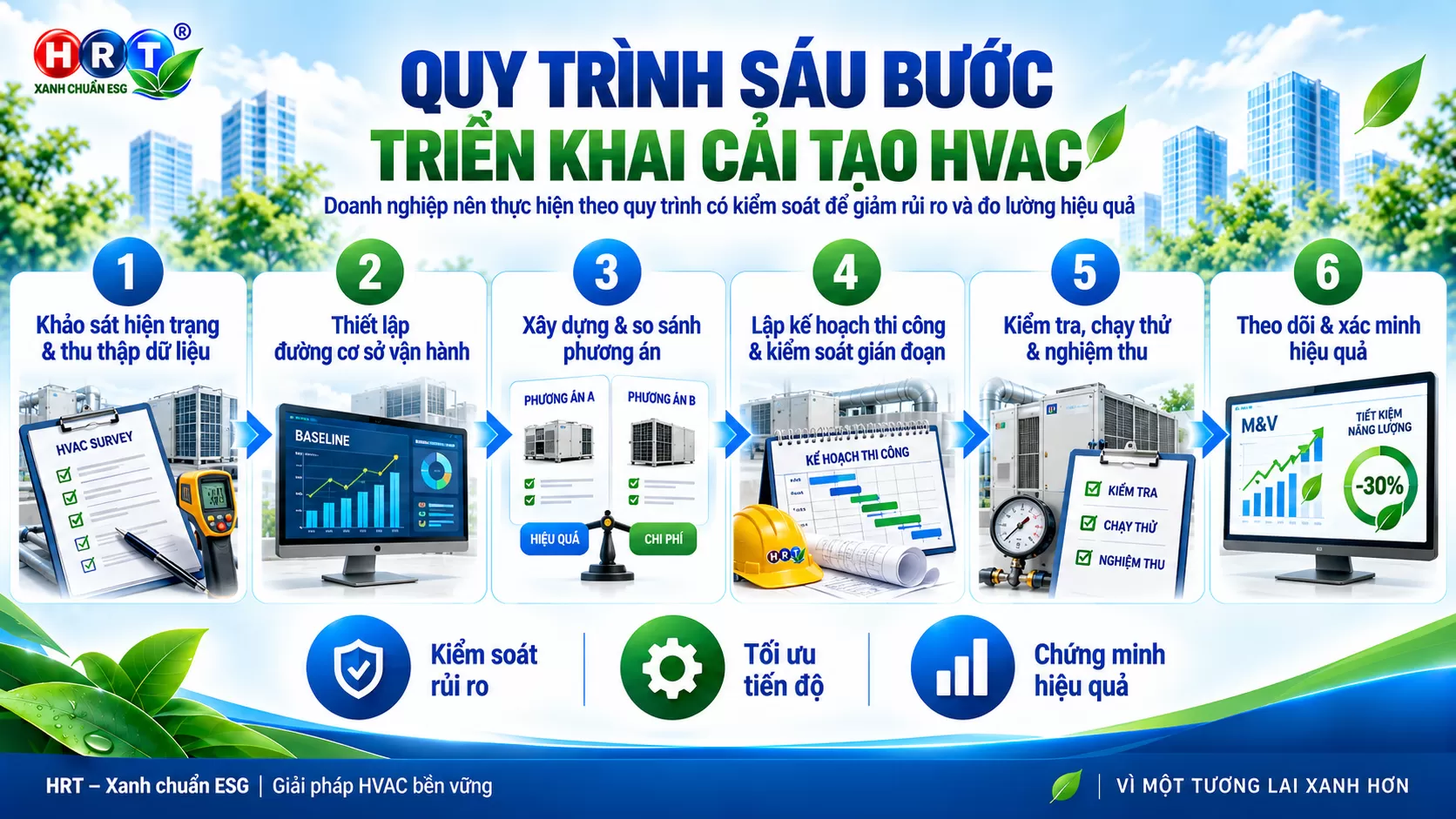
Step 1: Surveying the current status and collecting data
Before recommending the device, it is necessary to collect:
-
Design documentation and as-built.
-
List of existing equipment.
-
History of operation and maintenance.
-
Electricity bills or meter data.
-
Incident log.
-
Temperature, humidity, flow rate and pressure parameters.
-
Requirements for each area's function.
The more complete the data, the better the chance of pinpointing the right cause.
Step 2: Set up the operation baseline
The baseline is the basis for evaluating the system before renovation.
Energy consumption, load conditions, weather, schedule of operation and other influential factors should be determined.
When evaluating the post-renovation efficiency, significant differences in operation conditions must be adjusted to avoid false conclusions.
Step 3: Develop and compare the plans
Don't just offer one option.
Depending on the current situation, it is possible to consider:
-
Option A: maintenance, repair and correction.
-
Option B: Renovation of some equipment or system assemblies.
-
Option C: Replace the main equipment and upgrade the control.
-
Plan D: Overall renovation according to the multi - stage roadmap.
Each plan should clearly indicate the expected costs, benefits, risks and extent of impact on the work operation.
Step 4: Construction planning and interruption control
For active buildings, HVAC renovation is often more constrained than new construction.
The Contractor shall clarify:
-
Time allowed to stop the system.
-
Temporary cooling or ventilation options if needed.
-
Conditions of transportation, hoisting and lowering equipment.
-
Ability to access technical areas.
-
Electrical, mechanical and fire safety measures.
-
Plans for handling equipment, supplies and refrigerant dismantling.
-
Plan for coordination between parties.
A good technical plan must protect both the construction progress and the business operation of the project owner.
Step 5: Testing, commissioning and acceptance testing
After renovation, the system should be inspected according to the agreed scope and criteria.
The contents may include:
-
Check mechanical and electrical installation.
-
Check airtightness and pipe quality.
-
Check water flow rate, airflow rate.
-
Balance the system as needed.
-
Sensor and control test.
-
Commissioning of operation modes.
-
Interlocking and warning.
-
Test operating parameters.
Commissioning requires documentation and measurement results, not just a successful device startup.
Step 6: Monitor and verify the effectiveness after renovation
After handover, data should be collected to evaluate the results.
Measurement & Verification (M&V) can be used, refer to IPMVP framework in accordance with the project scope.
Indicators to monitor may include electrical power, system performance, temperature, humidity, number of breakdowns, and downtime.
A renovation project can only prove effective when the results are measured under suitable comparative conditions.
Source: Publisher’s English edition · Vietnamese original on doanvanhoang.com