
HVAC System Renovations and How to Avoid them
Machine-translated from Vietnamese. Read the original in Vietnamese

Renovating your HVAC system isn't about replacing old equipment. Miscalculation of cooling load, ignoring compatibility, incomplete acceptance testing or failure to evaluate the effectiveness after renovation can all cause investment waste. HRT analyzes 5 common mistakes and guides project owners to choose an effective, safe and sustainable HVAC Retrofit solution.
Common Mistakes When Renovating HVAC Systems – Identifying the Right One for Effective Investment
HVAC System Renovation is the solution chosen by many project owners when the existing air conditioning and ventilation system degrades, consumes large power or no longer meets the actual use needs.
However, not all renovation projects have been as effective as expected.
In fact, many investment projects replace equipment with large costs but high power consumption, uneven cooling or unstable operation continues.
The cause may not be the quality of new equipment but from the errors right in the process of survey, calculation, solution selection and acceptance testing.
An effective HVAC Retrofit project needs to address the right causes, select the right solution and verify the results after putting into operation.
The following article analyzes 5 common mistakes that project owners, building management and technical teams need to avoid when performing HVAC system renovation.
Why HVAC renovation is not effective despite the investment of new equipment?
HVAC system is a combination of many technical components that are closely related to each other, including:
-
Central cooling equipment Chiller or VRV/VRF.
-
AHU, FCU, PAU system.
-
Pumping system and chilled-water pipe line.
-
Air duct and fan ventilation system.
-
Electrical system and automatic control.
-
BMS/BAS system.
-
Measurement devices, sensors and accessories.
The overall performance of the system depends not only on each individual device, but also on how the components work together.
For example, a new high-efficiency chiller may still be inefficient if the pumping system, cooling tower or controls are not optimally proportional.
Similarly, replacing the outdoor VRV / VRF does not necessarily solve the weak cooling if the cause lies in the pipeline design, indoor unit or thermal load of each area.
So, HVAC renovation should be approached as a system problem, not just a device replacement problem.
5 common mistakes when renovating the HVAC system
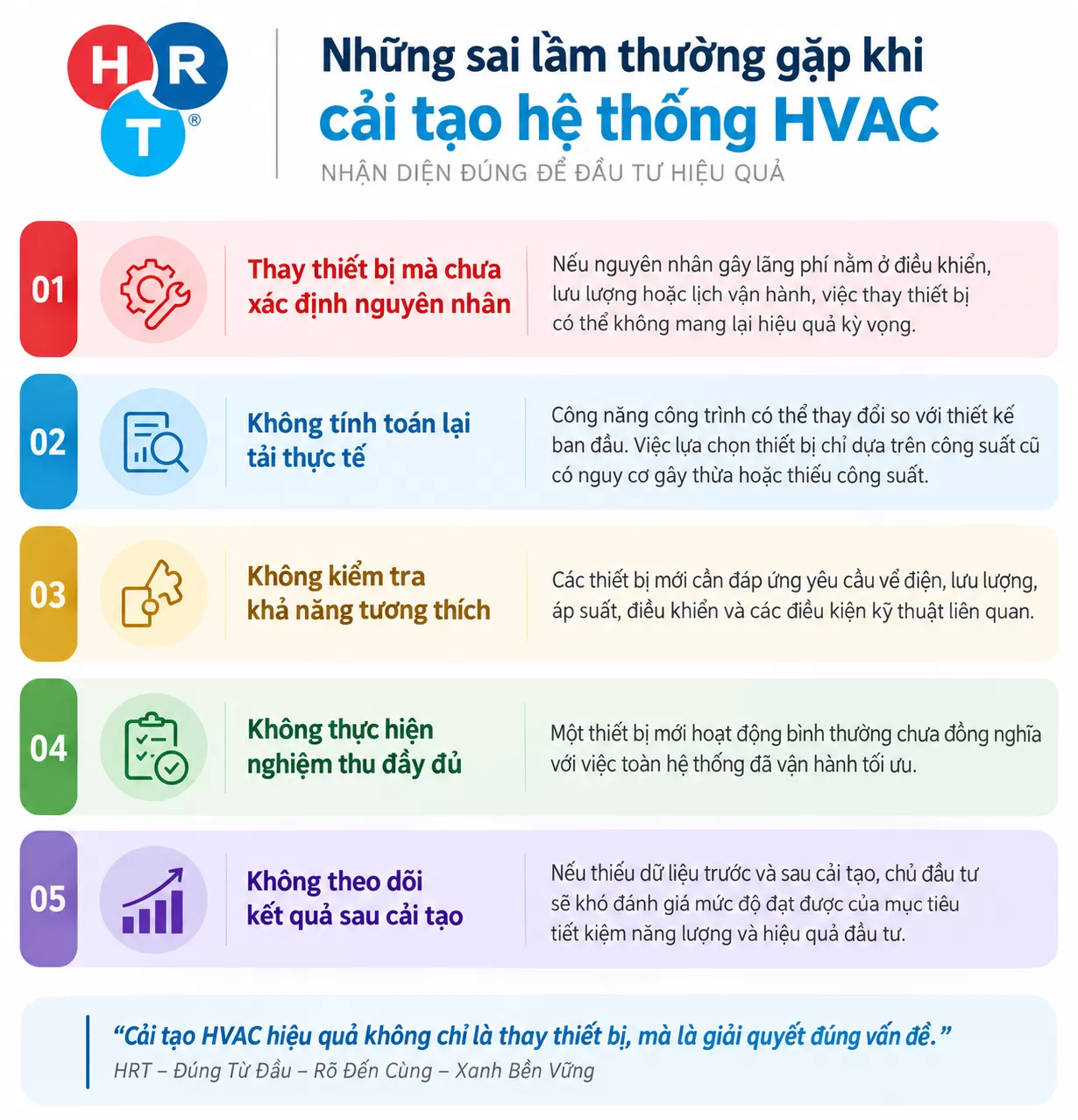
Mistake 1: Replace the device without identifying the root cause
One of the most costly mistakes is deciding to replace equipment just because the operation system is unstable or consumes large amounts of power.
When Chiller machines are inefficient, many project owners may immediately think of replacing the machine.
However, the actual cause may stem from:
-
cold water flow rate is not suitable.
-
Cooling tower operates inefficiently.
-
Water pump continuous operation not according to load demand.
-
The temperature sensor is off.
-
The control system is not optimal.
-
Heat exchanger cling dirt.
-
Multiple Chiller operation sequence is not logical.
Consequences: Project owner can invest in new equipment but not address the causes of the system's overall inefficiency.
Solution: Performing technical survey, measurement, data analysis and assessment of the original cause before deciding on the renovation plan.
For usable systems, priority should be given to evaluating the operation optimization, control renovation or upgrading of auxiliary items before selecting new ones.
Mistake 2: Failing to recalculate actual cooling load
Each work has certain changes in the process of exploitation.
An office building can increase the density of users. A factory can add production lines. A hotel can change the layout of space and operation time.
These changes directly affect cooling load and ventilation needs.
If the selection of new equipment is based solely on the original design capacity, the system may experience problems:
Equipment Overcapacity:
-
Increases unnecessary investment costs.
-
There is a risk of operation outside the optimal performance zone.
-
Some devices may experience frequent shutdowns.
Equipment Lack Of Power:
-
Does not meet the design temperature.
-
Slow temperature recovery.
-
Can increase the running time of the machine.
-
Difficult to maintain stable environmental conditions under high load.
Solution: Re-survey the capacity, using conditions, heat sources, density of people and other factors to determine the actual cooling load before selecting equipment capacity.
For industrial constructions, special attention should be paid to thermal loads arising from production lines, machines and operations.
Mistake 3: Ignoring System Compatibility
A new HVAC unit can not be selected based solely on the rated power.
The equipment must be able to coordinate with the remaining components of the existing system.
For Chiller system, it should be checked:
-
Water flow rate required.
-
Pressure drop through device.
-
Supply-water temperature and anise water.
-
The responsiveness of the pump.
-
Cooling system power.
-
Power supply and control mode.
For VRV/VRF system, check:
-
Type of refrigerant.
-
Compatibility outdoor unit and indoor unit.
-
Limit the length and height difference of pipelines.
-
Communication system.
-
Central control unit.
-
Installation conditions according to manufacturer.
Without careful evaluation, the system after renovation may develop operation errors, difficult to integrate or fail to meet the performance requirements.
Solution: - To draw up a table for checking the technical compatibility between new equipment and existing systems before approving the investment plan.
In some cases, the cost of renovation of auxiliary components should be included in the total investment rather than just calculating the purchase price of main equipment.
Mistake 4: Failing to perform full system acceptance testing
A normally operating device does not mean that the entire HVAC system is functioning as designed.
This is a commonly overlooked point in large - scale renovation projects.
For example, after installing a new AHU, if the airflow rate is not adjusted, some areas may have excess wind while others do not meet the requirements.
Similarly, after changing the chilled-water system configuration, if there is no hydraulic balance and control test, the system may work unstable.
The inspection and acceptance testing should be determined according to the scope of the project, which may include:
-
Check mechanical and electrical installation.
-
Check the pipes, valves and insulation.
-
Check the controls.
-
Measure airflow rate and water.
-
Testing, Adjusting and Balancing (TAB).
-
Check the operation sequence.
-
Commissioning system.
-
Confirm the agreed acceptance testing criteria.
Solution: Developing the test plan and acceptance testing right from the design stage, while specifying the indicators to be achieved before handover.
Mistake 5: Fail to Track Improvement After Renovation
A retrofit HVAC project needs to have a basis for evaluating the level of achievement of investment goals.
If data before and after renovation is lacking, it is difficult to determine how much energy the system has saved, how performance has improved or whether operational problems have been corrected.
Indicators should be considered according to the scope of the project:
-
Power consumption (kWh).
-
Electrical power (kW).
-
Chiller system efficiency (kW/RT).
-
Temperature and humidity using area.
-
Water flow rate and airflow rate.
-
Equipment operation time.
-
Frequency of errors.
-
Maintenance and operation costs.
It should be noted that power consumption may vary with weather, load used and operation time.
Therefore, to determine the energy saving level, it must be compared on the basis of equivalent data or adjusted according to influencing factors.
Solution: Build up baseline data before renovation and measurement and verification (M&V) plan accordingly after renovation.
How to avoid waste when renovating HVAC system?
Instead of starting with a list of equipment to replace, the project owner should clearly identify what issues to solve and what goals to achieve.
Stage 1: Accurately assess the existing system
First of all, it is necessary to conduct surveys and collect information:
-
Design documentation and as-built drawings.
-
Device parameters and age.
-
Actual operation data.
-
Repair history, maintenance.
-
Current cooling load condition.
-
Problems affecting operation.
-
New requirements of the project owner.
On that basis, the consultants can classify items which are still in good use, items which need to be upgraded and equipment which should be considered for replacement.
Phase 2: Comparison of renovation options
Don't just build a device replacement.
Depending on the status of the work, three groups of solutions can be compared:
| Solutions Team | Scope of implementation |
|---|---|
| Optimize Existing | Adjust operation, calibration, control upgrade |
| Renovation of each part | Replace degraded items, make use of suitable equipment |
| Replacement of equipment | Replacement of equipment that no longer meets technical requirements |
The selection should be based on operation efficiency, investment capital, maintenance costs, expected life and the extent of impact on the work operation.
Phase 3: acceptance testing and verification of results
After construction, the system should be tested, calibrated and acceptance testing according to the agreed criteria.
The follow-up period after renovation helps determine the achievement of investment objectives and detects issues that need additional adjustments.
A renovation plan is well evaluated not only at the time of handover but also in the ability to maintain efficiency in the long-term operation.
HVAC items should be especially noted when renovating
Chiller and cold water system
For Chiller system, it is necessary to evaluate the central cooling machine, pump, cooling tower, distribution and control system simultaneously.
It is not recommended to compare individual device performances, but to ignore the power consumption of auxiliary devices.
VRV/VRF Air Conditioning System
Equipment compatibility, load response capability, refrigerant pipeline conditions, power supply and controls should be checked.
The selection of replacement equipment must comply with the technical limits and instructions of the manufacturer.
AHU, FCU and PAU systems
The heat exchange capacity, airflow rate, water flow rate, pressure loss and control method should be assessed.
In many cases, calibration and upgrading of the appropriate items can improve the responsiveness of an existing system.
Ventilation and BMS system
When the work function changes, it is necessary to review outdoor airflow, level/suction mode and control management capabilities.
Optimal ventilation and BMS must ensure air quality, comfort and safety requirements, not only focus on reducing power.
HVAC renovation: Should prioritize investment price or life cycle efficiency?
Another mistake in the decision - making process is to judge only renovation options based on purchase prices and initial installation costs.
In order to have a rational investment basis, it is necessary to consider at the same time:
CAPEX: Total cost of investment, equipment, materials, design and construction.
OPEX: Electricity, operation, maintenance and repair costs.
LCC (Life Cycle Cost): Life-cycle cost of the plan during the evaluation period.
Payback period: The expected period of time for the net savings to offset investment costs.
The formula for determining the payback period is simple:
Payback period = Investment capital / Annual net saving.
Example illustration:
An HVAC renovation project has an investment of VND800 million, with an expected net savings of VND200 million per year.
The payback period is simply:
800 / 200 = 4 years.
This is an example of assuming calculations, not the savings committed to every building.
For large projects, additional analysis of cash flow, equipment life, operational risks and costs is required.
HRT – Solution to renovate HVAC properly technically, optimize investment
With a background in refrigeration and thermal engineering technology and experience in the field of air conditioning, ventilation, HRT Air Conditioning and Ventilation Company Limited towards consulting solutions to renovate HVAC based on the actual requirements of each project.
HRT focuses on the assessment of the entire system rather than just selecting and replacing individual equipment.
HRT Solutions Provided
-
Survey and evaluate the existing HVAC system.
-
Advice on HVAC Retrofit renovation.
-
Renovation and upgrade of Chiller system.
-
Renovation of VRV/VRF systems.
-
Upgrade AHU, FCU, PAU.
-
Renovation of Packaged, Rooftop systems.
-
Renovation of ventilation and heat recovery systems.
-
Optimize BMS control.
-
Maintenance and evaluation of HVAC system performance.
-
Testing, acceptance testing and operation support.
Principles of implementation of HRT
CORRECT INTRODUCTION: Evaluate the cause and actual requirements before proposing solutions.
CLOSED: Transparency of technical scope, equipment selection, cost and acceptance testing criteria.
VISION: Accompany project owners during survey, deployment and operation.
HRT aims to provide technical solutions, meeting demands, controlling costs and effectively using investment resources.
Frequently Asked Questions When Renovating HVAC Systems
Should I replace the entire HVAC system when the equipment is old?
Not necessarily. It is necessary to assess the lifespan, performance, damage, maintenance and life-cycle cost before deciding whether to renovate or replace.
Is the Chiller system high in power consumption due to a degraded machine?
Not entirely. The cause may involve a chiller, pump, cooling system, water distribution or control method. Measurements should be made to determine the cause.
Is it possible to renovate HVAC without stopping the whole building?
Some items can be deployed in stages. However, the implementation capacity depends on the system configuration, safety requirements and actual operation conditions.
How to know if HVAC renovation project saves electricity?
Data should be collected before and after renovation, establish appropriate comparison conditions and implement measurement methods, verify energy efficiency.
What criteria should I choose an HVAC contractor based on?
It is necessary to assess the survey capacity, technical expertise, experience with the corresponding system, construction plan, acceptance testing criteria and post-handover support capacity.
Conclusion: Effective HVAC renovation starts from identifying the right problem
HVAC system renovation is not only replacing old equipment with new equipment but also the process of evaluating, selecting solutions and verifying results to improve the operation efficiency of the whole system.
5 mistakes to avoid when renovating HVAC include:
-
Replace the device without identifying the cause.
-
Do not recalculate the actual cooling load.
-
Ignore system compatibility.
-
Failed to perform full acceptance testing.
-
No follow-up after rehabilitation.
Avoiding these mistakes will help the project owner have a basis to choose the appropriate technical plan, limit unnecessary investment and increase the ability to achieve renovation goals.
Effective HVAC renovation is not just about replacing the equipment, but solving the problem.
HRT – GREEN BATH FOR EVERY WORK
CORRECT FROM THE HEAD – CLEAR TO THE SAME – SUSTAINABLE GREEN
HRT Air Conditioning and Ventilation Company Limited
Contact HRT for advice, survey the current status and build a plan to renovate the HVAC system suitable for the project.
Source: Publisher’s English edition · Vietnamese original on doanvanhoang.com