
Investing in factory air conditioning: 5 documents to finalize | HRT
Machine-translated from Vietnamese. Read the original in Vietnamese

A factory conditioning plan should clearly answer: which area to serve, what conditions to meet, how much to use and how to verify. CEO Đoàn Văn Hoàng – HRT propose 5 documents to help the enterprise control the investment from the approval of the plan to the takeover of the operation.
Investment in factory air conditioning: 5 records to close before signing a contract
If there are three air conditioning quotations for the same factory, I will start by checking the conditions that each unit is committing to meet.
Where is the temperature confirmed? At what level does the line work? Does the exhaust system operate simultaneously? To what extent does the price offering cover electricity, pipelines, control and commissioning?
Those answers determine whether or not we're comparing the same problem.
To me, factory air conditioning investment needs to have clear requirements, clear selection basis and verified results are.
For easy control of project owner, I propose to prepare five groups of documents before signing the contract: operation requirements, technical options, cost comparison table, implementation plan and acceptance testing criteria.
Each profile must help the decision maker know what he or she is approving, based on what data and who to delegate responsibility for.
Document 1: Operation request confirmed by the production department

Write down the requirements for each area
The requirement of “factory cooling” is still too much to understand.
The production manager may be concerned about the condition at the worker's site. The quality department needs to maintain the environment around the product. The engineering team needs to know how many hours the equipment must run and which areas are allowed to stop.
I suggest bringing these requirements to the same table before implementing the design.
| Content to be closed | Questions to answer |
|---|---|
| Range of service | What area needs air conditioning? Where is the boundary on the ground? |
| Environmental conditions | What is the permissible temperature, humidity and fluctuation level, if required? |
| Production Mode | What lines operate simultaneously? Does shifts change? |
| Time of use | When should the system meet the required conditions? When is it allowed to reduce load or stop? |
| Test Points | Measure at work, product area or other location agreed? |
| Validator | Who represents the production, quality and technical approval of the top post? |
A temperature parameter should be included with the measurement location, production conditions and acceptance range. When these factors are specified, the new design team has a consistent head to work on.
Mark Unverified Data
At the stage of investment preparation, there are information that cannot be immediately confirmed: the production line is not sufficiently installed, the production schedule is changing or new equipment has no heat radiation data.
I'm asking for a record stating three states:
-
Confirmed: There are drawings, documents, equipment, survey results or opinions of the department in charge.
-
Assuming: There are temporary calculation bases and persons responsible for re - inspection.
-
No data available: Additional prior to relevant decision milestones are needed.
For example, if the actual heat content of a new line is not known, the contractor should state how it is temporarily calculated, affects equipment selection, and when to update.
Work to be closed: A validated operation request, with a list of missing data and deadlines for addition.
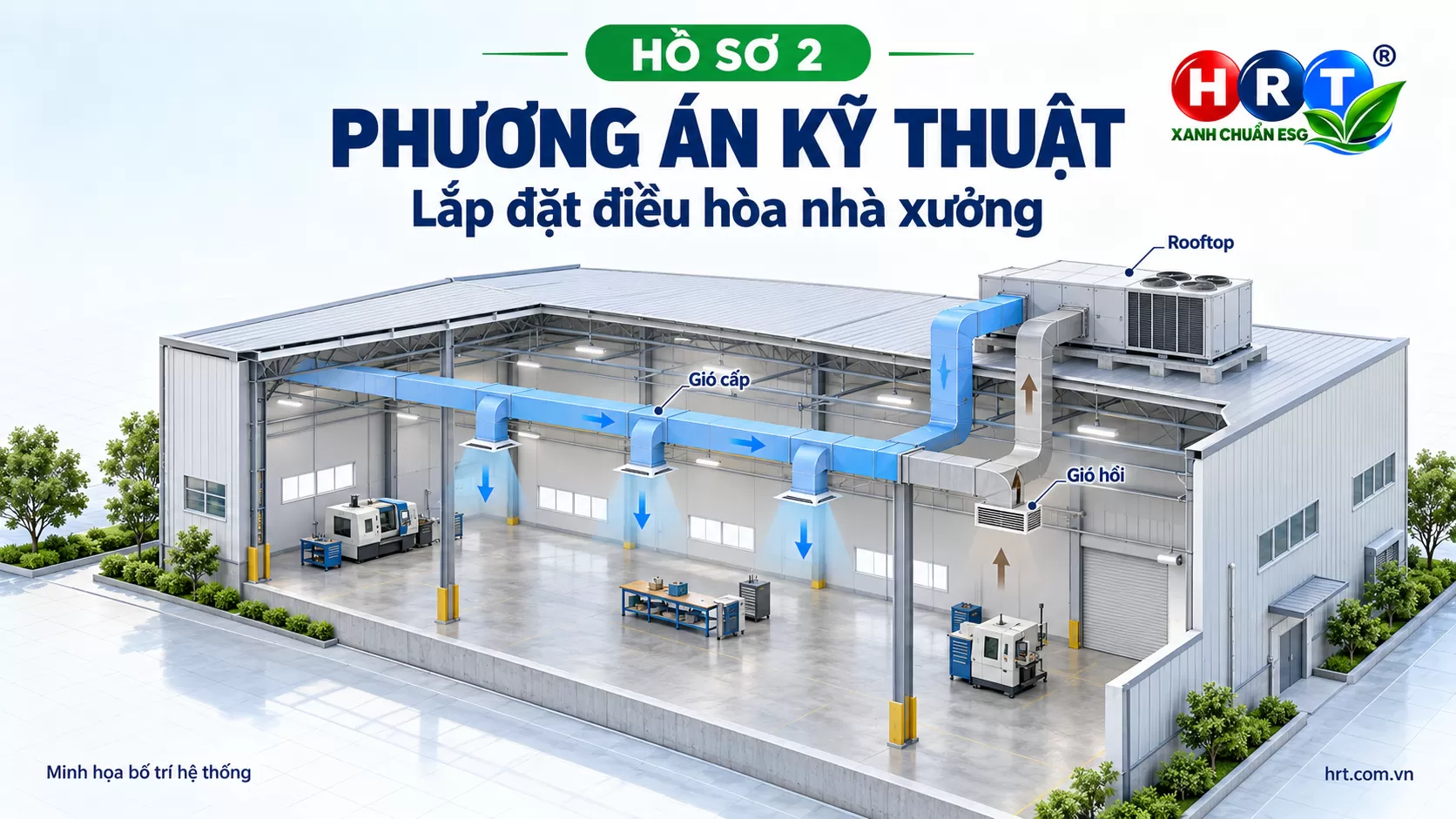
Dossier 2: Technical plan explaining why to choose that system
Power reverse to input data
When receiving a cooling capacity proposal, I want to see the components that make up the result: heat through structure, people, lighting, appliances, outdoor air and moisture treatment requirements.
The ASHRAE load calculation documentation distinguishes the current load, hidden load and use of coefficients related to the utilization level, the load level of the engine. This indicates that the equipment figures should be set under specific operation conditions when calculating.
With the heat part from production, I suggest to clarify:
-
Data from a line supplier, measurement or assumption?
-
What devices run simultaneously?
-
What part of the heat goes into the air conditioning space?
-
What part of the heat has been taken out by separate cooling or exhaust system?
-
What needs does the provision serve and where is it calculated?
This presentation helps the project owner discuss the selection basis directly, and controls the multiple additions through the steps.
Read the schematic diagram correctly before comparing device names
A water-cooled, cooling tower and air duct system is still needed to be explained.
The chiller generates cold water and then distributes it to cooled appliances. Meanwhile, a water-cooled combined air conditioning unit can use the tower to discharge heat from the condenser. Trane's documentation describes both configurations.
So I ask the drawing to specify:
Where the water goes, where the refrigerant goes, where the air is processed and how the heat is released.
When the diagram is clear, the evaluation of the plan will be more specific:
| The recommended plan | The content I requested clarification |
|---|---|
| VRV/VRF | How to divide the system by area, operation schedule, pipeline and outdoor air handling solution |
| Packaged/Rooftop | Specific machine configuration, installation location, air supply – return route, cooling method and maintenance approach |
| Chiller combined AHU/FCU | Range of cold water supply, load-sharing, pumping system, control and operation options as demand decreases |
VRV has regional control capabilities, as described by Daikin. However, the use of this feature should be demonstrated by dividing the system and control layout in the actual plan.
The name also needs to be accurate. Rooftops are often supplied as roof-mounted assemblies; Daikin has a “Packaged Rooftop" product group. When comparing quotes, I recommend specifying the configuration to avoid seeing names intersecting as completely independent groups.
Coordinate air conditioning with exhaust system and compensation air supply
If the line has a vacuum, vapor or air suction at source, I require that the system be included in the same scope of design coordination.
OSHA's technical guidelines describe localized exhaust as a way of collecting pollutants at or near the source; the amount of air that is sucked out requires a compensatory supply plan.
From this principle, the profile needs to answer: where is the offset gas taken, is it treated with moist heat, how does the air passage work and which system is responsible for controlling?
Work to be closed: The spreadsheet must contain grounds, diagram of principles, preliminary layout plan and conditions to be completed for the implementation plan.
Dossier 3: Quotation comparison table on the same scope of work

Bringing expenditures to the same comparative level
I suggest purchasing and engineering departments collate the range before ranking total price.
Each bidding unit shall clearly certify its responsibilities for the following groups of jobs:
-
Main equipment and accessories included.
-
Piping system, air duct, insulation and condensate drainage.
-
Power supply, electrical cabinet, control wire and monitoring connection.
-
Machine base, support structure, opening and finishing position of roof penetration, wall penetration.
-
Transport, lifting, installation and coordination with existing systems.
-
Commissioning, inspection, training and handover records.
Each item should be marked: included, project owner implemented or not.
Suppose that Plan A has a lower offering price but the power supply, supporting structure and control are done by the project owner. Plan B has calculated all these parts. I will ask for additional costs before evaluating the difference.
This is something that can be done immediately, helping the contractor selection meeting focus on the actual scope and value.
Request an explanation of how power forecasts are made
The cooling capacity spreadsheet and the power forecast should be presented separately.
ASHRAE notes that the RTS method is suitable for calculating design peak loads, but not for full - year power simulations due to the method's limited assumptions.
So when a plan gives an estimated power level, I would ask:
-
What production shifts are the operation schedules taken from?
-
How does the load rate change during the day and year?
-
What devices are included in the calculated power range?
-
How are weather conditions and temperature requirements assumed?
-
When production changes, how will the forecast result?
Example illustration: If the two options meet the top priority and the average difference in electrical power of the entire comparative range is 10 kW for 3,000 hours of operation per year, the corresponding power difference is:
10 kW × 3,000 hours = 30.000 kWh/year.
This is the assumption calculation to clarify the method. When making actual estimates, it is necessary to have a basis for the difference of average capacity and apply the cost of electricity according to the plant's history.
Cost evaluation throughout lifetime
I suggest making additional cost statements at a time of uniform analysis, including investment, energy, water if any, maintenance and expected replacements.
The life-cycle cost method of NIST considers expenses arising over time and converts them to the same value base for comparison.
For the factory, I also want to know how maintenance conditions will affect production: which parts need to stop, expected intervention time and which components need to be prepared.
Amounts with insufficient data for calculation of charges should be recorded as assessment conditions, together with handling plans.
Work to be closed: The comparison table has sufficient scope, assuming uniform operation and a list of additional costs.
Dossier 4: Implementation plan in accordance with the production schedule

Determine when to hand over the premises or stop operation
Before agreeing on the schedule, I suggest that we take turns following the path into the work of each group of equipment and supplies.
Where is the machine brought in? Do goods or production equipment have to be moved? What area does the pipeline go through? What work needs to be disconnected from power or connected to an active system?
These should be included in the deployment plan with the validator.
I want to see the minimum of landmarks:
-
Fasten drawings and equipment location.
-
Hand over each construction area.
-
Complete electrical, structural and transportation conditions.
-
Installation, inspection and connection.
-
Commissioning by region.
-
Verify when coordinating with production activities.
For an active plant, the phased plan should specify which areas continue to operate, which areas are affected, and who has the authority to confirm when to move on.
Delegate responsibilities at coordinating points
I suggest a brief accountability table for the parts of the project that involve multiple parties.
For example:
-
Which department confirms the location and power supply capacity?
-
Who approves the structure of the equipment support?
-
Who handles waterproofing after opening the roof?
-
Which unit connects the signal to the existing management system?
-
When the line changes position, who evaluates the effect on HVAC design?
Each task should have a clue to the main responsibility, deadline and person checking the results.
I also asked for agreement on how to handle the change: recording the content, evaluating the impact on technique, cost and progress, then approving before implementation.
Work to be closed: - The tempo according to the region, conditions for handing over the ground and focal points for handling each part of the coordination.
Profile 5: Acceptance testing criteria are agreed before
Write down what you will measure, where you will measure and under what conditions.
Before signing the contract, the project owner can finalize the principles, scope and method of verification. The actual results will be recorded during deployment and commissioning.
I suggest to include the important criteria in the technical appendix:
| Group of criteria | Contents to be agreed |
|---|---|
| Conditions at the use area | Measuring position, acceptance value range, tracking time and production mode |
| Distribution of wind, water | Measuring range, adjustment and balance according to design |
| Controllers | Operation modes, coordination sequences, warnings and situations to try |
| Power or Performance | Measuring boundaries, evaluation methods and comparison conditions, if committed |
| Profile and training | Documents to be handed over, contents of instructions and recipients |
If the contract has moisture targets, those conditions should appear in the design, control scheme and inspection plan.
If there is a commitment to power efficiency, it is necessary to reach an agreement in advance on how to confirm the load, measurement time and equipment range to be calculated.
Clearly handle conditions that cannot be verified
The commissioning date may not coincide with the manufacturing conditions used in the design.
In that case, I request the record to clearly state:
-
Items tested and results achieved.
-
Actual conditions during the test period.
-
Contents awaiting verification.
-
Time, responsibilities and methods of additional inspection.
This will help both parties understand the extent of the verified results and what needs to be done.
Operations team must take over the system.
Under the guidance of the U.S. Department of Energy, commissioning for new construction includes design review, functional testing, system documentation and training of operators to meet owner requirements.
From a deployment perspective, I suggest organizing the handover according to the operations that the operation team will perform:
How to start the system? Where to adjust the schedule? When warnings appear, which information should be checked first? What device serves which area? Where are maintenance schedules and support contacts saved?
The instruction session should have hands-on on the system, accompanied by as-built drawings, equipment list and documentation suitable for the installed configuration.
Work to be closed: The criteria, the plan to handle unsatisfactory content and the requirements for handing over to the operator.
Frequently asked questions when investing in factory air conditioning
Can multiple systems be used in the same factory?
It is possible to include the combination in the evaluation when the areas have different headings.
I suggest defining the service boundaries, controls, maintenance responsibilities and cost tracking methods for each part. Decision on the choice should be based on the overall coordination plan.
Is the preliminary quotation enough to decide to buy the equipment?
I consider preliminary quotation as the basis for budget preparation and further evaluation.
Before placing an order, the project owner should request confirmation of the lead, capacity selection basis, equipment configuration, installation conditions and scope of responsibility. The missing data needs specific handling.
Where to look for budget reduction?
I suggest to review the service scope and investment progress first: which areas need to be deployed immediately, which areas can be implemented in stages, which backup data need to be rechecked?
Each budget adjustment should come with an assessment of how it affects the closed operational requirements. This is a way for finance and engineering to see the trade-off conditions together.
CEO's view Đoàn Văn Hoàng: Every investment has someone responsible for the outcome
When approving a workshop conditioning plan, I want the meeting to end with specific tasks:
Who confirms the production requirements? Who is responsible for the calculated data? Who controls the cost range? Who coordinates the construction? Who witnesses and confirms the results?
These five sets of records are how I propose to tie those responsibilities into a trackable process.
Requirements must be clear before design. Scope must be clear before price closing. Verification method must be clear before commitment results.
If you are preparing to invest or renovate your factory, gather in front of you premises, production line information, production schedule and environmental requirements. That is the basis for discussing with HRT about the appropriate plan and additional data.
CEO Đoàn Văn Hoàng – HRT
Understand - Clear - Dedicated.
HRT – Green Breath for All Buildings.
Website: hrt.com.vn
Viewpoints and expertise sharing: doanvanhoang.com
Source: Publisher’s English edition · Vietnamese original on doanvanhoang.com