
Optimize Chiller Operation – Reduce Energy Waste
Machine-translated from Vietnamese. Read the original in Vietnamese
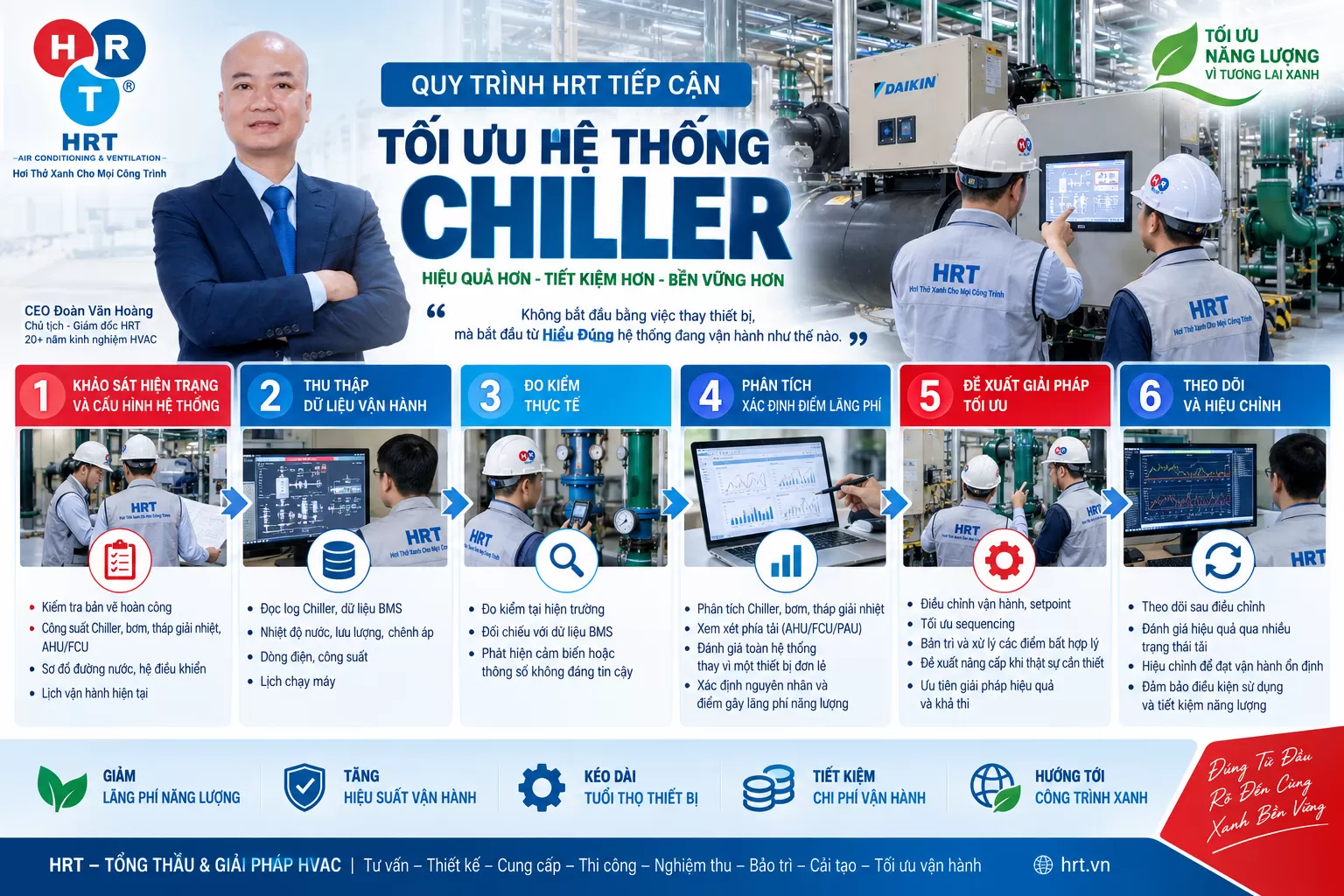
High power consumption is not necessarily due to the Chiller. HRT analyzes the entire Chiller Plant to find the right point of waste and optimize according to actual load.
Where does Chiller Optimization start?
When the Chiller system consumes high power, the common reaction is to check the Chiller, reduce the water temperature or think about replacing the unit.
However, Chiller is only part of the whole system.
A Chiller Plant also includes chilled-water pump, condenser water pump, cooling tower, AHU, FCU, PAU, control valve, sensor and BMS.
Therefore, a Chiller with good performance can still be in a wasteful operation system.
The point is not just:
“Is the Chiller running well?"
It should be:
“How much energy is the entire system generating cooling load?”
6 signs that the Chiller Plant may not be operating optimally
Not all power-consuming systems show obvious failures. Many systems are still cooling normally but are silently draining energy.
Signs that usually need to be checked include:
- Multiple Chillers running at the same time while low work load.
- Chilled-water pump frequently runs high speed.
- Cold water heat difference ΔT lower than design.
- The temperature of the condenser water increases abnormally.
- AHU/FCU opens large valves but the area still lacks refrigeration.
- Electricity is increasing while power usage remains almost unchanged.
This is where the word “operation by experience” sang “operation by data”.
Want to reduce Chiller power must look at the whole Chiller Plant
The performance of the system does not depend on an individual device.
Chiller Machine
Real load, % load, chilled-water supply temperature – return, power capacity and operation performance should be monitored.
If multiple Chillers run simultaneously at low load areas, the total power of the system may not be optimal.
Chilled-water pump
Pumping excess flow rate or keeping differential pressure too high can cause wasted electricity.
With the right system, VFD helps to adjust pump speed according to actual load instead of running fixed.
Cooling tower
dirty cooling tower, fill attenuation, nozzle clogging or inappropriate water flow rate can cause the water condenser temperature to rise.
The chiller must then work at more adverse condensation conditions.
AHU – FCU – PAU
Dirty coil, wrong airflow rate, improperly operated control valve or unbalanced water system can all directly affect ΔT cold water.
BMS and Sensors
BMS is only effective when the input data is accurate.
If the temperature sensor, flow rate or differential pressure is wrong, the control system may make the wrong decision despite well - programmed algorithms.
Low ΔT – issue not to be ignored in Chiller system
One of the key indicators to keep track of is Cold water heat difference ΔT.
Simple formula:
ΔT = return-water temperature – supply-water temperature
When ΔT is significantly lower than designed, the system may have to increase water flow rate to transmit the same amount of cooling load.
This can entail:
Flow rate increase → pump work more → difficult to exploit Chiller Plant capacity → the whole system performance decreased.
But Low ΔT is not always due to Chiller.
The cause may lie in the AHU/FCU coil, control valve, bypass, sensor, hydraulic balance or control strategy.
Thus HRT does not treat Low ΔT by adjusting a single parameter.
Full system testing is required before a solution can be proposed.
5 groups of important solutions when optimizing Chiller operation
Control the Chiller quantity according to actual load
For multi- Chiller systems, it is necessary to determine the time of starting or stopping each machine accordingly.
The goal is not to make a Chiller achieve the best performance, but to reduce Total Energy of Whole Chiller Plant.
Optimize cold water temperature
Cold water setpoint is not necessarily fixed all year round.
Under some load conditions, chilled-water supply temperature resets may be considered.
However, the change should be evaluated to affect load, humidity, AHU/FCU and water flow rate.
Optimal pump and differential pressure
The pump should not be run continuously at high speeds as the demand for cold water decreases.
VFD can be considered and controlled according to the actual differential pressure, but still must ensure the minimum flow rate of the Chiller.
Optimal cooling tower
Need to check the fill hygiene, nozzle, water flow rate, tower fan and condenser water temperature.
It is not advisable to simply aim for the water to be as cold as possible, since tower fans also consume electricity.
Maintenance tied to performance
Maintenance not only to avoid machine failure.
After cleaning the condenser, evaporator, AHU or cooling tower, it is recommended to re-compare data before - after to determine the actual effect.
HRT process approaches the optimal Chiller system
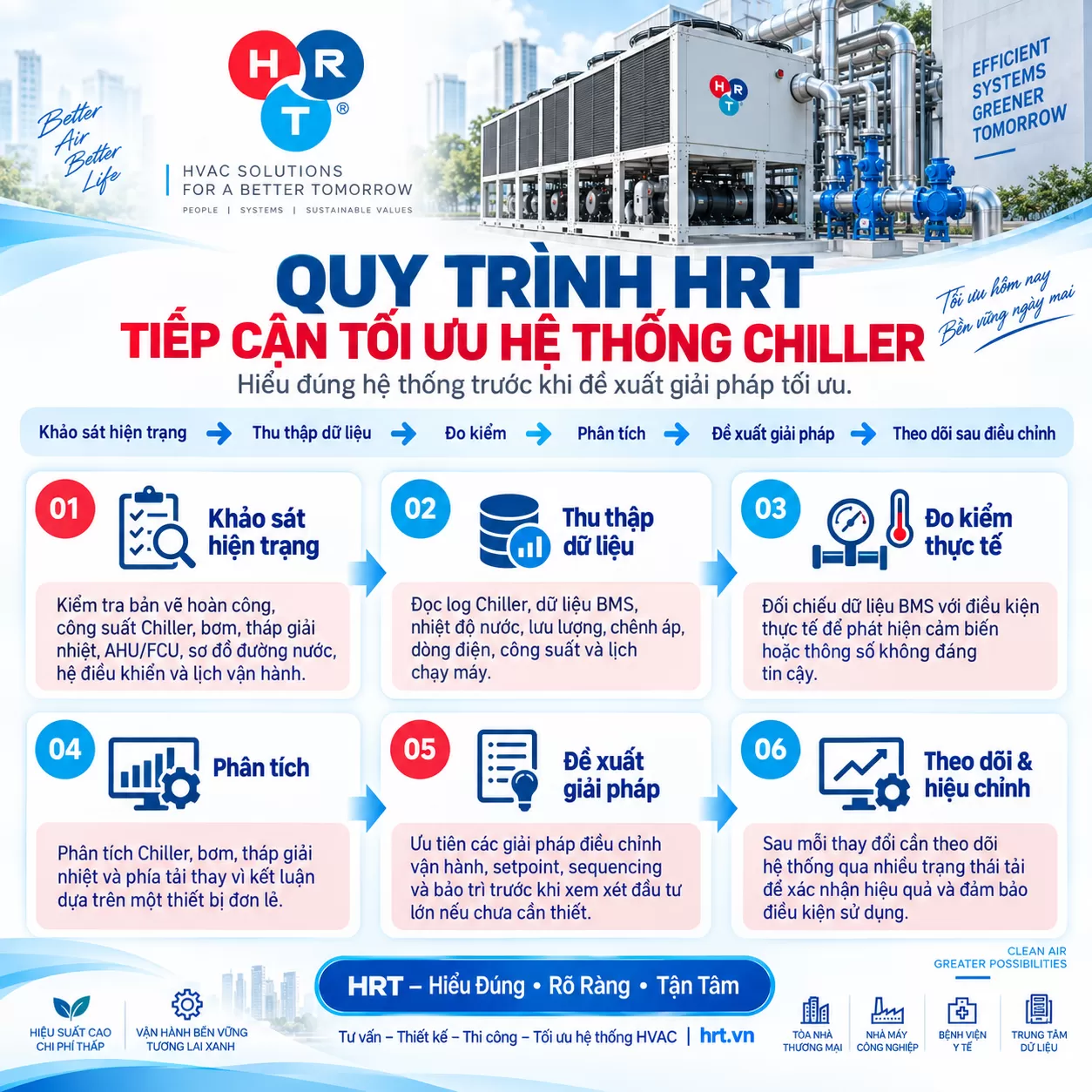
HRT does not begin with recommending replacement or investment of new equipment.
The first principle is:
Understand how the system is properly operating.
The process consists of 6 steps:
Surveying the current status → Collecting data → Actual testing → Analysis → Suggest solutions → Monitoring and correction.
1. Survey of current conditions and system configuration
Check as-built drawings, Chiller capacity, pump, cooling tower, AHU/FCU, water line diagram, control system and operation schedule.
2. Operation Data Collection
Read Chiller log, BMS data, water temperature, flow rate, differential pressure, current, capacity and machine running schedule.
3. Actual measurement and inspection
Collate BMS data with equipment and field conditions to detect unreliable sensors or parameters.
4. Wastefulness score analysis
HRT evaluates both Chiller, Pump, Cooling tower and Load side instead of concluding based on an individual device.
5. Proposing solutions according to priority level
Prioritize the solutions that can be optimized by operation, setpoint, sequencing and maintenance before considering large investments.
6. Tracking and calibration
After each change, it is necessary to monitor through multiple load states to confirm the efficiency and ensure the system still meets the conditions of use.
9 Chiller operation errors often increase energy waste
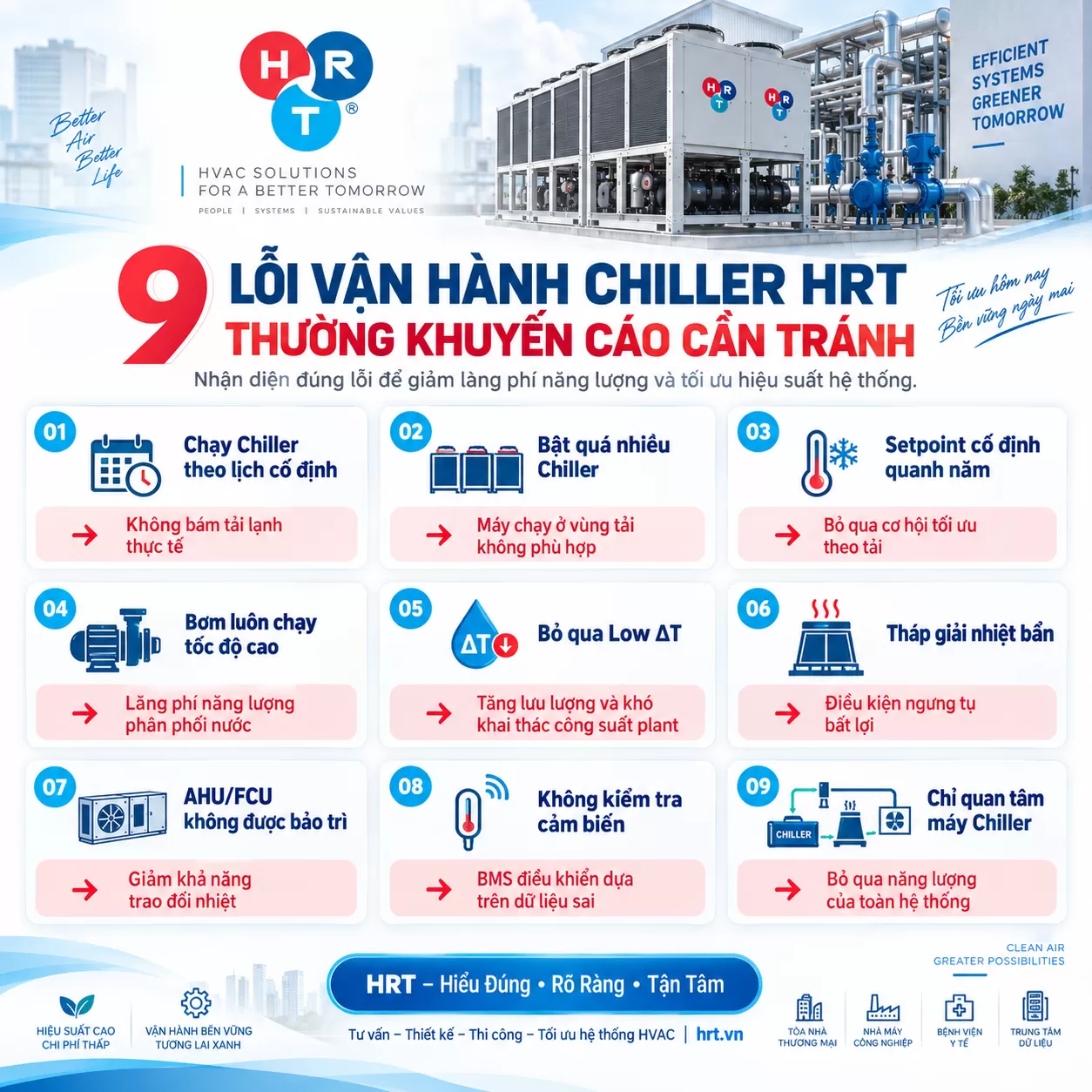
Not only does the system have problems not due to equipment degradation but also due to the way it operates.
| Common Errors | Possible consequences |
|---|---|
| Run Chiller on a Fixed Schedule | No cling actual cooling load |
| Over-Turning on Chiller | Machine running in the inappropriate load zone |
| Fixed setpoint year round | Ignore optimal opportunities by load |
| Pumps always run at high speed | Waste of energy distributing water |
| Ignore Low ΔT | Increase flow rate, reduce plant harvesting capacity |
| Cooling tower dirty | Adverse condensation conditions |
| AHU/FCU is not maintained | Reduce heat exchange capacity |
| No sensor test | BMS controller based on wrong data |
| Chiller only interested | Ignore the power of the whole system |
Optimized before – invest after
A high power consumption system does not mean that you have to replace the chiller.
Before investing in new equipment, it is recommended to check:
Schedule operation → sensor → setpoint → sequencing → flow rate → pump → cooling tower → AHU/FCU → BMS.
Many irrationalities can be improved by corrective operation adjustment, commissioning or maintenance.
Then, assess whether it is necessary to renovate the waterway system, add VFD, upgrade BMS or replace Chiller.
This approach helps avoid the situation that:
The device is new but the operation method is old.
Should not commit to a fixed rate of electricity savings
Each Chiller Plant has different design and operation conditions.
The degree of improvement depends on actual load, equipment age, water line configuration, Chiller performance, pump, cooling tower, AHU/FCU, BMS and maintenance status.
HRT therefore does not recommend a general saving rate when not yet surveyed.
A more appropriate way of assessing is:
Baseline construction → measurement → solution implementation → follow-up → comparison before and after in equivalent conditions.
When should I re-evaluate my Chiller system?
Enterprises should check deeper when the power is abnormally increased, the system often lacks refrigeration, ΔT decreases, pumps or tower fans are constantly running at high speed, must turn on more Chiller earlier than before, the work changes its function or the system has been operating for many years but has not been recommissioning.
For factories, hotels, hospitals, shopping malls and office buildings with long operation periods, optimizing the Chiller Plant is of great significance because energy costs are continuously accumulated over time.
Frequently Asked Questions About Optimizing Chiller
Is Chiller Optimization Only Optimizing Chillers?
No. Synchronous Chiller, Pump, Cooling Tower, Water Line, AHU/FCU/PAU and Control System should be considered.
Does Low ΔT affect the system?
Possible. Low ΔT often causes the system to have to increase water flow rate and can affect the capacity harnessing capabilities of Chiller Plant.
Should the cold water temperature be raised to save electricity?
Can be suitable for some load conditions but must assess the impact on AHU/FCU, humidity and pump power before application.
Is installing variable-frequency drive for pumps electrically saving?
VFD can be effective with the right system, but it needs to be accompanied by logical control and ensure minimum flow rate through Chiller.
Does BMS automatically optimize the Chiller?
BMS is important, but effectiveness depends on accurate sensors, correct control logic, and regularly monitored data.
HRT – Optimize Chiller based on actual operation data
HRT approach Chiller system in series:
Chiller → Pump → cooling tower → Water line → AHU/FCU/PAU → BMS → operation → maintenance.
The goal is not simply to make the chiller run colder.
The goal is to:
Refrigerated – Stable – Economical – Sustainable.
HRT deployed by value:
Understand - Clear - Dedicated.
And oriented:
Right From the Start – Clear To the End – Green Sustainable.
HRT – Green Breath for All Buildings
Source: Publisher’s English edition · Vietnamese original on doanvanhoang.com