
Improving chiller efficiency: stabilising the load and reducing electricity use
Machine-translated from Vietnamese. Read the original in Vietnamese

CEO Đoàn Văn Hoàng – HRT Share how to optimize Chiller performance from load data, water temperature, flow rate, cooling and kW/RT to reduce power but still ensure stable operation.
Optimize Chiller Performance: Do not adjust the machine before reading data

Imagine a situation.
Yesterday the Chiller delivered 200 RT and consumed about 140 kW.
Today, cooling load is still around that level but power capacity has increased to 150 kW.
My first question is not:
“Is the machine degraded?”
I want to know what condition the system is working under today.
Is the temperature outside higher?
Does the condenser water into the condenser change?
Is the water flow rate cold?
Acute heat gradient – how much is it?
How are the pumps and fans running?
That's my approach. Optimized Chiller Performance.
The same device but performance can vary significantly according to load, cooling condition, cold water temperature, flow rate and control system. Therefore, it is not possible to take a fixed operation mode and consider it the optimal option for all times.
Do not adjust the Chiller before understanding the conditions that cause it to work as such.
I want to look at trends before I look at numbers.

A value of kW/RT at a time tells me the status of the machine at that time.
But it doesn't tell us which way the system is going.
I want to see the data over time.
Morning Low Load but How Much Chiller is Running?
At peak hours, does the chilled-water supply keep its set point?
When the load drops at the end of the day, does the machine continue to run in a rush hour configuration?
Is the number of starts – stops increasing abnormally?
The original HRT also stressed that when the load is low, it should not be shut down or split evenly by default; it is necessary to see the performance characteristics of each model, kW/RT at each load level, minimum load limit and number of start-stops.
From an operational perspective, I would like to report an operation that is:
How did the load change and how did the system react?
A separate table of figures is not enough.
Low Load Doesn't Mean Chiller Always Runs Poorly
This is a statement I don't want the operation to use machines.
Some Chillers, especially with suitable power adjustment technology, can operate efficiently in the partial load area.
Other devices may experience instability when downloading too low.
So I don't use a rule like:
“Below 50% load, one machine must be shut down”
Or:
“Split evenly the load for two machines will be more economical"
Have to look at the performance curve of the right device.
For multiple chiller stations, the decision to put the machine in or out of operation must also take into account the pump and the accompanying cooling system.
What I want to know when the load drops
I'll have the operations team check:
-
Actual cooling load on each machine.
-
Corresponding power output.
-
kW/RT at each load level.
-
Number of shut-offs.
-
Low load limit of the device.
-
Electric pump and cooling device when changing the running number.
Target doesn't have to run the least Chiller.
The goal is to find the equipment combination has a good total efficiency but still stable operation.
High load: don't save by losing the main task
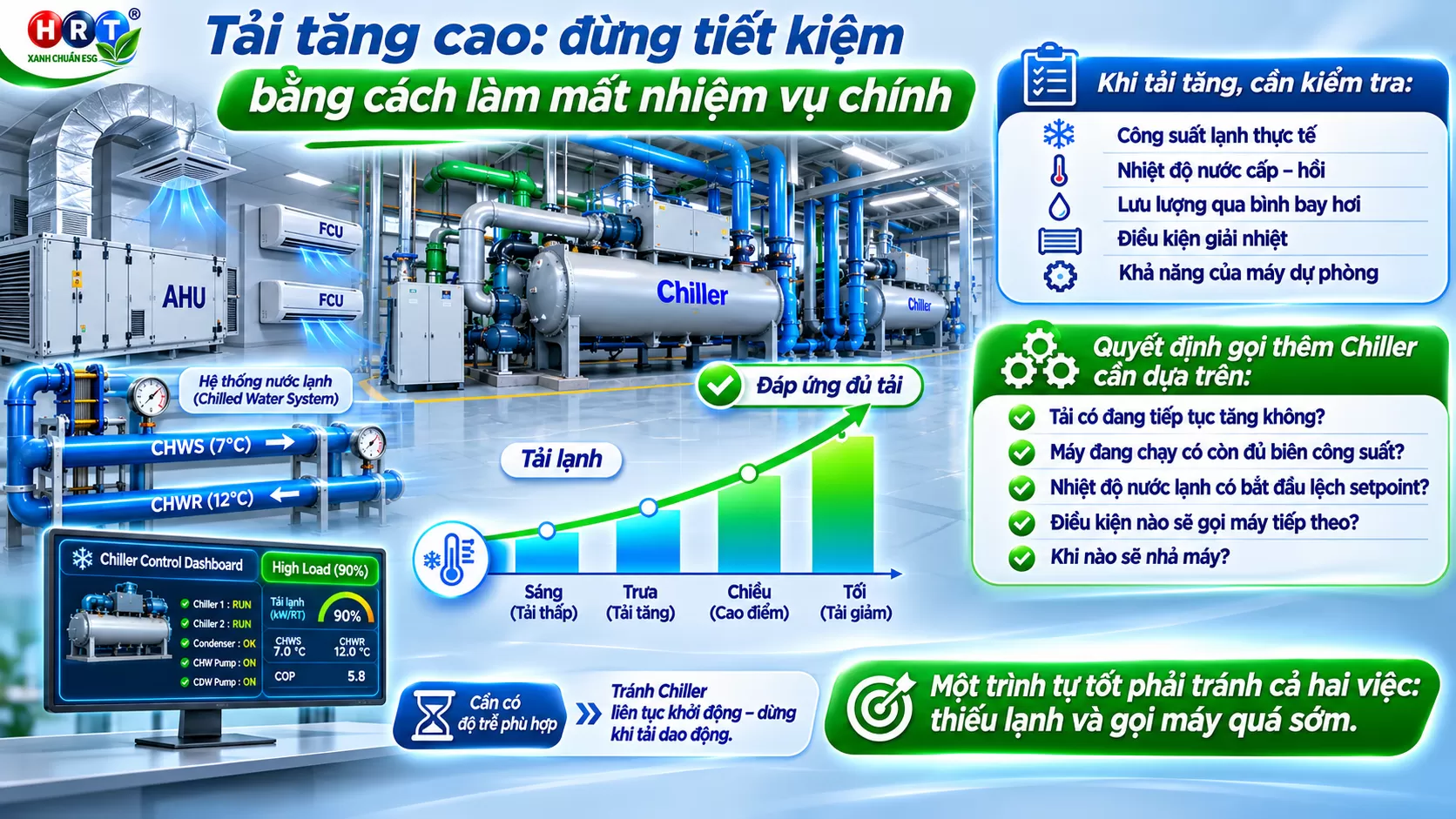
When the building enters rush hour, priorities must change.
If the chiller does not meet the load, the chilled-water supply temperature can increase and directly affect the AHU, FCU or chilled equipment. In that condition, reducing electrical capacity at all costs is no longer a priority goal.
I want the system to get the job done first.
When the load increases, it should be checked:
Actual cooling capacity.
Supply-water temperature – return.
Flow rate through evaporator.
Cooling condition.
The capacity of the backup machine.
If I need to call more Chiller, I don't want to decide based on a single load % figure.
Is the load continuing to rise?
Is the machine running at full power bound?
Does cold water temperature start to setpoint deviation?
What condition will call next?
When will we hang up?
The original article also noted the need for an appropriate delay to avoid the Chiller continuously starts and stops when the load fluctuates around the threshold of transferring the machine.
A good sequence must avoid both: lack of cold and calling too soon.
Same cooling load but different weather, different power can also
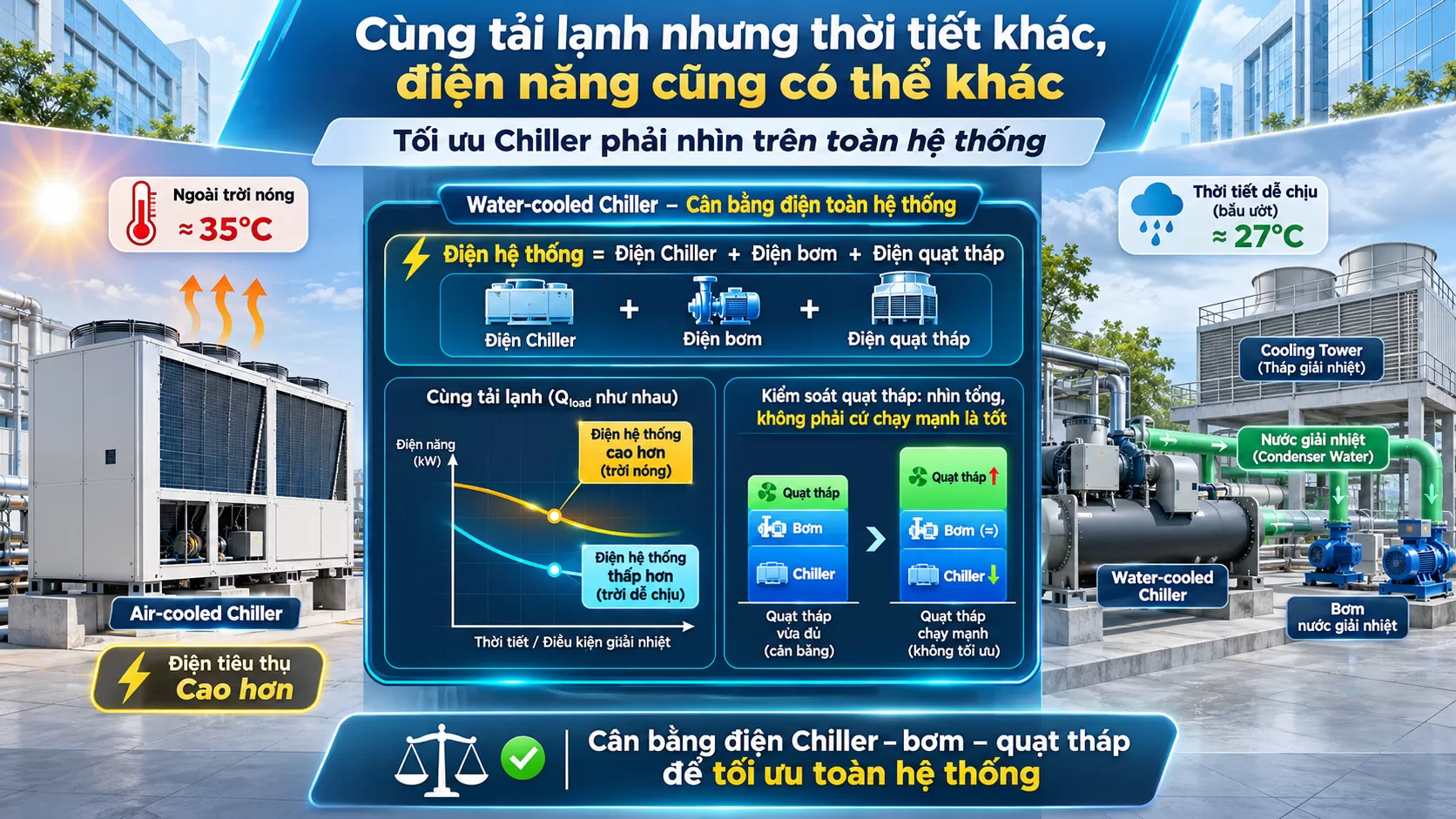
This is a very important point when evaluating performance.
With air-cooled chiller, the air temperature entering into condenser coil directly affects the working condition.
With water-cooled chiller, it is necessary to monitor the water temperature into the condenser, cooling tower and outdoor wet potting conditions.
So if today the Chiller consumes more power than yesterday, I do not want to conclude right away that the device has reduced performance.
Compare the heating conditions first.
Cooling Tower isn't about running fast.
When the weather is favorable, there may appear opportunities to lower the condenser water temperature to improve the working conditions of the Chiller.
But if the tower fan has to accelerate too much to reach that goal, the fan power will also increase.
The final result must look across the system:
Electric Chiller + Electric Pump + Electric Fan Tower.
The original HRT also specified that this electrical part should be balanced and always keep the condenser water temperature within the limits allowed by the manufacturer.
I don't want to optimize one device by making another device more electrical.
The lower the cold water level, the better.
A familiar setpoint can be kept for years just because “the system is still running".
I want to ask the question again:
Do you need to keep the cold water temperature so low at all times?
Under the right conditions, raising the chilled-water supply temperature when the load is low can reduce compression and improve Chiller efficiency. The original article gave an example of a 7°C design system that could be considered for higher set point testing when the load is reduced, but emphasized this is not recommended for simultaneous application.
I agree with that approach.
Constant setpoint just because theory says that Chiller will save power.
AHU and FCU must be monitored at the same time
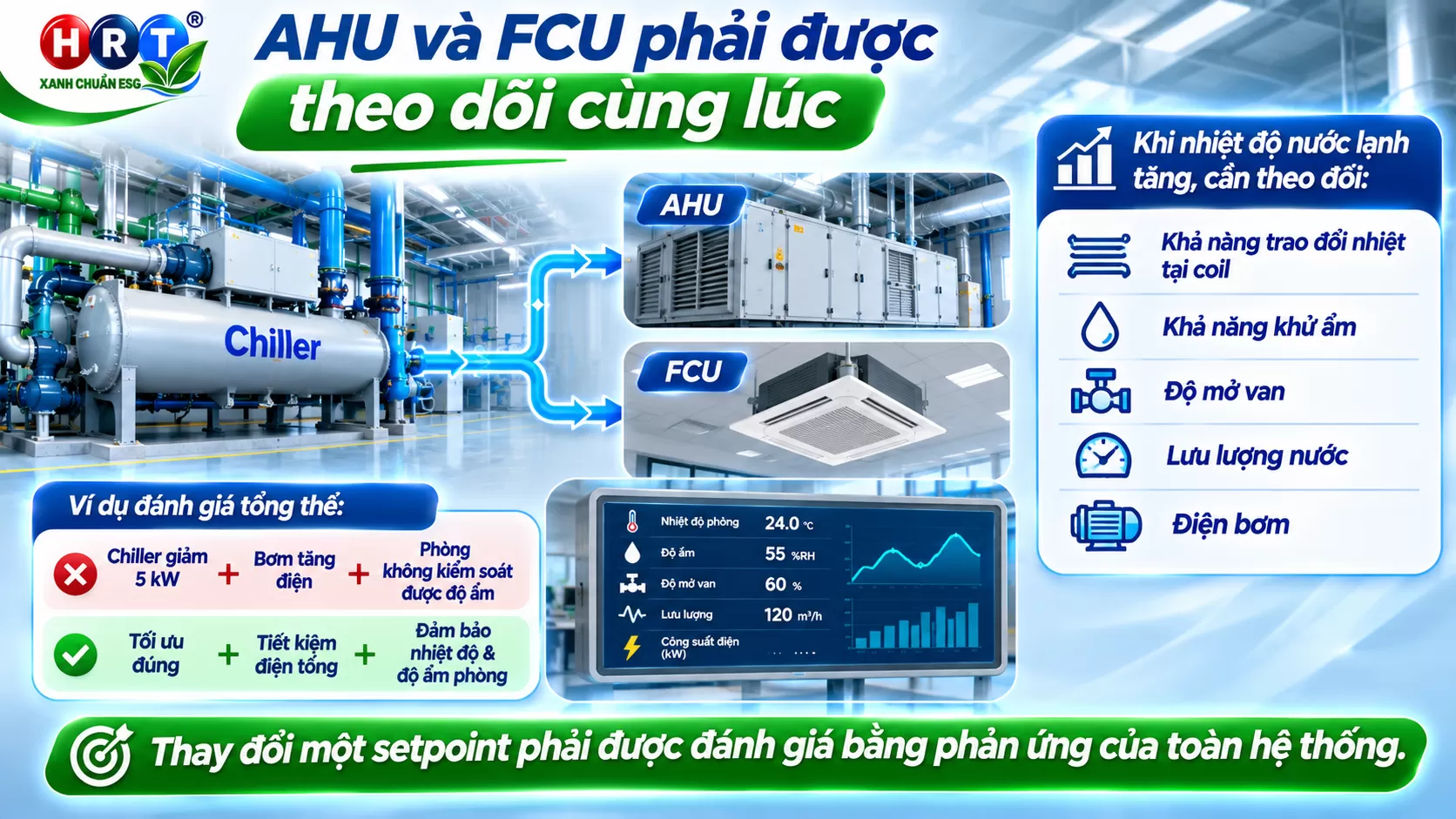
When the cold water temperature rises:
The heat exchange capacity at the coil varies.
Dehumidification capacity may vary.
The valve may have to be larger.
Water flow rate can increase.
Electric pumps can increase.
If the result is a 5 kW chiller but the pump increases power and the room begins to lose control of humidity, that's not a good option.
Before accepting changes, the original post requires monitoring room temperature, humidity, valve opening, flow rate and electrical power.
This is also the principle I want to keep:
Changes to a setpoint must be evaluated by the reaction of the entire system.
Pump deceleration is not sure the system has been optimized
Variable-frequency drives are good tools when placed in the right strategy.
But I don't judge an optimal project by reporting:
“Pump deceleration 20%”
I want to know after deceleration:
Is the flow rate through the Chiller still within the limit?
Is the differential pressure on the unfavorable gland still sufficient?
How much percentage open end valve?
ΔT how does it change?
Does the farthest AHU still receive enough water?
The original article determined that too low flow rate could cause the Chiller to fail to meet requirements or trigger protection, while unnecessary high flow rate increases pump power.
Low ΔT is not handled by reducing machine flow rate
If ΔT of cold water is abnormally low, I want to check the cause first.
Is the bypass valve open?
Does Coil have a good heat exchanger?
Is the sensor accurate?
Is the distribution flow rate too high?
Does the control valve work properly?
The original article also pointed out these points and stressed that ΔT should not be increased by simply reducing flow rate.
ΔT is a signal for diagnosis, not a number that must be reached at all costs.
Performance drops: prove the fault is in the machine before fixing it

One of the questions I ask is:
“With cooling load, why today the machine uses more electricity?”
There are many causes besides compressor itself.
Cold water temperatures change.
Cooling conditions are worse.
Flow rate sai.
Condensers or evaporators are dirty.
Sensors or gauges are misaligned.
If the input conditions are different, a change in performance index is possible even if the device has not yet failed.
So I don't want to propose replacements or overhauls based solely on the sentence:
“kW/RT increases”
Answers to be given:
Increase in the same conditions compared or not?
Maintenance by status, not just schedule
Routine maintenance schedule still needed.
But I want to associate that with the operation data.
With water-cooled chiller, it is necessary to pay more attention to the scale of condenser, water quality, cooling tower and pump condition.
With air-cooled chiller, it is necessary to check the cleanliness of condenser coil, fan, airflow and cooling space.
If performance begins to decline but the next maintenance schedule is not yet in place, the data must be able to generate a test head.
Good maintenance is maintenance of the right problem, not just the right day.
COP and kW/RT must be used for the right purposes
The two most common indices are COP and kW/RT.
COP = cooling capacity generated / Power consumption
Higher COPs typically exhibit better energy conversion efficiency within the same range and assessment conditions.
kW/RT = Actual electrical consumption / cooling capacity
Lower kW/RT usually shows better performance when compared under equivalent conditions.
What I'm particularly noting is:
The kW/RT of the chiller is not the same as that of the whole plant.
The entire station also has pumps, cooling tower and related auxiliary equipment.
Therefore, the report must specify the scope.
An example of why operational conditions matter
The original article puts the hypothetical situation:
Chiller supplies 200 RT.
Condition A: the machine uses 150 kW → 0,75 kW/RT.
Condition B: still 200 RT but more favorable heating, the machine uses 140 kW → 0,70 kW/RT.
The machine doesn't change.
Variable operation conditions and better performance.
However, I didn't use such a good time to announce my savings for the year.
Must consider the operation time and electricity of auxiliary equipment.
I want each experiment to change just enough to understand the cause.
When optimizing a Chiller station, changing too many parameters at once creates a problem:
The results are better, but we don't know why.
I want the process to be sequenced.
Record the current state.
Collect load, electricity, water temperature, flow rate and environmental conditions.
Analyze.
Compare data with operation history and device characteristics.
Choose a valid change.
Can be staging, cold water setpoint, cooling or pump control.
Controlled testing.
Monitor the response of the device and the area in which it is used.
Verify before you maintain.
Compare data in equivalent conditions and update operation processes.
This is also the five optimal steps proposed by the original HRT.
I'd like to add a rule throughout:
Do not lose the protection interlock and safety limits just to achieve a nice performance figure.
BMS must turn data into operation decisions
A dashboard with dozens of charts may not necessarily make the system better.
I want the operators to see indicators that can trigger action.
Current load.
kW/RT.
Cold water temperature.
ΔT.
Condition condenser water.
Flow rate.
Pump speed.
Chiller number running.
If performance leaves the normal zone under the same load conditions, the system needs to generate an alert or test header.
If operators adjust setpoints manually, they must know who does and when to review them.
Data is only valuable when it helps the operator make better decisions.
CEO's view Đoàn Văn Hoàng: I don't optimize the Chiller, I optimize the conditions in which it has to work.

When viewing an optimal report, I don't want to just see:
“Reduce setpoints"
“Pump deceleration"
“Reduce the number of machines running"
“Electric Chiller Reduction”
I want to see the connection between decisions.
How much load was that?
How is the cooling condition?
How much cold water is set?
Is flow rate within limits?
Are AHU and FCUs responsive?
How's the total power across the station changing?
That's how I apply the spirit True – Clear – Dedicated.
Understand correctly load and operation conditions.
Clearly about data, technical limitations and the impact of each change.
Dedicated follow up until the results are verified in actual operation.
The original article HRT concluded very clearly: High-performance chillers on the catalog are not enough; the value lies in the ability to maintain efficiency in real conditions of the building.
I want to turn that principle into an action statement:
Do not ask what setpoint Chiller is running at first. Ask why the system needs that setpoint in its current conditions.
When the answer is clear, the optimal decision is grounded.
Exchange the optimal Chiller performance with HRT
For operating systems, prepare cooling load data, power, kW/RT, supply-water temperature – return, flow rate, cooling conditions, pump status and operation schedule.
If there is an electricity surge, cold shortage or Low ΔT, it should be clearly stated the time and conditions of occurrence.
From that data, the parties can determine whether the problem lies in load, chiller, hydraulic, cooling or control before deciding to change setpoints, maintenance or equipment investment.
CEO Đoàn Văn Hoàng | HRT
Right from the beginning – Clear to the end – Sustainable Green.
HRT Contact: 0909 326 888
Post Tags: Chiller efficiency, Chiller efficiency, kW/RT Chiller, COP Chiller, operation Chiller, Low Delta T, Control Chiller, Sectional load Chiller, Plant Chiller, Power saving Chiller, CEO Đoàn Văn Hoàng, HRT.
Source: Publisher’s English edition · Vietnamese original on doanvanhoang.com