
Chiller plant optimisation: five decisions before you invest
Machine-translated from Vietnamese. Read the original in Vietnamese

Optimizing Chiller Plant helps businesses save electricity and control operation costs. CEO Đoàn Văn Hoàng – HRT share 5 effective and sustainable investment decisions.
Optimizing Chiller Plant: 5 Decisions to Help Business Control Power and Investment Costs
In commercial and industrial HVAC system management, I often ask a question to the project owner:
Is the Chiller plant consuming a lot of electricity because of inefficient equipment, or because we are operating improperly?
These are two completely different issues.
If your Chiller is severely degraded, repair or replacement may be necessary.
But if the system is still working well, while the sequence of running machines, water pumps, cooling towers and control points are not suitable, businesses may be wasting electricity without investing in new equipment.
From an HRT operator perspective, I don't want to start a Chiller Plant optimization project with the question: “What additional equipment should I buy?"
I want to start with three questions:
-
How much electricity is the system currently consuming to generate a unit cooling capacity?
-
What losses can be handled by improving operation?
-
What investment can be proven effective by actual data?
Optimizing the Chiller Plant is not merely about reducing the power of the compressor, but also about controlling the total power of both the cold water production and distribution system.
For effective implementation, I propose five management decisions that should be clarified before the enterprise approves the optimal project.
1. Decide to measure the correct performance before discussing electricity saving

The first mistake in many energy - saving plans is to set a goal for electricity reduction when it is not yet known how efficient the system is operating.
A Chiller plant may consume a lot of electricity because of the large cooling load. That does not mean that the operation is less efficient.
Conversely, a system with low total power but very little cooling capacity may still have poor performance.
We have to look at the total power of the station.
For Water Cooled Chiller system, the electrical consumption components usually include:
-
Chiller.
-
Chilled-water pump.
-
Condenser water pump.
-
Cooling tower fan.
-
Auxiliary equipment within the scope of assessment.
I want the engineering team to define the boundaries of measurement before concluding performance.
If you only measure the power of your chiller and ignore the pump and cooling tower, the results may not reflect the overall efficiency of the station.
Use the kW/RT indicator properly
The kW/RT indicates the electrical capacity required to generate a unit of cooling capacity at a given condition.
kW/RT = Total input power (kW) / actual cooling capacity (RT)
Where:
1 RT ≈ 3,517 kW cooling capacity.
Example illustration assumes:
A Chiller plant is producing 600 RT with a total electrical capacity of the equipment in the measurement range of 420 kW.
Whole Station Performance:
420 / 600 = 0,70 kW/RT
If after adjustment, at the equivalent load, the total power is reduced to 390 kW:
390 / 600 = 0,65 kW/RT
Power was reduced by 30 kW, or about 7.14% at two assumed operation points.
However, this reduction cannot be maintained for the entire year by default.
To assess actual energy savings, load levels, operation time, environmental conditions and changes affecting the system must be considered.
What HRT data proposes to collect
| Data & Information | Purposes |
|---|---|
| Electrical Capacity Each Chiller | Evaluation of the efficiency of generating sets |
| Full station power | Determine total consumption |
| cold water flow rate | Actual cooling capacity |
| Supply-water temperature – return | Heat Exchanger Rating |
| Temperature condenser water | Evaluation of working conditions of condenser |
| Pump, Fan Operation Mode | Determine auxiliary equipment power |
| Cooling load over time | Performance analysis at load levels |
Decisions to be closed: Is there enough data to establish a reliable energy baseline?
Output: Report Chiller Plant performance according to actual load and operation conditions.
2. Decide the optimal operation before investing in replacement of equipment
In project management, I prioritize the assessment of the possibility of improving existing systems before proposing large investments.
This is not a deferral rule.
This is how operational problems are distinguished from equipment capacity problems.
Evaluable solution group with low investment
Adjust Chiller Running Sequence
For factories with many units, the number of Chillers operating should be consistent with cooling load and performance characteristics of each machine.
It is not recommended to run one chiller by default always saving than running two chillers.
It is necessary to compare the total power capacity of the whole station at the same load condition, and consider the minimum load limit, running time and number of starts.
Check the cold water temperature setting point
Under some load conditions, increasing the chilled-water supply temperature can improve Chiller efficiency.
But the adjustment must take into account AHU/FCU capacity, humidity, water flow rate and electrical power of the pump.
If the area no longer meets the requirements, that option is not considered optimal success.
Checking point set differential pressure pump system
When hydraulic and equipment conditions permit, differential pressure adjustment can be studied according to actual needs instead of maintaining a high set point at all times.
However, the minimum flow rate of the chiller and critical terminals must be ensured.
Review operation schedule
It is possible to check the start-up and stop-down times and the history of the work to determine unnecessary operation time periods.
Any changes must ensure the requirements of cooling load, humidity and related technological conditions.
Classification of solutions by investment level
| Groups | Example | Conditions for decision |
|---|---|---|
| No or little investment | Adjustable running schedule, machine sequence, set point | Have data and control operation limits |
| Average investment | Sensors, control valves, BMS logical renovation | There is evidence that existing equipment or controls have not met |
| Big investment | Replace Chiller, renovate pump or cooling tower | Have technical evaluation, life-cycle cost and capacity demand |
Managers need to avoid choosing a solution solely because of newer technology.
Decisions to be closed: What improvements can be made safely on the existing system before deciding to invest in new equipment?
Output: Optimal opportunity portfolio, categorized by cost, benefit and priority.
3. Decide to properly handle the congestion point of the entire Chiller Plant
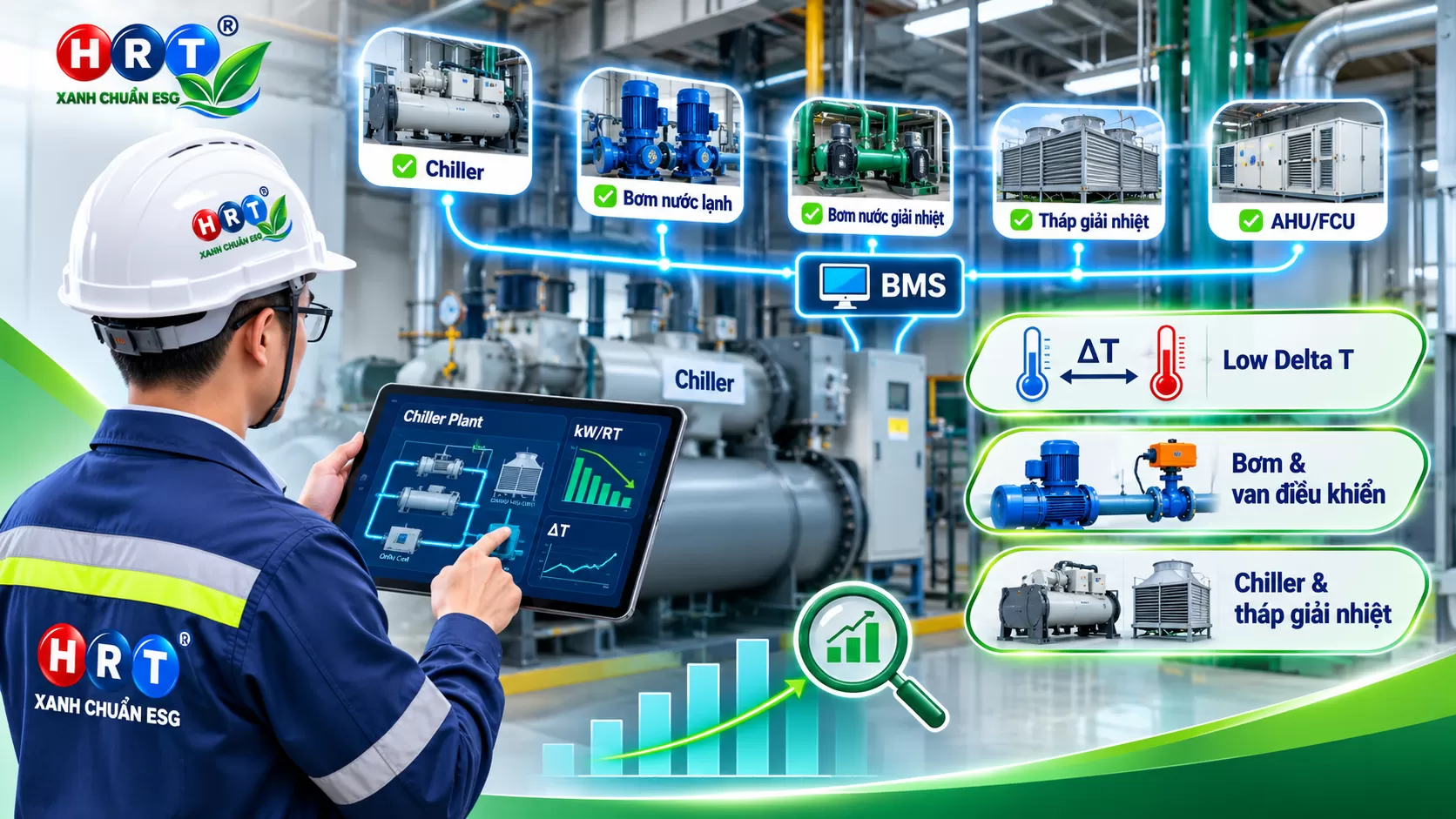
A chiller plant does not operate as individual devices.
Chiller, pump, cooling tower, AHU/FCU and control system are directly related to each other.
So I don't accept the way that one device - focused assessment ignores the impact on the rest.
Not optimizing the Chiller by increasing total power
For example, reducing the temperature of condenser water can help your chiller reduce its electrical power.
But for this to work, cooling tower systems may need fan acceleration.
If the energy saved at the Chiller is less than the additional power of the cooling tower, the total system has not reached the savings target.
Similarly, when the temperature of chilled water supply changes, compressor capacity may decrease but the heat exchange conditions at AHU/FCU may change.
That's why I always ask for an overall assessment.
Three bottlenecks to prioritize analysis
Blockage Point 1 – Low Delta T
When the chilled-water supply temperature difference is lower than expected, it is necessary to distinguish the effect of flow rate, cooling load, control valve, coil and hydraulic system.
Low Delta T does not always mean dirty coil.
In particular, it is not recommended to increase the water flow rate to handle any cases of cold shortage when the heat exchange capacity and system limits have not been assessed.
Blockage Point 2 – Pump and Control Valve
Pumps may operate with inappropriate differential pressure, while valves at the terminals have not been properly balanced.
Adding variable-frequency drives does not automatically guarantee savings if the setpoint and control method are not suitable.
Blockage Point 3 – Chiller and cooling tower
Scaling, heat exchange status, water distribution, environmental conditions and tower operation methods all affect efficiency.
A change in tower must be evaluated with the same power capacity of chiller and cooling pump system.
Suggested HRT assessment method
I want engineers to put the results on the same control panel:
| Composition | Indicator to evaluate | Management Issues to Answer |
|---|---|---|
| Chiller | kW/RT, partial load, temperature | Does the machine work under suitable conditions? |
| Chilled-water pump | kW, flow rate, differential pressure | Is it transporting water in excess of demand? |
| Cooling tower | Water temperature, fan power | Is the control strategy appropriate? |
| AHU/FCU | Temperature, flow rate, valve status | Does the terminal respond to load? |
| BMS | Placement, history, alerts | Does the control logic reflect actual needs? |
Decisions to be closed: Identify the right bottlenecks that are affecting station-wide performance before selecting a solution.
Output: The cause – effect – remedy matrix.
4. Decide investment according to total life-cycle cost, not only purchasing price
A low - cost chiller is not necessarily the most economical option during the operation.
Conversely, equipment with high nominal performance is also unlikely to be effective if actual load, operation mode or renovation costs are inappropriate.
I want the business to compare the plan over the entire life cycle of the project.
Four groups of costs to calculate
Initial Investment Cost (CAPEX)
Including equipment, materials, construction, system renovation, control, commissioning and acceptance testing.
Operational costs (OPEX)
Including electricity, water, water treatment chemicals, consumables and related operational costs.
Maintenance and repair costs
Includes routine servicing, expected repairs, component replacements and those related to maintaining reliability.
Cost of interruption
For industrial plants or works in exploitation, the system stoppage time may have a major impact on production or business activities.
Examples of investment performance assessments
Assume a Chiller Plant Optimization project has the expected data:
-
- Implementation cost: VND 600 million.
-
Energy saving is verified or forecasted after adjusting conditions: 150,000 kWh/year.
-
Average electricity unit price: 2,000 VND/kWh.
-
Additional operation and maintenance cost: 20 million VND/year.
Power Saving Value:
150,000 × 2,000 = 300 million VND/year.
Estimated Net Benefits:
300 – 20 = 280 million VND/year.
Simple Payback Period:
600 / 280 ≈ 2.14 years.
This is a hypothetical example to illustrate the method of evaluation, not actual data or commitment to effectiveness of HRT.
The actual result must take into account the electricity tariff, cooling load, operation hours, financial costs and future changes.
For large projects, the net present value (NPV), life-cycle cost (LCC) and sensitivity of the plan should be evaluated according to different operation scenarios.
Not just how long the payback
I would like the project owner to consider simultaneously:
-
Energy saving effect.
-
Ability to maintain function.
-
Remaining equipment life.
-
The reliability of the system.
-
Repairability, maintenance.
-
- Impacts on the operation of the project.
Decisions to be closed: Which option brings the most suitable use value and economic efficiency in the project life cycle?
Output: CAPEX – OPEX – risk – benefit comparison report.
5. Decide acceptance testing effectively by data, not by commitment

This is my most important request when approving an energy - efficient project.
It is impossible to assert power saving just because a graph after renovation is lower than before renovation.
If before renovation of operation works at high load, after renovation of load is reduced sharply, the power difference does not reflect accurately the impact of the solution.
Set up the power baseline
Before deployment, data should be collected that represents the actual operational conditions.
Factors to be considered include:
-
Secondary cooling load over time.
-
Weather and environmental conditions.
-
Operating time.
-
Configure the operating machine.
-
Temperature and water flow rate.
-
The power of the device within the measurement range.
-
Changes in function and use.
Evaluate efficiency according to equivalent conditions
After optimization, the data should be compared with the baseline adjusted to suit the load and influencing factors.
Can refer to the principle of energy efficiency measurement and verification according to IPMVP, select the method suitable for the project scope.
I suggest to distinguish two indicators:
Performance at the time of measurement
Reflects the operational state under a specified condition, e.g. kW/RT at the corresponding load level.
Periodic energy saving
This reflects the electricity difference in the period of time assessed after considering appropriate adjustment factors.
Do not get results at several points to default to the full year effect.
KPI acceptance testing HRT proposal
| KPI | Purposes |
|---|---|
| kW/RT full station | Performance evaluation at defined load conditions |
| kWh in period | Determine the power consumption |
| RT Practical | Cooling capacity rating provided |
| Delta T Water Cooler | Heat Exchanger Characteristics Monitoring |
| Pump and tower capacity | Auxiliary Equipment Control |
| Temperature, humidity area | Confirm the request for use |
| Alerts and Incidents | Track stability and safety |
| Operation time | Analysis of the running schedule and mode of use |
Three conditions before conclusion reached
Condition 1 – Required function
The system still meets cooling load, temperature, humidity and related technological requirements.
Condition 2 – Safe operation equipment
Do not exceed the technical limits of Chiller, pump, cooling tower and related equipment.
Condition 3 – Energy Efficiency Verified
There are clear data, methods of assessment, measurement scope and conclusions.
Decisions to be closed: Confirm the efficiency of savings only when the data is reliable enough and the results meet the agreed conditions.
Output: Measurement reports, performance verification and operation handover records.
6. Five mistakes businesses need to avoid when investing in optimum Chiller Plant
Mistake 1 – Only evaluate the performance of the Chiller
Reducing the compressor power but increasing the pump or cooling tower power can cause the total efficiency to not meet expectations.
Actions: Evaluation within station - wide boundaries.
Mistake 2 – Installing variable-frequency drives without evaluating the hydraulic system
If the minimum flow rate, control valve and pressure setting point conditions have not been checked, the investment efficiency may not be achieved.
Actions: Hydraulic analysis and control logic before renovation decision.
Mistake 3 – Apply the same set point to every building
Cooling load, climate, humidity requirements and different equipment configurations result in different optimum conditions.
Actions: Build set point according to actual data and design limit.
Mistake 4 – Commit to Savings Without Baseline
Without baseline data it will be difficult to demonstrate a true improvement.
Actions: Unify measurement and verification methods before investing.
Mistake 5 – Failure to maintain control after acceptance testing
Performance may deteriorate over time due to misaligned sensors, scale, load changes, or inappropriate control adjustments.
Actions: Integrate performance KPIs into operation and maintenance plans.
7. Three ports optimized Chiller Plant project approval according to HRT
From a management perspective, I propose using three verification checkpoints to limit unfounded investment.
| Gate | Contents to be approved | Outputs |
|---|---|---|
| Port 1 – Before Planning | Data, status and causes | System Evaluation Report |
| Gateway 2 – Before Investment | Solutions, CAPEX, OPEX, Risks and Benefits | Technical – financial plan |
| Port 3 – Before acceptance testing | Practical efficiency, safety and operation profile | Verification and handover report |
These three ports help project owners distinguish clearly:
-
What issues have been verified.
-
What solution has been approved.
-
What effect has been proven.
-
What responsibilities to maintain after handover.
8. Frequently Asked Questions About Optimal Investment Chiller Plant
8.1. Is it mandatory to replace the Chiller Plant Optimizer?
No. The improvement of the operation sequence, pumping system, control and maintenance can be beneficial under suitable conditions. Replacement should only be decided after evaluation of equipment capacity and economic efficiency.
8.2. Should variable-frequency drive be installed for all chilled-water pumps?
Should not be decided in series. It is necessary to consider the hydraulic configuration, flow rate limit, valve type, load requirements and operation mode of each system.
8.3. Does low kW/RT always mean good operation?
Low indicators usually represent the low level of electrical capacity per unit of cooling capacity at the measurement condition. However, it is necessary to consider the measurement range, cooling load, power and operation conditions to properly evaluate.
8.4. When should you reevaluate your Chiller Plant performance?
When electricity costs rise abnormally, loads change, the system appears to be low Delta T prolonged, auxiliary equipment operates inappropriately or the work has been exploited for a long time without an overall assessment.
8.5. Can I make a commitment on the electricity saving before the survey?
The forecast can be made only with the assumptions clearly stated. The actual saving level should be verified after implementation by the agreed method.
8.6. Is Chiller Plant Optimization related to ESG?
Yes. Control and reduction of electricity consumption can support the objective of efficient energy use and indirect emission reduction from purchased electricity. The emission reduction level must be calculated according to the verified saved electricity and appropriate emission coefficient.
9. HRT – Optimize Chiller with Data and Responsibility
.
In HVAC system management, I do not judge an optimal solution solely by the number of replaced equipment or additional technology.
It is important that the business addresses the problem correctly and achieves a verifiable effect.
That's also how I want HRT to implement the three core values.
YES
Correctly assess cooling load, performance, causes and operation conditions before proposing solutions.
CLINICAL
All options must have specific scope, cost, objectives, acceptance testing criteria and responsibility.
VISION
Monitor the effectiveness of deployment, support operators to maintain quality and reliability of the system.
HRT provides solutions for design, construction, maintenance, renovation and optimization of commercial and industrial HVAC systems, including Water Chiller, Air Cooled Chiller, AHU/FCU, VRV/VRF, pumping system, ventilation and BMS control.
For businesses considering renovating Chiller plants, preparing equipment records, schematics, power data and operation history will help the survey process have a clearer basis.
10. Conclusion: Optimizing Chiller Plant must start from the right decision
An efficient Chiller Plant system is not the one with the most technology.
It is the system that meets the needs of cooling, safe operation, reasonable energy use and has suitable life-cycle cost.
From a management perspective, I ask that five decisions be made in order:
-
Measure actual performance.
-
Take advantage of the ability to improve existing systems.
-
Correctly address the station congestion.
-
Assess your investment according to life-cycle cost.
-
Testing the effectiveness before acceptance testing.
Correct measurement – Correct understanding – Correct investment – Clear proof.
It is the HRT approach to be aimed at in each HVAC energy optimization project.
KS. Đoàn Văn Hoàng – CEO HRT
HRT – Green Breath for All Buildings
Right from the beginning – Clear to the end – Sustainable Green.
Website: https://hrt.vn
Email: ceo@hrt.vn
Hotline: 0909 326 888
Source: Publisher’s English edition · Vietnamese original on doanvanhoang.com