
Packaged Air Conditioners for Industrial Factories
Machine-translated from Vietnamese. Read the original in Vietnamese

Packaged Air Conditioner is an HVAC solution suitable for many factories, factories and industrial warehouses with large space, high airflow rate requirements. The article analyzes how to survey, select capacity, design air duct, outdoor air control, energy saving and mistakes to avoid when implementing Packaged systems.
Packaged Air Conditioner for Factory is not only choose a large capacity machine
Industrial buildings often have completely different characteristics from offices or civil buildings.
The space can be very wide, high ceiling, many exothermic machinery, the door is frequently open, the exhaust wind volume is large and the operation time is long.
Therefore, the choice of air conditioner for the workshop can not be based solely on the floor area.
A Packaged system that wants to work effectively must simultaneously address:
- Thermal load reality.
- Air flow rate.
- Fan pressure.
- Wind distribution.
- Outdoor air.
- Return air.
- Suctioning waste.
- Maintenance conditions.
- Consume energy.
- Stable operation capability.
This is the reason Packaged Air Conditioner should be considered as a Complete HVAC solution, not just a refrigeration device.
What is Packaged Air Conditioner?
Packaged Air Conditioning is a relatively large capacity air conditioning system in which many key components of the refrigeration cycle are integrated within a unit cluster.
Depending on the configuration, the air after treatment is delivered to the area of use through the system:
- Air duct.
- Air outlet.
- Air supply door.
- Wind reclaimer system.
Packaged is usually considered for:
- The factory.
- The factory.
- Kho.
- Logistics center.
- Production area.
- Large commercial space.
- Areas with high demand for airflow rate.
Packaged's strength lies not only in its cooling capacity but also in its ability to combine with a wind distribution system to bring air to the right area for conditioning.
When should factory consider using Packaged?
Not all factories should choose Packaged by default.
This system is often worth considering when the building has the following characteristics.
Large space and relatively few partitions
If a wide production area has relatively uniform temperature requirements, Packaged can help simplify the system compared to over-laying small indoor units.
Large airflow rate required
With tall and wide workshops, the problem is not just creating enough cooling capacity.
The cold air must also be delivered to the correct work area.
Therefore, the ability to meet:
Airflow rate + fan pressure + air duct system
It's a very important role.
Have space to put equipment and take air duct
Packaged is more suitable when the construction has:
- Equipment placement area.
- Space for ductwork.
- Maintenance route.
- Get the right power.
- Condensate drainage location.
- Ability to put large equipment into the building.
Factory wants relatively centralized system
Compared to the layout of multiple distributed equipment, Packaged can help reduce the number of machine assemblies that must be managed at some types of buildings.
7 Factors to Survey Before Choosing Packaged Air Conditioner
This is the most important part before deciding on a model and wattage.
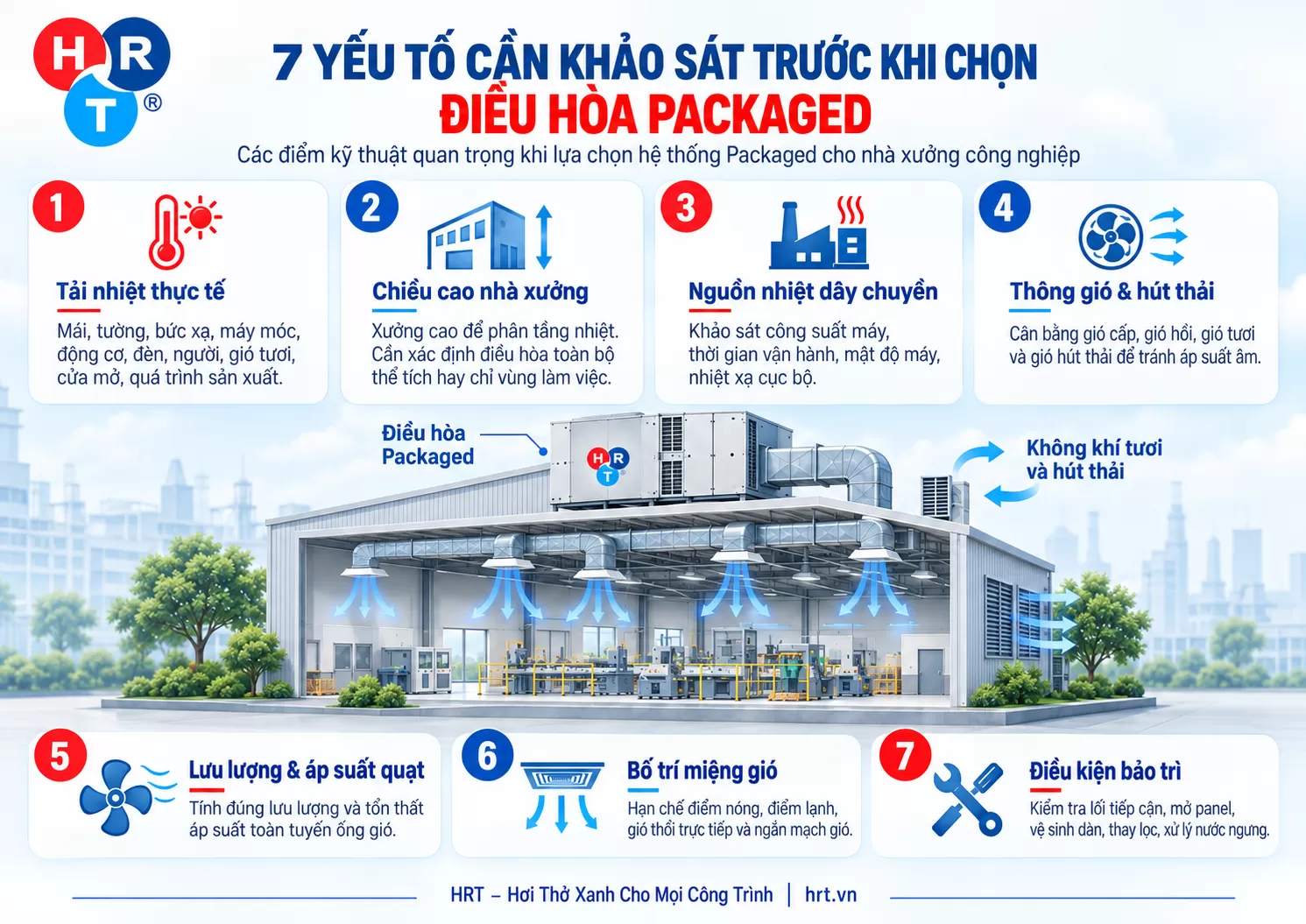
1. thermal load actual of workshop
The conditioning capacity must start from thermal load.
Common load sources include:
- Heat is transferred through the roof.
- Heat through the wall.
- Solar radiation.
- Machinery manufacturing.
- The engine.
- Illuminate.
- The worker.
- Outdoor air.
- Air came through the door.
- Heat from the production process.
Two workshops with the same area can absolutely require very large different cooling capacity.
Therefore, it is not recommended to use a single W/m2 factor for all types of workshops.
2. Workshop height and volume
The floor area only reflects a fraction of the size of the space.
For example:
- The workshop is 4 m high.
- The factory is 12 meters high.
Despite the same area, thermal properties and air distribution vary widely.
High-rise factories often appear phenomenon Thermal stratification.
Hot air tends to accumulate above, while humans work in the lower areas.
Therefore, the engineer needs to determine at the beginning:
Full volume conditioning or just work area conditioning?
This decision directly affects cooling load and wind supply options.
3. Heat source of production line
In many plants, thermal load from machinery may be greater than load from people or lights.
Need to collect at least:
- Equipment capacity.
- Operating time.
- Simultaneous operation coefficient.
- Heat waste to the area.
- Heat emission location.
- Ability to absorb heat at source.
For example, if a machine produces intense heat at a fixed point, the sensible solution might be to draw heat from the source instead of increasing the cooling capacity of the entire plant.
4. outdoor air and exhaust system
An air conditioning system cannot operate independently of the ventilation system.
If exhaust fan discharges a large amount of air but there is no corresponding compensation solution, the workshop may be negative pressure.
This will cause hot, humid air to be drawn into the building.
System balance should be considered simultaneously:
Supply air – return air – outdoor air – exhaust wind.
5.Flow rate and fan pressure
It's not cooling capacity enough.
A Packaged with sufficient capacity but incapable of winning air duct loss may still fail to deliver the designed air to the production area.
Loss should be calculated through:
- Air duct straight.
- Co.
- Get lost.
- Squeeze.
- Damper.
- Filter.
- Air outlet.
- Auxiliary equipment.
Then choose the right fan pressure.
6. Air outlet layout plan
Air outlet design directly affects the heat sense in the workshop.
Need to limit:
- Hot spot.
- Cold spot.
- The wind blows directly on you.
- Supply air returned to the return gate too soon.
- The area is missing air circulation.
High-rise buildings should pay special attention to the blowing range and ability to bring wind down to the work area.
7. Maintenance conditions
A common mistake is to only find the “placement" location without checking the maintenance capability later.
Enough space is required to:
- Open the panel.
- Remove the filter.
- Clean the heat exchanger.
- Check the motor.
- Check the fan.
- Replace the components.
- Transportation of equipment.
- Condensate treatment.
Good design should take into account the whole operation life cycle and not only the installation stage.
How to choose Packaged capacity?
One way to make it unsafe is to:
Area × coefficient = cooling capacity.
The experience factor may support initial estimation but should not be used as a final basis for industrial design.
The more appropriate process is:
Survey → Collect data → Calculate cooling load → Determine flow rate → Calculate pressure head → Select equipment → Check working condition.
When choosing Packaged, check simultaneously:
| Parameter | Meaningful |
|---|---|
| Total Cooling Capacity | Total cooling capacity |
| Sensible Cooling Capacity | Cooling capacity current |
| Airflow | Air flow rate |
| External Static Pressure | Pressure external head of fan |
| Power Input | Power Capacity |
| Outdoor Design Condition | Outdoor environmental conditions |
| Return Air Condition | Return air condition |
| Sound Level | Noise level |
| Power Supply | Power Supply |
| Dimensions | Equipment Dimensions |
Don't just look at a cooling capacity number and lock the device.
The air duct design determines the actual efficiency of Packaged
Packaged can generate enough cold energy, but if the design wind distribution system is not suitable then the production area can still be hot.
Air duct too small
May result in:
- High wind speed.
- Increase your pressure drop.
- Increase noise.
- Reduce the actual flow rate.
Air duct too big
May cause:
- Increase your costs.
- Take up a lot of space.
- Difficulty coordinating MEP.
- Difficult to arrange in height restricted areas.
Duct leakage
The locations where leaks usually arise:
- The coupling.
- Co.
- Squeeze.
- The door.
- Soft connection.
- Device connection point.
Leaks cause cold air to be lost before reaching the correct area of use.
Air duct insulation
Cold air duct running through hot areas should be properly insulated to limit:
- Heat transfer.
- Condensation.
- Small amounts of water.
- Damage to surrounding materials.
7 Common Mistakes When Implementing Packaged
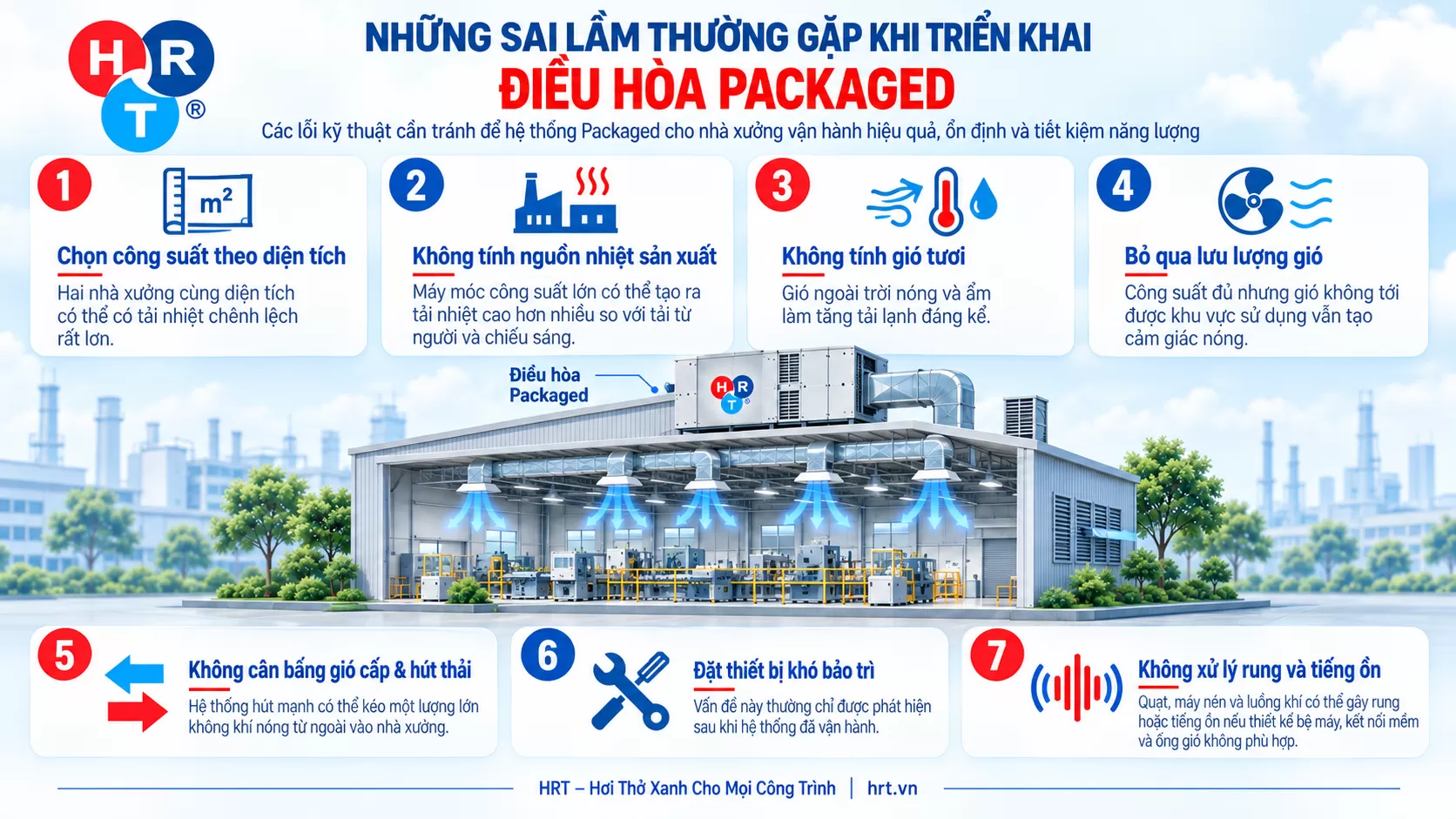
Mistake 1: Choose power by area
The same 2,000 m2 but an electronics assembly plant and a plant with plastic injection molding machines can have very different thermal loads.
Area is just one input.
Mistake 2: Do not calculate heat from the production line
Motors, compressor, heat furnaces, presses, CNC machines, or industrial lines can all generate significant amounts of heat.
If this load is missed, the design capacity may be missing.
Mistake 3: Ignoring outdoor air
The hot and humid outdoor air brought into the system generates both thermal load present and hidden load.
For hot and humid climates, the amount of outdoor air can greatly affect the total cooling load.
Mistake 4: Look only at cooling capacity, ignore airflow rate
A system may have enough cold kW but still fail to meet temperature requirements if the cold gas is not properly distributed.
Especially with high workshop, flow rate and blow range are very important.
Mistake 5: Unbalanced wind level and exhaust suction
Exhaust suction is too large that insufficient airflow level compensation can make the factory negative pressure.
The constant heat from the outdoors will increase the cooling load.
Mistake 6: Putting the machine in a position that is difficult to maintain
Inappropriate placement can make simple tasks such as filter change, cleaning the seat or changing the motor difficult.
Mistake 7: Failure to Handle Vibration and Noise
The vibration source can come from:
- Compressor.
- Fan.
- Motor.
- Airflow.
- Air duct.
Need to consider:
- Machine base.
- Anti-vibration rubber.
- Spring isolator as needed.
- Soft connection.
- Wind speed.
- Air outlet location.
How to save power for Packaged system?
Energy efficiency does not depend only on the nominal performance of the machine.
It also depends greatly on the design and operation.
Reasonable division of operational zones
If only a part of the workshop is operating, it is not recommended to maintain air conditioning of the entire area when not needed.
Control operation schedule
Can organize on/off according to:
- Production shift.
- Area.
- rush hour.
- Device operation schedule.
Air filter test
Filter Dirt Making:
- Reduce flow rate.
- Increased pressure loss.
- Increase fan power consumption.
- Reduce heat exchange.
Sanitary heat exchanger
Dust on coil can reduce heat exchange efficiency and affect operation conditions of the system.
Control duct leakage
The air is cooled but the loss before reaching the use zone is energy wasted.
Heat suction at source
With large heat generators, sometimes the most economical solution is not to increase the air conditioning power but to remove the heat at the site of generation.
Packaged, VRV/VRF or Chiller for factory?
There is no one solution that works best in every case.
| Criteria | Packaged | VRV/VRF | Chiller |
|---|---|---|---|
| Large space | Good. | Customize configuration | Very suitable |
| Many small rooms | Average | Very good. | Good. |
| Large airflow rate | Good. | Dependent indoor unit | Very good with AHU |
| Control each zone | Average | Very good. | Good. |
| Large Load Cooling System | Depending on the project | Depending on the project | Very suitable |
| Air duct system | Commonly used | Can be used | Often Combined AHU |
| Scalability | Customized Design | Good. | Good. |
| Maintenance Focus | Relatively good | Dispersion | Good. |
When to Consider Packaged
- Big space.
- Less zone.
- Need high airflow rate.
- Able to arrange air duct.
When to Consider VRV/VRF
- Many are independent.
- Different use needs.
- Zone - specific joysticks.
When to Consider Chiller
- Huge total cooling load.
- Multiple AHU/FCU system.
- Long-time operation plant.
- Need central solution.
- There are requirements for long-term expansion or energy optimization.
In some plants, the most effective option may be to combine multiple systems.
When can Packaged not be the optimal choice?
Should evaluate other solutions if the works:
- There are too many small zones.
- Temperature controls are needed for each area independently.
- There are very tight humidity control requirements.
- It's a specific cleanroom.
- No space goes air duct.
- No suitable location for placing the device.
- There are very large cooling load and many different operation areas.
- A particularly high level of redundancy is required.
The choice of the system should be based on TCO – Total Cost of Ownership, not only the initial investment cost.
What does the Packaged System cost include?
Packaged quotation should not only include equipment price.
Complete costs may include:
- Packaged Equipment.
- Air duct system.
- Insulate.
- Air outlet.
- Damper.
- Outdoor air.
- Suctioning waste.
- Electrodynamics.
- Electrical control.
- Machine base.
- Anti-vibration.
- Condensate.
- Lifting equipment.
- Construction.
- Testing & Commissioning.
- Warranty.
- Maintenance.
Therefore, comparing two quotes based solely on the machine price can lead to false conclusions.
Packaged implementation process at HRT
HRT implements HVAC solution in a controlled manner from the beginning until the actual system operation.
Step 1 – Survey the current status
Collect:
- The ground.
- Height.
- Functional.
- Machines.
- Heat source.
- Number of people.
- Operating hours.
- Suctioning waste.
- Outdoor air.
- Power supply.
- Space to place the machine.
- Air duct.
Step 2 – Determine Requirements
Clarification:
- Target temperature.
- Areas to air condition.
- Production mode.
- Time of operation.
- Request backup.
- Scalability.
Step 3 – Calculate cooling load
Loads are determined from actual conditions rather than just based on area.
Step 4 – System Design
Includes:
- Capacity.
- Flow rate.
- Pressure head.
- Air duct.
- Outdoor air.
- Windswept.
- Suctioning waste.
- Controls.
Step 5 – Select your device
Compare the design specifications with the catalog and manufacturer's technical data.
Step 6 – Installation
Control:
- Machine base.
- Air duct.
- Electricity.
- Insulate.
- Soft connection.
- Condensate.
- Anti-vibration.
Step 7 – Testing & Commissioning
Testing:
- Flow rate.
- The temperature.
- The current.
- Noise.
- Vibration.
- Condensate.
- Controls.
- Ability to respond to actual load.
Step 8 – maintenance and optimization
After operation, the system needs to be monitored for further optimization:
- Energy.
- Flow rate.
- The temperature.
- Stability.
- Maintenance cycle.
HRT - green breath for every building
Source: Publisher’s English edition · Vietnamese original on doanvanhoang.com