
What is R-Refresher? An energy-saving solution for existing air conditioners
Machine-translated from Vietnamese. Read the original in Vietnamese
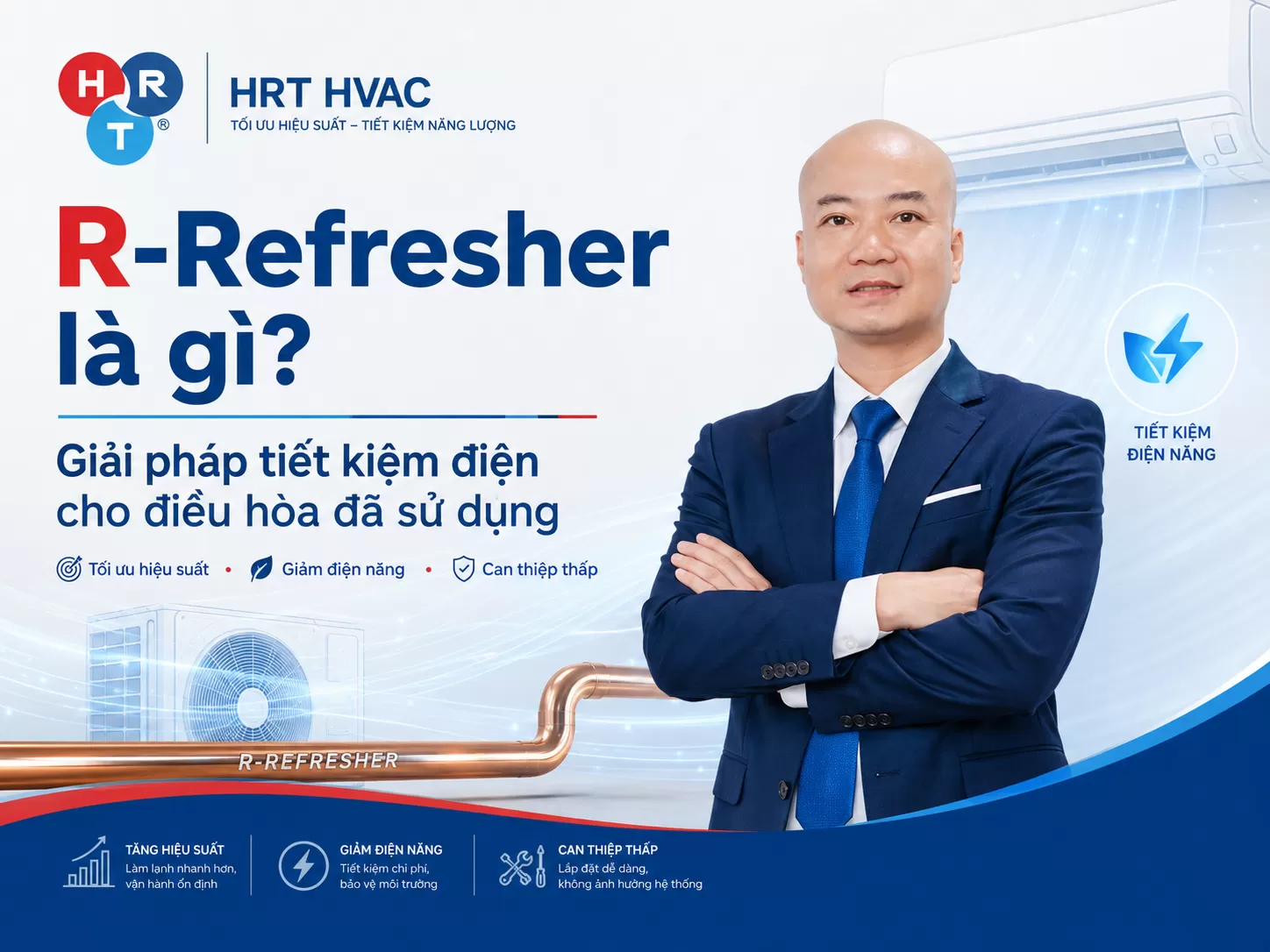
R-Refresher is an additional device installed outside the refrigerant pipeline, aiming to improve operation efficiency and reduce power for existing air conditioning systems without major interference with the refrigeration circuit.
What is R-Refresher?
R-Refresher is an energy saving device that is installed in addition to the air conditioning system or cooling equipment in operation.
The notable difference lies in the way it is installed.
The device uses a signal cable wrapped outside the refrigerant pipeline instead of having to open the circuit.
According to the product configuration, the installation is not directed at:
- Cut the copper pipework.
- Weld additional fitting.
- Fill the refrigerant with chemicals.
- Thay compressor.
- Direct cooling capacity limit.
- Control ON/OFF air conditioner as a controller.
It's easy to imagine:
Existing HVAC system + R-Refresher → optimized cold circuit operation support
instead of:
Remove the old system → replace all new equipment.
Remarkable Points of R-Refresher
A retrofit solution is usually only really valuable when three conditions are met:
Low interference
The installation of the equipment does not require the opening of the refrigeration circuit according to the mounting method described by the supplier.
No change of the design capacity of the machine
The R-Refresher is not a device that turns a small power plant into a larger power plant.
Can be verified by data
Efficiency should be measured before and after implementation, rather than just based on feel or brochure.
This is an HRT point that is particularly emphasized when evaluating energy saving solutions.
What part of the refrigeration system does R-Refresher work on?
A basic cold compression cycle consists of:
Compressor → Condenser → Expansion Device → Evaporator → Compressor
Where:
Compressor
Compress the liquid vapor from low pressure to high pressure.
This is usually one of the largest electrical loads of the refrigeration circuit.
Condenser
Discharge heat from the solvent into the environment.
Expansion valve
Reduce the pressure of the solvent before entering the evaporator coil.
Evaporator
Absorbs heat from air or water.
R-Refresher does not replace any of the above main devices.
The device is installed additionally outside the fluid pipe and acts according to the signal mechanism announced by the manufacturer.
How is the principle of R-Refresher described?
According to the product literature, R-Refresher generates a pulse signal and transmits this signal to the wire wrapped around the refrigerant pipeline.
The manufacturer describes this impact towards the state of:
- Refrigerant.
- Compressor oil.
- Process roving in circuit.
- Heat exchanger capacity.
The action chain is logically oriented:
R-Refresher Signal
→ impact through pipe
→ supporting the state of the solvent and oil
→ support roving process
→ support heat exchanger
→ Reduce the operation load required by compressor
→ reduced power
It should be noted that this is mechanism described by the manufacturer for the product.
This explanation should not be taken as an absolute statement for all HVAC systems if measurements are not available on a specific site.
Why is the used air conditioner of interest?
New equipment is usually operating relatively close to the design state.
Meanwhile, systems that have been in operation for years may appear:
- Impaired heat exchange efficiency.
- Control deviation.
- Compressor runs longer.
- The condensing pressure is higher.
- Lower airflow.
- Running time increases.
- Systemic efficiency decreases.
Therefore, the old device optimization problem often has larger redundancy.
However, “old” is not synonymous with “fitting R-Refresher is definitely saving”
The system still needs to be tested first.
What systems does R-Refresher fit on?
In principle, the selection should be based on practical refrigeration circuitNot just based on the system name.
Can be considered with groups:
- Commercial air conditioner.
- Central air conditioning.
- VRV/VRF system suitable.
- Packaged Unit.
- Some chillers use refrigerant fitting.
- Commercial refrigeration equipment.
- Freezing equipment.
Before deploying, it is necessary to determine:
- Refrigerant.
- Compressor type.
- Circuit number.
- Power each circuit.
- The amount of solvent.
- Runtime.
- Machine status.
- Current electrical data.
What kind of solvents does R-Refresher work with?
The product literature refers to a number of groups of fluorocarbons such as:
- R11.
- R12.
- R22.
- R32.
- R134a.
- R404A.
- R407C.
- R407F.
- R410A.
- R502.
This list should be interpreted as the range of solvents covered by the product literature.
Do not take this as a recommendation to continue using older generation solvents.
Some refrigerants on the list are now restricted or in the process of being phased out in many markets.
How is the R-Refresher installed?
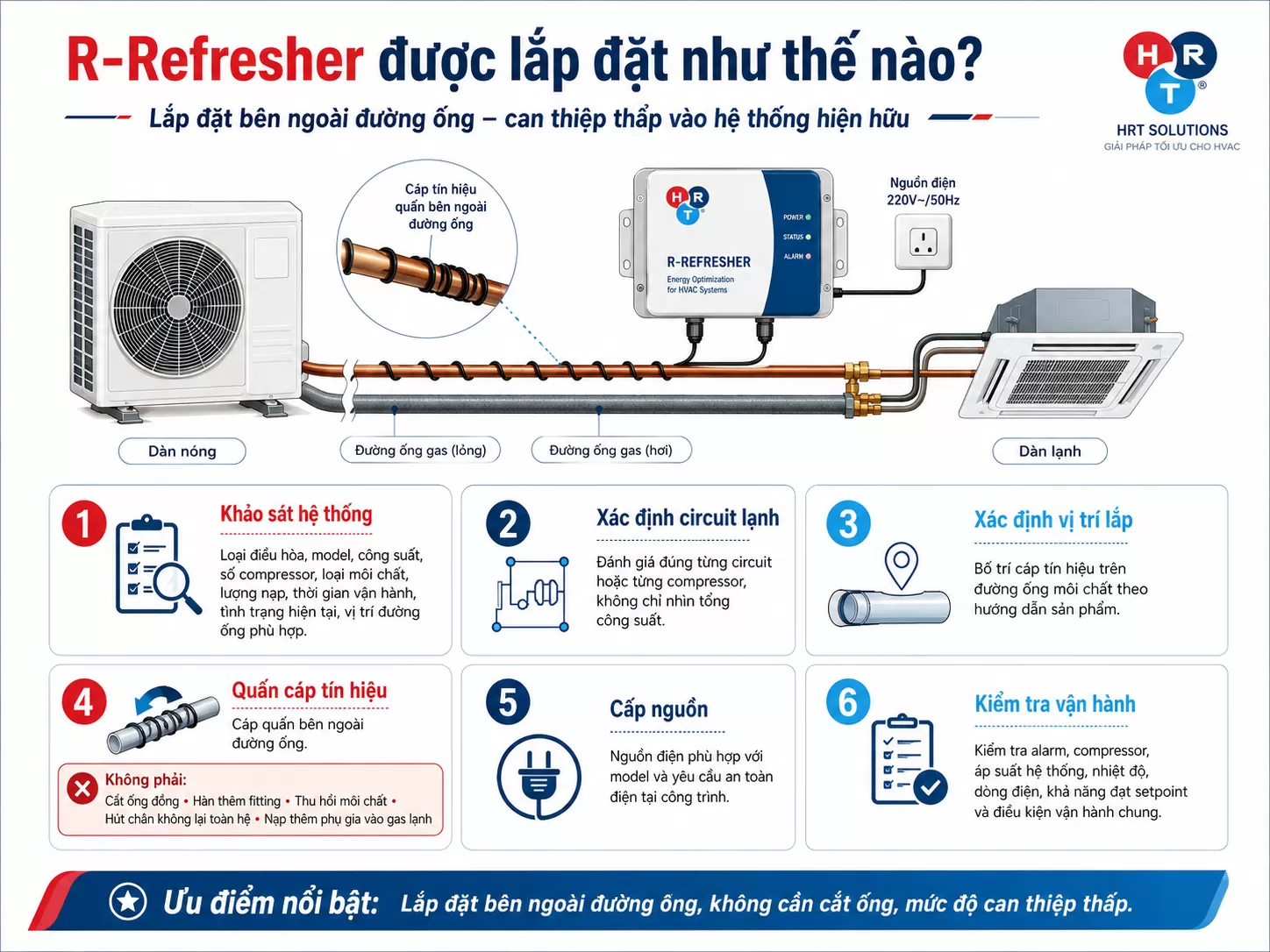
Instead of presenting each technique separately, it is possible to see the entire process in six steps.
Step 1: System survey
Collect:
- Model.
- Capacity.
- Compressor.
- Refrigerant.
- Intake.
- Runtime.
- Operation status.
- Pipeline location.
Step 2: Determine the refrigeration circuit
A large device can contain multiple compressor or circuits.
Do not just take total system power to choose.
Step 3: Select the mounting position
It is necessary to determine the correct position on the fluid pipeline according to the technical instructions of the equipment.
Step 4: Wrap the signal cable
The cable is wrapped outside the pipe.
According to this mounting principle is not:
- Cut the copper tubing.
- Welding fitting.
- Recover the solvent.
- Vacuum evacuation back the entire circuit.
- Add additives to the refrigerant.
Step 5: Power Supply
The power source must be compatible with the model and safety regulations at the work.
Reference product documents state the source range:
AC 100–240 V
Equipment itself capacity about:
5 W/Equipment
Actual parameters must still be confirmed according to the model before construction.
Step 6: Post-assembly inspection
After finished need to check:
- Alarm.
- Compressor.
- Pressure.
- The temperature.
- The current.
- Setpoint.
- Ability to reach loads.
- General operation conditions.
What is the biggest advantage of the way of fitting outside the pipeline?
For operating systems, any interference with the circuit may result in:
- Gas recovery.
- Welding pipes.
- Leak testing.
- Vacuum evacuation.
- Refrigerant charging.
- Stop the system.
A solution installed outside the pipeline greatly reduces the level of interference.
This is especially significant for:
- The hotel.
- The mall.
- The office.
- The factory.
- Hospital.
- Supermarket.
- The chain store.
These are the buildings that are often difficult to stop the system for long periods of time.
How much electricity does R-Refresher save?
Some product introduction documents refer to the power reduction range:
15–25%
Some case studies also give different specific rates.
However, HRT does not recommend taking a percentage in the brochure and then applying it by default to all works.
For example:
If the brochure says:
Save 20% on your purchase
Does not mean:
Electrical HVAC current × 20% = money surely saved.
Actual efficiency depends on:
- Equipment age.
- Refrigerant.
- Cooling Load.
- Outdoor Temperature.
- Humidity.
- Runtime.
- Setpoint.
- Coil condition.
- Filter.
- Compressor.
- Airflow.
- Water Flow.
- Control Logic.
- Maintenance work.
How to measure R-Refresher efficiency?
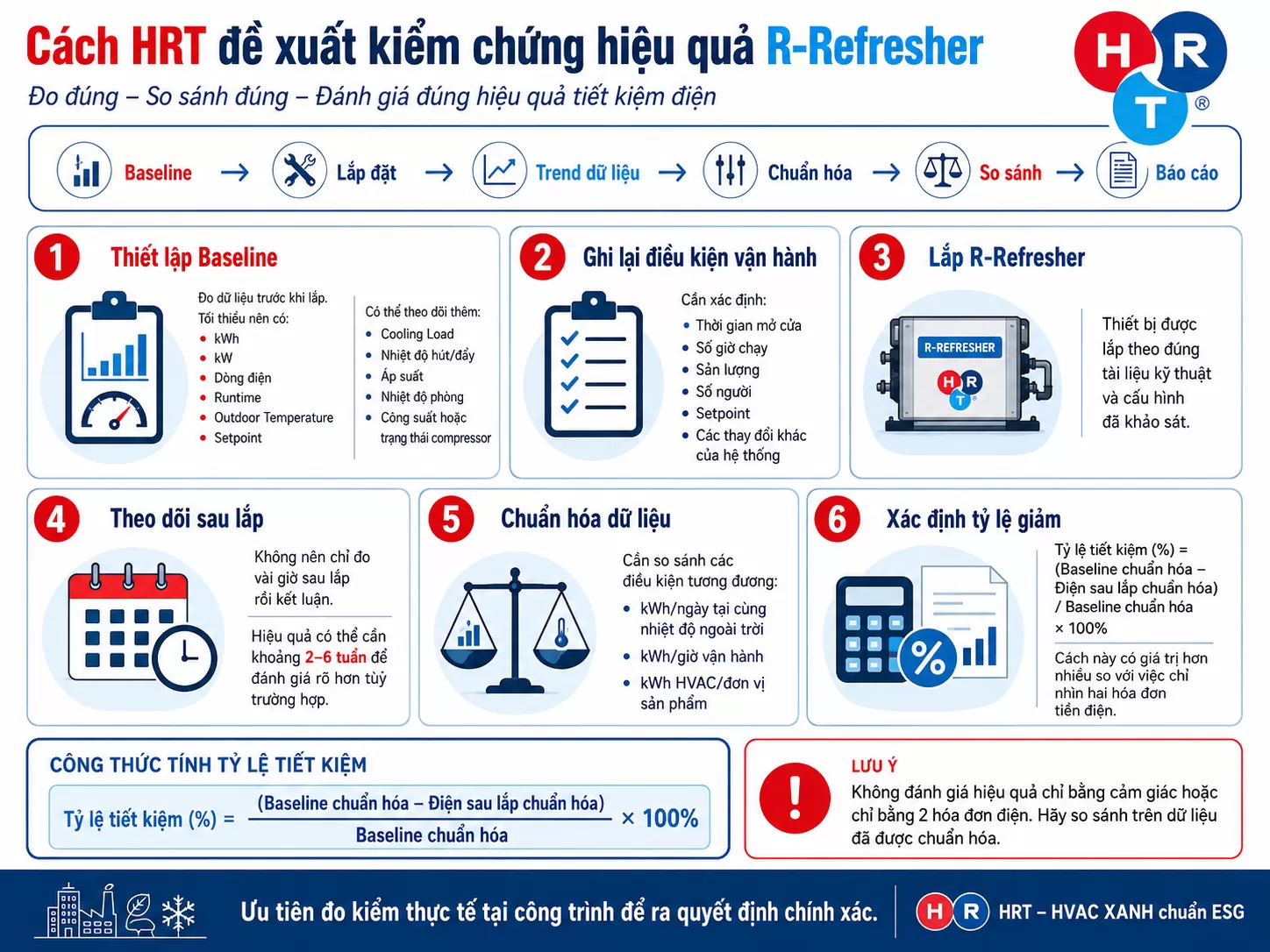
HRT recommends evaluation sequence:
Baseline → Installation → Data Trends → Normalization → Comparison → Reporting
Baseline Settings
Data should be measured before mounting.
At a minimum there should be:
- kWh.
- kW.
- The current.
- Runtime.
- Outdoor Temperature.
- Setpoint.
If conditions permit, further monitoring should be carried out:
- Cooling Load.
- Suction/Pushing Temperature.
- Pressure.
- Room temperature.
- Compressor status.
Record operation conditions
In the two periods of comparison it is necessary to record:
- Opening hours.
- Hours run.
- Output.
- Number of people.
- Setpoint.
- Change the load.
- Other optimal measures.
Equipment Installation
R-Refresher should be deployed according to the surveyed configuration.
Trend after mounting
Don't measure for a few hours and then conclude.
According to product documentation, some cases may need about:
2–6 weeks
to see the trends change.
Standardize Data
This is extremely important.
Can be evaluated according to:
kWh/day at the same Outdoor Temperature
or:
kWh/hour operation
or:
kWh HVAC/unit
Calculate the saving rate
Can be used:
Saving rate (%) =
(Standardized Baseline – Electrical post-fit standardized) / Standardized Baseline × 100%
This is a much more valuable method than just comparing two electricity bills.
Examples of how to calculate savings
Assume HVAC before renovation use:
12,000 kWh/month
After mounting and standardizing data:
10,800 kWh/month
Power Reducing:
12,000 – 10,800 = 1,200 kWh/month
Saving Rate:
1.200 / 12.000 × 100 = 10%
If the average electricity price assumes:
2,500 VND/kWh
then:
1,200 × 2,500 = VND 3,000,000 per month
Equivalent:
36,000,000 VND/year
This is just an example of how to calculate, not a commitment to R-Refresher savings.
5 mistakes that make R-Refresher evaluation easy to be wrong
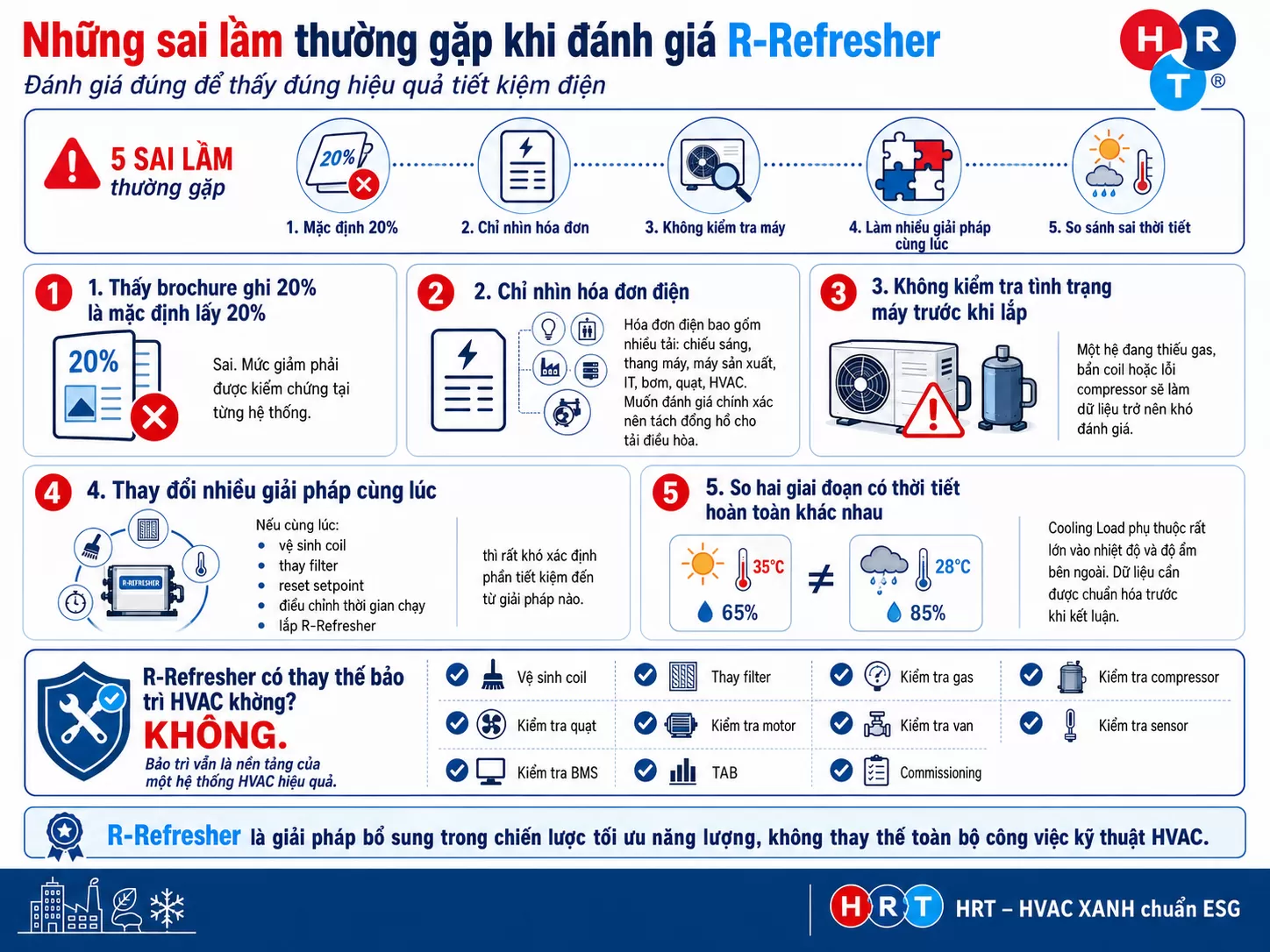
By default the brochure says 20%, then the work will be reduced by 20%
That's not true.
Measurement should be done on the system in use.
Just look at the total electricity bill
The invoice also includes:
- Illuminate.
- Elevator.
- Machine Manufacturing.
- IT.
- Fan.
- Pump.
- Other loads.
R-Refresher is better evaluated by measuring HVAC or circuit separately.
Do not test the machine before mounting
If the system is:
- Lack of gas.
- Dirty coil.
- Filter clogging.
- Compressor error.
- Sensor sai.
data are hard to compare accurately.
Change too many solutions at once
If at the same time:
- Clean the coil.
- Thay filter.
- Reset setpoint.
- Adjust the runtime.
- Install the R-Refresher.
then when the power drops it will be difficult to know which part comes from R-Refresher.
Compare two completely different weather periods
One Day:
35°C – RH 65%
cannot be compared directly with:
28°C – RH 85%
without a standardized step.
Cooling Load varies with both temperature and humidity.
When should you not expect R-Refresher to solve the problem?
There are errors that must be treated with traditional HVAC techniques.
Power deficiency system
If the Cooling Load is 120 kW but the unit only meets 80 kW, a redesign is needed.
The R-Refresher does not convert 80 kW equipment into 120 kW equipment.
Dirty Coil
Must clean the coil.
Filter Switch
Filters must be changed or cleaned.
Refrigerant leakage
The correct process is still:
Find leak → repair leak → leak testing → vacuum evacuation → Load the right amount of solvent
Compressor damaged
Must be repaired or replaced.
Bad control
If the system runs 24 hours but works for only 12 hours, optimizing the operation schedule can be much more efficient.
Does R-Refresher replace HVAC maintenance?
No, no, no.
Maintenance remains the foundation of an effective HVAC system.
Items to be maintained include:
- Clean the coil.
- Thay filter.
- Check the refrigerant.
- Check the compressor.
- Check the fan.
- Check the motor.
- Check the valve.
- Check the sensor.
- Check the BMS.
- TAB.
- Commissioning.
R-Refresher should be seen as:
Additional solutions for energy optimization strategies
not:
Replacement solution for the whole HVAC engineering work.
How does R-Refresher differ from VFD?
VFD and R-Refresher work in two different directions.
VFD/Inverter
Speed Adjustable:
- Motor.
- Fan.
- Pump.
- Compressor matching.
The goal is to reduce power as the load decreases.
R-Refresher
Does not act as variable-frequency drive to directly reduce the compressor speed.
The device is deployed on the circuit of the substrate according to the announced product mechanism.
Two solutions can therefore exist simultaneously in the same energy - optimal project.
Does R-Refresher replace BMS?
No, no, no.
BMS focuses on:
- Monitoring.
- Scheduling.
- Setpoint.
- Control.
- Alarm.
- Trending.
- Energy Management.
While R-Refresher is an additional solution on the refrigeration circuit.
One HVAC system can simultaneously apply:
BMS + VFD + PICV + Reset Setpoint + TAB + maintenance + R-Refresher
if the analysis shows each solution is suitable.
When should businesses consider R-Refresher?
The solution is more worth investigating when the system has the following characteristics:
Operation hours
For example:
- 10 hours a day.
- 16 hours a day.
- 24/7.
The greater the runtime, the greater the potential for economic value from each kWh saved.
The system is still usable
The machine was not to the point of being completely replaced but performance was reduced from its original level.
The cost of replacement is too large
Large VRV/VRF, Packaged or Chiller systems often have significant investment costs.
Capable of separate power measurement
The works have:
- Power Meter.
- Energy Meter.
- BMS.
- Data Logger.
It's a lot easier to test the effect.
R-Refresher and Green HVAC problem
Energy savings are more than just lowering your electricity bills.
Each kWh of electricity saved also contributes to:
- Reduce your energy needs.
- Reduce indirect emissions.
- Reduce operation costs.
- Increase asset efficiency.
- Support ESG targets.
- Support Net Zero route.
- Improve the performance of the building.
However, GREEN HVAC should not depend on a single device.
HRT approaches the problem in a systematic way:
Cooling Load
→ Equipment
→ Airside
→ Waterside
→ Control
→ Operation
→ Maintenance
→ Retrofit
→ Measurement
Only when the cause is correct can the right solution be chosen.
HRT process when consulting optimal HVAC power
HRT suggested string:
Survey → Measurement → Analysis → Optimization → Retrofit → Testing
Surveys
Understand the system as it is.
Measuring
There's data before the change.
Analysis and analysis
Determine where electricity is being wasted.
Optimized
Prioritize low - cost measures first.
Retrofit
Consider R-Refresher or other renovation solutions if appropriate.
Verify
Measure efficiency using standardized data.
Source: Publisher’s English edition · Vietnamese original on doanvanhoang.com