
Resort hotel HVAC: 7 control points before welcoming guests
Machine-translated from Vietnamese. Read the original in Vietnamese

One... HVAC system for hotel resort can not be accepted testing just because the air conditioner has run. Before putting the room into operation, the project owner needs to confirm the comfort conditions, humidity, noise, ventilation, control and maintenance capabilities. CEO Đoàn Văn Hoàng – HRT share 7 key control points to limit malfunction and protect operation efficiency.
HVAC resort hotel: 7 checkpoints before picking up guests
A hotel can perfect luxury furniture, fully prepare personnel and ready to welcome guests. But just the air conditioning in the room is not stable, condensate leaks to the ceiling or fan noise makes guests insomnia, the stay experience will be affected.
In many projects, the installation is often considered an important milestone. However, to me, If the installation is complete, the system is ready to be put into business..
HVAC hotel resort must be verified by actual operation conditions, not just by commissioning each machine.
I asked three questions before handing over:
-
Are guests served in a comfortable environment as required by the project?
-
Is the operation team capable of controlling the system when the extraction capacity changes?
-
Does the project owner have technical evidence to confirm that the system meets agreed requirements?
From my perspective, HVAC quality must be proven before the customer is the first to discover a problem.
Here are 7 points of control I recommend project owner, hotel management and HVAC contractor to agree before putting the work into operation.
Control Point 1: Determine HVAC handover criteria by room group
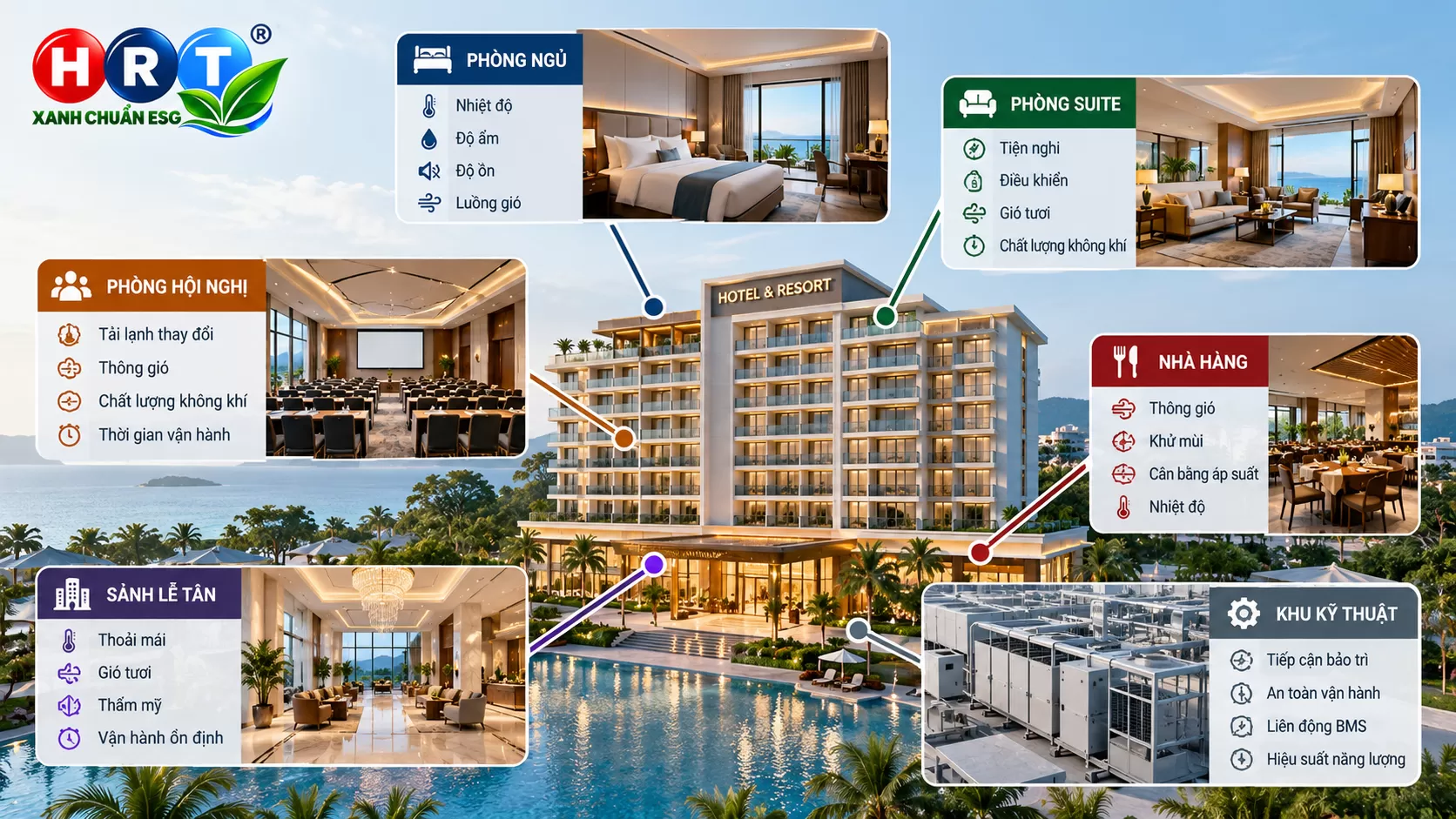
Do not use an acceptance testing condition for all spaces
Bedrooms, suite rooms, conference areas, restaurants and hotel lobbies have completely different uses.
A lounge should maintain quietness while guests sleep. Conference rooms should respond to rapid changes in the number of people. Restaurant areas should pay attention to ventilation and the effects of service activities.
If all use the same criteria “air conditioning works normally”, acceptance testing will lack practical basis.
I propose to make acceptance testing catalog by space group, which defines:
-
Design temperature and humidity conditions.
-
Require outdoor air and air quality.
-
Applicable noise limit.
-
Time and operation mode.
-
Independent control capabilities.
-
Request to contact the building management system.
-
Accessibility conditions maintenance.
The specific values must be based on the approved design documentation, applicable standards, hotel brand requirements and project contracts.
Don't set a single temperature or humidity threshold and use it for every building.
Deadline request from the person who will directly operate
The design team can understand the engineering system, but the hotel operations department understands how the room is operated.
Therefore, when setting the handover criteria, there should be coordination between the technical department, operation, room and project owner representative.
A real example:
If room staff needs to clean the room in a short time between two guests, the system must have operation mode and ability to restore the amenities in accordance with the operation plan.
If guests are allowed to adjust the temperature themselves, it is necessary to determine the control limit and how the system reacts when guests change the settings.
Action to be latched: Issue acceptance testing criteria for each room group before commissioning.
Control point 2: Check the sample room by actual use situation

Do not just measure the temperature at the time of turning on the machine
I want the engineering team to test a sample room under multiple meaningful operational states.
For example:
-
Room is vacant and ready to receive guests.
-
Rooms with long-term use.
-
The air conditioner operates on night mode.
-
The door to the room or balcony is opened and closed.
-
System switches between different load levels.
Each situation should be recorded with the same test conditions to be able to evaluate correctly.
For the bedroom, it is necessary to check the air outlet level position, the direction of blowing, the fan speed and the influence on the bed area.
Don't let the entire interior be completely finished until you have detected a cold draft directly into your sleeping area.
Check for things guests can't see.
A room that reaches the recommended temperature may not be a good experience.
Guests may still feel uncomfortable if the humidity is high, the airflow is inappropriate, or there is a vibration transmitted through the ceiling.
With the sample room, I suggest measuring and recording:
Temperature Range: Inspection during sufficient representative time, at the locations consistent with the use area.
Humidity Range: Monitor stability in operational states, especially when cooling load decreases.
Noise Level: Measurement is based on the agreed method and conditions, not just sensory evaluation.
Controller: Check response speed, setting limits, error status and recovery capabilities.
These are the parameters that need to be included in the sample room test record before implementing mass acceptance testing.
Action to be latched: Only approve the configuration of mass installation after the sample room meets the agreed technical and facilities criteria.
Control point 3: Prove ventilation system does not spread odor between areas
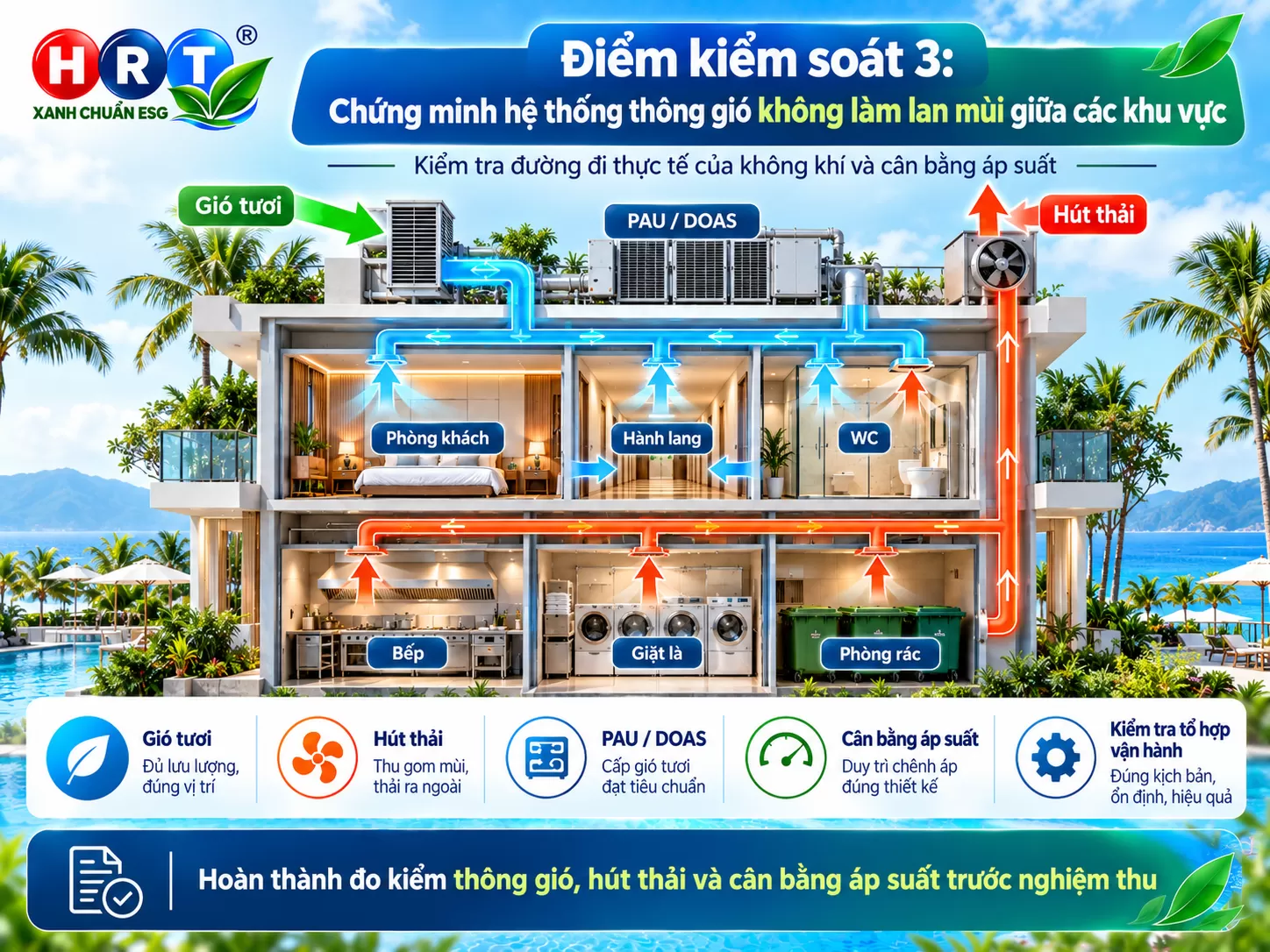
Check the actual path of air
One problem that is often overlooked is that air does not just follow the pipeline shown on the drawing.
Air can also move through doorways, engineering axes, corridors and other positions where pressure differentials are present.
This should especially be controlled in hotels with multiple auxiliary areas such as restrooms, kitchens, laundry and garbage rooms.
When an exhaust system is in operation, it can affect the pressure balance of the spaces involved.
Without interlocking and compensating wind sources, odors may appear in unwanted areas.
Commissioning by equipment combination, do not test each fan individually
An exhaust fan operation that is in its proper parameters does not guarantee the system is in balance.
I suggest checking when the relevant equipment is simultaneously working:
-
Outdoor air supply fan.
-
Exhaust fan sanitary and auxiliary area.
-
Outdoor air handling equipment PAU or DOAS.
-
Room air conditioning system.
-
Exhaust fan stove or related differential pressure generating equipment.
Must confirm the flow rate, direction of air movement and differential pressure in the area according to design requirements.
For works greatly affected by outdoor winds or temperature differences, additional consideration should be given to conditions that may alter air flow.
I also note that it is impossible to take a good CO2 value to automatically conclude that the entire ventilation and odor control requirement has been reached.
Action to be latched: Complete ventilation, exhaust and pressure balance measurements in the relevant operation modes before acceptance testing.
Control Point 4: Humidity control even when the room is unoccupied

Non-use room does not mean no moisture load
In hotels and resorts, not every room has a constant guest.
There are periods of room availability for many days, especially at the seasonal resort.
If only the reduction in power is concerned when the room is empty and the humidity control requirements are ignored, the project owner may face problems with air quality and interior preservation.
This is especially noticeable in coastal buildings or hot and humid areas.
The outside air can still bring moisture into the room due to ventilation, air leaks or opening doors during use.
So, you know, power saving mode must be designed simultaneously with the requirement of maintaining the internal environment.
Low load mode test instead of just running at high power
Many systems have good cooling capability at high loads but have difficulty controlling humidity when the load is reduced.
The technical team needs to check the responsiveness of the outdoor air treatment system, indoor unit, temperature control and humidification treatment functions designed.
Depending on the configuration of the building, it is necessary to consider equipment such as FCU, AHU, PAU, VRV / VRF or Chiller system.
In particular, when optimizing the running schedule to save electricity, it is not recommended to arbitrarily turn off the functions necessary for ventilation, humidity or work protection requirements.
If room-based operation is used, the switching criteria must be clearly defined.
Action to be latched: Confirm that guest rooms and empty rooms meet agreed environmental requirements.
Control Point 5: Confirm the control system is in line with hotel process
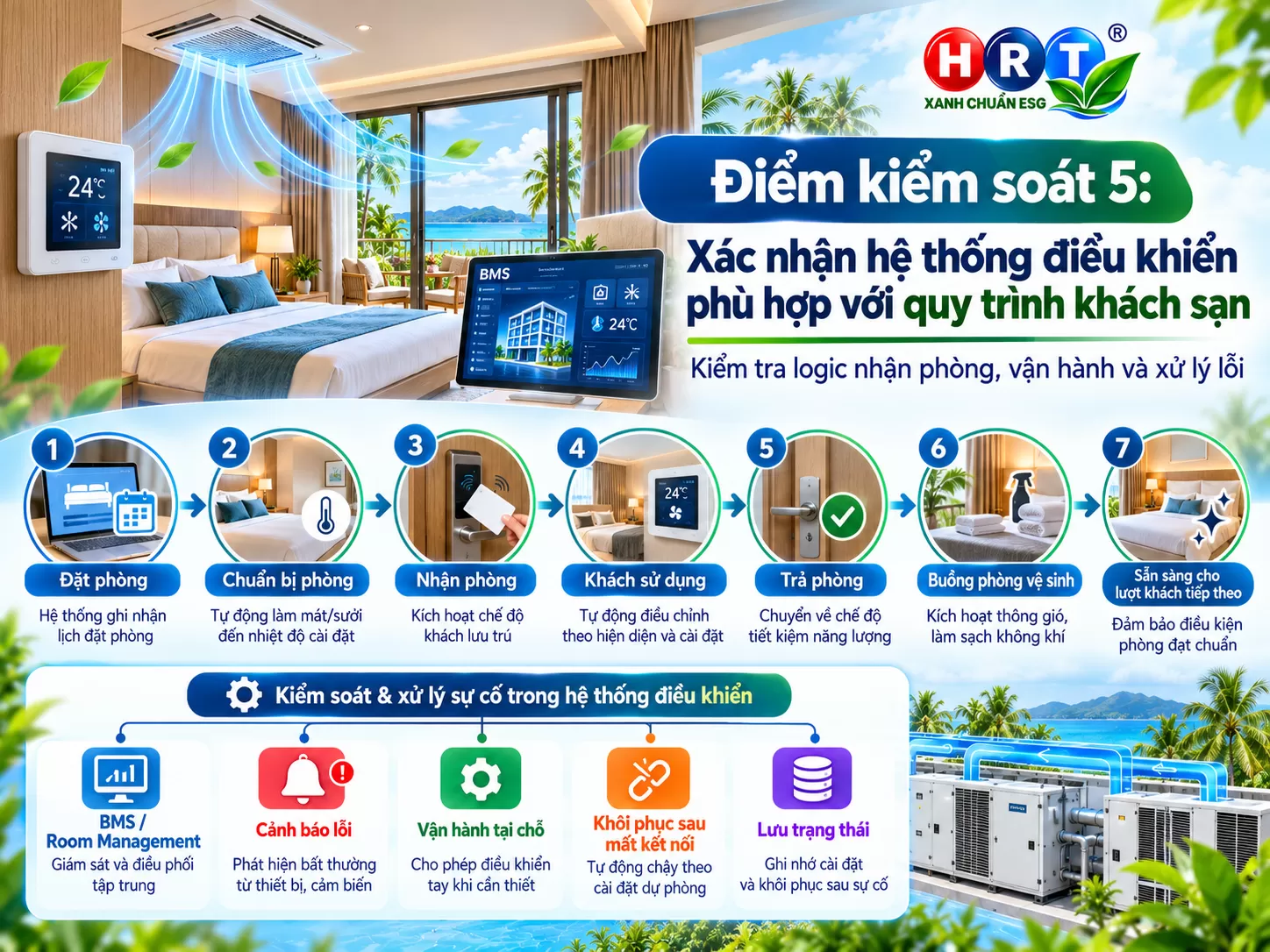
Air conditioner should coordinate with check-in and check-out
A modern hotel may use a room management system, room controller, presence sensor or BMS to support operation.
But connecting the device doesn't mean the system is doing something logical.
I suggest simulating an actual operation cycle:
Guest book → Room prepared → Check-in guest → Guest use → Guest check-out → Toilet room → Room ready for next guest.
Step by step determine the expected conditioning, setting limits, control rights and requirements for humidity maintenance, ventilation.
Don't assume that every hotel has the same strategy for controlling vacancies.
Must have script when control system fails
The operations team needs to know what happens if there is a loss of connection between the HVAC unit and the BMS or room management system.
The contents I request to clarify include:
-
Can the air conditioner be operated on site when needed?
-
Is the error status displayed and saved?
-
How do the technical staff receive alerts?
-
Will the loss of connection affect my ability to maintain the necessary conditions?
-
After restoring power or communication, what state is the system back to?
The safety functions, equipment protection and mandatory operation requirements must be prioritized according to the design documentation and manufacturer's instructions.
Action to be latched: Completely check the control scenarios and handle errors before the hotel team takes over operation.
Control Point 6: Eliminate the risk of the room having to stop operations for repair

A wrong maintenance location can create huge costs
In the hotel is doing business, repair work not only incurs the cost of materials and labor.
It may cause the room to be suspended, affect the room sales schedule or inconvenience guests who are staying.
So I consider maintenance capability as a criterion for acceptance testing rather than just a post-handover problem.
Equipment such as FCUs, valves, condensate pumps, air filters, sensors or control mechanisms need appropriate approaches.
If you want to clean equipment that must dismantle large areas of decorative ceiling, the project owner needs to identify the problem before completing and putting the work into operation.
Test condensate as an asset protection item
A condensate drain problem can cause ceiling stains, finish damage or affect furniture.
I suggest the technical team to carry out inspection according to the scope of design and equipment guidance:
-
Slope and drainage capacity of pipeline.
-
The suitability of the water trap, if the configuration requires.
-
Operation capability of condensate pump.
-
Warning and protection function when abnormal drainage.
-
Thermal insulation condition, the risk of condensation outside the tube.
-
Ability to inspect, clean and troubleshoot after handover.
The testing must be carried out safely without causing damage to the finished area.
Divide responsibilities when an incident occurs
If you find water leaking from the living room ceiling, who should be there first?
Hotel operation team or warranty contractor?
Who is entitled to open the ceiling, isolate equipment, check condensate pump or request to stop using the room?
These questions must be agreed upon in the incident handling process, together with contacts and contractual response time.
Action to be latched: Handover is only approved when critical maintenance locations, condensate systems and troubleshooting responsibilities have been clearly checked.
Control Point 7: Only sign acceptance testing when the system has adequate operation proof

Commissioning device cannot be replaced commissioning
A normally operating chiller does not mean that the entire chilled-water system is satisfactory.
Similarly, a VRV/VRF cooling system is not automatically demonstrated that the control system, ventilation and condensate drainage of the area have been reached.
Need to distinguish the work:
Pre-operation test: Confirm installation, connection and safety conditions.
Commissioning device: Confirm functions and operating parameters according to manufacturer instructions.
TAB: Measure, adjust and balance wind system, water system according to the design range.
Functional Performance Testing: Check functions, control sequences and related operation states.
Commissioning: The process of verifying and documenting the system meets the requirements of the project owner.
According to ASHRAE commissioning guidelines, verification is not limited to commissioning but also involves project owner requirements, operational records and training of the receiving team.
The application must help the hotel's technical staff to check the results
I suggest that the handover dossier should show at least:
-
As-built drawing: Matching the current status of equipment, pipelines and maintenance positions.
-
Equipment List: Model, identification code, location and related system.
-
TAB Results: Flow rate, differential pressure and range adjustment results.
-
Commissioning minutes: Measurement conditions, parameters and confirmation results.
-
Interlocking Scenario: Sequence control, warning, protection and mode switch.
-
Operation – maintenance instructions: Checking schedule, error handling options and support information.
-
Existing catalogue: Unfinished issues, their impacts, responsible persons and time limits for remedying them.
I do not want the record to be saved only for acceptance testing.
A technician who is new to the job after six months must be able to use that record to find the right equipment, retrieve errors, and do the necessary work.
Action to be latched: Only approve the putting of the area into operation when the compulsory criteria have been met, exists affecting the safety or conditions for serving guests have been processed and the handover dossier is eligible for reception.
After handover, what indicators do hotels need to monitor HVAC efficiency?
Switching from reactive maintenance to data-driven operation
For me, acceptance testing is an important milestone, but HVAC quality must continue to be verified during the extraction process.
HRT recommends that project owners select the metrics that will actually help operational teams detect problems and make decisions.
For example:
| Following Team | Indicator to consider |
|---|---|
| Room facilities | Reflection number related to temperature, noise, humidity |
| Serviceability | HVAC Troubleshooting Time |
| Reliability and reliability | Number of iterations of errors, number of rooms to be suspended from exploitation |
| Equipment performance | Load status, power capacity, operation warning |
| Energy consumption | kWh of HVAC system by measurement range |
| Maintenance | Periodic job completion and overdue existence rates |
KPIs need to have a unified definition. For example, it is possible to evaluate reflections on 1,000 nights of occupancy rather than just comparing absolute reflections between months with different occupancy.
No conclusions save electricity from just one bill
HVAC power depends on weather, number of guest rooms, time of operation of utilities and event schedule.
If the number of guests drops sharply, the decrease in hotel - wide power will not necessarily reflect improved technical performance.
Therefore, when evaluating a control solution or HVAC optimization, it is necessary to establish the baseline and select the appropriate comparison method.
kWh overnight for guest rooms may be useful for management, but should not be used alone to conclude technical efficiency without considering the effects of weather, utility and other energy loads.
The goal of HRT is to help project owners see both service quality and energy efficiency through testable data.
Plan 30 days before putting HVAC hotel into operation
A deployment schedule to reduce last-day aggregated work
Depending on the size and progress of the project, I suggest that the project owner considers organizing the following control milestones. These are calendar references for job administration, not replacing the approved commissioning plan.
| Time of day | Things to be done |
|---|---|
| 30 days in advance | Finalize the room category, acceptance testing criteria and responsibilities of parties |
| 21 days before | Complete the sample room inspection, review technical conflict points |
| 14 days in advance | Implement TAB, equipment inspection and interlocking testing as planned |
| 7 days in advance | Evaluate shortcomings, retry corrective items and prepare for handover |
| Before the day of reception | Confirm the required conditions have been met, hand over troubleshooting instructions |
| After 30 days of operation | Aggregate data, reflect reality and plan for next optimization |
Tests requiring weather conditions or loading operations that have not appeared at the time of handover should be clearly planned additionally according to the project agreement.
Do not consider untested as equivalent to the result achieved.
Decision Mechanisms When Business Progress and Engineering Conflict
Before the opening day, the pressure for progress is often great.
However, it is necessary to distinguish the existing that can be completed later from the problems affecting safety, serviceability or the compulsory acceptance testing conditions.
I propose to divide the existence into:
The group that must be overcome before exploitation: Errors affecting the required conditions, safety or serviceability to the agreed extent.
The group is allowed to complete as planned: The existing problems do not obstruct the exploitation, approved by the project owner in accordance with the contract requirements and applicable regulations.
Groups to follow up more: Indicators must be assessed under suitable load or weather conditions at the operation stage.
The decision to put the area into use must be certified by the competent parties on the basis of dossiers, not only by oral commitment.
CEO's view Đoàn Văn Hoàng: HVAC quality must be proven by customer service
After more than 20 years of working in the field of Heat – Cold – HVAC, I realize that a project can only be properly evaluated when considering both the quality of installation and long-term usability.
For hotels and resorts, that's even more important because HVAC is directly related to the day - to - day business.
Understanding Correctness – Determine operation requirements before acceptance testing
I want acceptance testing criteria to come from the actual requirements of the project, not just catalog specifications.
A guest room, conference area or restaurant has different needs.
Understand these requirements before you determine how to test.
Clear – Every result must be grounded
A satisfactory system must have appropriate test data or evidence.
An unfinished item must be noted.
An existing error must have a person in charge and a handle.
I don't want to end acceptance testing session with comments like “the machine runs fine”, “the wind is strong” or “the room is cool”
Dedicated – Handing over according to the needs of the recipient
With HRT, the job is not just signing a record.
We value instructing our operation team to understand how to control equipment, recognize alerts and coordinate in handling incidents.
A good HVAC system should not become a technical burden on the hotel after the contractor leaves the building.
I believe that it is the responsibility of the HVAC contractor to bring the project to a stable operation, control risks and have grounds for quality assessment.
It is also the spirit HRT pursues:
Understand - Clear - Dedicated.
Frequently Asked Questions about acceptance testing HVAC hotel resort
Do you need acceptance testing for all guest rooms in the same way?
It is necessary to clearly determine the scope of inspection for each room and group of rooms according to the project dossier. A sample inspection plan may be applied to a number of tests when it is appropriate and approved, but items which must be inspected separately in each room must not be ignored.
Is the room temperature satisfactory enough for acceptance testing HVAC?
Not enough. Depending on the project scope, additional verification of humidity, ventilation, noise, control, condensate drainage and related functions is required.
Can an already operating hotel perform commissioning?
Yes. For existing buildings, appropriate commissioning and assessment methods can be applied to identify operational issues, check post-renovation efficiency and develop improvement measures.
The plan must take into account the maintenance of business operations, protection of guests in stay, and restrictions on interruptions.
Should air conditioning renovation or BMS upgrade be prioritized?
There is no single answer.
If the equipment no longer meets the load or exists technical damage, repair or replacement should be assessed.
If the device is still responsive but operationally inefficient due to control logic, schedules, or system coordination, control optimization may be the direction to study first.
The decision must be based on surveys, operation data and life-cycle cost.
HRT accompanies project owner in HVAC quality control for resort hotels
Hotels and resorts need HVAC systems that meet the needs of use, but also have long-term maintenance and operation capabilities.
HRT provides HVAC engineering solutions and services across the project scope, including survey, design consultancy, equipment supply, installation, commissioning, maintenance and renovation.
Systems that may be considered include:
-
Central air conditioner VRV/VRF.
-
Water Chiller System.
-
Air Handling Equipment AHU, FCU, PAU.
-
Ventilation, exhaust and outdoor air treatment.
-
Control system and BMS integration.
-
Improve and optimize HVAC energy efficiency.
For each project, HRT aims to clarify the scope of work, technical requirements and criteria for certification of results before implementation.
HRT CONTACT INFORMATION
HRT Air Conditioning and Ventilation Company Limited
-
Website: https://hrt.com.vn
-
Hotline: 0909.326.888
-
Email: CEO@hrt.com.vn
-
Address: No. 9TT7, Foresa 7A Street, Tasco Ecological Urban Area, Xuan Phuong Ward, Hanoi.
HRT – Green Breath for All Buildings.
Conclusion: Do not let the guest stay as the final checker of the HVAC system
For hotels and resorts, the time of completion of installation is not the end of the quality assurance process.
Before putting a room into business, the project owner needs to verify seven groups of critical conditions: criteria for use, sample room results, airflow, humidity control, control sequence, maintenance capabilities and commissioning proof.
When these requirements are controlled with a clear plan, businesses have better grounds to limit incidents, protect the accommodation experience, and manage operational costs.
A successful HVAC project does not just hand over the cooling system. It must hand over serviceability, control capabilities and technical responsibility.
CEO Đoàn Văn Hoàng – HRT
Understand - Clear - Dedicated.
Source: Publisher’s English edition · Vietnamese original on doanvanhoang.com