
R-Refresher for HVAC: six decisions before investing in energy savings
Machine-translated from Vietnamese. Read the original in Vietnamese

R-Refresher HVAC is introduced as a solution to support power reduction for existing air conditioning systems. But before investing, businesses need to verify compatibility, design testing, measure efficiency and clarify acceptance testing responsibility. CEO Đoàn Văn Hoàng – HRT share 6 decisions to close.
R-Refresher HVAC: 6 decisions to make before investing in power savings
In the field of HVAC, I often meet a question from the project owner: Is there any device that helps reduce power without having to replace the entire air conditioning system?
R-Refresher HVAC is one of the products introduced to meet that demand.
The point of interest lies not only in the technology described by the supplier, but also in its ability to prove effectiveness when installed on the actual system.
In my view, a power - saving solution is only really valuable when the business knows what it is investing in, how the results are measured and who is responsible for validation.
So, before putting R-Refresher into a project, I suggest clarifying the six decisions below.
How should R-Refresher HVAC be viewed in the investment problem?
Distinguish the technology introduced and the effect confirmed
According to Power Support documentation, an R - refresher is a device that is installed additionally outside the refrigerant pipeline, using a signal cable wrapped around the pipe.
The supplier described the signal as being able to affect refrigerant and oil states, which would lead to improved heat exchange conditions and reduced power usage.
However, it is important to distinguish: this is a published mechanism by the supplier, not the same as independently proven effectiveness on all air conditioning systems.
Unlike compressor replacement, heat exchanger upgrade or control program adjustment, R-Refresher was introduced as an external cooling circuit support device.
According to the product configuration described, the installation does not require opening of the fluid pipe. However, compatibility and construction conditions must still be confirmed for each specific model.
Investment must be directed towards the results of the entire system
A device can be introduced as power saving, but for project owner, it is of interest to the total energy used and the quality of operation.
The system must still ensure:
-
Cooling capacity meet the demand of using.
-
Temperature and humidity meet the design requirements.
-
Compressor and safety operation protection device.
-
Uninterrupted production or business operations.
-
Energy saving can be measured and verified.
With HRT, I don't want to trade the reliability of the system for an unproven savings yield.
Decision 1: Determine the right amount of electricity that enterprises want to reduce
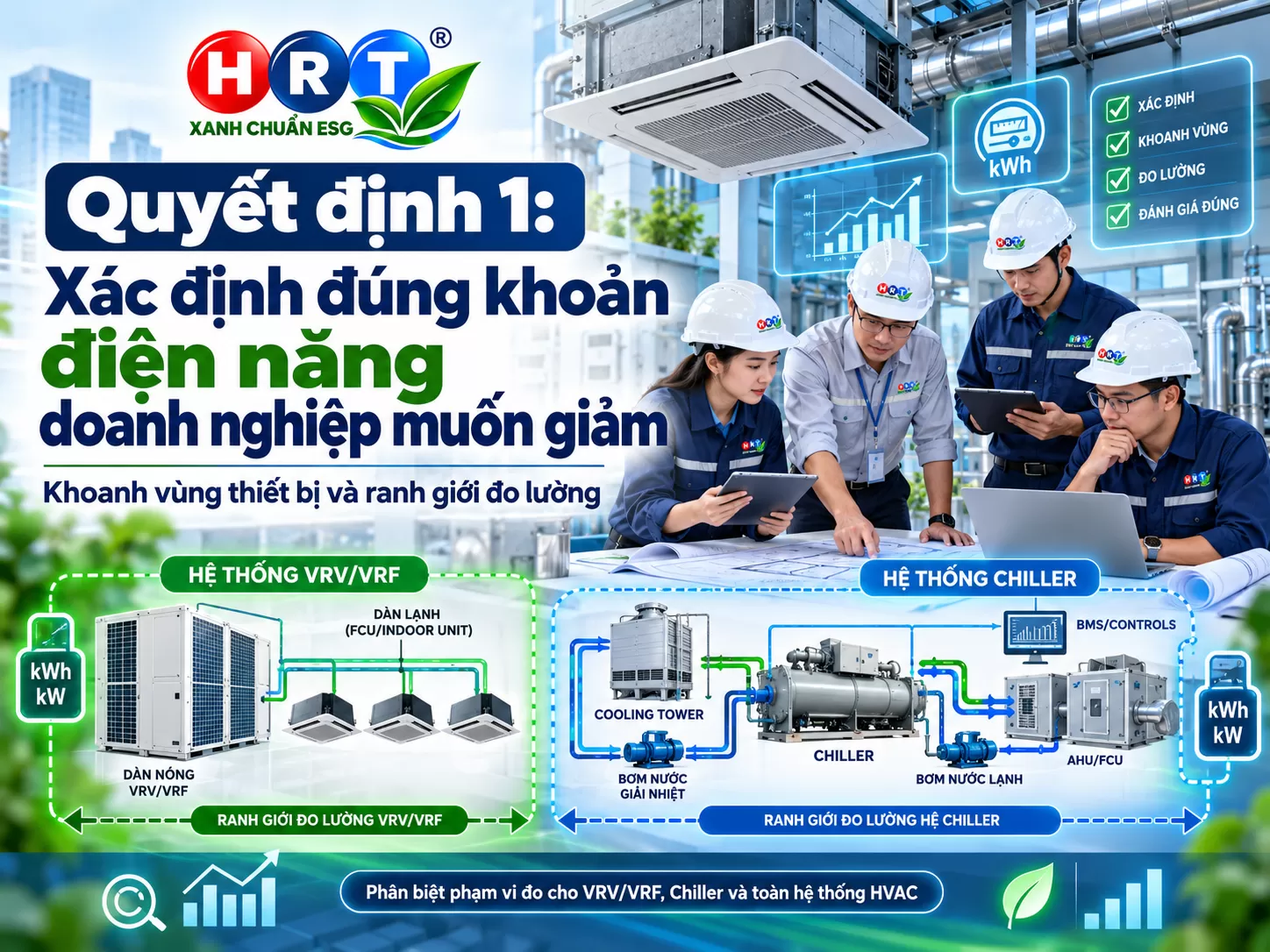
Equipment zoning and measurement boundaries
Before asking how much power the R-Refresher can reduce, it is necessary to determine which portion of the power will be included in the assessment.
For VRV/VRF systems, the power used by outdoor units within the test range can be considered and load conditions from relevant indoor units can be monitored.
For chillers, it is necessary to distinguish compressor power from the power of the whole chilled-water system.
A chiller system may include a water cooler, chilled-water pump, condenser water pump, cooling tower, AHU/FCU and control system.
If you only measure the Chiller's power but publish the savings rate for the entire HVAC system, you will be left with a lack of baseline.
Convert savings goals into verifiable targets
I want the engineering team to determine three things in advance:
Firstly: Is the measurement range a single unit, a cold circuit or an entire system?
Second: The main indicator is kWh power, kW electrical capacity or operation efficiency by cooling load?
Third: What conditions of service use are required to be maintained?
After the agreement is reached, these indicators must be recorded in the assessment plan, not to let the beneficial data be selected until the end of the experiment.
Decisions to be closed: Only deploy when the power range and assessment criteria have been clearly defined.
Decision 2: Handling the causes of electricity consumption before purchasing additional solutions

Do not confuse performance degradation with the need for technological upgrades
A high power consumption system does not necessarily require additional support equipment.
In fact, the cause may come from heat exchanger fouling, lack of flow rate, filter increased differential pressure, sensor misalignment or inappropriate operation mode.
For direct refrigeration systems, the condition of the solvent, throttle, compressor and heat exchanger should be checked.
For chilled-water systems, additional evaluations of flow rate, water temperature difference, pump capacity and load control strategies are required.
If the problem is caused by a technical error, the priority task should be to fix it.
Select the right order of improvements
I propose to categorize improvement opportunities into three groups.
-
Recovery Group: Servicing, cleaning, repairing and calibrating so that the system returns to suitable operating conditions.
-
Optimal Group: Adjust operation schedule, setpoint, control sequence, flow rate and load response mode.
-
Additional investment group: Consider new equipment or technology when there are grounds for showing that the system has potential for improvement.
R-Refresher belongs to the group that needs to be appraised as an additional investment.
Do not install the device and simultaneously clean the condenser coil, adjust the controls and replace the sensor, then attribute the entire power reduction to the R-Refresher.
If these tasks must be performed, their effects should be noted and separated in the assessment method.
Decisions to be closed: Additional investment shall be assessed only after the basic technical condition has been controlled.
Decision 3: Confirm whether R-Refresher is compatible with existing devices
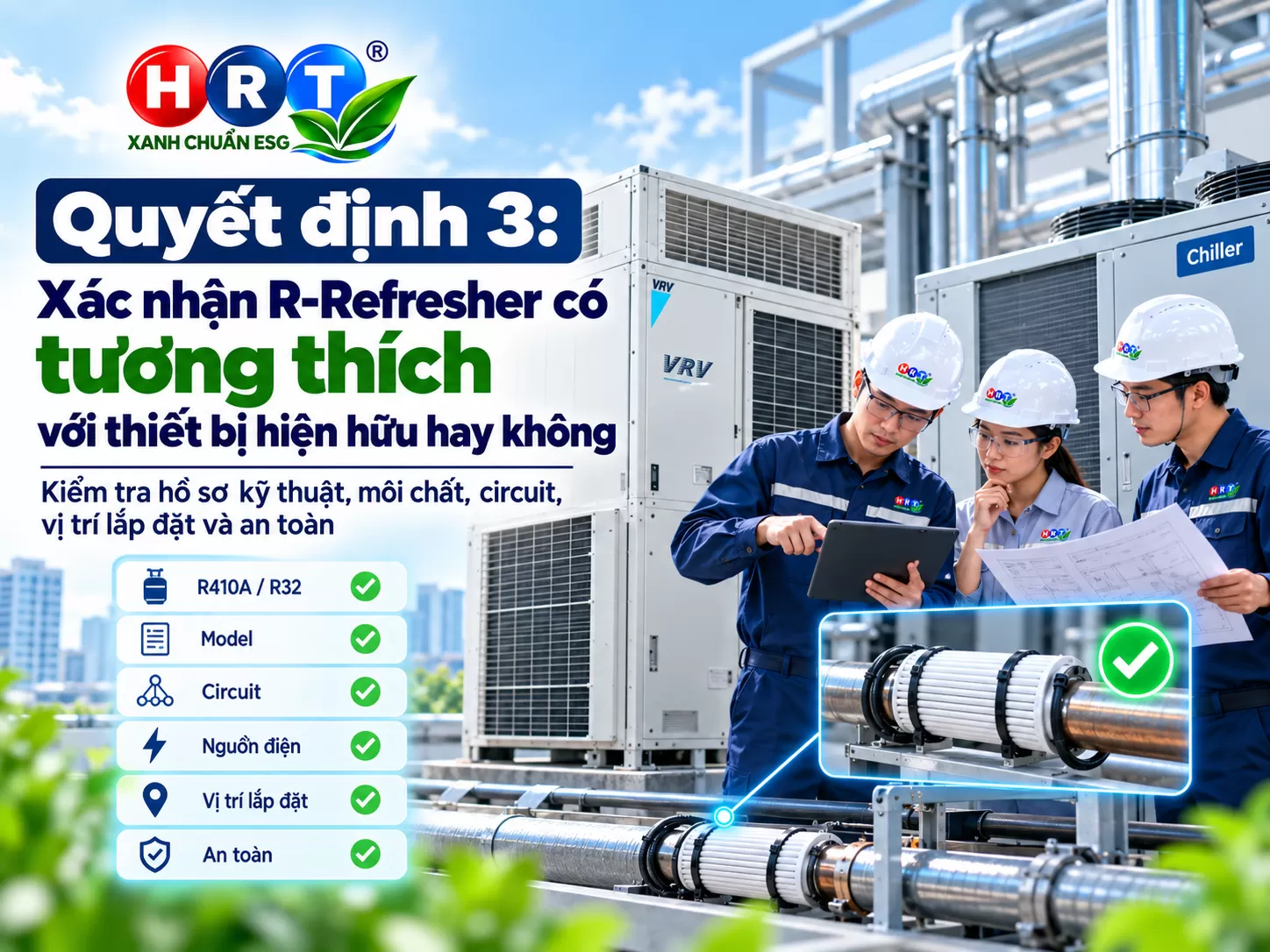
Do not select based on refrigerant name only
The two systems using the same R410A or R32 can have completely different cold circuit configurations, power and control modes.
For VRV/VRF, the system can have multiple outdoor units, multiple distribution branches, different operating modes and complex liquid control mechanisms.
For Chiller, it is necessary to determine the type of compressor, cold circuit configuration and operation conditions of each machine.
So, before choosing R-Refresher, the technical profile must clarify:
-
Manufacturer and model of existing equipment.
-
Type of refrigerant.
-
Cold circuit capacity and configuration.
-
Number of circuits to consider.
-
Expected installation location.
-
Power supply and wiring conditions.
-
Impact on warranty, safety and maintenance capabilities.
Request confirmation by document, not just by oral exchange
I would like installation instructions in accordance with the product configuration, together with compatibility confirmation from a competent technical unit.
It is necessary to check the cable wrapping position, distance from electrical components, wire protection plan and access to equipment when servicing.
Pipe outside fitting does not mean every configuration is automatically approved.
In particular, do not arbitrarily interfere or disable the protective functions of compressor, control valve or electrical system.
Decisions to be closed: If the compatibility dossier and safety plan are not sufficient, the installation shall not be permitted.
Decision 4: Request Evidence of Effectiveness Before Budget Approval

Power saving report should show the measurement condition
When receiving an Energy Saving HVAC product, the business is usually provided with a brochure, test results or reference project documents.
These documents are valid for initial consideration but not enough to certify the efficiency of the project to be invested.
The R-Refresher documentation publishes savings rates in some cases. Those figures should be understood according to the provider's testing scope and conditions, not the general guarantee.
I suggest the engineering team ask for clarification:
-
What kind of machine and medium are the results measured on?
-
Cooling load, ambient temperature and operation time?
-
Is the power measured separately at the device or at the meter?
-
Have the data been adjusted for changing conditions?
-
Is the result independently verified or is it just an internal report?
If no answer is available, the published savings should only be used as reference information when making plans.
Distinguish between instantaneous power reduction and actual power reduction
For example, at one time of measurement, the compressor's electrical power decreased compared to before.
This may be a signal to analyze, but it is not enough to conclude a corresponding month's decrease in electricity.
Compressor may be operating at different load, outdoor temperature changes or operation time is not the same yet.
For me, meaningful results must reflect the power consumed in the appropriate period of time, after considering the differences of operational conditions.
Decisions to be closed: Do not include an unverified savings ratio in your official financial commitment.
Decision 5: Design a Test to Determine the R-Refresher's Own Impact
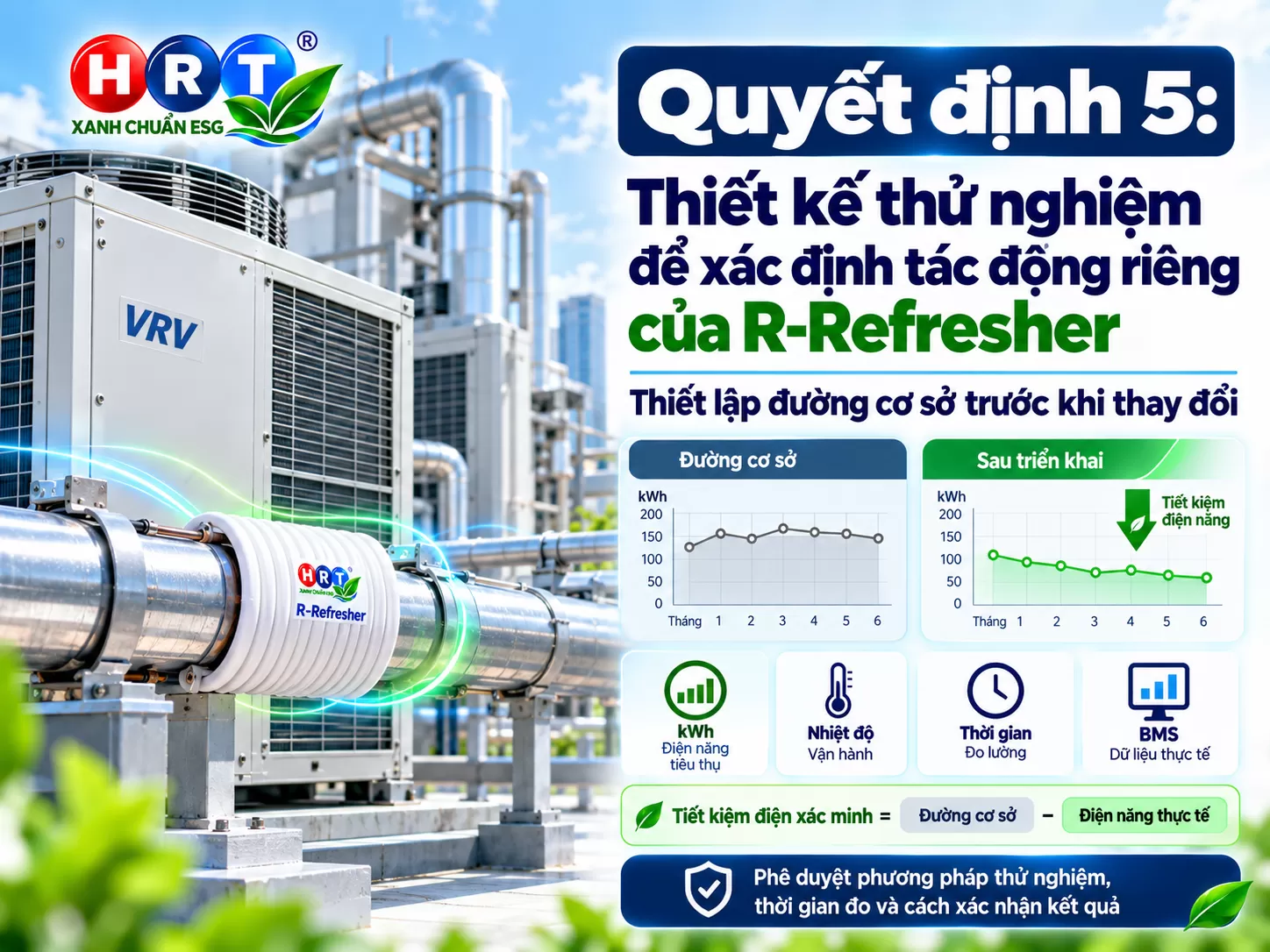
Set baseline before changes
If the goal is to verify efficiency, data before installation must be purposefully collected.
The baseline should show the relationship between electricity and the main influencing factors, such as:
-
Ambient temperature.
-
Cooling load.
-
Time of operation.
-
Temperature setting.
-
- The output or utilization rate of the project.
-
The working state of the device.
The collected time should be sufficient to represent the expected operation mode of evaluation. It should not be defaulted that only a few days of measurement can represent the whole year.
When possible, specialized electrical measuring equipment should be arranged or reliable data from BMS and energy monitoring systems should be exploited.
Perform controlled testing
HRT may recommend appropriate energy measurement and verification methods, such as the Option B system specific measurement approach in the FEMP M&V guidelines.
When testing, it is necessary to keep stable the controllable conditions, limiting the simultaneous change of other technical items.
If there is a compulsory change, the time, cause and expected effect must be clearly noted.
In some projects, controlled trial or rotation of state may be considered according to the plan approved by a competent technical unit, provided that equipment instructions are compliant and do not affect safety and warranty.
Electricity saving rating on equivalent conditions
In principle:
Verified saved power = Power forecasted from baseline at evaluation conditions − Actual power after deployment.
The result should take into account the auxiliary power of the solution, the relevant operational changes and the uncertainty of the measurement.
If the data quality is insufficient or the load difference is too large, the report must state the limit. A certain saving rate should not be published when data is not yet permitted.
In addition to electricity, the ability to respond to loads, temperatures, humidity and equipment protection status must be further controlled.
Decisions to be closed: Approving the testing method, measuring time and method of confirming the results before deployment.
Decision 6: Only expand investment when financial and technical efficiency are achieved
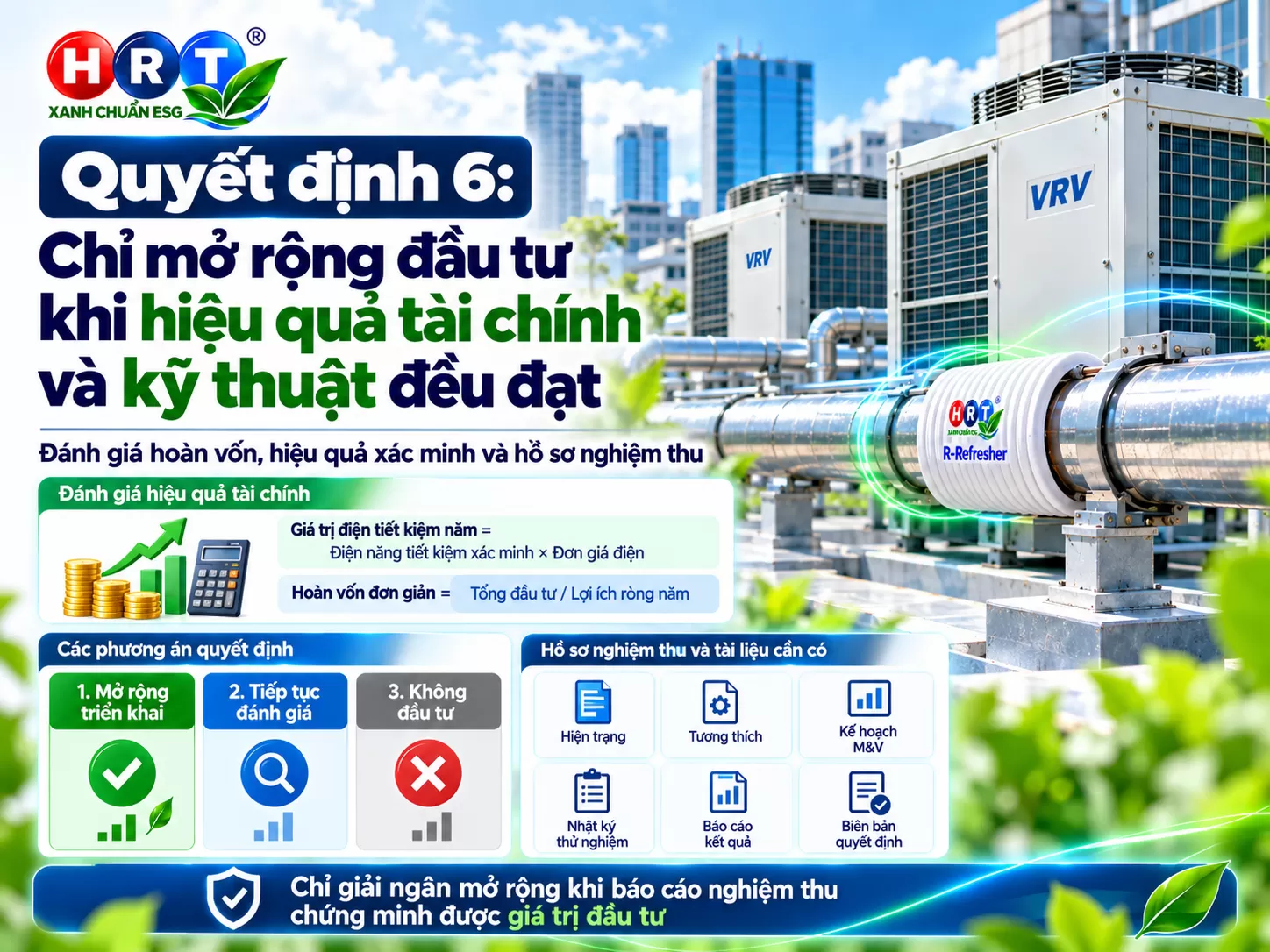
No return on investment from promotional savings
For project owners, reducing power is part of the problem.
The plan must also take into account:
-
Cost of equipment purchase.
-
Installation and accessories costs.
-
Cost of measurement, testing and acceptance testing.
-
Maintenance or replacement costs arise.
-
Warranty conditions and technical liability.
-
Actual power benefits after verification.
A rough calculation:
Annual saved electricity value = Verified and converted annual saved electricity × Applicable electricity unit price.
To evaluate finances, it is necessary to subtract operational, maintenance and related additional costs.
Simple payback period = Total initial investment cost / Annual net benefit.
This is the initial screening formula. For large projects, equipment life, electricity price fluctuations, capital costs and operational risks should be taken into consideration.
Set three post-test decision options
I don't want every test to default to shopping.
The results should be clearly categorized.
Option 1 – Expansion of implementation: When the data is reliable enough, the efficiency meets the agreed criteria and the system continues to operate stably.
Option 2 – Continue evaluation: When there are signs of improvement but the measurement time or data quality is not sufficient to confirm.
Option 3 – No Investment: When the benefits are negligible, the effectiveness is not demonstrated, or inappropriate technical and financial risks arise.
Failure to deploy can also be a good decision if it helps your business avoid underfunded investments.
Decisions to be closed: Extended disbursement is only made when the acceptance testing report proves the investment value.
What documents should be included before signing acceptance testing solution?
Convert test results into retestable records
For a pilot R-Refresher HVAC project, I recommend a minimum set of records that includes:
-
Status record: Equipment, configuration, technical conditions and pre - deployment condition.
-
Compatible Profile: Product documentation, installation instructions and necessary technical confirmations.
-
M&V Plans: Measuring boundaries, baseline, input data and evaluation criteria.
-
Test log: The moment of installation, operation change, breakdown and servicing operation.
-
Reporting results: The power before and after the correction, the uncertainty and the limits of the conclusion.
-
Minutes of decision: - The expansion, continued evaluation or termination of the deployment, together with the parties' responsibilities.
All important data should be saved in a retrievalable format, rather than just included in a summary slideshow.
Responsibility must be demarcated from the beginning
The supplier is responsible for the documentation and commitments under the product.
The installation units shall be responsible for the construction quality and safety within the assigned scope.
The measuring unit shall take responsibility for the method, measuring equipment and consistency of data.
Project owner and stakeholders agree on criteria for acceptance of the result.
If one party simultaneously assumes multiple roles, there should be an appropriate data check mechanism to limit conflicts of interest.
For me, acceptance testing is not just about confirming that the equipment has been installed. acceptance testing must answer how far the investment goal has been reached.
CEO's view Đoàn Văn Hoàng: Technology investment must go with responsibility
After more than 20 years working in the field of Heat – Cold – HVAC, I think businesses should not choose technology just because of new products or attractive introductions.
At HRT, we pursue three values: Understand - Clear - Dedicated.
Understand the right: Analyze the problem before choosing a product
If your goal is to reduce electricity, you need to know how electricity is being used.
If the system in operation is unsatisfactory, a technical cause must be identified.
If the supplier introduces a new mechanism, it must know what the product information is and what the proven results are.
I don't want the team to default against an unfamiliar technology, but I also don't accept coming to conclusions without the necessary evidence.
Clear: Commitment must be tied to the validation method
A good report should help the project owner answer:
How much money have you spent? How much electricity has been reduced? Are the measurement conditions suitable? Are the results reliable enough to decide on the next step?
Any point that cannot be proved must be clearly stated as unproven.
What is an assumption has to be publicly assumed.
Clear from the beginning helps parties avoid arguments when it comes to acceptance testing.
Dedicated: Protecting the long-term interests of customers
I don't aim to sell another device at any cost.
If servicing or optimal control offers more consistent value, prioritize that option.
If R-Refresher shows sufficiently convincing effectiveness, deployment can be considered within the appropriate scope.
If the data do not prove beneficial, it is straightforward to propose a stop.
HRT does not pursue power savings by a nice number on the report. We aim for efficiency that can be verified in real operation.
Frequently Asked Questions on R-Refresher HVAC Investment Appraisal
Is R-Refresher suitable for all VRV/VRF systems?
Such conclusions cannot be reached. It is necessary to check the exact model, type of solvent, cold circuit configuration, installation location and requirements of the existing equipment manufacturer.
Can I rely on a few days' trial data to decide on an investment?
Only if such data is sufficiently representative and the grounded testing methodology is consistent with the objective. For systems with large load fluctuations or strong weather influences, the assessment period may need to be extended.
Is it possible to evaluate by kW power instead of kWh power?
kW can be used to analyze operational characteristics at specified load conditions. However, conclusions on the saved power in a period need to be assessed kWh or a grounded conversion method.
What if the device does not prove to be economical?
The agreed criteria should be followed before the test. Additional data may be required, adjusted scope of assessment or discontinued investment, depending on the results and commercial terms.
HRT companion in assessing and optimizing HVAC energy
For enterprises operating central air conditioning systems, the investment in improvement should begin with a technical assessment of the right focus.
HRT can assist customers in reviewing the current status, inspecting operation conditions and determining options that suit the needs of the project.
Scope of consulting and deployment may involve VRV/VRF systems, Chiller, AHU/FCU, pumps, fans, ventilation and BMS control.
For R-Refresher or other additional energy saving solutions, it is necessary to unify the scope of assessment, applicable conditions, measurement methods and acceptance testing criteria before making commitments.
HRT Contact Information
HRT Air Conditioning and Ventilation Company Limited
-
Website: https://hrt.com.vn
-
Hotline: 0909.326.888
-
Email: CEO@hrt.com.vn
-
Address: No. 9TT7, Foresa 7A Street, Tasco Ecological Urban Area, Xuan Phuong Ward, Hanoi.
HRT – Green Breath for All Buildings.
Conclusion: Investment decisions must be based on proven effectiveness
R-Refresher HVAC is a technology option that can be included in the evaluation process to improve the efficiency of existing air conditioning systems.
But the decision to invest should not be based solely on the principle introduced, the promotional savings level or an individual measurement result.
Enterprises need to control fully six contents: determination of power targets, handling of operation causes, compatibility certification, evidence assessment, experimental design and calculation of investment efficiency.
To me, the value of an HVAC solution lies not in how attractive the technology is introduced, but in its ability to deliver clear, safe and responsible results to customers.
CEO Đoàn Văn Hoàng – HRT
Understand - Clear - Dedicated.
Source: Publisher’s English edition · Vietnamese original on doanvanhoang.com