
Rooftop Air Conditioning Unit – Principle, Structure and Application
Machine-translated from Vietnamese. Read the original in Vietnamese
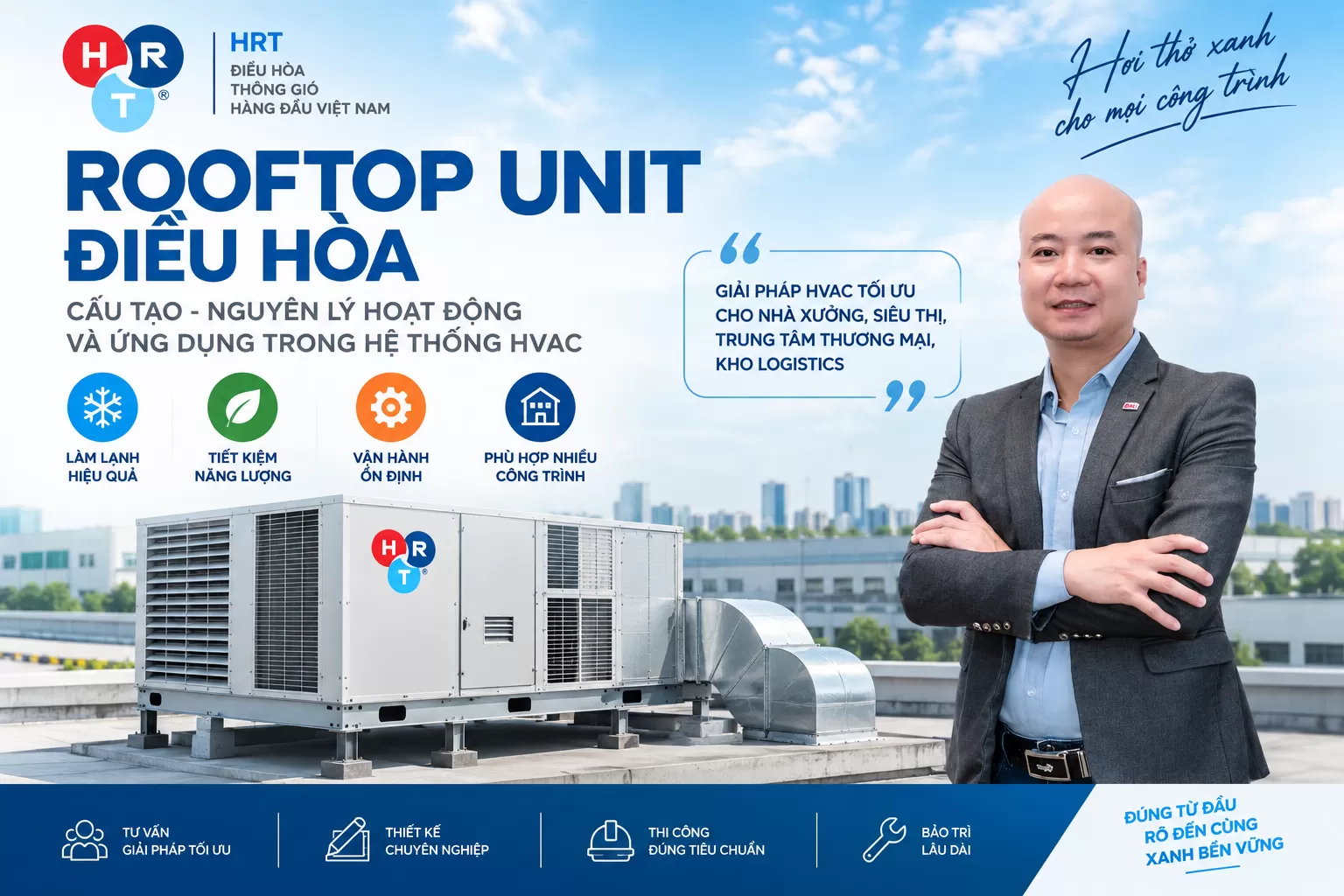
Rooftop Unit (RTU) is the air conditioning solution for whole cluster, integrated cooling, air handling and distribution through air duct system. Discover the specification, operating principles, practical applications and important notes when choosing a Rooftop Unit system for industrial and commercial works with HRT.
Rooftop Unit Air Conditioner – Integrated HVAC Solution For Factories And Commercial Buildings
For large-scale projects such as factories, supermarkets, shopping malls or logistics warehouses, choosing the appropriate air conditioning system is an important technical and investment cost problem.
Among the current HVAC solutions, Rooftop Air Conditioner Unit (RTU) It is considered a worth considering option due to its integral structure, integrated cooling and air treatment functions, and can be arranged outdoors to reduce the need for use of technical space inside the building.
However, the efficiency of Rooftop Unit is not only dependent on cooling capacity but also related to airflow rate, air duct system, static pressure, climate conditions and control method.
So what characteristics does Rooftop Unit have, which works are suitable for and what factors should be noted when choosing? HRT will analyze the technical perspective and actual operation efficiency.
When Should I Choose Rooftop Unit System?
Rooftop units are air conditioning equipment in a whole cluster, usually installed on the roof or in suitable outdoor areas.
The system's feature is to integrate the main components of cooling and air handling process in one assembly, then distribute the air to the use area through the air duct system.
Large space for use
Rooftop Unit is usually considered in large-scale projects, need air conditioning by area or by area of use.
Common applications include:
-
Factory and production area.
-
Supermarkets, shopping malls.
-
Logistics warehouses have air conditioning requirements.
-
Restaurants and service areas.
-
Hall, the common area.
-
HVAC system renovation works.
The project needs to optimize the technical area
Rooftop Unit can arrange the main components of refrigeration and air handling system in outdoor location.
This helps reduce the need to arrange a number of separate electromechanical equipment inside the building.
However, the project owner still needs to provide space for air ducts, power lines, controls and necessary ancillary items.
The works have suitable structural conditions
Due to the equipment is often installed on the roof, Rooftop Unit system must meet the requirement of load capacity, supporting pedestal, vibration resistance and maintenance accessibility.
These are the factors to be evaluated right from the stage of survey and design.
How does Rooftop Unit Work?
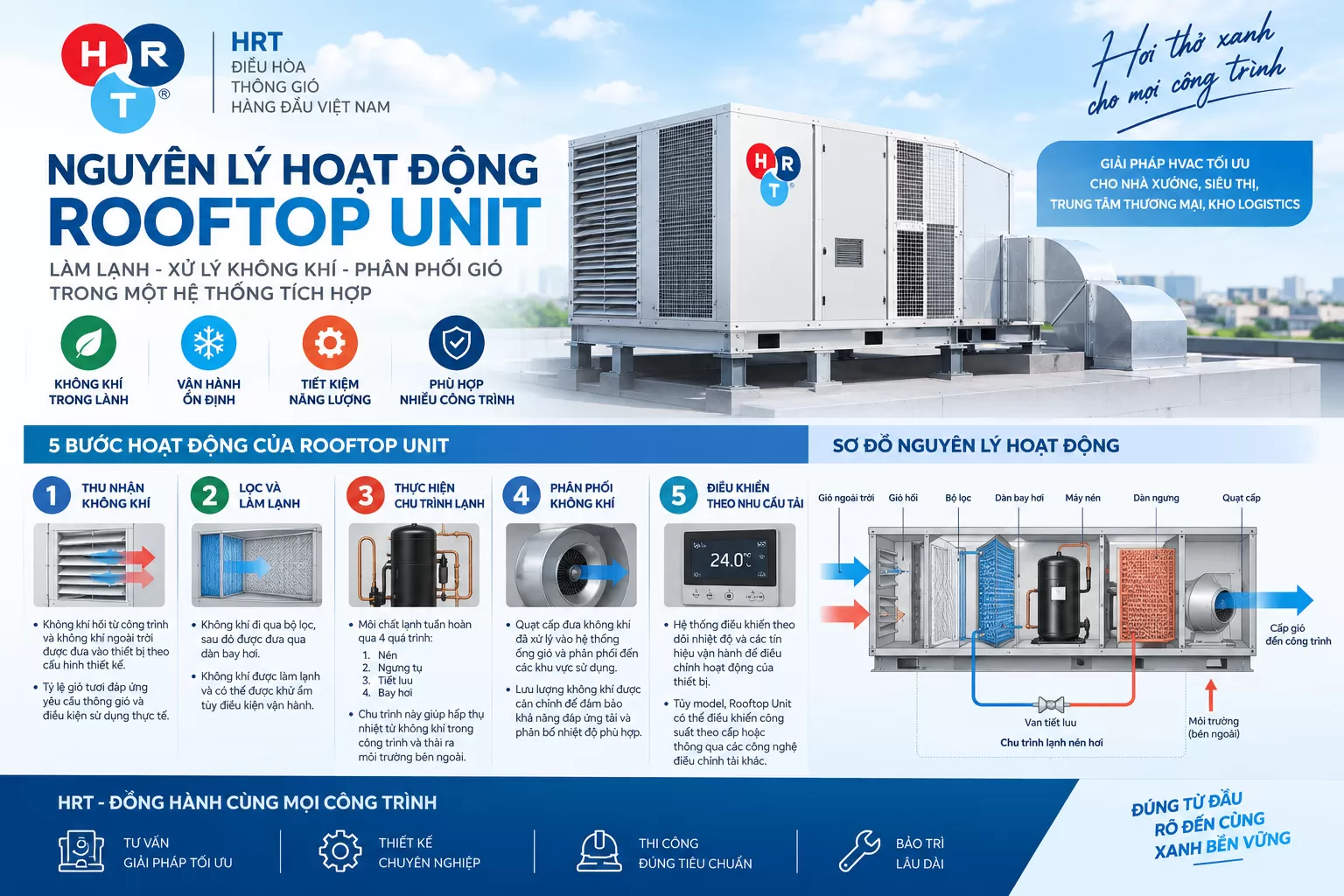
Rooftop Air-cooled Units use a compressed air cooling cycle to cool the air and a fan system to distribute the wind to the area in use.
The operation process consists of two closely related parts: the refrigerant cycle and the air handling process.
Refrigerant Cycle
The four main components of the cold cycle include:
Compressor (Compressor): Compressed refrigerant vapor, creating differential pressure required for the solvent to circulate.
Condenser coil (Condenser): Heat is released into the environment, causing the solvent to condense.
Expansion valve (Expansion Device): Reduce the solvent pressure before entering the evaporator coil.
Evaporator coil (Evaporator): Absorbs heat from the air stream that needs cooling.
Through continuous circulation, the system transports heat from the air inside the building to the outdoor environment.
Air Handling and Distribution Process
In parallel with the cold cycle, the air handling system performs the following tasks:
-
Receive return air and outdoor air according to the design configuration.
-
Pass air through the filter.
-
Cooling and can dehumidify at evaporator coil.
-
Use a fan to distribute air through the air duct.
-
Adjust equipment operation according to cooling load requirements.
Depending on the product lineup, Rooftop Units can be equipped with additional heating functions, Economizer or advanced control solutions.
Important Parts In Rooftop Unit
Although designed as a whole, the Rooftop Unit still includes many technical components that need to be selected and coordinated correctly.
Compressor and Heat Exchanger System
This is the part that does the cooling function.
Equipment capacity and performance depend on compressor configuration, heat exchange area, refrigerant and operation conditions.
Heat exchanger needs to be cleaned, periodically checked to maintain its operability.
Air supply fan system
The fan is responsible for bringing the treated air to the areas in use.
When choosing Rooftop Unit, special attention should be paid to:
-
Supply airflow (m³/h).
-
External static pressure (Pa).
-
Fan characteristics and performance.
-
Noise level.
-
Ability to control flow rate.
If the fan does not meet the system air duct pressure loss, the actual airflow rate may be lower than the design.
Filters and control systems
The filter helps reduce dust in the air stream, while the control system monitors parameters and manages equipment operation.
Some models have the ability to connect BMS/BAS to support centralized management.
Specific functions should be tested according to the manufacturer's technical documents.
What Are The Advantages of Rooftop Unit?
Integrated equipment and convenient layout
The whole cluster design helps to concentrate the main components, which simplifies the system layout compared to some options using multiple separate devices.
Suitable for wind distribution system
Rooftop Unit uses the air duct network to bring air to areas that need air conditioning.
This option can be suitable for large spaces if the air duct system is calculated and calibrated correctly.
Ability to adjust according to load needs
Depending on the model, the device can use multi-level power control or appropriate tuning technologies to meet the changing cooling needs.
Support for energy saving
The system is capable of efficient operation when:
-
Equipment capacity is selected to the right load.
-
Air duct system is designed accordingly.
-
Airflow rate and static pressure are controlled.
-
The controller is installed properly.
-
Maintenance is done periodically.
Energy saving should be assessed according to equipment and actual operation conditions, it is not recommended to apply a fixed rate for every project.
Rooftop Unit Application In Practice
Air conditioner for production workshop
The workshop is one of the groups of works that can consider using Rooftop Unit.
However, thermal loads in factories are often heavily influenced by roofs, machinery, people, lighting systems and the manufacturing process.
The selection of RTU needs to base on the actual cooling load, outdoor air supply demand and air distribution conditions.
Supermarket and mall air conditioning
Commercial buildings have a variable density of people over time and a relatively large demand for air conditioning.
Rooftop Unit can serve large areas through the feed and return system.
The design should pay attention to the level of comfort, noise, outdoor air conditions and control methods over time.
Logistics warehouse air conditioner
Some warehouses need to control temperature or maintain environmental conditions that are consistent with storage characteristics.
When using Rooftop Unit, it is necessary to consider the warehouse height, thermal load through the building shell, the frequency of opening doors and the ability to distribute air evenly.
Not every logistics warehouse needs full-area air conditioning. In many cases, a local ventilation or cooling solution may be more appropriate.
Rooftop Unit for Renovation Works
For existing buildings, Rooftop Unit can be an HVAC renovation option if the structure, installation location and wind distribution system allows.
It is necessary to check the load capacity of roof, electrical conditions, ductwork and condensate before deciding to invest.
Rooftop Unit, VRV/VRF or Chiller – Which Solution Should You Choose?
Each system has its own characteristics of configuration and delivery methods refrigeration and thermal engineering.
| Criteria | Rooftop Unit | VRV/VRF | Chiller |
|---|---|---|---|
| Configure | Raw cluster | Outdoor Unit And Indoor Unit | Chilled-water system |
| Distribution & Distribution | Mainly through air duct | Indoor unit directly | AHU/FCU and terminals |
| Partitioning | By Design | Flexible | By Design |
| Equipment Location | Usually outdoor | Outdoor unit outdoor | Depends on the system type |
| Applications | Large space | Multi-room building | Large-scale construction |
Rooftop Unit can be suitable for large space projects and is convenient for deploying air duct system.
VRV/VRF often has the advantage in buildings that need to control multiple areas separately.
Chiller is a solution to consider for projects that require chilled-water system or large cooling load.
Do not choose a system based solely on the rated power or purchase price of the device. Total investment, operation, maintenance and technical requirements should be compared.
5 Technical Criteria When Choosing Rooftop Unit
Cooling capacity
Cooling capacity must be based on the result of calculation of thermal load works.
Commonly used units are kW refrigeration or RT.
1 RT ≈ 3,517 kW refrigeration.
Too large selection can increase the investment cost, while equipment with a lack of capacity risks not meeting requirements when the load is high.
Airflow Rate and Static Pressure
Airflow rate and external static pressure must meet the requirements of the distribution system.
Fan characteristics should be checked at the actual working point instead of using only the nominal flow rate.
Energy efficiency
Parameters such as COP, EER or IEER should be evaluated according to applicable standards and corresponding testing conditions.
High nominal performance devices may not provide low operational costs if the system is not designed and controlled appropriately.
Outdoor air and humidity handling capability
In Vietnam's hot and humid climate, hidden loads from outdoor air can significantly affect system performance.
Therefore, it is necessary to check the ability to handle humidity, outdoor airflow and air condition level.
Installation Conditions
Factors to be evaluated include:
-
Structure and roof load.
-
The size and volume of the equipment.
-
Power supply.
-
The crane-mounting plan.
-
Air duct connection position.
-
Condensate drainage system.
-
Space maintenance and technical safety.
Rooftop Unit Deployment Process In The Works
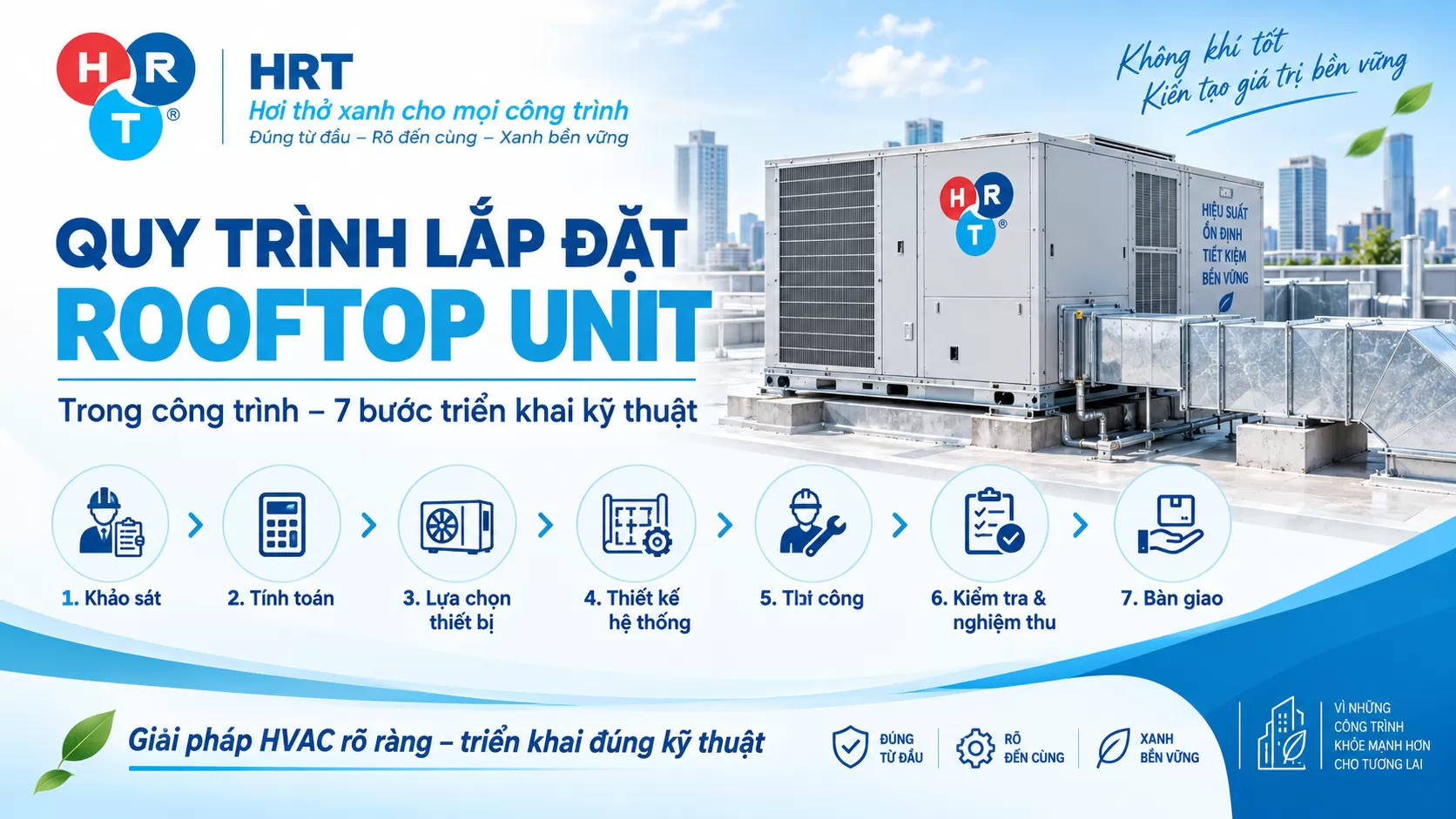
In order for the operation system to be stable and meet the design requirements, the deployment should be carried out in a controlled process.
Step 1 – Survey the current status: Assess the function, structural conditions, installation location and power supply.
Step 2 – Technical calculation: Determine cooling load, airflow rate, outdoor air demand and static pressure.
Step 3 – Select equipment: Compare power, performance, size and function requirements.
Step 4 – System Design: Complete the plan of machine pedestal, air duct, electricity, control and drainage.
Step 5 – Installation: Installation of equipment and auxiliary items according to technical records.
Step 6 – Check, calibration and acceptance testing: Perform measurement, TAB and commissioning in accordance with the scope.
Step 7 – Handover: Complete records, operation instructions and maintenance plans.
The process should be adjusted according to the construction characteristics, the scope of the contract and the requirements of the manufacturer.
Mistakes to Avoid When Investing Rooftop Unit
Some problems can affect system efficiency:
Capacity selection by area: Failure to adequately evaluate thermal load can lead to inappropriate device selection.
No static pressure calculation: Air duct systems with large pressure loss may cause actual flow rate to be unsatisfactory.
Skip moisture load: The equipment that meets the total cooling capacity does not guarantee the ability to maintain the desired humidity.
No Roof Structure Test: There is a risk of reinforcement costs or change of installation plans.
Lack of acceptance testing and calibration: The system may not meet the performance and comfort conditions as designed.
To limit these problems, it is necessary to coordinate synchronously between HVAC design, structure, electricity and construction plan.
Rooftop Unit And Industrial HVAC Solutions At HRT
HRT Air Conditioning and Ventilation Company Limited operating in the field of consulting, design, supply, construction, acceptance testing and maintenance of air conditioning and ventilation systems.
With a background in refrigeration and thermal engineering, HRT aims to select solutions based on actual needs, technical criteria and investment efficiency of each project.
HRT Solutions Provided
-
Rooftop Unit and Packaged Consultant.
-
Central air conditioning system VRV/VRF.
-
Chiller, AHU, FCU, PAU system.
-
Design and construction of air duct system.
-
Ventilation solution and outdoor air supply.
-
Built-in BMS control.
-
Maintenance and renovation of HVAC systems.
-
Advising on air conditioning energy optimization.
HRT aims to three core values: True – Clear – Dedicated, help customers have the basis to choose the right HVAC solution for the project.
FAQs About Rooftop Unit
Is Rooftop Unit Packaged Air Conditioner?
Rooftop Unit usually belongs to Packaged type of air conditioning unit, but designed to suit for outdoor or rooftop installation.
Is Rooftop Unit suitable for workshop?
Can be suitable if cooling load, airflow rate, static pressure and environmental requirements meet equipment capabilities.
Can Rooftop Unit supply outdoor air?
Some models support outdoor air intake and adjustment. The specific function depends on the product configuration.
Does Rooftop Unit have a BMS connection?
Some models support BMS/BAS integration. Communication protocol and control capabilities should be confirmed.
Does Rooftop Unit Save Electricity Than Chiller?
General conclusions cannot be reached. Performance and operational costs should be compared on the same load, climate and use conditions.
Conclusion – Rooftop Unit is the HVAC Solution that needs to be Chosen Technically
Rooftop Air Conditioner Unit is a whole-cluster HVAC solution, capable of integrating cooling, air handling and distribution in the same system.
For large-scale constructions that require proper ventilation and favorable installation conditions, Rooftop Unit can be a worthwhile option.
However, the investment efficiency depends on the correct selection of cooling load, airflow rate, static pressure, equipment configuration and control solutions.
Proper selection from the design stage is the basis for stable operation, cost control and long-term exploitation.
HRT – GREEN BATH FOR EVERY WORK
CORRECT FROM THE HEAD – CLEAR TO THE SAME – SUSTAINABLE GREEN
HRT Air Conditioning and Ventilation Company Limited
Contact HRT for advice on choosing Rooftop Unit, Packaged system and HVAC solutions to suit the actual needs of the project.
Source: Publisher’s English edition · Vietnamese original on doanvanhoang.com