
What is HVAC heat recovery and when should you use it?
Machine-translated from Vietnamese. Read the original in Vietnamese
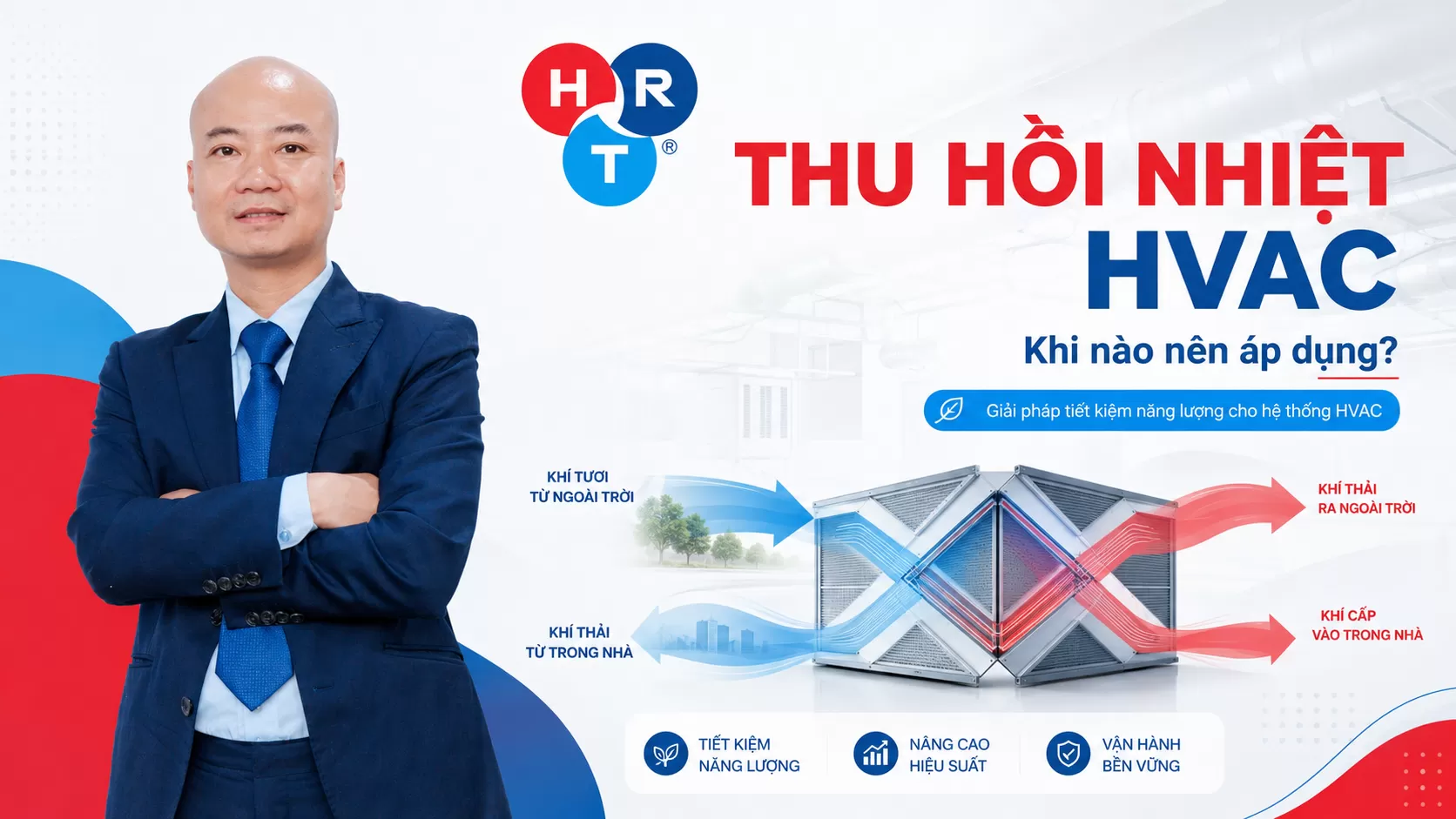
Heat recovery HVAC utilizes the remaining energy in exhaust air to pretreat outdoor air before passing through AHU, DOAS or cooling coil. Solutions can help reduce cooling load and energy consumption if selected properly.
Heat recovery HVAC – why is it increasingly interested?
In an air conditioning system with outdoor air supply, outdoor air must be brought from the environmental state to suitable conditions before being supplied into the used space.
Especially in hot and humid climates, outdoor winds often have:
- High temperature.
- Great humidity.
- Enthalpy cao.
- Large processing load for cooling coil.
Meanwhile, a portion of the air in the room that has been cooled and dehumidified is regularly sucked in and released.
This raises a question:
Is it possible to take advantage of the remaining energy in exhaust air to reduce the outdoor air handling load?
That's the principle of heat recovery HVAC – Heat Recovery.
What is HVAC heat recovery?
Heat recovery HVAC is the solution that uses the remaining energy in the line exhaust air – exhaust air to preprocess the line outdoor air – outdoor air before the wind enters the AHU, FAHU, DOAS or cooling coil.
The principle can be visualized:
Outdoor Air → Heat Recovery → AHU/DOAS → Supply Air
At the same time:
Indoor Air → Exhaust Air → Heat Recovery → Outside
Two air flows exchange energy through heat exchanger.
In hot season:
Exhaust air cooler → Energy exchange → outdoor air is pre-cooled
In cold season:
Exhaust air warmer → Energy exchange → outdoor air is preheated
The goal is to reduce the load that cooling coil or heating coil must handle at the next stage.
The essence of the problem is not just “heat recovery”
When it comes to Heat Recovery, many people only care about temperature.
But for HVAC systems, especially in hot and humid areas, outdoor air loads consist of two important components:
Sensible Load
As the loading part related to changes air temperature.
For example:
High temperature outdoor winds are pre-cooled before reaching the cooling coil.
Latent Load
As the loading part related to moisture in the air.
With hot and humid outdoor air, cooling coil not only has to reduce the temperature but also has to dehumidify.
Therefore, when evaluating heat recovery should see:
Temperature + Humidity + Enthalpy
And not just temperature.
What are the differences between HRV and ERV?
The two most common terms are HRV and... ERV.
HRV – Heat Recovery Ventilator
HRV mainly exchange sensible heat.
In the hot season:
Outdoor Air Heater → HRV → Outdoor Air Cooler
In cold season:
Outdoor Air Refrigeration → HRV → Outdoor Air Warmer
HRV is suitable for applications where temperature exchange between two air streams is preferred.
ERV – Energy Recovery Ventilator
Exchangeable ERV:
Sensible Energy + Partial Latent Energy
This means that in addition to temperature, the device is also capable of exchanging some moisture.
With hot and humid outdoor air conditions, ERV can help reduce:
- Sensible load.
- Latent load.
- Enthalpy of outdoor air before coil.
This is why ERV is often considered in outdoor air treatment systems in hot and humid climates.
HRV vs ERV Quick Comparison
| Criteria | HRV | ERV |
|---|---|---|
| Temperature exchanger | Yes | Yes |
| Partial exchange of moisture | Usually not | Yes |
| Reduce sensible load | Yes | Yes |
| Reduce latent load | Restrictions | Able to |
| Suitable for hot and humid areas | Need to evaluate | Often worth considering |
| Requirement for exhaust air source control | Yes | Yes |
However:
ERV is not better than HRV by default.
The right plan must be based on:
- Outdoor condition.
- Indoor condition.
- Exhaust air quality.
- Requires humidity.
- Risk of cross-contamination.
- Pressure drop.
- Investment and operation costs.
Common HVAC heat recovery technologies
Heat recovery is not just HRV or ERV as small devices.
There are many different technologies in large HVAC systems.
Heat Recovery Wheel
The heat wheel uses a rotor that rotates between two streams of gas.
The rotor continuously absorbs energy on one side and transfers it to the other.
Some types can be exchanged:
Heat + Humidity
Common names:
- Heat Wheel.
- Energy Wheel.
- Enthalpy Wheel.
- Total Energy Wheel.
Advantages:
- High energy exchange capacity.
- The structure is relatively compact.
- Both sensible and latent energy can be recovered.
Need to check:
- Seal.
- Leakage.
- Carryover.
- Motor.
- Clean the rotor.
- Quality exhaust air.
Plate Heat Exchanger
Two gas streams pass through separate channels and exchange heat through the plate surface.
Advantages:
- Few moving parts.
- The structure is relatively simple.
- The two air streams are separated by composition.
Plate exchanger normally mainly exchange sensible heat.
Some lines use membranes that can impart an additional fraction of moisture.
Run-Around Coil
Run-around system uses two coils and an intermediate fluid circulation loop.
Principle:
Exhaust Air → Coil 1 → Pump → Coil 2 → Outdoor Air
The two streams don't need to be close together.
This solution is beneficial when a high separation between exhaust air and outdoor air is required.
However the system arises further:
- Pump power.
- Pressure drop qua coil.
- Pipeline.
- Van.
- Controls.
So we have to calculate the effectiveness of whole system, not just the amount of heat recovered.
How does heat recovery help reduce AHU load?
No heat recovery:
Outdoor Air → Cooling Coil
Cooling coil must handle almost the entire load of outdoor wind.
There is heat recovery:
Outdoor Air → Heat Recovery → Cooling Coil
Outdoor air was pretreatment before arrival to coil.
Then:
Cooling Load after Heat Recovery < Original Cooling Load
With ERV, the load reducer can include:
Sensible + Latent
This benefit is more apparent when the system has large outdoor airflow.
When should I apply HVAC heat recovery?
Do not choose heat recovery just because this is a solution labeled “energy saving”
Real condition of the system is required.
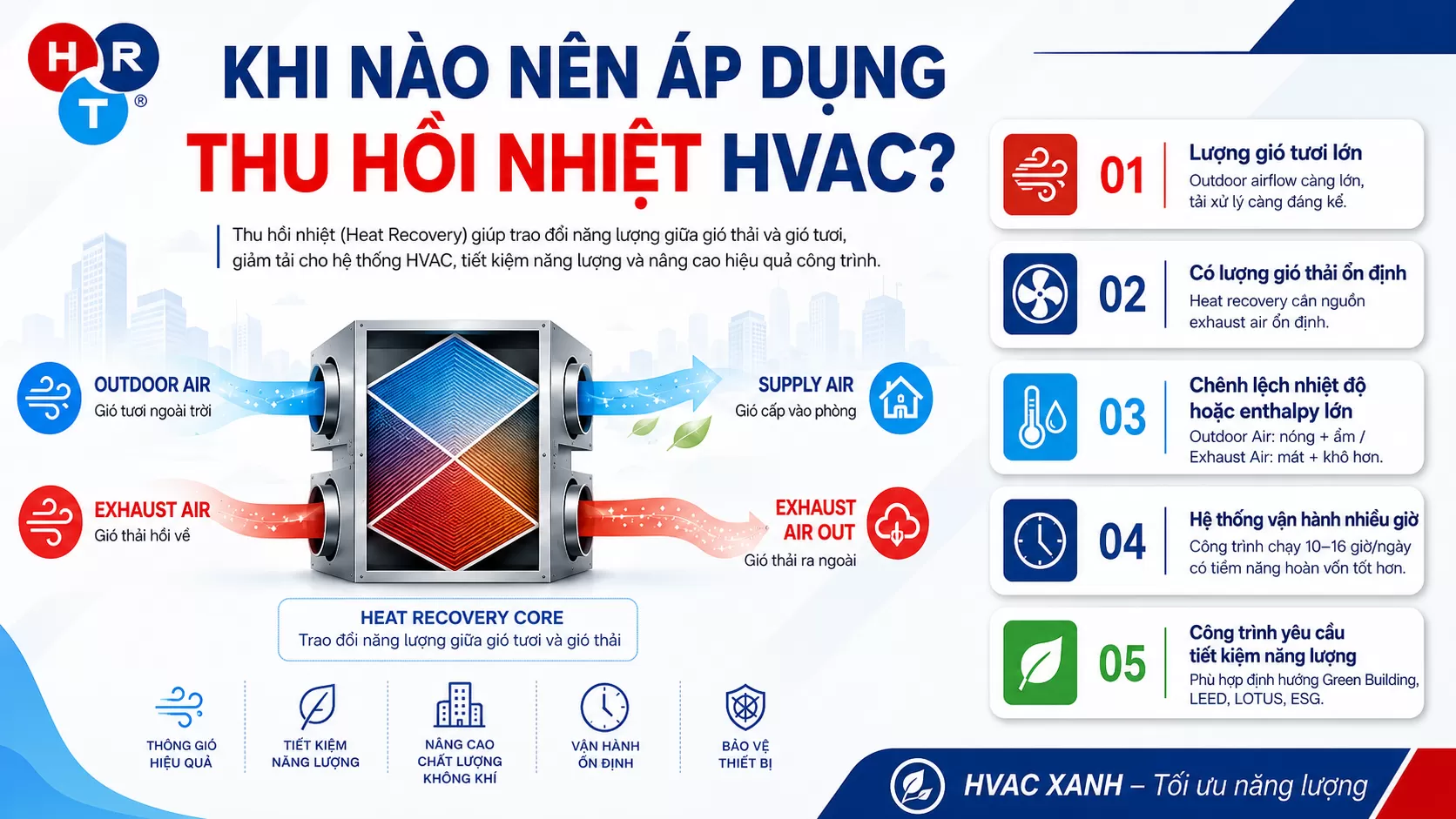
1. The building has a large amount of outdoor air
The greater the outdoor airflow, the more significant the outdoor air handling load.
Examples of systems:
- AHU has high outdoor air ratio.
- FAHU.
- PAU.
- DOAS.
can both have large ventilation load.
In this case, heat recovery has more energy to optimize.
2. Have stable air exhaust
The appropriate exhaust air source is needed to recover energy.
If the exhaust air volume is too small or unstable, the recovery potential also decreases.
Therefore, it is necessary to check:
Supply Airflow ↔ Exhaust Airflow
before choosing exchanger.
3. Temperature or enthalpy difference is large enough
The heat recovery potential depends greatly on the state difference of the two gas streams.
In summer:
Outdoor Air: Hot + Humid
Exhaust Air: Cooler + Dryer
The greater the enthalpy difference, the greater the energy recovery potential.
4. Multi-hour operation system
Not only equipment performance but operating hours also determines economic efficiency.
An operation works:
10-16 hours/day
usually has a greater annual energy savings potential than buildings that run only a few hours.
5. Works towards energy saving
Heat recovery is often considered in the directional works:
- Green Building.
- LEED.
- LOTUS.
- ESG.
- Reduce OPEX.
- Reduce HVAC power.
Especially when introduced right from the design stage, heat recovery can be optimized synchronously with AHU, fan and cooling source.
What works have high potential application?
Offices
The high density of users makes ventilation requirements relatively large during working hours.
Hotel Location
Living room areas, corridors and functional spaces have the need for outdoor air and continuous exhaust.
Business Center
Large air flow rate and long operation time create significant energy recovery potential.
Schools and schools
Classrooms with high density of people should ventilation load is not small.
Hospitals
Some areas have very large supply and exhaust air.
However, this is also a group of works that must be controlled particularly strictly the risk:
Cross-Contamination
Factory Supply
Large production sites with a large supply-discharge system may also consider heat recovery if exhaust air quality is suitable.
When should you not use heat recovery?
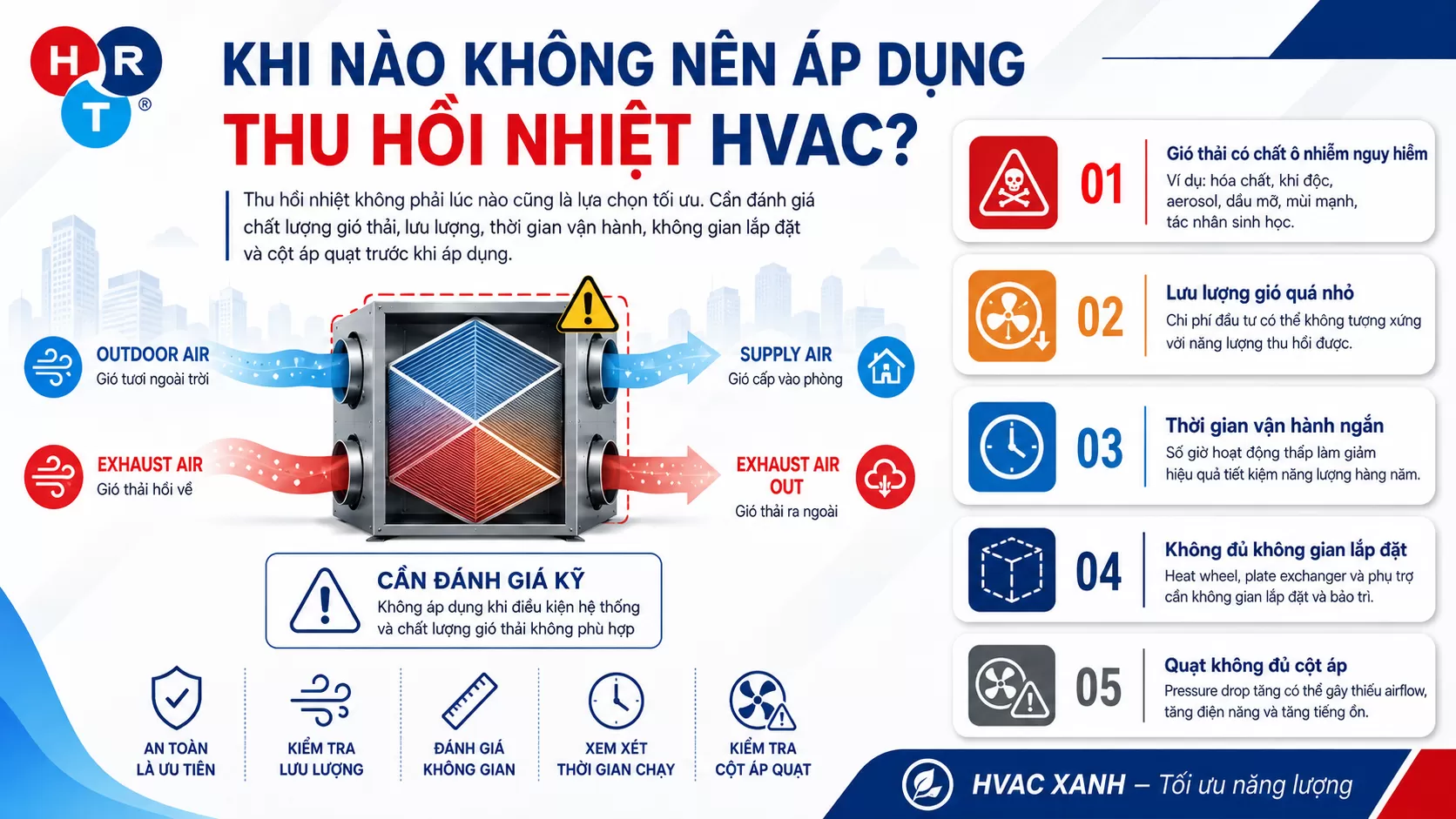
Not all HVAC systems should have heat recovery included.
There are cases where the energy benefits are not enough to offset the risk or investment costs.
1. exhaust air contains dangerous pollutants
Particular caution should be exercised if exhaust air contains:
- Chemicals.
- Poisonous gas.
- Aerosol.
- Grease.
- Strong smell.
- Biological agents.
In these cases:
IAQ + Safety + Cross-Contamination
must be prioritized before energy saving.
2. airflow rate is too small
If exhaust airflow and outdoor airflow are small, the amount of energy recoverable is also low.
Costs:
- Exchanger.
- Ductwork.
- Control.
- Fan modification.
- Maintenance.
may not match the energy saved.
3. Short operation time
A device with high effectiveness but running only few hours per year can have a very long payback period.
Therefore, it must be evaluated according to:
Annual Energy Saving
instead of just looking at one moment.
4. Not enough installation space
Heat wheel, plate exchanger or run-around coil all need space for:
- Equipment.
- Ductwork.
- Damper.
- Sensor.
- Maintenance access.
Space maintenance is often overlooked during the retrofit phase.
5. Fan not enough pressure head
This is one of the most important issues.
Heat exchanger generates more:
Pressure Drop
If the fan is no longer external static pressure backup, after installing the exchanger system can:
- Reduce airflow.
- Increase your fan speed.
- Increase power.
- Increase noise.
- Failure to reach the design flow rate ventilation.
Pressure Drops Can Lose the Benefits of Heat Recovery
A common mistake is to ask only:
“How much energy can the device recover?”
But exchangers always create resistance on the wind.
If the system must increase the fan power significantly to overcome this resistance then net saving will be lower than original calculation.
Can you imagine:
Net Energy Saving = HVAC Energy Reduction – Auxiliary Energy Increase
Auxiliary energy may include:
- Supply fan power.
- Exhaust fan power.
- Wheel motor.
- Pump power.
- Control power.
So the effect of heat recovery must be seen on HVAC system.
High efficiency is not necessarily the optimal option
A highly effective exchanger can simultaneously have:
- Pressure drop cao.
- Big size.
- Large investment price.
- High maintenance requirements.
- Risk of leakage varies.
Don't choose a device based on one parameter.
The appropriate plan should balance:
Effectiveness + Pressure Drop + IAQ + Fan Energy + Maintenance + CAPEX + OPEX
How is heat recovery in the AHU arranged?
A typical configuration:
Outdoor Air → Filter → Heat Recovery → Cooling Coil → Fan → Supply Air
Exhaust Air Side:
Return/Exhaust Air → Heat Recovery → Exhaust Fan → Outside
In the hot season, outdoor air after heat recovery has a temperature or enthalpy lower than the initial state.
Cooling coil so must handle less load.
System can add:
- Bypass damper.
- Temperature sensor.
- Humidity sensor.
- Differential pressure sensor.
- VFD.
- BMS.
Why is Heat Recovery compatible with DOAS?
DOAS is a system that specializes in handling outdoor air.
Due to the high outdoor air rate, ventilation load is also large.
A configuration can be:
Outdoor Air → ERV → Cooling Coil → Supply Air
In hot season:
ERV → Precooling + Partial reduction of moisture load
Then cooling coil continues processing to required state.
Therefore, DOAS is one of the most interesting applications of energy recovery.
Does heat recovery reduce Chiller power?
The answer is:
Maybe, but not by default.
If heat recovery is calculated right from the design stage, peak cooling load reduction can affect:
- Cooling coil capacity.
- Chilled water flow.
- AHU capacity.
- Cooling source capacity.
However, the cooling load problem must be re-implemented.
For the existing system, Chiller was selected and installed.
When retrofit heat recovery, benefits are often expressed in:
Reduce operation load
not cause the nominal power of the Chiller to automatically decrease.
Should retrofit heat recovery for old HVAC system?
Maybe, but make sure you look.
Installation Space
Exchanger and accessories need considerable area.
Ductwork
Can outdoor air and exhaust air be delivered to a convenient heat exchange area?
Fan Static Pressure
Is the fan still running?
Electrical and Control
Need to add:
- VFD.
- Sensor.
- Actuator.
- Damper.
- BMS point.
Maintenance
There is enough space to:
- Clean the exchanger.
- Check the seal.
- Maintenance motor.
- Clean the coil.
- Thay filter.
A system that saves electricity but is difficult to maintain will be difficult to maintain long - term efficiency.
The process of heat recovery assessment at HRT
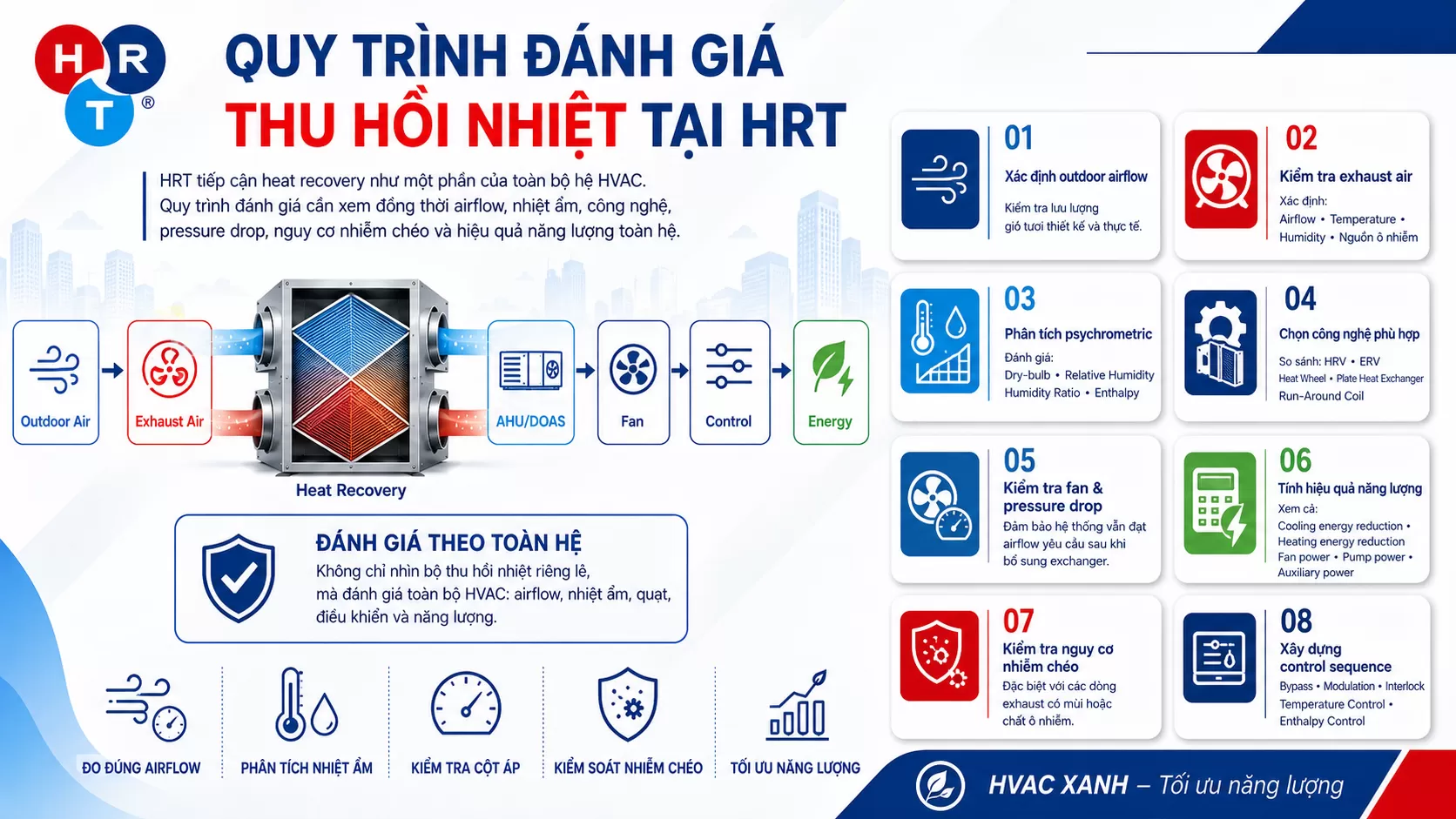
HRT does not treat the heat recovery as a stand - alone device.
The evaluation chain is approached systemically:
Outdoor Air → Exhaust Air → Heat Recovery → AHU/DOAS → Fan → Control → Energy
Step 1: Determine Outdoor Airflow
Testing:
- Flow rate design.
- Actual flow rate.
- Outdoor air ratio.
- Operation mode.
This is the first data to evaluate ventilation load.
Step 2: Check Exhaust Air
Not just know the airflow.
Need to identify:
- Temperature.
- Humidity.
- Source of generation.
- Contaminants composition.
- Possibility to use for energy exchange.
Step 3: Psychrometric Analysis
Heat recovery cannot be assessed solely by temperature.
HRT simultaneous viewing:
- Dry-bulb Temperature.
- Relative Humidity.
- Humidity Ratio.
- Enthalpy.
Especially in hot and humid conditions, enthalpy often reflects more fully than outdoor air handling load.
Step 4: Choose the right technology
Compare between:
- HRV.
- ERV.
- Heat Wheel.
- Plate Heat Exchanger.
- Run-Around Coil.
There is no one technology that works for every building.
Step 5: Fan and Pressure Drop Test
Recalculate system resistance after adding exchangers.
Objectives:
The actual airflow still has to be designed.
If not, review:
- Fan selection.
- Fan speed.
- Ductwork.
- Exchanger resistance.
Step 6: Calculate energy efficiency
It's not just cooling energy that's down.
Need to view simultaneously:
- Cooling energy reduction.
- Heating energy reduction.
- Fan power.
- Pump power.
- Wheel motor.
- Auxiliary power.
The final result should be:
Net Energy Saving
Step 7: Cross-contamination risk testing
Especially important for exhaust air have:
- Smells.
- Aerosol.
- Chemicals.
- Biological agents.
Energy saving is not traded for air quality and safety.
Step 8: Build Control Sequence
Heat recovery does not have to run 100% of the time.
Can Design:
- Bypass.
- Modulation.
- Interlock.
- Temperature Control.
- Enthalpy Control.
Good control helps exchanger only work when really beneficial.
Common mistakes when choosing Heat Recovery
Only Look Effectiveness
Effectiveness is an important parameter but cannot represent the effectiveness of the entire HVAC.
ERV defaults always better than HRV
Sai.
ERV must be suitable for humid heat and exhaust air conditions.
No Pressure Drop
This is an error that may cause the system to lack airflow after retrofit.
No Cross-Contamination Reviews
It is especially dangerous to use an inappropriate exhaust source.
Default savings 20–30%
A fixed ratio should not be applied to every system.
The savings depend on:
- Airflow.
- Weather.
- Operating hours.
- Exchanger.
- Fan system.
- Control sequence.
Maintenance not included
Dirty Exchanger can:
- Reduce heat transfer.
- Increase your pressure drop.
- Increase fan power.
How do I know if my heat recovery is working properly?
After commissioning, should measure or trend the parameters:
- Outdoor air temperature before exchanger.
- Outdoor air temperature sau exchanger.
- Exhaust air temperature.
- Relative humidity.
- Airflow.
- Differential pressure.
- Fan speed.
- Fan power.
- Pump power if available.
If the system has BMS, should trend data over time for evaluation.
It should not be demonstrated that:
“The wind behind the exchanger has cooled"
The ultimate goal should be:
The whole HVAC system consumes less energy but still ensures airflow and IAQ.
Heat recovery and HVAC Green
Heat recovery is one of many solutions that can help reduce HVAC energy.
But to really get the effect, it needs to be in relation to:
Cooling Load → Ventilation → AHU → Fan → Control → Energy
A good system is not the one with the most energy - efficient equipment.
It's the system:
- Right load.
- Right airflow.
- Right pressure.
- Right control.
- Easy maintenance.
- Consume energy responsibly.
This is also the approach of HRT in solutions HVAC GREEN – energy optimization – sustainable operation.
Conclusion
Heat recovery HVAC help to make full use of the remaining energy in exhaust air for outdoor air pretreatment before passing through AHU, DOAS or cooling coil.
Solutions worth considering when the project has:
- Outdoor large airflow.
- Exhaust airflow is stable.
- Significant thermal or enthalpy differences.
- Long operation time.
- High energy saving demand.
However, Heat Recovery should not be evaluated individually.
A correct alternative should be considered simultaneously:
Airflow + Psychrometric + Heat Recovery + Pressure Drop + Fan Energy + IAQ + Control + Maintenance
The ultimate goal is not to hit a nice effectiveness figure on the catalog.
It is:
Reduces the actual energy of the entire HVAC system while maintaining air quality, flow rate design and operation stability.
Source: Publisher’s English edition · Vietnamese original on doanvanhoang.com