
Choosing a VRF system starts with understanding the building
Machine-translated from Vietnamese. Read the original in Vietnamese

CEO Đoàn Văn Hoàng – HRT Share when to use VRF central air conditioning based on cooling load, partition, operation schedule, outdoor air, control and actual maintenance capabilities of the building.
VRF Central Air Conditioner: Do not choose before understanding the building
A project owner can start a meeting with the following question:
“Is this work using VRF reasonable?”
I usually don't respond immediately with the device name.
I want to know how many areas the building uses, which areas operate at the same time, how cooling load changes during the day, where the outdoor unit can be located and who will operate the system after handover.
That's where the decision begins.
Central air conditioning VRF is not a good solution because it is modern. VRF is only really good when the characteristics of the system match the way the building is used.
VRF stands for Variable Refrigerant Flow, i.e. the system of adjusting refrigerant flow rate according to demand. A typical system uses one or more outdoor unit clusters connected to multiple indoor units, allowing the areas to be controlled relatively independently. Daikin described VRV—its trade name for the same technology—as a multi-split system for commercial buildings with individual room or floor control.
But from an HRT executive perspective, the more important question remains:
Does the building really need that?
Look at the operation date before looking at the catalogue
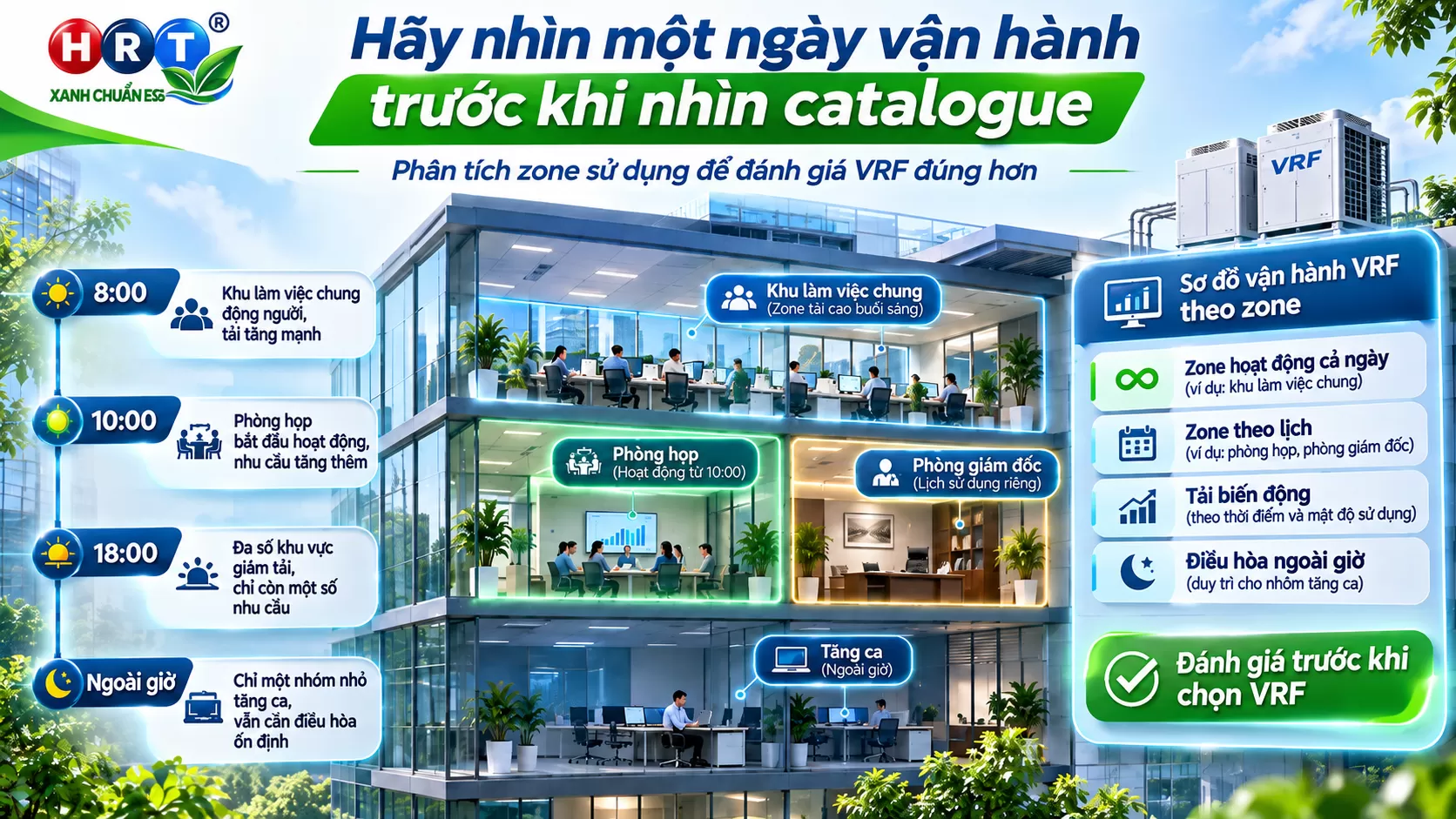
Suppose an office starts working at 8: 00.
The common office was almost full in the morning. Meeting rooms were used only from 10: 00. The director's office had its own schedule. By 18: 00, most of the staff left, but a group still worked overtime.
This is the kind of work that got me thinking about VRF.
The reason is not the total area.
The reason lies in... the difference between zones.
Daikin said VRV has the ability to adjust individually for each area and change the amount of environmental substance according to actual needs. This feature helps the system be suitable for buildings with many spaces that do not work simultaneously.
At the survey step, I want the design team to mark directly on the ground:
What part of the city works all day?
Which area is only available on a schedule?
Which room has a high volatility load?
Which area needs overtime air conditioning?
If the whole work is almost always running in the same mode, the partitioning advantage of VRF should be reevaluated instead of the default which remains the optimal option.
I choose the system from how works operation, not choosing how operation to match the purchased system.
Cooling load new changes are where VRF takes advantage
Two rooms of the same area do not have the same cooling load.
A 50 m2 meeting room can be almost empty in the morning but full of people in the afternoon. A showroom has loads from glass and lighting. An IT room has constant equipment loads.
The original HRT article also emphasized that the choice of VRF must go from utility, cooling load, number of zones and operation schedule, rather than just looking at area.
I asked the engineer to show the load by area before adding up the total capacity.
This helps the approver see:
Which area generates large loads?
Which zone is frequently operating at low load?
Which zone has the ability to change functions?
When the system is frequently working at partial loads, the ability to adjust the power of the compressor inverter and each zone becomes an advantage to consider. Daikin also identified independent zone control and inverter technology as key characteristics that support VRV operation efficiency.
But I'm not using that to promise a fixed rate of electricity savings.
Actual power also depends on the work load, installation temperature, outdoor air, construction quality, operation and maintenance.
VRF has the ability to save. The project must facilitate such ability to become a result.
Less outdoor unit is not a reason enough to choose VRF
One obvious advantage of VRF is that multiple indoor units can connect to one or several outdoor unit clusters.
This reduces the number of discrete devices on the vertical surface compared to each room using an independent air conditioning system. For buildings with high requirements for architecture, this is a significant advantage.
But at the design meeting, I'll move on to the outdoor unit.
Where will the outdoor unit draw air?
Where does the hot air go?
Is there a risk of hot wind return?
Is there enough maintenance space?
When you need to change equipment, where is the shipping line?
If these questions are not answered, the “reduce the number of outdoor unit” is not enough to conclude that the plan is good.
A VRF system can be properly calculated but still operate poorly if the outdoor unit is placed in a closed area, hot air returns to the inlet or no maintenance space.
Do not just look for a place to put the device. Look for a location where the device can work properly.
Less technical ceiling does not mean VRF does not need MEP coordination
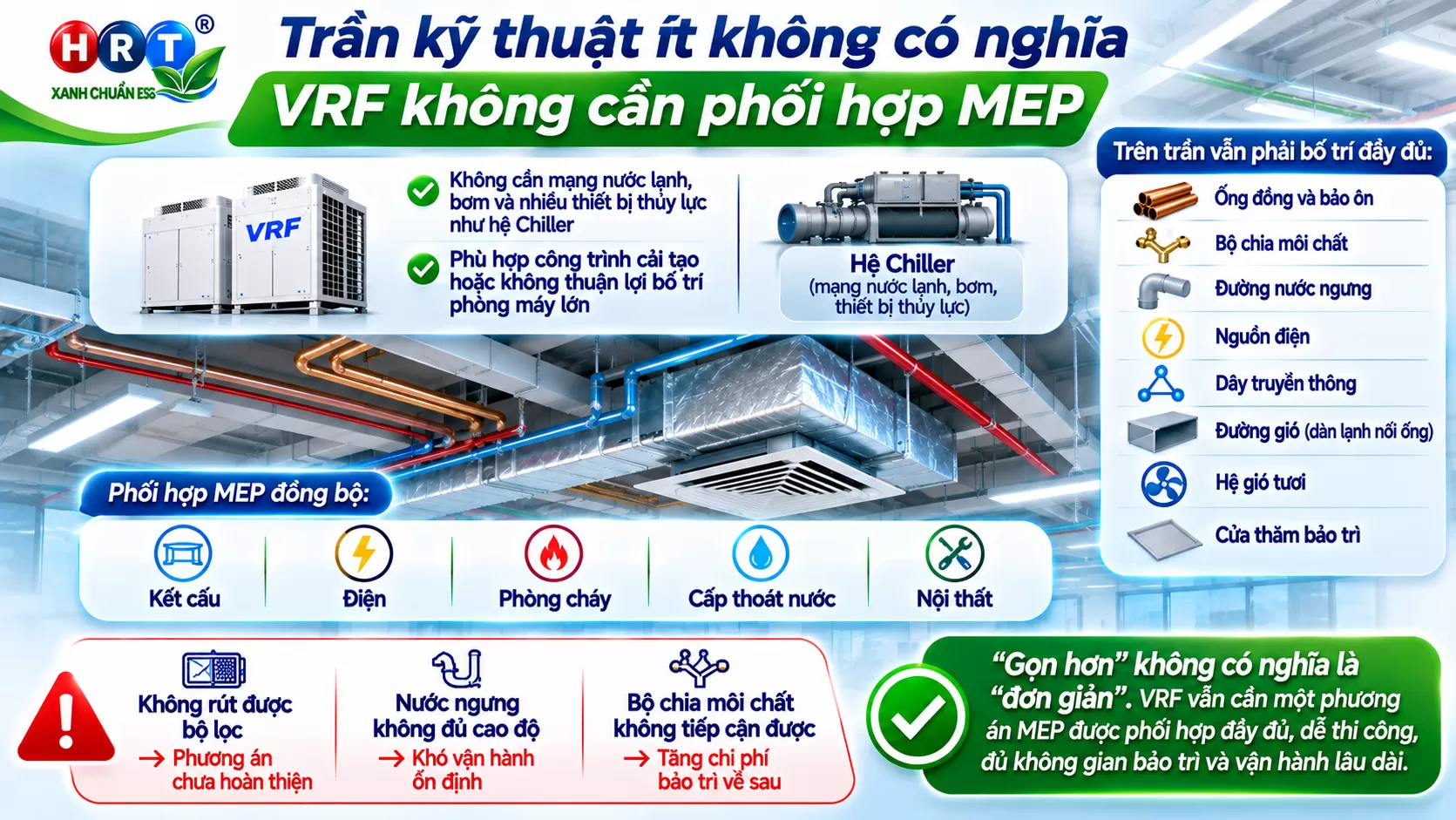
VRF has a practical advantage: instead of having to arrange cold water network, pump and many hydraulic equipment such as Chiller system, the system uses pipeline directly to the indoor unit.
This may be suitable for renovation works or where large machine room layout is not convenient. The original article also states this is one of the VRF cases worth considering.
But I don't want the project team to see “more than" as “simple".
There must still be room in the ceiling for:
Copper tubing and insulator.
The solvent divider.
Condensate.
Power supply.
Communications cable.
Airway with indoor unit connecting pipe.
Outdoor air system.
Maintenance visit door.
Therefore, Shop Drawing still has to fully coordinate with the structure, electricity, fire prevention, water supply and drainage and interior.
If the indoor unit hangs but does not remove the filter, the option is incomplete.
If condensate line is not high enough, the machine “just bare” no longer makes much sense.
If the reactor is in an inaccessible location, maintenance costs will later return the convenience that the project thought was there.
Aesthetics must go with maintenance ability
VRF has many forms of indoor unit such as cassette, concealed ceiling connecting air duct, wall mounted, ceiling or floor placed. This is the reason the system is often considered for high-end offices, hotels, showrooms and villas.
From an interior design perspective, the ability to hide the device is an advantage.
In terms of operation, I want to ask:
How will the technician approach you after hiding the machine?
Can you remove the filter?
Can you open the power box?
Can you check the condensate pump?
If a visit is placed on the drawing but the maintenance person cannot manipulate it, I do not consider it a complete solution.
Hide the device. Do not hide the maintenance line.
This is the rule I want the design team to confirm before the ceiling is closed.
Individual control of each room is only valid when the operation actually uses it
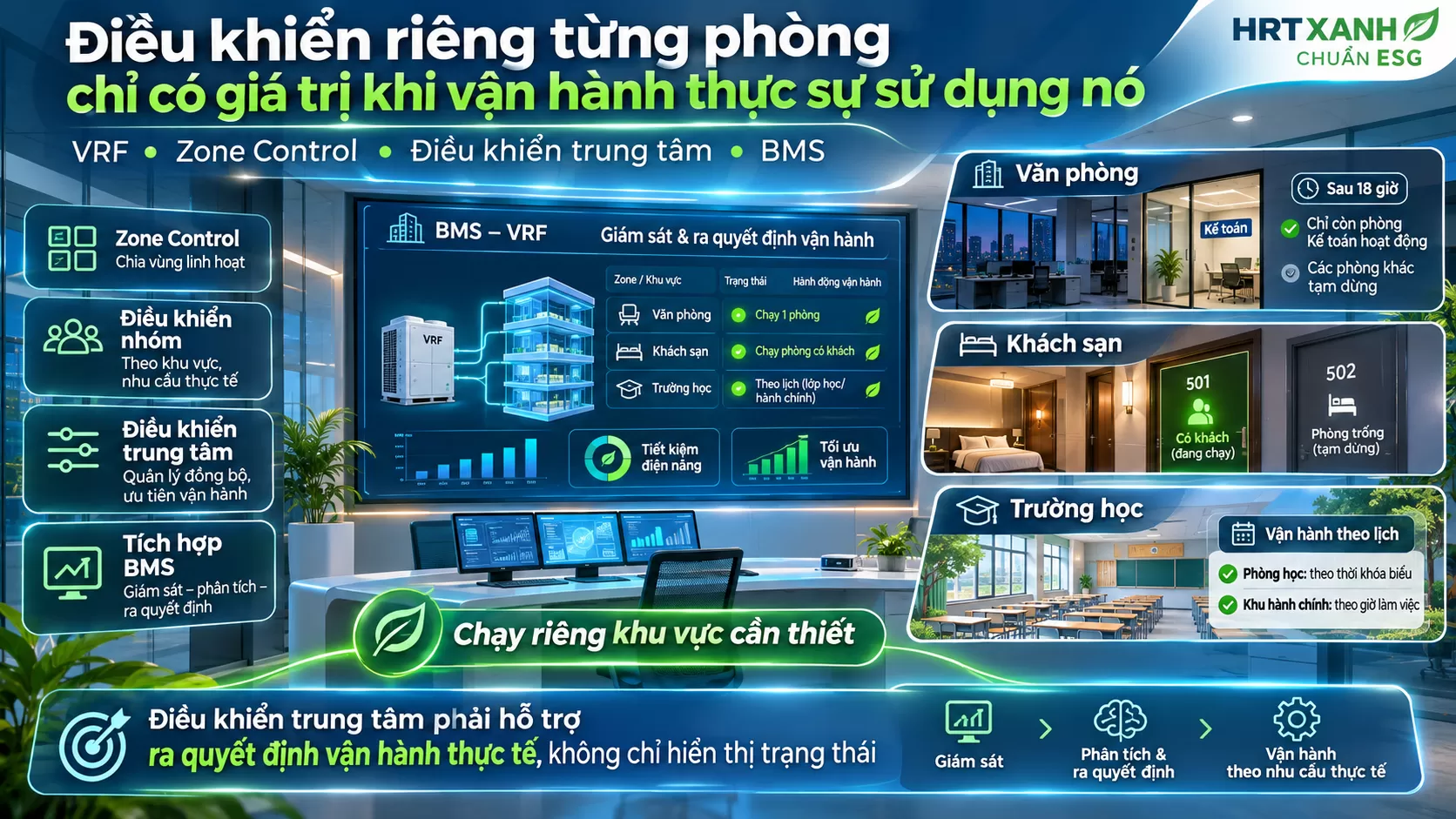
VRF can be deployed in each room, group, centrally and in multiple configurations that can be integrated with BMS. Daikin now provides zone-level to centralized control networks, operation scheduling support, fault monitoring and building management integration.
But I don't want the file to say:
“There is central control"
I want to know what that remote is for.
Example with office:
After 18 hours, only the accounting department works overtime. Will the system allow operation of this area without turning on the whole floor?
With hotel:
How are guest rooms and vacant rooms managed?
With school:
Can the classroom and administrative area calendars be separated?
If these capabilities were not included in the operation sequence, the VRF's control advantage would exist on the catalogue more than it does in practice.
I want BMS or central control to help the operator make decisions, not just help the screen with more icons.
When is the office suitable for VRF?
The office is a good example of multiple zones with different history.
A site may include:
Open office.
Meeting room.
Leadership room.
IT dept.
Training room.
The reception area.
Functional rooms.
If each zone has different loads and schedules, VRF's ability to control each zone has obvious value.
But before we close, I'm still asking for a test.
Outdoor air source.
Load the meeting room.
Outdoor unit location.
Pipeline.
Condensate.
Controls.
Space maintenance.
An office with multiple zones is signaled to look at the VRF.
It is not yet licensed to ignore the rest of the HVAC design.
Hotel with many rooms but should not use VRF for the whole building by default
Hotel rooms are a great example of zoned thinking.
Each room has its own history. The proportion of rooms with guests varies constantly. This is an environment where VRF's independent control can be effective.
But a hotel can also have:
Big Lobby.
Ballroom.
The restaurant.
Spa.
The conference.
Indoor pool.
These areas have loads and require different air handling than the bedroom altogether.
I don't want a building to be decided by the sentence:
“Hotel uses VRF”
The final solution may be a hybrid system.
VRF for the lounge.
AHU or other system for large concentration area.
PAU/DOAS for outdoor wind.
Ventilation and exhaust for functional zones.
It's important to assign tasks to each system.
A project may need multiple HVAC solutions that coexist. There is no requirement that the entire project uses a single technology.
Luxury villas may be suitable, but the tranquility and maintenance must be taken into account from the beginning
With villas, VRF is often considered when the project owner wants to:
Reduce the number of outdoor units.
Hide the indoor unit in the ceiling.
Control each room separately.
Centralized management.
Keep the outside of the building more compact.
These are reasonable advantages.
But with high-end housing, I'm particularly interested in noise and maintenance.
An indoor unit positioned directly above the bed can create problems even if the capacity is correct.
A condensate pump in an inaccessible location can make a small maintenance job a ceiling - breaking one.
A pipeline that is too complex can increase the construction risk.
Therefore, the system selection must be made with the interior, not waiting for HVAC design to be completed before grafting into the architecture.
The factory must separate the administrative area from the technological requirement
I often see the question:
“Can the factory use VRF?"
The answer needs to be a separation of the area.
Factory office, operating room, meeting room or some QC area can be suitable application.
But production areas with dust, high heat, oil vapor, chemicals or requirements for humidity control and cleanliness must be assessed according to the technological task. The original article of HRT also noted that VRF should not be extended from the office area to the entire production area.
Here, I want the production representative to participate in confirming the conditions.
HVAC needs human service or chain?
Is there a humidity limit?
Is there a filtering requirement?
Is there emission?
Is space a special pressure?
If those requirements are unknown, choosing VRF or Chiller is too early.
Outdoor Air is the part I don't allow to be forgotten.
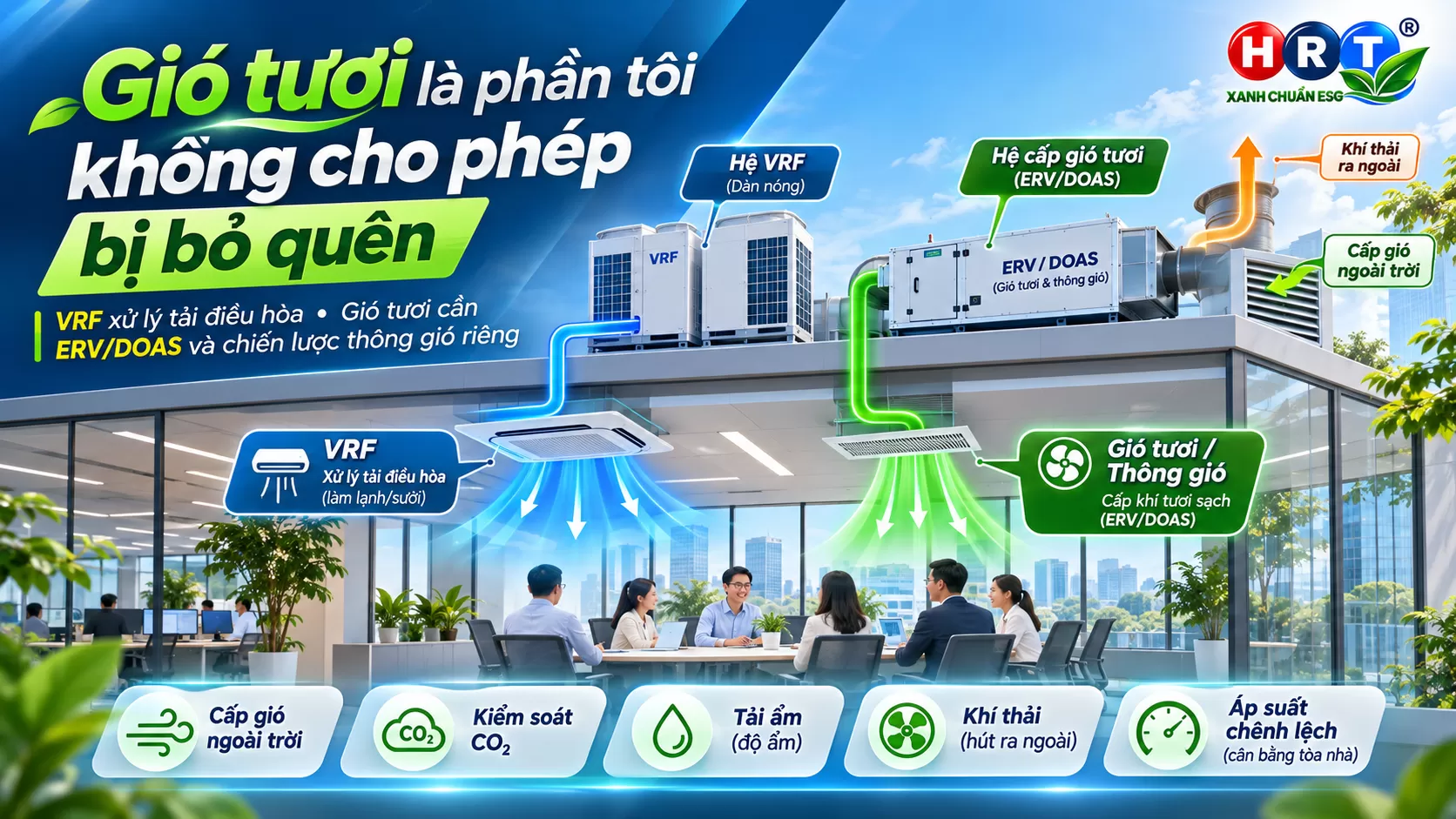
This is a mistake I want the project owner to pay special attention to.
VRF solves the load of air conditioning in the zone. It does not automatically replace the task of providing outdoor air.
Mitsubishi Electric Trane HVAC specifies that VRFs are not designed to provide ventilation air by themselves or always take full charge of dehumidification; ERV or DOAS systems are often coordinated for outdoor air handling.
So, just because a room is at 24°C doesn't mean that the air quality is good.
I would like the profile clarified:
How much outdoor wind is provided?
Which area is it to?
How is CO2 controlled in large numbers?
Where is moisture load from the outer wind processed?
Which way does the emissions go?
Do rooms require differential pressures?
For schools, meeting rooms, crowded offices, or hotels, this part is even more important.
Air conditioning and ventilation are related but not a task.
When do I not want to choose VRF?
If the building has only a few small rooms, I would ask to compare with the local system first.
If the load is very large, I would like to put Chiller or other HVAC solution on the comparison table.
If the project requires strict control of temperature, humidity, cleanliness and pressure, I will consider an AHU, PAU/DOAS or specialized processing system.
If there is no suitable outdoor unit location, I have not approved VRF despite the very nice power spreadsheet.
If there is no outdoor air solution, I have not seen the complete design.
These are also the groups of cases that the original HRT recommends not to rush to choose VRF.
I don't need a system that proves it can be installed.
I need a system that proves it... suitable for long-term operation.
Do not use the phrase “VRF saves electricity” as a sales commitment
Daikin identified zone-independent control and inverter as factors that support VRV's effective operation.
But I'm not using that to commit:
“Using VRF definitely reduces X% of power”
To talk about savings, there's a comparison.
Compared to what system?
Do you load the same thing?
Same operation schedule?
Do you have the same outdoor air requirements?
Is the setting temperature the same?
Power also strongly depends on how the operator uses the system after handover.
A well - zoned VRF system but with the whole building switched on from morning to night may not benefit from zoning.
Technology creates possibilities. The operation process determines how many of those possibilities become practically effective.
I want to decide that VRF comes after a real comparison.
In the HRT process, I suggest that we don't start with a single solution.
After surveying and calculating the load, put VRF next to the solutions that are really capable of meeting the project.
It may be:
VRF/VRV.
Chiller combined AHU/FCU.
Packaged or Rooftop.
Local system.
Combined solution.
The original HRT article also included system comparison into the survey sequence → performance analysis → load calculation → zone division → configuration selection → design → commissioning and handover.
In the comparison table, I want to see the same problem:
Ability to respond to loads.
Partition level.
Technical space.
Outdoor air.
Scalability.
Controls.
Maintenance.
Investment costs.
Expected operational costs.
Construction risks.
If an alternative is cheaper because it takes away some of the task, that's not fair comparison.
CEO's view Đoàn Văn Hoàng: I didn't choose VRF because of the system name
When approving a plan VRF central air conditionerI want to know why that system is so good for this project.
I want to see how the building works during the day.
I want to know which zones are divided by base.
I want to see cooling loads calculated by function.
I want to know how the outdoor unit will cool down and maintain.
I want outdoor air cleared.
I want the controls to be designed in a way that the operator actually works.
That's how I apply the spirit True – Clear – Dedicated.
Understand correctly needs and use pattern of the work.
Clearly about the mission of VRF and what systems to coordinate.
Dedicated follow up until the design, construction, commissioning and operation reflect the agreed plan.
VRF does not have to be an option for every building to be a good solution.
It just needs to be picked out in the right place.
To me, the last question is not:
“Is VRF good?"
It is:
“Is the VRF's characteristics consistent with how this project will operate in years to come?"
Exchange of VRF air conditioning options with HRT
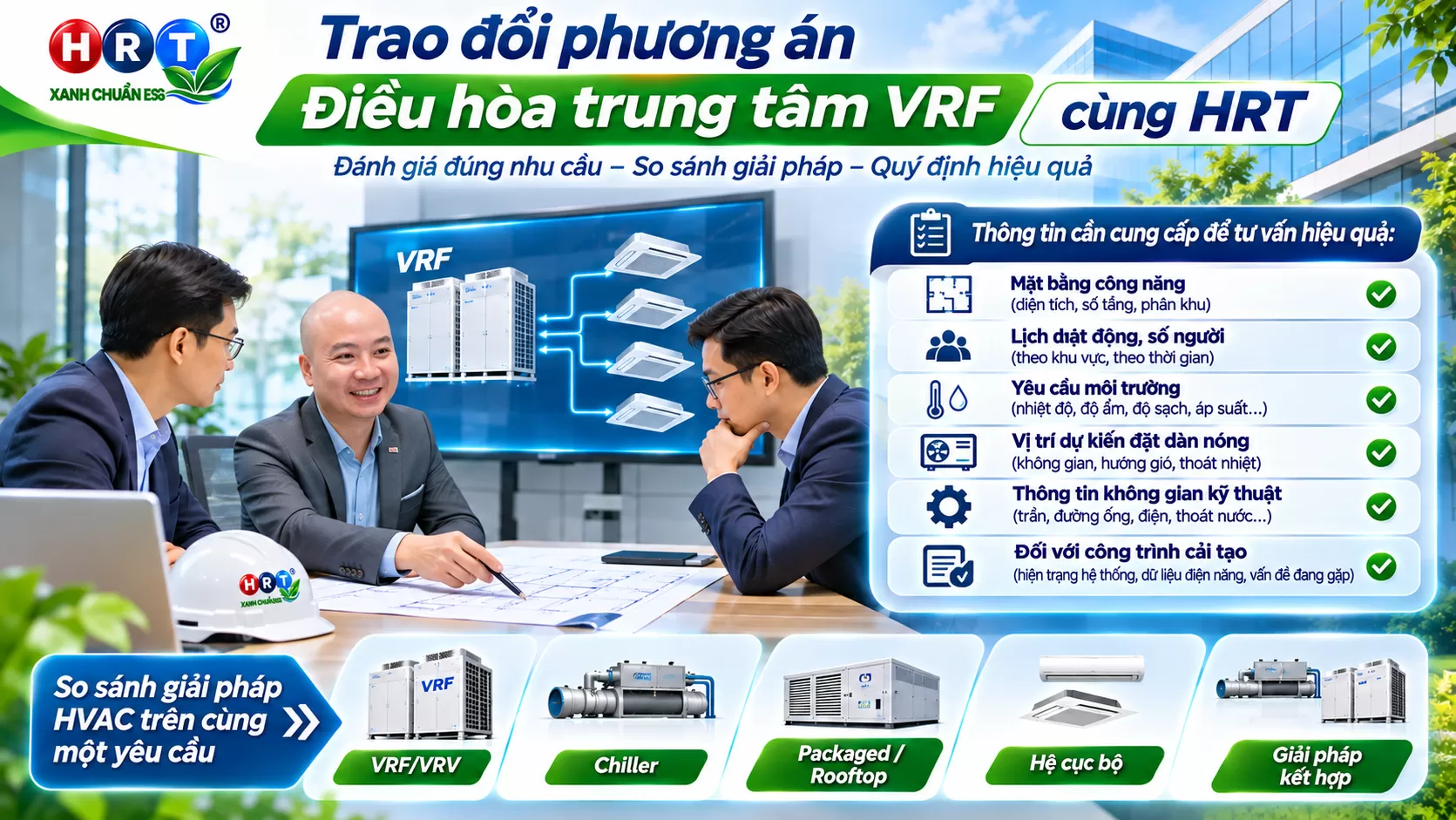
When preparing to choose the system, the project owner should provide the utility site, schedule, number of people, environmental requirements, expected location of the outdoor unit and technical space information.
For renovation works, the current status of the system, power data and problems are added.
From this data, the parties can compare VRF with other HVAC solutions on the same requirement before making an investment decision.
CEO Đoàn Văn Hoàng | HRT
Right from the beginning – Clear to the end – Sustainable Green.
HRT Contact: 0909 326 888
Post Tags: VRF central air conditioning, when to use VRF, VRF systems, VRV and VRF air conditioning, selecting an HVAC system, VRF for offices, hotels and villas, outdoor air for VRF, CEO Đoàn Văn Hoàng, HRT.
Source: Publisher’s English edition · Vietnamese original on doanvanhoang.com