
VRF Central Air Conditioning: When Should It Be Used For Construction?
Machine-translated from Vietnamese. Read the original in Vietnamese
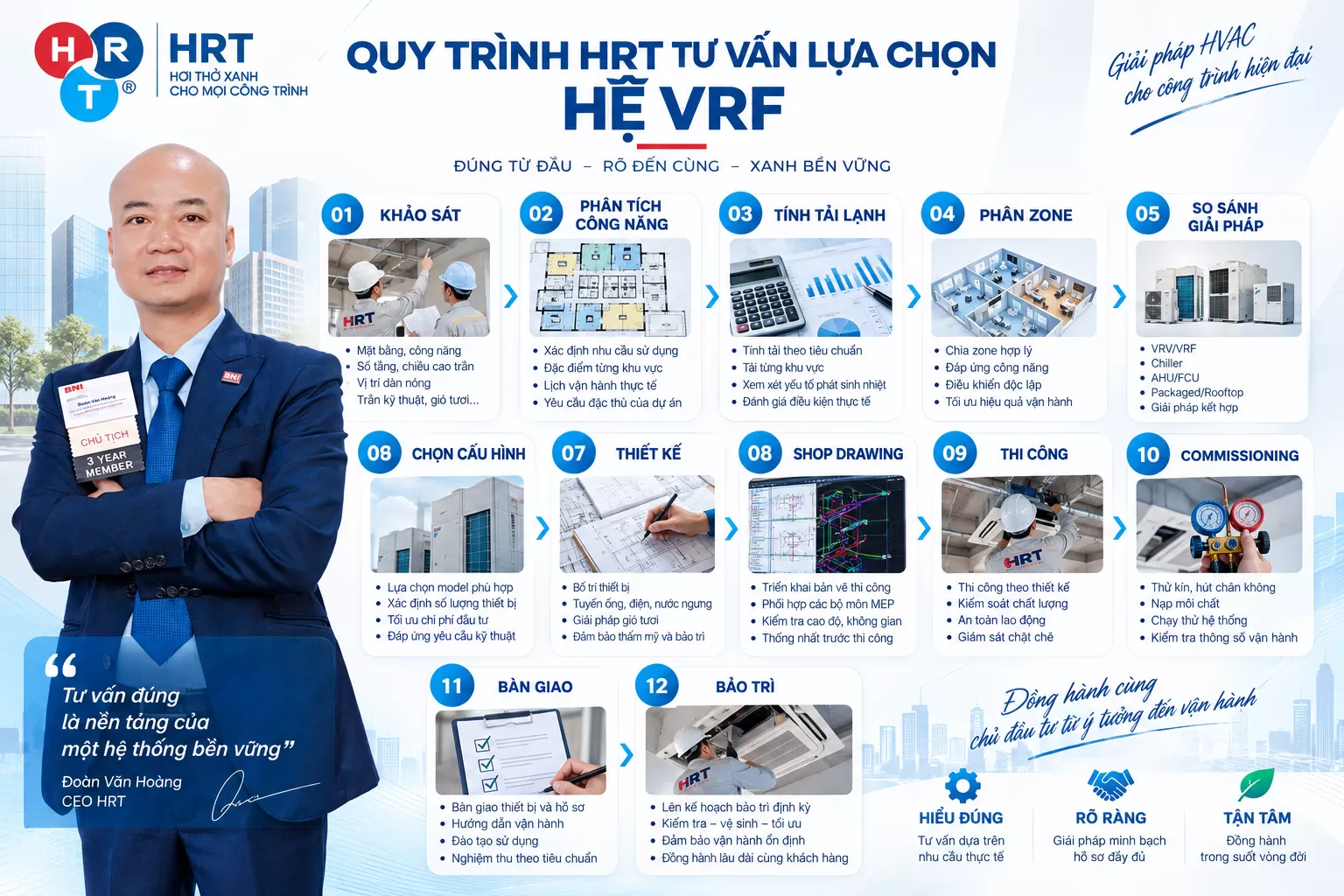
Central air conditioner VRF suitable for multi-room, multi-zone, variable cooling load and independent control. HRT analyzes when to use VRF and when to consider Chiller, Packaged or combined HVAC solution.
Central air conditioning VRF is not a big deal to use
Central air conditioner VRF is one of the HVAC solutions widely used for offices, hotels, villas, showrooms, schools and many commercial buildings.
The outstanding advantage of the system is its ability to:
- Serving multiple rooms from one or several outdoor unit clusters.
- Independent control by zone.
- Change the power according to actual load.
- System organization is more compact than multiple local machines.
- Flexible with many types of indoor unit.
However, the important question is not:
“Is VRF good?"
It should be:
“Is VRF suitable for this project?"
A suitable HVAC option should be evaluated across the chain:
Function → cooling load → zone division → usage time → outdoor unit location → pipeline → outdoor air → control → maintenance → operation cost.
Before choosing VRF, answer these 5 questions
This is a simple way for the project owner to determine whether VRF is worth including in the design plan.
1. Does the building have multiple independent operating areas?
If the works have:
- Director's office.
- Meeting room.
- The common office.
- IT dept.
- Functional room.
- The living room.
- Resting room.
And given that each region has a different history, VRF is worth considering.
2. Does cooling load change much during the day?
Example meeting room:
0 person → 5 person → 20 person
will have completely different cooling load needs.
Similar hotels:
Rooms are empty ≠ guest rooms ≠ lobby ≠ restaurant ≠ office.
VRF system is capable of adjusting capacity according to the needs of each area.
3. Does the project owner need to control each room separately?
If required operation according to:
Room → floor → area group → the whole building
then VRF has a greater advantage over many simple air conditioning systems.
4. Is the building eligible for outdoor unit?
Must be checked:
- Clear space.
- Intake and blow direction.
- Risk of hot wind return.
- Noise.
- Rung.
- Maintenance capability.
- Ability to transport replacement equipment.
Do not choose VRF before looking for outdoor unit.
5. How will the outdoor air system be solved?
This is a commonly overlooked issue.
Air conditioning is not synonymous with ventilation.
VRF handles cooling load in space but the work still needs evaluation:
Outdoor air → CO2 → moisture → exhaust → room pressure → indoor air quality.
When does VRF central air conditioning really take advantage?
VRF is especially suitable when the works have many factors below.
Multiple rooms – multiple zones
Example of a one - storey office with:
Open office + meeting room + directors' room + pantry + IT room.
Instead of turning the whole system on or off, each area can be controlled separately.
Cooling load changes over time
Morning low load but afternoon sunny.
Meeting rooms are sometimes unused but sometimes full.
VRF has good adaptability to this type of operation.
High aesthetic requirements
System can use:
- Concealed ducted indoor unit.
- Cassette bare.
- Wall mounted.
- Barefoot.
- Lay the floor.
This is advantage for:
Luxury office – hotel – villa – showroom.
However:
Hide the device but not the maintenance door.
Do not want the exterior of the building to have too many outdoor units
If each room uses a local air conditioner, the number of outdoor units can increase very quickly.
This affects:
- Exterior architecture.
- Noise.
- Maintenance.
- Electricity.
- Aesthetic.
VRF helps to organize outdoor unit more concentrated.
Works need to be managed in a centralized manner
The system can be organized according to:
Room control → group control → central control → BMS integration as needed.
This is a significant advantage with multi-function buildings.
7 signs that the work should consider VRF
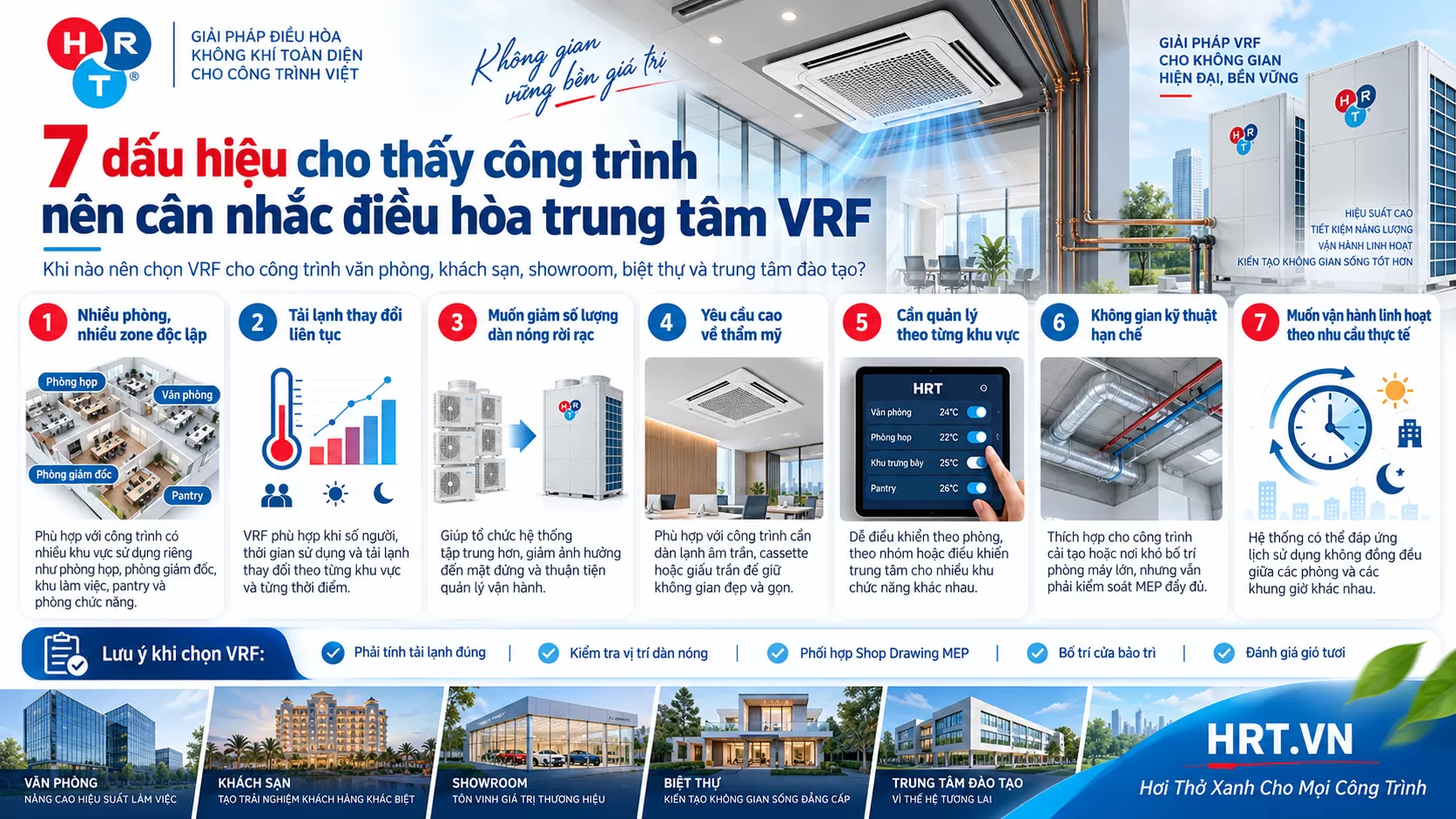
If the work appears most of the following signs, VRF should be included in the list of analysis options:
01. Multiple rooms, multiple independent zones
02. Cooling load continuous change
03. Want to reduce the number of discrete outdoor units
04. High requirements on aesthetics
05. Need to manage operation by each area
06. Limited technical space
07. Want flexible operation according to actual needs
Works that are often suitable for VRF
Offices
VRF is suitable for models with many different function rooms and hours of use.
For example:
Open office + meeting room + leadership room + pantry + IT room.
Hotel Location
Each guest room is almost an independent zone.
The rate of rooms used varies frequently, so the control by each area has a clear advantage.
However, large areas such as:
- Ballroom.
- Lobby.
- The restaurant.
- The conference.
may need AHU/PAU or combined HVAC solution.
Luxury Villas
VRF is suitable when required:
- Less outdoor unit.
- Nice furniture.
- Control each room.
- Ceiling-concealed indoor unit.
- Centralized management.
Showroom
Especially suitable when the showroom divides into multiple display areas and requires high aesthetics.
Cooling load must be sufficient:
Glass + light + people + equipment + sunshine direction.
Schools and training centers
Classrooms, teacher rooms, meeting rooms and administrative areas have different schedules of activities.
VRF may be suitable, but special characteristics are required outdoor air and CO2.
Office in factory
VRF can be suitable for:
- The office.
- Operations room.
- Meeting room.
- Administrative district.
But it shouldn't automatically apply to the entire manufacturing site.
There are 5 cases that should not be rush to choose VRF
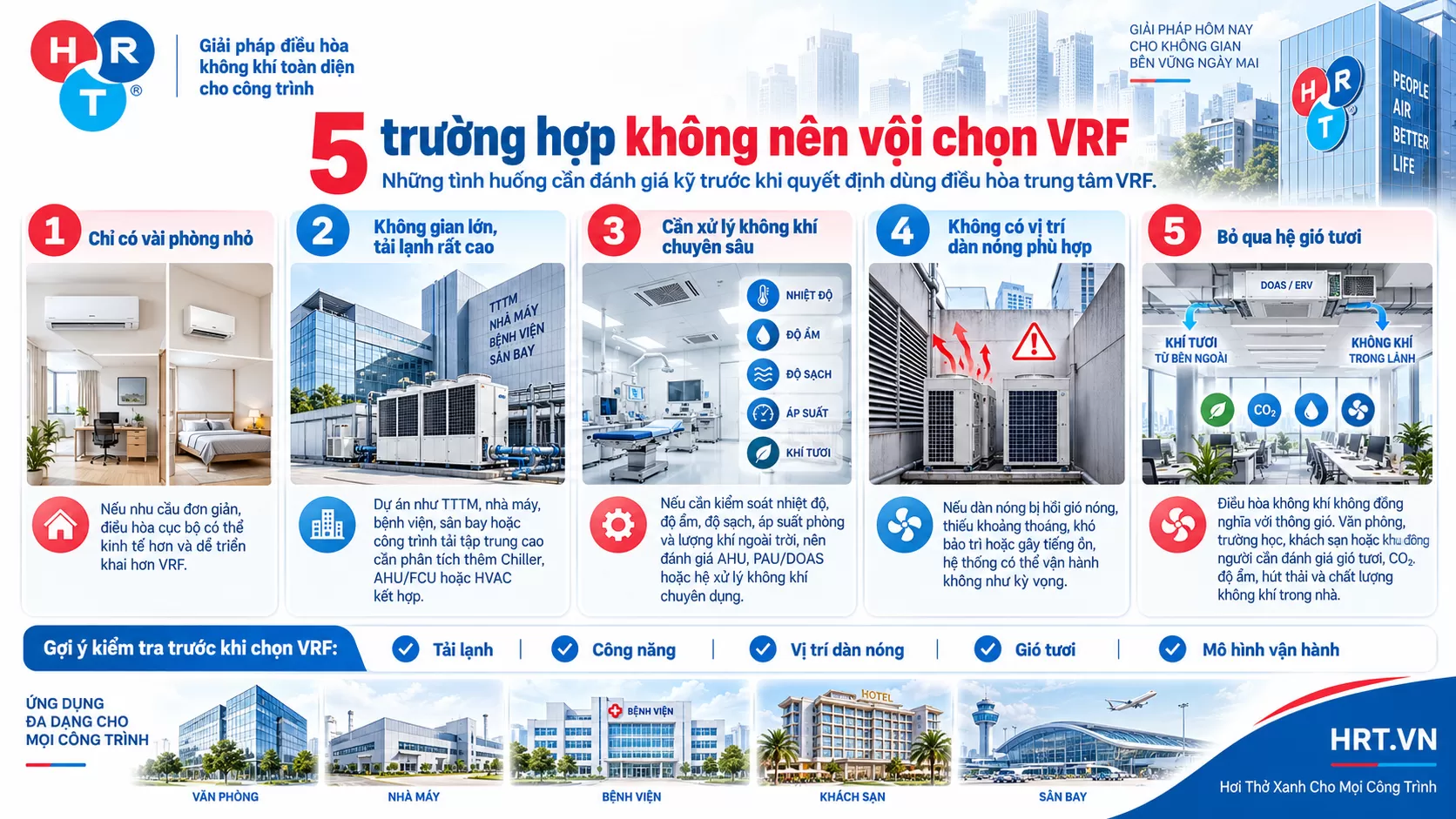
VRF has many advantages but is not the optimal solution for all projects.
1. Only a few small rooms
If the construction is simple, local air conditioning can:
- Easy to invest.
- Easy to install.
- Easy to replace.
- Lower initial cost.
It is not necessary to use a complex central system.
2. Very large space and high concentration cooling load
For example:
- Big commercial center.
- The factory.
- Hospital.
- The airport.
- The complex.
need further analysis:
Chiller + AHU/FCU + PAU or combined HVAC solution.
3. Works requiring intensive air treatment
If control is needed:
Temperature + humidity + cleanliness + room pressure + outdoor air intake
then VRF alone may not be enough.
Need further evaluation:
- AHU.
- PAU.
- DOAS.
- Filter system.
- Specialized air handling system.
4. No good outdoor unit location
If outdoor unit:
- Heat wave.
- Lack of ventilation.
- Difficult maintenance.
- Make noise.
- Hard to replace.
then the VRF option needs to be reconsidered.
5. Select VRF but ignore outdoor air
This is one of the most common design mistakes.
The space may be cold enough but still:
- Secret.
- CO₂ cao.
- The humidity is not suitable.
- Smells.
- Poor air quality.
VRF or Chiller: should not be compared by the question “which system is better?"
A system is considered good only when it fits the construction problem.
| Criteria | VRF | Chiller |
|---|---|---|
| Multiple small zones | Flexible | Can be done |
| Control each room | Advantageous | Via FCU and Controller |
| Transmission Line | Refrigerant | Cold water |
| Central Machine Room | Not as big as Chiller | Often Needed |
| Large loading space | Need to evaluate | Have advantages in many projects |
| AHU Air Handling | Need coordination | Advantageous |
| Renovation works | Can be flexible | Depending on the status quo |
| Hydraulic system | No cold water network | With pump, valve, water line |
Don't rely on area alone to make a conclusion.
Must analyze:
Cooling load + type of construction + operation time + control requirements + life-cycle cost.
Do not choose VRF just because you hear “save electricity”
VRF has the platforms to support efficient operation:
- Compressor variable-frequency drive.
- Adjust the power.
- Zoning.
- Turn off unused areas.
- Independent control.
But the actual electricity consumption also depends on:
Cooling load + installation temperature + construction shell + amount of glass + outdoor air + usage + maintenance + construction quality.
Therefore, it is not recommended to advise:
“Using VRF definitely saves X%”
if there is no specific model and comparative data.
6 common mistakes when project owners choose VRF
Select capacity by area
Do not rely solely on:
m2/HP or m2/kW.
Two rooms of the same area can still have very different loads.
No zoned from the beginning
If the zone is not appropriate, the system will be difficult to operate optimally.
Only interested in equipment prices
Must see total cost:
Equipment + materials + construction + electricity + operation + maintenance + repair.
Do not check the location of outdoor unit
This is a bug that can directly affect your ability to cool down.
No maintenance door layout
The ceiling device must still be accessible.
No outdoor air
This is a serious error for offices, schools, and crowded spaces.
HRT process of consulting VRF system selection
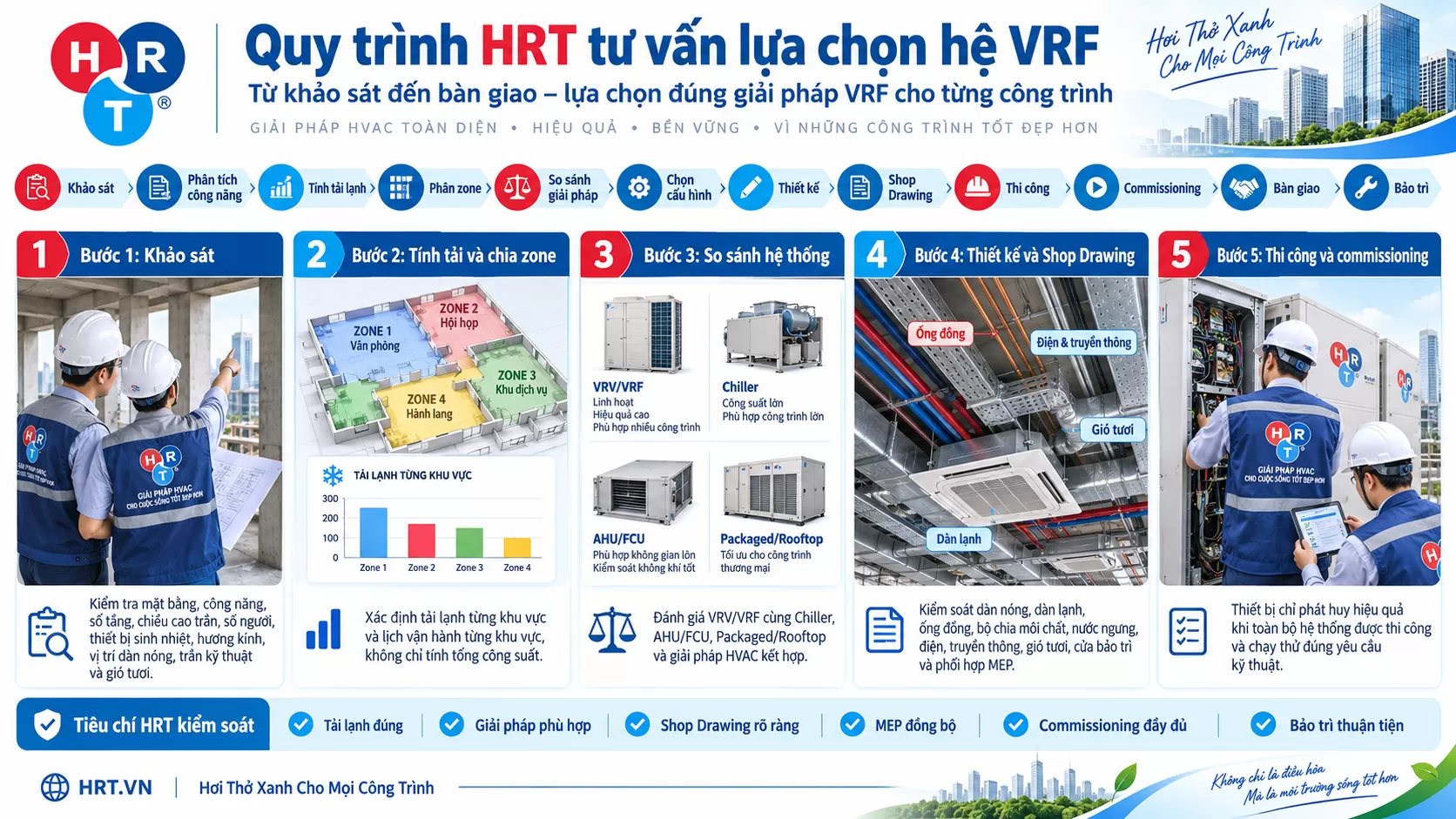
HRT does not begin with the question:
“Which brand do you want to use?"
Which begins with:
“What does the project really need?"
Process is controlled in series:
Survey → Functional analysis → Cooling load calculation → Zone division → Compare solutions → Select configuration → Design → Shop Drawing → Construction → Commissioning → Handover → Maintenance.
Step 1: Survey
Testing:
- The ground.
- Functional.
- Number of floors.
- Ceiling height.
- Number of people.
- Glass direction.
- Heat generators.
- Outdoor unit.
- Technical space.
- Outdoor air.
Step 2: Cooling load analysis
Don't just determine the total power.
Need to identify:
Load each room + load each zone + activity schedule.
Step 3: Compare HVAC Solutions
HRT simultaneous evaluation:
VRV/VRF – Chiller – AHU/FCU – Packaged/Rooftop – combination solution.
Step 4: Select configuration
Selection:
- Outdoor unit.
- Indoor unit.
- Capacity.
- Connection rate.
- Controls.
- Outdoor air solution.
Step 5: Design and Shop Drawing
Control:
Copper tubing + Refnet + condensate + electricity + communication + outdoor air + door maintenance + MEP coordination.
Step 6: Construction – commissioning – handover
Good equipment only works properly when the system is:
Proper construction → leak testing → vacuum evacuation → commissioning → commissioning → full handover.
VRF central conditioner should be selected from operation problem
A suitable VRF system not only helps the building reach the desired temperature.
The goal should be broader:
Comfort → flexibility → easy operation → easy maintenance → energy efficiency → sustainable.
Therefore, the choice of system should go in sequence:
Understand the work → calculate the right load → divide the right zone → choose the right system → design the right → construction the right → operation the right.
That's also why HRT pursues the principle:
Right From the Start – Clear To the End – Green Sustainable.
HRT – Consulting, designing and constructing VRV/VRF system
HRT implements solutions:
- Central air conditioner VRV/VRF.
- Water Chiller.
- AHU/FCU/PAU.
- Packaged/Rooftop.
- HRV/ERV.
- Ventilation.
- Outdoor air.
- Air duct system.
- BMS and controller.
- HVAC renovation and optimization.
Process:Consulting → Design → Supply → Construction → Commissioning → Maintenance.
CORRECT – CLEAR – CONSCIENT
Source: Publisher’s English edition · Vietnamese original on doanvanhoang.com