
VRV Central Air Conditioning
Machine-translated from Vietnamese. Read the original in Vietnamese

Offices and hotels have one thing in common: multiple rooms, multiple areas and constant cooling load changes.
In offices, meeting rooms may be used only for a few hours per day, while the common area operates continuously according to office hours.
In hotels, each room has a different usage time and temperature level. There are guest rooms, there are empty rooms; while lobby, restaurant, hallway, and conference rooms have completely different load characteristics.
What is VRV and how does the system work?
VRV stands for Variable Refrigerant Volume – Air conditioning system is capable of adjusting refrigerant flow rate according to the actual needs of each area.
In the HVAC industry, the term VRF – Variable Refrigerant Flow also used for the group of systems with similar principles.
Unlike local air conditioning, a VRV system can connect:
One or more outdoor units → refrigerant pipe system → multiple indoor units in the building.
Each indoor unit can serve one room or a separate area.
As a result, the system is suitable for works with:
- Multiple rooms.
- Multi-level.
- Various uses.
- Operation time is not uniform.
- Requires zone temperature control.
- High requirements for architecture and aesthetics.
What does a complete VRV system consist of?
Many people often think VRV system only includes outdoor unit and indoor unit. In fact, a complete system consists of many closely related components together.
Outdoor unit VRV
The outdoor unit is the center of the system, performing capacity adjustment and distributing refrigerant to areas in need.
Outdoor unit location should meet:
- Clear the air.
- Cools down well.
- No hot winds.
- Have enough distance maintenance.
- Minimize noise impact.
Indoor unit
Depending on the space can choose:
- Indoor unit cassette.
- Concealed ducted indoor unit.
- Indoor unit wall mounted.
- Indoor unit pressure ceiling.
- Indoor unit flooring.
Superior offices and hotel rooms are often preferred concealed ducted indoor unit when it comes to high aesthetics.
Refrigerant piping system
Pipelines must be properly controlled:
- The size.
- The length.
- High gradient.
- The solvent divider.
- The weld.
- Thermal insulation.
- Leak testing.
- Vacuum evacuation.
- Additional amounts of solvent.
Condensate drainage system
Condensate must be collected and safely drained.
If the design or construction is wrong, it may cause:
Small water – condensation – ceiling infiltration – interior effects.
Control system
VRV systems can be designed with:
- Control each room separately.
- Team control.
- Central control.
- Schedule your operation.
- BMS connection depending on the size of the building.
Why is VRV suitable for office?
Offices are often divided into several areas such as:
- Open workspace.
- Meeting room.
- Director's office.
- Training room.
- Pantry.
- Reception.
- Technical dept.
- Server room.
These areas have very different cooling loads and lifetimes.
If the entire office is designed as a large area, it is easy to appear the situation:
Hot place – subcooling place – unused room still must run air conditioner.
VRV allows partitioning according to actual needs, thereby making it more convenient in management and operation.
Advantages when changing premises
Offices regularly need:
- Split up the rooms.
- Move the meeting room.
- Change the number of employees.
- Change the layout.
If the system is well calculated and designed from the beginning, the renovation of the latter will be more favorable.
Why is VRV suitable for hotels?
Hotel require very high independent control.
Each room can:
- With or without guests.
- Use at different times.
- Different temperature setting.
Meanwhile, areas such as:
Lobby – Restaurant – Lobby – Meeting Room – Spa – Service Area
It's a completely different operation.
VRV facilitates the division of the system into multiple zones instead of a whole building operation.
What priority do you need for a hotel bedroom?
HRT is often concerned with four factors:
Smooth – Enough refrigeration – Not blow directly into the bed – Easy maintenance.
Concealed ducted indoor unit is often a suitable option because it can be actively designed the level mouth and rewind position.
However, the calculation must be accurate:
- External static pressure.
- Air duct length.
- Pressure drop.
- Air outlet location.
- Maintenance visit door.
VRV air conditioner does not replace outdoor air system
This is a point that can be easily misinterpreted.
Air conditioning is not synonymous with ventilation.
The VRV system mainly performs the task of handling thermal load.
Meanwhile, the office and hotel must also take care of:
- The air is outdoors.
- CO₂.
- Moisture.
- Smells.
- Suctioning waste.
- Air purification.
- Room pressure.
Depending on the project, it may be necessary to combine VRV with:
HRV – ERV – PAU – DOAS – outdoor air supply and exhaust system.
Especially for meeting rooms, hotel bedrooms, restaurants or offices with high density of people, outdoor air should be calculated right in the design stage.
8 factors that determine a good VRV operation
A VRV system should not be selected solely based on brand or nominal power.
Multiple technical factors should be considered simultaneously.
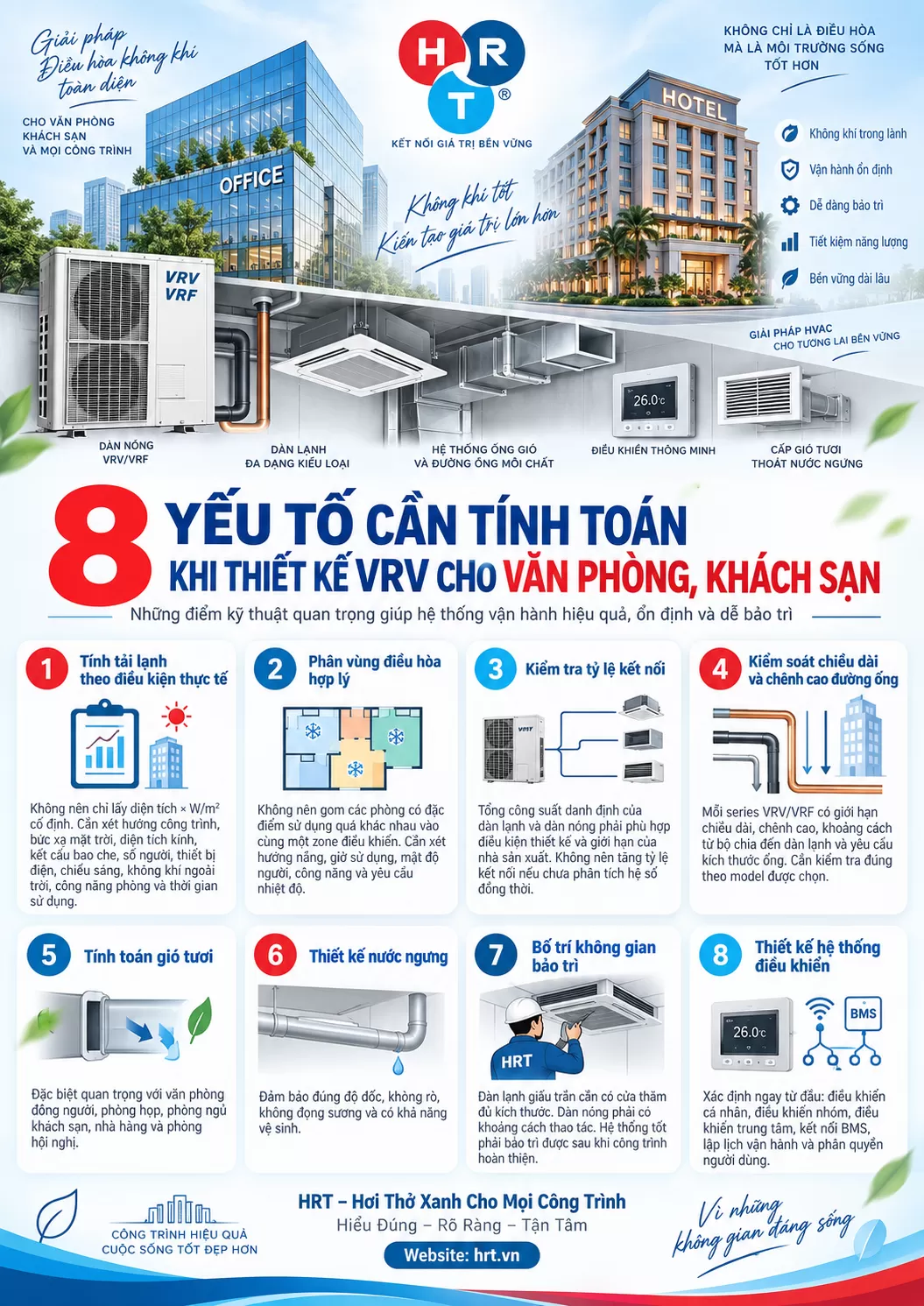
1. Correct cooling load calculation
It is not recommended to simply use the formula:
Area × a fixed coefficient = machine power.
Cooling load also depends on:
- Direction of the building.
- Glass area.
- Solar radiation.
- Covering structure.
- Number of people.
- Equipment.
- Illuminate.
- Outdoor air.
- Time of use.
Two rooms of the same size don't necessarily need the same wattage.
2. Air conditioning zoning
Rooms have:
- Different sunshine direction.
- Different functions.
- People are different densities.
- Different usage time.
should not arbitrarily be assembled into a control zone.
3. Connection ratio test
Total capacity of indoor unit connected to outdoor unit must be within the technical limits of the manufacturer and suitable diversity factor of the building.
4. Pipeline length and height difference control
Each VRV/VRF series has its own regulations on:
- Total length of pipe.
- The length is equivalent.
- High gradient.
- Distance from splitter to indoor unit.
- Pipe size.
5. Calculation of outdoor air
This is important for:
- Offices are crowded.
- Meeting room.
- Hotel suite.
- The restaurant.
- The conference room.
6. Condensate drainage design
Basic requirements:
Correct slope – no leakage – no condensation – easy to clean.
7. Leave space maintenance
Ceiling-concealed indoor unit must have full sized visit door.
Outdoor unit must also have technical operation space.
8. Control design from the beginning
Need to identify:
- Personal control.
- Team control.
- Central control.
- Set a schedule.
- Connect BMS.
- Decentralize operations.
Errors that make a good VRV system still work poorly
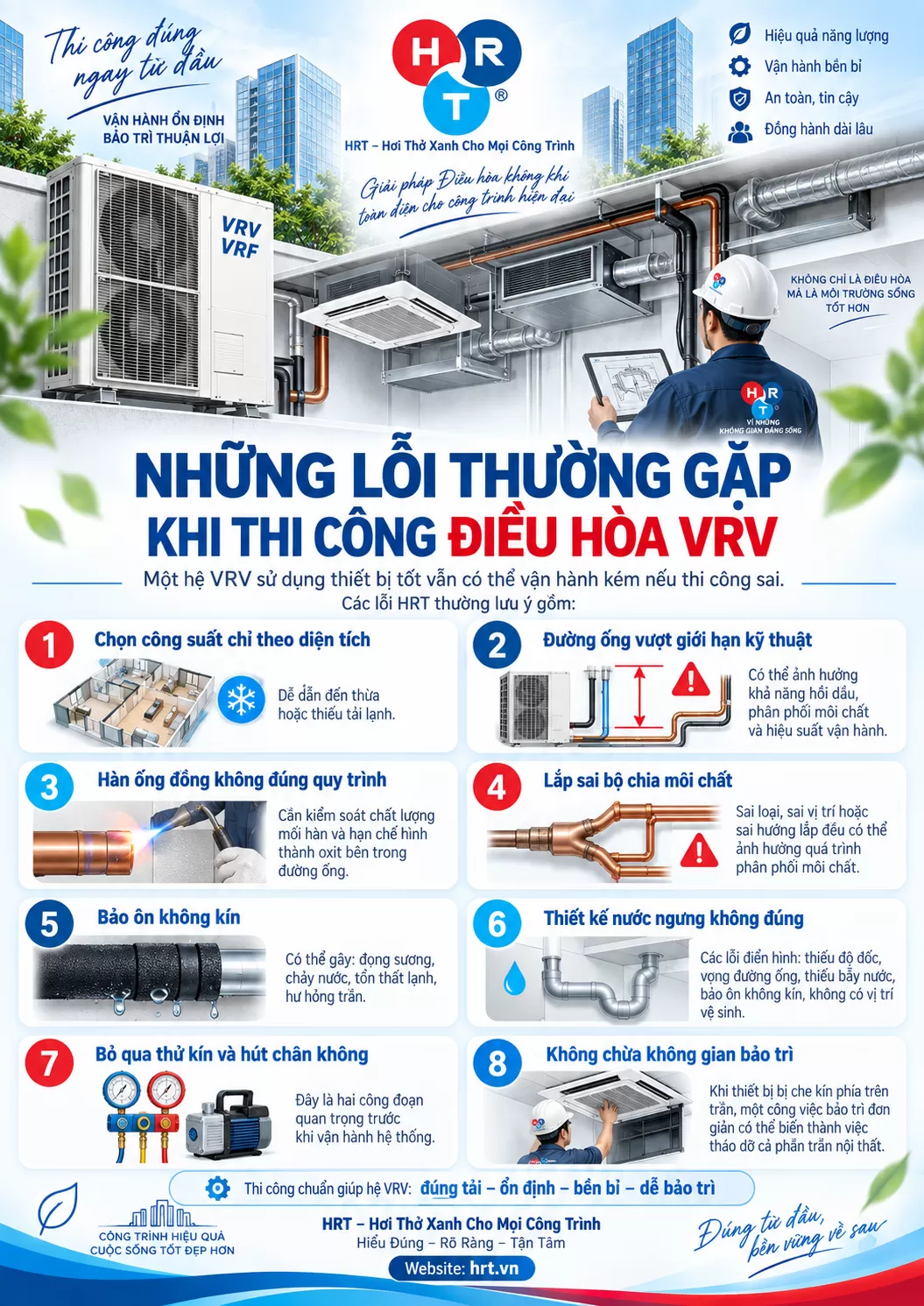
Good equipment can not compensate for a wrongly designed or constructed system.
Common errors include:
Select power by area only
May result in excess or lack of load.
Pipelines beyond technical limits
Effect on the ability to distribute the solvent, oil return and operation efficiency.
Welding copper tubing improper process
The welding must be controlled to limit the oxide and impurities inside the system.
Incorrectly installed solvent divider
The wrong type, direction, or location can all affect the distribution of the solvent.
Thermal insulation non sealed
May cause:
- Condensation.
- Flowing.
- Heat loss.
- Damaged ceiling.
Incorrect condensate exit
Some common errors:
- Lack of slope.
- Hammocks.
- Lack of water traps when needed.
- Thermal insulation is not sealed.
- There's no toilet spot.
Ignore leak testing and vacuum evacuation
These are two important steps before putting the system into operation.
Leave no maintenance space
Equipment that is covered in ceiling can cause a small maintenance job to remove the interior.
VRV or Chiller – which is the right solution?
It should not be assumed that VRV is always better than Chiller or vice versa.
VRV is suitable when
The works have:
- Many separate rooms.
- Load changes.
- Flexible joystick.
- Limited technical space.
- Demands operation each independent area.
Chiller worth considering when
Works:
- There's a big cooling load.
- Focused activity.
- Have the right technical space.
- Requires centralized cold water HVAC.
- Use AHU/FCU on a large scale.
So the correct problem should be:
Which option is best suited for cooling load, architecture, functions, investment and life-cycle cost of the building?
VRV deployment process at HRT
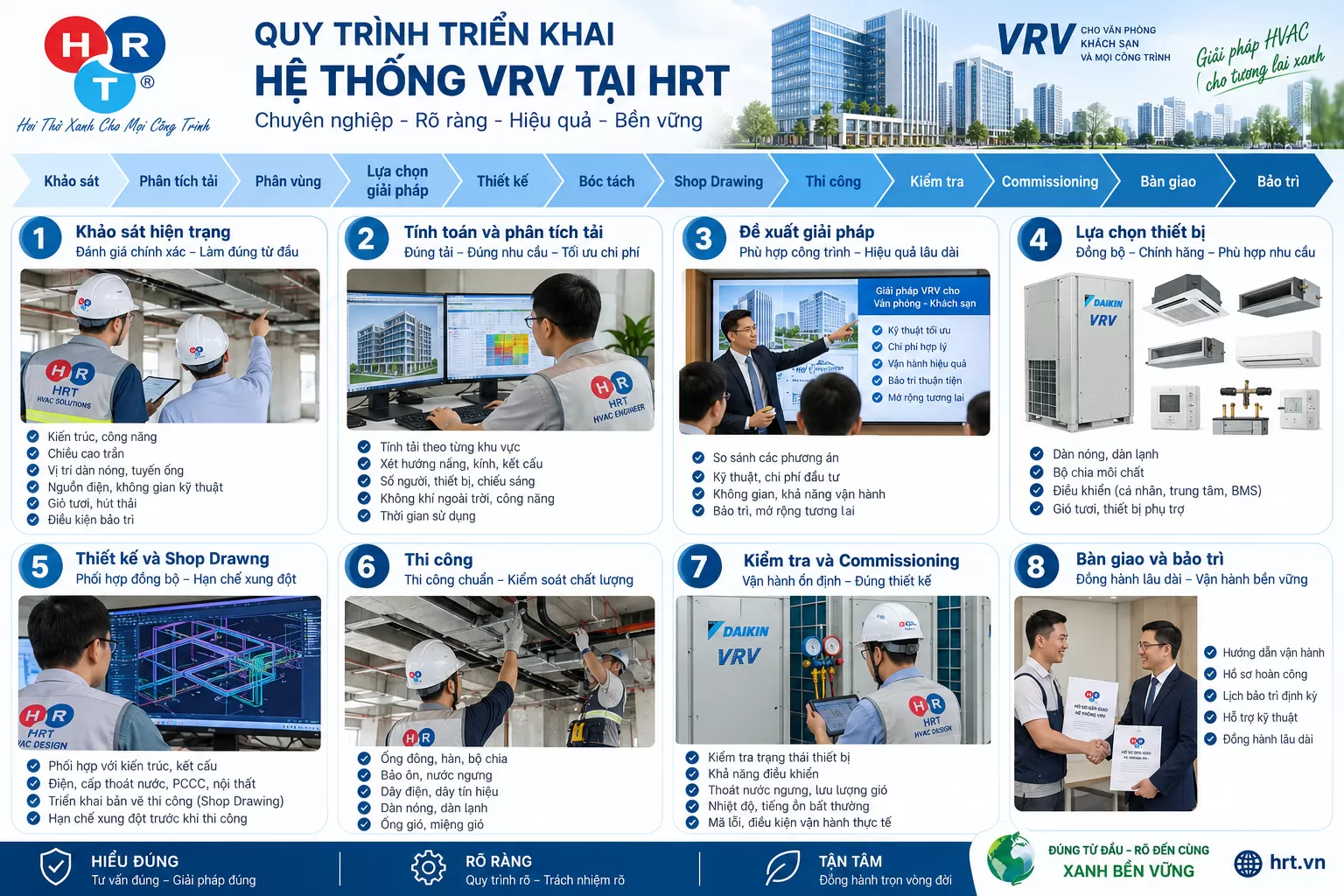
HRT did not start the project with the question “How many HPs to install?"
The process is implemented in a series:
Survey → Load analysis → Partitioning → Solution selection → Designing → Separation → Shop Drawing → Construction → Inspection → Commissioning → Handover → Maintenance.
Step 1. Survey of current conditions
Testing:
- Architecture.
- Functional.
- Ceiling height.
- Outdoor unit location.
- Pipeline.
- Power supply.
- Technical space.
- Outdoor air.
- Suctioning waste.
- Maintenance conditions.
Step 2. Calculate the load
Cooling load is analyzed by each area instead of just taking the total area.
Step 3. Propose solutions
Compare:
- Technical efficiency.
- Investment costs.
- Space.
- Operation.
- Maintenance.
- Scalability.
Step 4. Select your device
Determine:
- Outdoor unit.
- Indoor unit.
- The solvent divider.
- Controls.
- Outdoor air.
- Auxiliary equipment.
Step 5. Design and Shop Drawing
HVAC Coordination with:
Architecture – Structure – Electricity – Water Supply and Drainage – Fire Protection – Interior.
The goal is to limit conflicts immediately before construction.
Step 6. Construction
Synchronous Control:
- Copper tubing.
- The weld.
- Splitter.
- Thermal insulation.
- Condensate.
- The wires.
- Signal wire.
- Outdoor unit.
- Indoor unit.
- Air duct.
- Air outlet.
Step 7. Inspection and Commissioning
Shouldn't watch the... “the machine was running cold” is the system completed.
Need to check:
- Device status.
- Control ability.
- Condensate.
- Airflow rate.
- The temperature.
- Noise.
- Error code.
- Actual operation conditions.
Step 8. Handover and maintenance
HRT hand over records, provide operation instruction and develop periodic inspection plan to maintain the system stability throughout its life cycle.
When should I invest in a VRV system?
VRV is especially worth considering when the project has:
- Multiple rooms or multiple zones.
- Independent operating areas.
- Cooling load transform.
- High aesthetic requirements.
- Limited outdoor unit space.
- Centralized management needs.
- Ability to change or expand in the future.
However, the final solution should still be decided after surveying and analyzing actual load.
How does HRT approach the VRV system?
HRT considers air conditioning system as part of living and working environment, not merely a cooling device.
So a VRV solution needs to simultaneously solve:
Temperature + outdoor air + humidity + wind distribution + Control + Noise + Energy + maintenance.
HRT is implemented according to three values:
Understand - Clear - Dedicated.
From survey, design, equipment supply, construction, commissioning to maintenance, the objective is:
Right From the Start – Clear To the End – Green Sustainable.
HRT – Green Breath for All Buildings
Website: hrt.vn
Conclusion
A good VRV system is not determined solely by the brand name or outdoor unit capacity.
The actual effect comes from a whole series:
Right load calculation → Right partitioning → Right equipment selection → Right design → Standard construction → Full commissioning → Convenient maintenance.
For the Office And Hotel, which is even more important because of the cooling load, the number of people and the time of use are constantly changing.
HRT towards an HVAC system not only enough cold, but also to:
Easy operation – Easy maintenance – Stable – Effective – Sustainable.
Source: Publisher’s English edition · Vietnamese original on doanvanhoang.com