
VRV condenser water drainage error: Handling from cause | HRT
Machine-translated from Vietnamese. Read the original in Vietnamese
CEO Đoàn Văn Hoàng – HRT share how to identify the cause and handle indoor VRV drainage failure, from leakage source testing to acceptance testing after repair. Do not conclude completion just because the ceiling is dry; confirm by actual test results.
VRV indoor unit drainage error: Do not hand over just because the ceiling is dry
Imagine a situation: late in the afternoon, water drips from the ceiling-concealed indoor unit. The engineering team goes to clean, clear the drain, dry it and put the machine back on. At the time of inspection, no drops of water appear.
The next morning, the building opened. Near noon, the blot came back.
Here's a scenario that illustrates the question I want to ask when viewing repair reports: Have we identified the cause, or have we made the phenomenon temporarily disappear?
With... indoor unit VRV drainage error, I don't want to conclude completion solely on whether the machine has run or the ceiling has dried. I want to know where the water arises, where the outlet is checked to and what conditions the post-treatment result has been confirmed under.
That's how I approach my work from an HRT executive perspective: troubleshooting must come with technical grounds, implementation responsibilities and clear handover conditions.
The blot is the beginning, not the end.
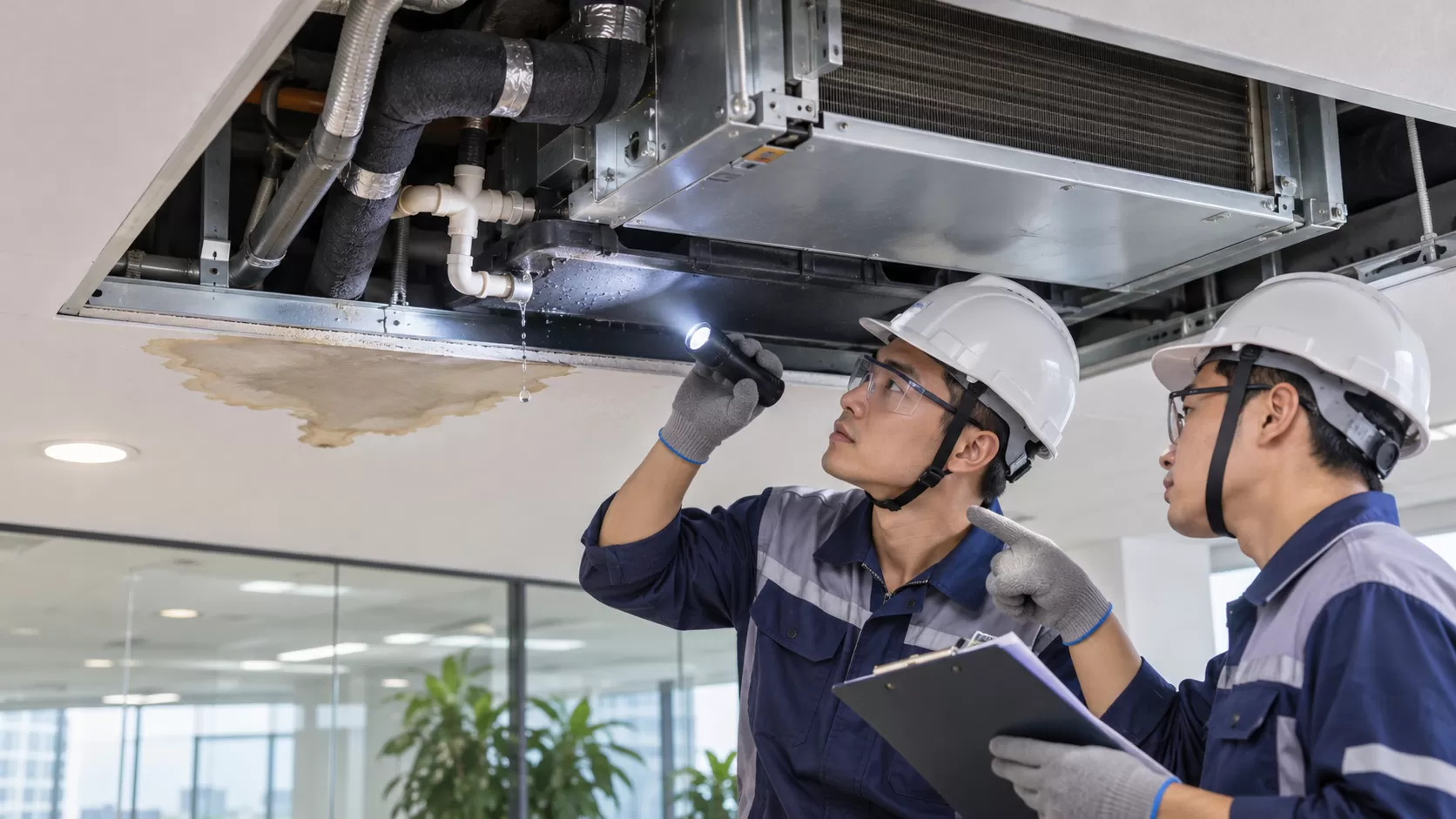
When receiving indoor unit VRV water runoff reflection, the first thing I suggest is to control the affected area. If the water appears near the electrical or ceiling parts with signs of unsafety, it is necessary to stop the operation, organize the isolation of the source according to the procedure and assign specialized personnel to inspect. Don't continue running the water cycle just to see if it runs any more.
After ensuring accessibility, the technical team should identify water sources before selecting a repair plan.
Water spilling from the trough is different from water that is sitting on a cold surface
A leaky pipe connection and a non-sealed insulation site may produce droplets, but the remedy is not the same. Daikin FXSQ-A installation documentation requires insulating the fluid pipe to the connection sites, while also insulating the condensate line indoors to limit condensation on the surface.
So I want the tester to describe what he's seeing: rising water in the trough, draining at the junction or forming outside the insulation?
If these phenomena are not yet distinguished, the proposed “drain pipe” is still a treatment hypothesis.
In the recording step, capture the right point of water appearance, not just wet ceiling plate. Record additionally the time of generation, indoor unit code and operation status. If there have been recent changes to the ceiling, pipeline or maintenance work, that information should also be included in the record for comparison.
I need a description that's clear enough for someone who's not on the scene to understand what the tech team is looking at.
To find the right fault, you have to look at the water.
After determining the water derived from condensate collection and drainage systems, the test range should be expanded according to the actual route.
Dirt and foreign objects can hinder the drainage. However, folded pipes, lack of slope or cracked water collector chute can also cause water leaks. So dirt detection is not enough to rule out other abnormalities in the same system.
Just because a tube is cleared doesn't mean we have a full line check.
I asked the engineer in charge to clearly identify where the water from the indoor unit is going, through which passages and enter into the general route at which location.
If the pipeline is only checked near the machine, the record must specify that range. The result of a short passage should not be used to confirm the entire exit route.
With multiple indoor units connected to the collection line, I want the drawing or site plan showing the related branches. Daikin's instructions also require selection of collection pipe sizes suitable for the connected equipment.
Suppose in the opening situation, the technical team detects a sagging pipe behind the entrance. Then, the work to be done no longer stops at cleaning. It must assess the way of supporting the pipe, the altitude and adjustment plan, then re-examine the affected gland.
This is why I'm asking for a full report. abnormal position and... Tested range, instead of just writing "unswitched".
Slope must be measured, not concluded visually
For example, the Daikin FXDA-A document specifies that the drainage section should slope down at least 1/100, or 10 mm in height per meter. The document also specifies how to arrange the water lift when pumping. These requirements must be compared with the correct model and installation configuration.
At the site, I want the test results to show the pitch and position to be adjusted. A comment such as “the pipe seems to be still steep” is not enough as a basis for acceptance testing.
If the repair plan must change the route, immediately identify which section needs to be updated on the as-built drawing. The maintenance person should later know how the pipeline was repaired, not continue to look from scratch.
Do not fix the pipe slope by arbitrarily tilting the indoor unit
The slope of the exit route and the balance when suspending the equipment are two different requirements.
With the FXSQ-A series, Daikin requires a balance test at four angles, and warns that tilting may affect float switches and cause water to drip. Therefore, it cannot be assumed that tilting the machine toward the outlet is a suitable treatment for every indoor unit.
I recommend that any adjustments related to the suspension rod, machine position and connection altitude should be grounded in equipment documents. Construction experience should be verified, should not replace the manufacturer's requirements.
A3 code helps orient the test, not the pump replacement order
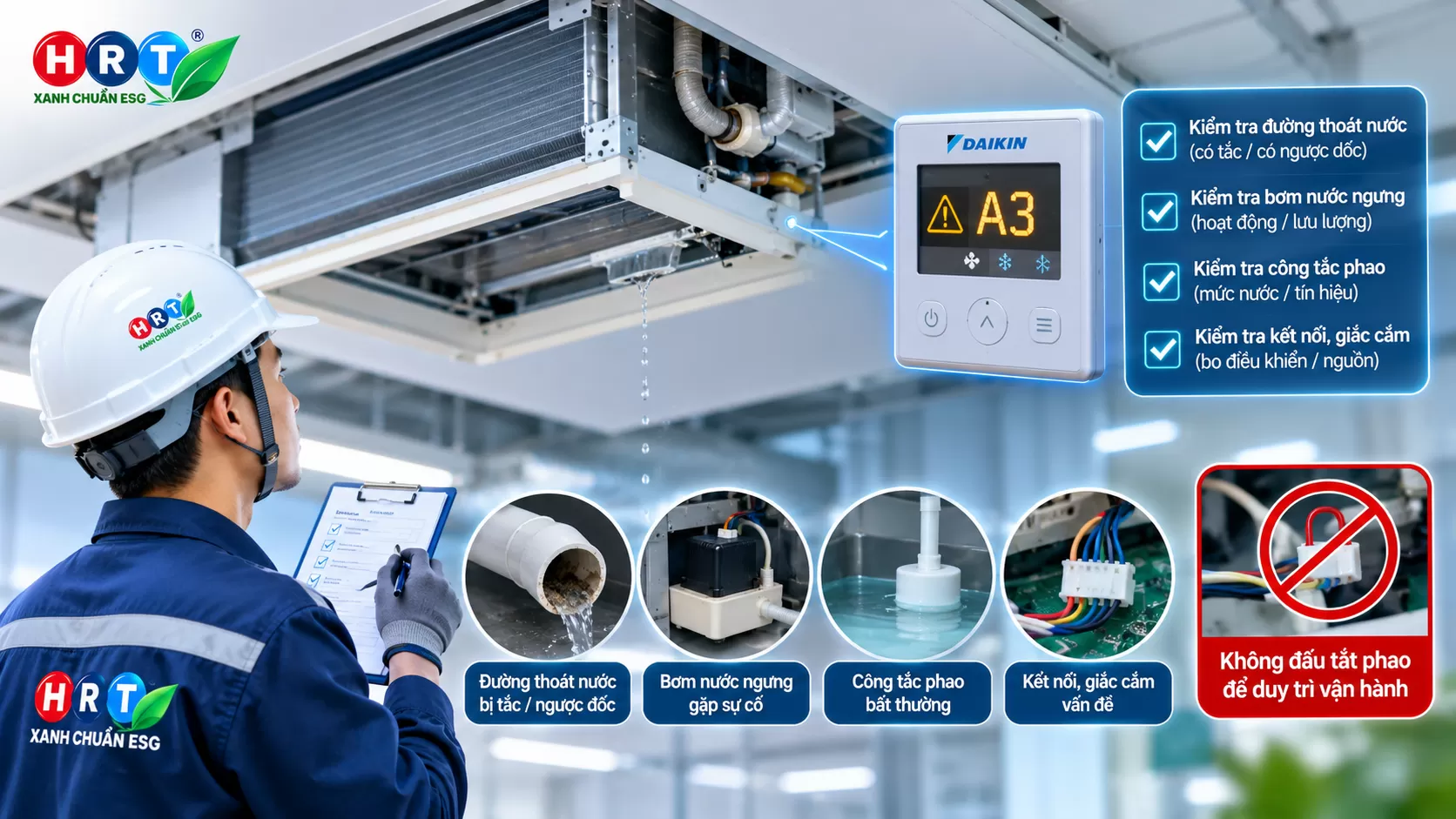
When the control screen appears error code, the technical team has more information to zone. But the error code is not yet conclusive about the components to be replaced.
Daikin Vietnam described A3 as an abnormality of the flushing system. The reasons mentioned include clogged or upside down drains, faulty pumps, abnormal float switches and problems at the connector.
Therefore, with the condensate pump replacement proposal, I want the person in charge to explain: what signs indicate that the pump is broken, how the outlet has been checked and what test results support the conclusion?
The VRV X service document also includes the power supply, connection, float, pump, outlet and control board into the diagnostic range A3 for the specified models. The test measurement must be in accordance with the document, performed by professional personnel in a safe condition.
Same display code still needs to match the machine line
With AF, it is even more advisable not to take an on-line explanation to apply to every system. The Daikin Vietnam lookup table describes AF associated with humidification systems, while the VRV X document has a control sequence that appears AF associated with float status and drainage abnormalities. Confirm model, accessories and service documentation before conclusion.
What I need in the report is a link between the code that's displayed, the actual state of things and the test results.
If you don't have enough data, write “no cause identified” and indicate that further investigation is needed. This is more valuable than a firm conclusion but lacks evidence.
Do not switch off the float to maintain operation. Disabling the water level monitor is not a fix for an overflow.
The correction must match the proven cause
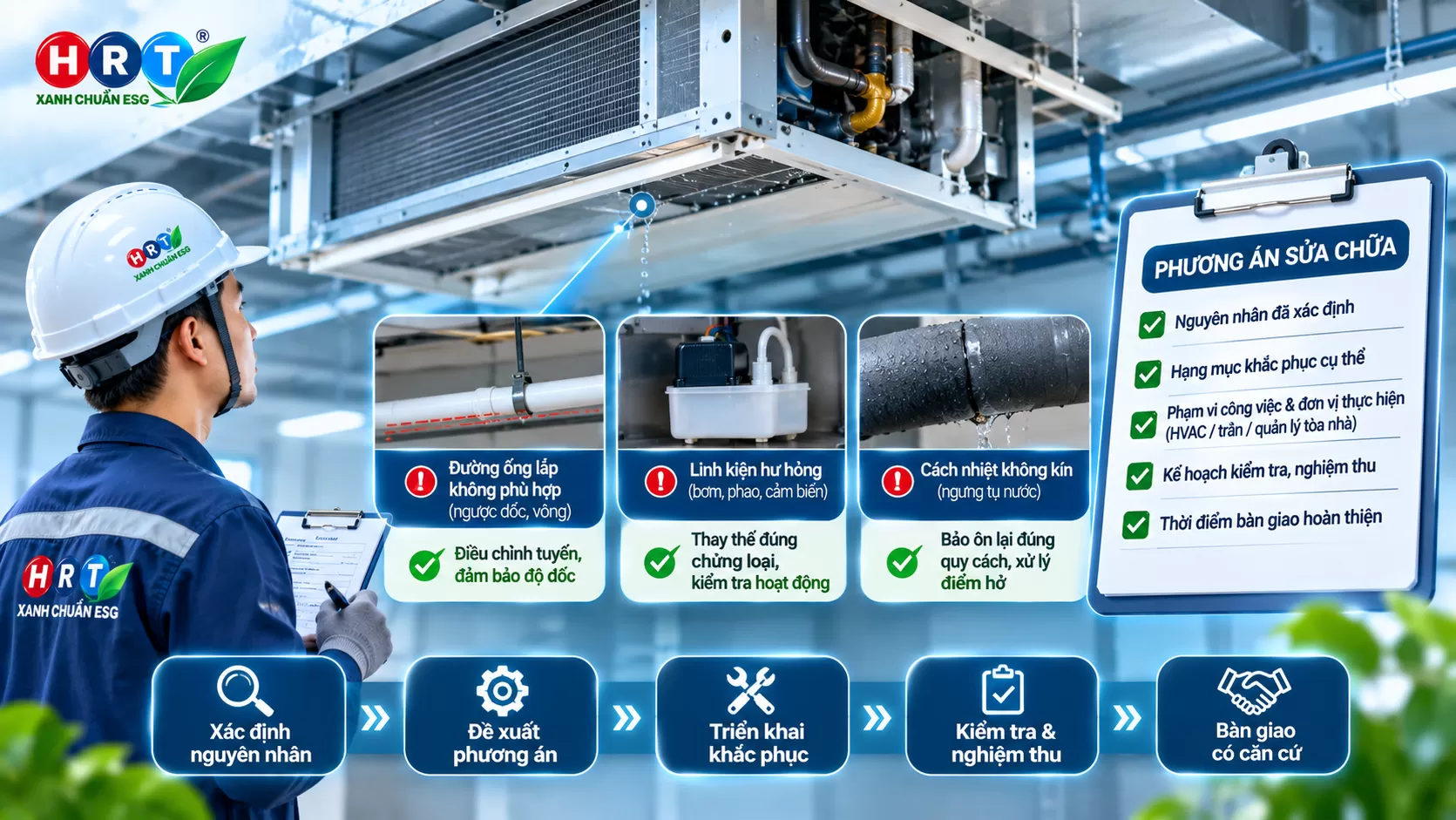
From a work approval perspective, I would like to propose fix that answers one question: What confirmed abnormalities have this intervention handled directly?
If the cause is determined to be inappropriate pipe fitting, the plan should show the adjustment of the line and how to re-check. If the conclusion of damage lies in the components, the dossier should have grounds for spare parts selection. If the water source comes from the insulation position, the work must focus on the relevant insulation.
It is not recommended to include all cases in a general description such as "cleaning, treating water runoff”.
I also recommend separating the troubleshooting from the finishing restoration. Waterway repair and ceiling repair are related in progress, but repainted ceilings should not be used instead of technical inspection results.
In the browser option, specify which work is on the HVAC team, which work needs to be coordinated with the ceiling team or building management unit. The coordinator needs to know when the finishing is coming back and who confirms that condition.
For unreachable locations, survey limits should be specified. I don't want a report that says “all worked out” while there is still untested route.
Approving repairs is approving a well - grounded solution, not just agreeing to a list of supplies.
When can I confirm that the VRV indoor unit drainage failure has been dealt with?
I want the conditions of completion agreed before the engineering team starts to correct, instead of just discussing it at the time of signing.
Drainage test should be according to the procedure of the equipment
The FXDA-A guideline contains the content of water leakage testing and distinguishes the test according to the condition of the system is complete installation or not. Therefore, the amount of water put in, test location and operation status should comply with the equipment's documentation, do not choose a common way to do it for every indoor unit.
During the test, I suggested that the engineer confirm the observed range: from the collection trough, outlet, the connections related to the discharge point are within the acceptance testing range.
The result should tell you where the water has gone, if there has been a leak or spill during the test, and what other items need to be verified.
If the machine has a pump and float, the test of related functions must be carried out according to the applicable procedure. Do not use “failure report" instead of the entire content of the test.
Test results should be accompanied by implementation conditions
Daikin notes condensate can vary with room temperature and humidity. Therefore, the amount of water drained observed at a time does not by itself fully reflect all mining conditions.
From that characteristic, I suggest to record the test time, machine mode and relevant use conditions. With incidents reflected only on one time frame or when multiple areas are in operation, the test plan should consider that situation in safe conditions.
There is no need to set a fixed commissioning time for all works. It is important to explain why the selected range and testing conditions are sufficient to evaluate the work just done.
If the conditions for the problem have not been reproduced, specify. Repairs can be confirmed as completed while operation monitoring remains unfinished.
A conclusion with a clear limit is more reliable than an assertion that “it's over completely" when there are insufficient grounds.
Do not let this edit save only one invoice
After processing, I want the record to be useful information for the operator, not just paperwork for payment.
The takeover should find the indoor unit code, exit route location, confirmed cause and changed work. Photos before and after editing should show the same area for convenient comparison. Test results must be associated with the performer and the validator.
If there is unfinished work, specify the responsibility and deadline. Content such as drawing updates, ceiling restorations or additional inspections should not disappear after the machine runs again.
I also suggest to include the location of the incident in the content of monitoring of the next maintenance period. The purpose is to check the effectiveness of the plan has done, instead of going to the next cleaning session like every other location.
For the construction work in progress, this lesson needs to be converted into a coordination requirement before closing the ceiling. I want the project team to check actual accessibility: is the door open, can the site be seen, is the operation possible and is it eligible for post-maintenance restoration?
A visit on the drawing is not the final answer. Please check with a field operation before confirming the finish.
CEO's View Đoàn Văn Hoàng: End Incidents with Evidence
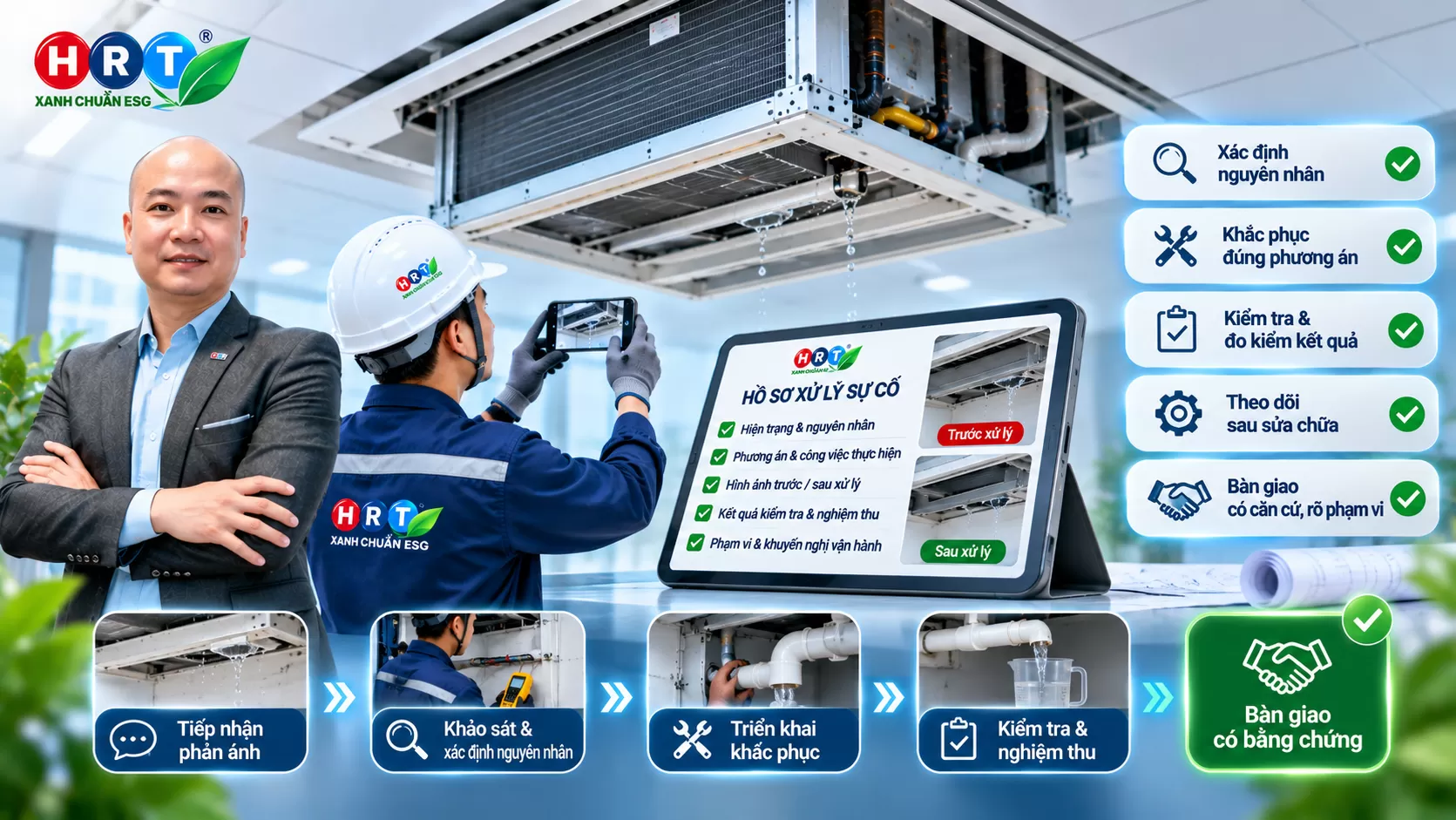
When project owners reflect indoor unit runoff, what they need is a clear treatment and a reliable result.
In my executive role, I want the engineering team to actively explain the cause instead of just specifying the components. I want the person in charge of the construction to monitor both the repair and the delivery conditions. I want the operator to know how far the system has been tested and what to follow next.
A work that is not well-founded must be retained for clarification. A change made at the scene must be updated. An unsatisfactory result must be followed up until re-examined.
That's how I define the spirit. True – Clear – Dedicated in HVAC troubleshooting.
With... indoor unit VRV drainage error, the destination is not a freshly dried ceiling. The destination is the cause identified, the work piece is overcome and the result is confirmed within the clear scope.
Hand over the evidence, not the feelings.
Exchange the same HRT when indoor VRV unit flows water
When surveying, prepare the model code of the indoor unit, the location of the leakage, the time of occurrence and information on previous treatments. These are the inputs that should be exchanged for the scope of inspection, remedies and how to confirm the results.
Contact HRT: 0909 326 888. HRT
CEO Đoàn Văn Hoàng | HRT
Right from the beginning – Clear to the end – Sustainable Green.
Source: Publisher’s English edition · Vietnamese original on doanvanhoang.com