
VRV gas filling: 5 control points before acceptance | HRT
Machine-translated from Vietnamese. Read the original in Vietnamese
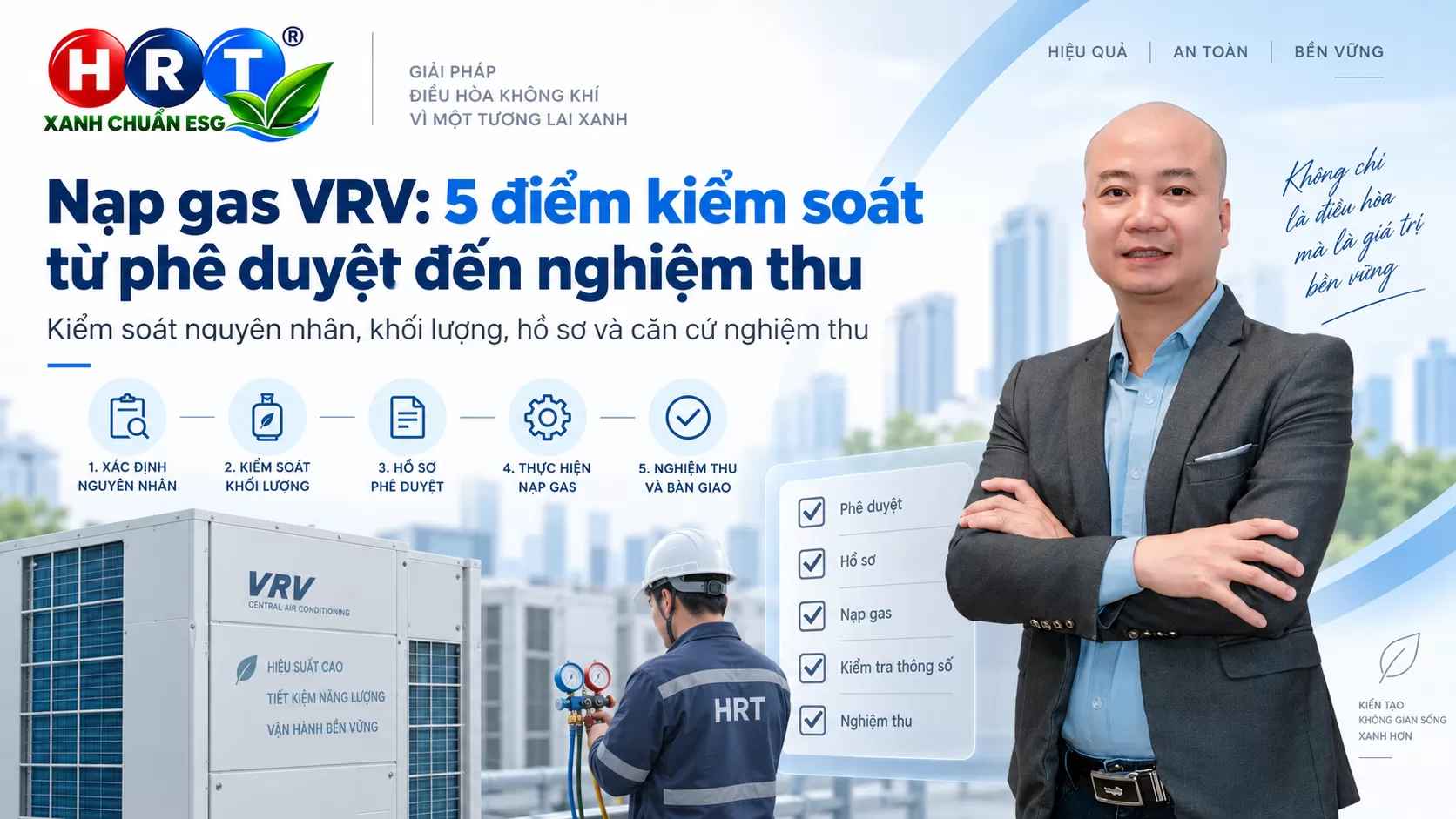
A proposal refrigerant charging VRV needs to clarify more than kilograms of the solvent. From a perspective CEO Đoàn Văn Hoàng – HRTThe article defines five control points that help project owners clarify the scope of work, volume management and acceptance testing with verifiable results.
Refrigerant charging VRV: 5 control points from approval to acceptance testing
A proposal to write “replacement of VRV gas according to reality” is not enough for managers to decide.
How is the reality determined? Why does the system need to add? What records are the estimated volume based on? After implementation, what grounds are used to confirm the work completed?
As a technician and HRT operator, I would prefer these questions to be addressed before the work begins, rather than until acceptance testing has been done.
What needs approval is not just a quantity of the substance. It must be a plan with reason, with scope, with responsible person and criteria for completion.
With that approach, refrigerant charging VRV should be controlled through five points: identifying the need for intervention, clarifying volume, confirming technical conditions, managing implementation and verifying results.
The operations on the circuit must be performed by professional personnel according to the documents of the right equipment; the following contents serve the management and supervision of work, not replacing the technical instructions of the manufacturer.
Control Point 1: Why does the system need refrigerant charging at this time?

Do not turn a phenomenon into a conclusion
“The room is not cool enough” reflects that it should be checked, not concluded to immediately add the solvent.
In the guidelines for dealing with poor cooling of VRVs, Daikin requires checking airflow, filters, temperature settings and heat sources in the room. Therefore, weak cold does not prove the system is running low on gas.
I want the initial report to clearly distinguish three things: what users reflect, what techniques have been tested, and how far the existing data allows for conclusions.
If the phenomenon is newly documented but the cause has not yet been identified, a suitable proposal should be Testing and Diagnosis, not yet closed the additional load volume.
This is not to prolong the work. The goal is not to approve a measure before knowing what it solves.
No maintenance defaults to gas addition
Refrigerant is not the fuel that is consumed over time in a closed system operating normally. When insufficient amounts of refrigerant are detected, the cause should be checked rather than treating the additional load as a default part of every maintenance period.
For operations management, I suggest that the documentation answers: is this work for a new installation, performed after repair, adjusted to a changed configuration or handling a verified abnormality?
Each situation needs a suitable range. It is not recommended to use the same line of description for all.
The result should be at this point: - A written determination of the intervention demand, clearly stating the proposed bases and contents to be further examined.
Control Point 2: Is the volume of refrigerant charging VRV traceable back to the record?

Distinguish preload, replenishment and total amount of solvent
The amount of pre-filled chemicals at the plant, the amount of additional chemicals according to the installation configuration, and the total amount required in the system are different concepts. In case all chemicals have been recovered, Daikin's instructions require calculation of both base and additional quantities determined for the system.
So before approving a number, the manager needs to know what that number is representing.
Is it the volume added to a new installation? The total amount to be refilled? Or the proposed amount of addition to a system that still has the solvent?
The total design volume must not be taken as additional pumping volume when the actual state of the system has not yet been determined.
In my proposal, I want the name and unit clearly stated. An unexplained number is hard to check, even if it's presented correctly to the decimal point.
Spreadsheet must be with actual configuration
The amount of additional solvent must be determined according to the model instructions. Depending on the model, the formula may use the length of each size of liquid pipe and the coefficients related to the equipment configuration. It is not recommended to take the coefficiency of one VRV system to apply by default to another system.
From a record - keeping perspective, I suggest that the spreadsheet show the system code, the firm's applicable documentation, the pipeline data source, the drawing version, and the examiner.
If the construction pipeline is different from the approved drawing, it is necessary to clarify which figures are used for calculation.
If the work lacks as-built documentation, specify additional survey scope and unconfirmable data section. It is not recommended to convert an unverified assumption into a formal payment volume.
The result should be at this point: The proposed volume is well - grounded, examined by persons and re - explained upon comparison.
Control Point 3: Is the system technically qualified to load the solvent?

Do not use progress to ignore input conditions
For newly installed circuits or open circuits for repair, after treating existing solvents and preparing the work scope according to appropriate plans, leak testing and vacuum evacuation should be completed under the manufacturer's instructions before loading. The test scope must cover the circuit to be treated; valve status and equipment mode must be consistent with that work.
At the site, I don't want an item to be moved just because “commissioning schedule has arrived".
Schedules need to be managed. But technical conditions must also be confirmed.
If a stage is not yet achieved or there is no evidence, the person in charge should clearly report the impact on the next milestone and propose the handling plan. Do not record the completion first and then supplement the dossier later.
Request measurement results, not just confirmed manipulation
A line that reads “vacuum evacuation” does not indicate a satisfactory system. Daikin documentation requires testing the ability to maintain vacuum after pumping stops; when it does, treat the cause according to the procedure instead of immediately switching to the liquid feed.
In the monitoring record, I want information on the test scope, measuring equipment, time of performance, results and criteria for evaluation.
Test pressure, holding time, vacuum level and relevant limits must be compared with documents applied to the works, not taking a set of oral parameters as a general standard.
If abnormal results are found, treatment and retest results should be noted.
The result should be at this point: A confirmation of eligibility for step-by-step transfer, not just a confirmation that the construction team has arrived to work.
Control Point 4: Is the refrigerant charging process transparent in terms of supplies, work and cost?
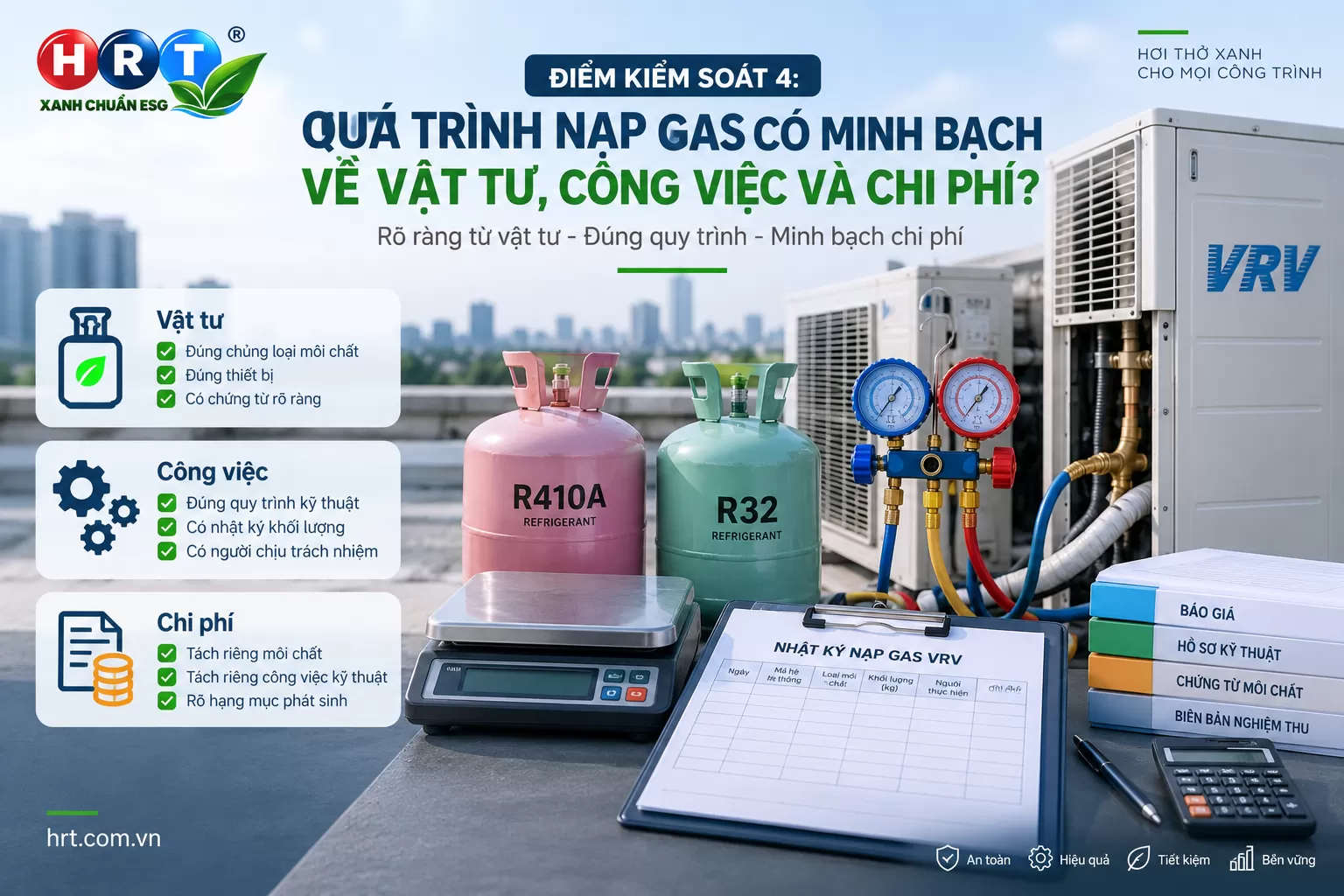
Control the right substance and the right method
The type of chemicals must be consistent with the equipment. Requirements for mixing chemicals when loaded, the port and machine mode must comply with the company's documents. When it is necessary to take out the chemicals, they must be recovered, not directly discharged into the environment.
The manager does not need to replace the manipulator, but needs to ask the plan to show how to control these contents.
Before deployment, it is recommended to reach agreement on the person in charge of technical matters, the witness of the volume, the focal point of operation and the person with authority to confirm the arising.
Each role needs to know what to check and what to sign for.
Log must reflect the volume of execution
Daikin's VRV filling instructions use a scale and require recording the amount of additional fluids after completion. This is the basis for building volume monitoring, rather than just recording the number of containers brought to the site.
I suggest that the log be linked each time with the correct system code, date and time, type of solvent and the implementer.
If the work is divided into many stages, it must be shown the number of work done, the remaining part and the reason for not being completed. It is not recommended to have a separate record for each stage without a reconciliation summary table.
Field photos can support records. However, a gas cylinder or clock photo should not replace the entire log and mass confirmation.
Separating the price of the substance from the range of services
In the quotation I want to clarify three groups: Substance by mass, Technical work and... Item arising outside the original range.
The technical part should explain the work including: survey, diagnosis, leakage treatment, leak testing, vacuum evacuation, loading of the substance, commissioning or filing.
Any content that cannot be closed immediately should have conditions to determine the price and approval after the survey.
For example, when access to a ceiling pipe is required, it is necessary to agree who is responsible for unloading, returning and confirming the status quo. Do not let a “refrigerant charging" proposal become an argument about unarranged work.
The result should be at this point: The quantity of collable, inspectable and arising scope is approved before implementation.
Control point 5: What evidence is used for acceptance testing after refrigerant charging VRV?
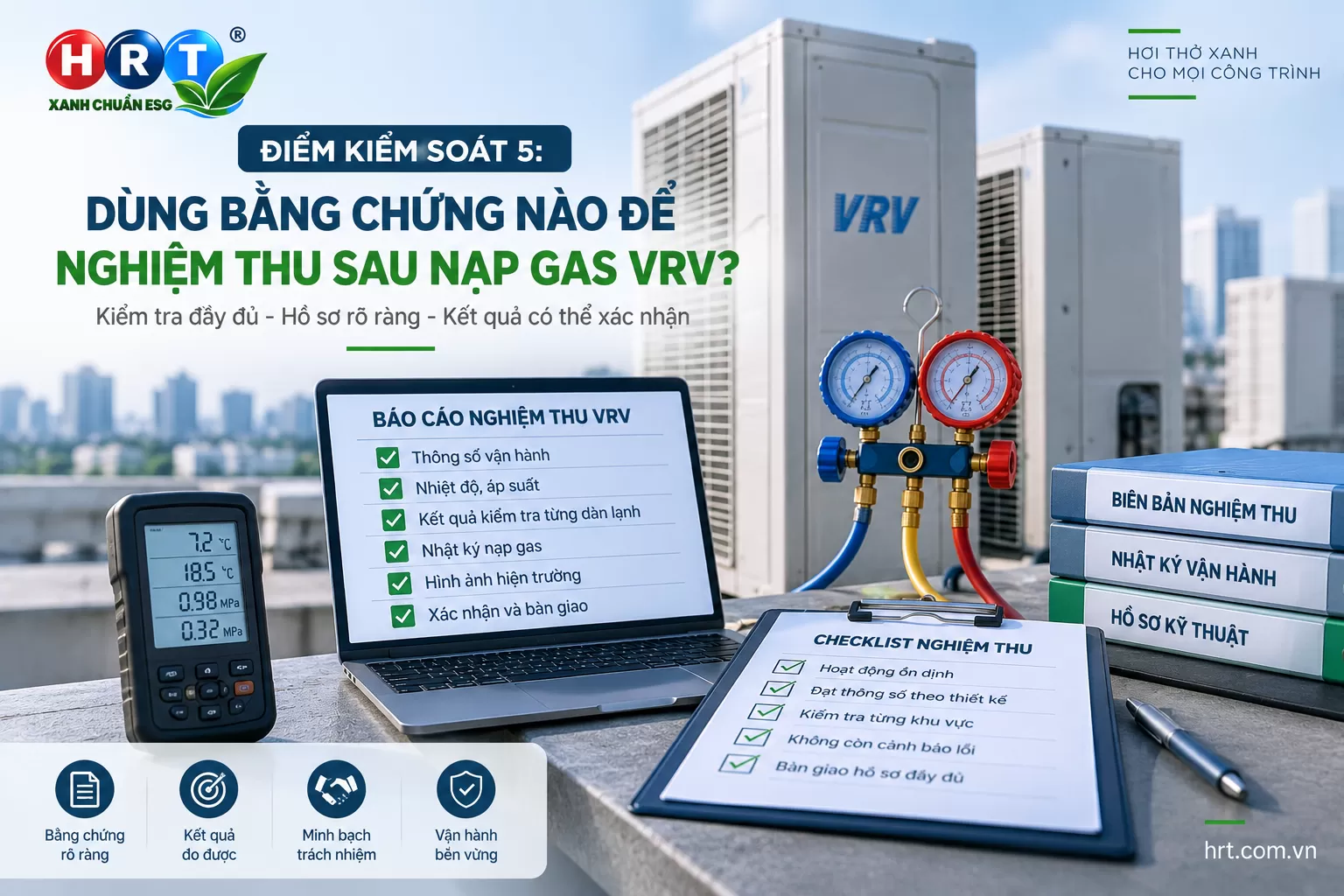
Do not end the work with the sentence “the machine was cold”
Daikin's VRV commissioning guidelines distinguish between a full system inspection and an indoor unit inspection afterwards. Ending a commissioning mode does not mean that every abnormality at each indoor unit has been individually checked.
So I want the acceptance testing plan to be agreed beforehand, not waiting until the construction team cleans up the new equipment to ask what to test.
The work for the new installation must be compared with the agreed scope of handover. The work of troubleshooting must go back to the initial inspection of problems.
If a user reflects an area in particular as unsatisfactory, the record should show the test results at that area, rather than just confirming outdoor unit operation.
The report must specify what has been achieved and what has not been confirmed
I suggest acceptance records answer three groups of questions.
About the work: What has been done, on what system, how much volume and is it different from the approved range?
About the results: What conditions were the system tested under, how was the original problem reevaluated, and what grounds were used for conclusion?
On the next responsibility: What is left unfinished, who is in charge and when to re-check?
Depending on the requirements of the building, the form may add indoor and outdoor temperatures, operation mode, areas in use, measurement data and related warning codes. This information should be associated with the specific time of inspection.
If there is no condition to check a content, write that limit. Do not turn “uncovered in this check” into a commitment wider than the data is.
The result should be at this point: The minutes should be enough so that the person not present can still understand where the work has come from and what to follow up on.
CEO's view Đoàn Văn Hoàng: Controlling refrigerant charging is responsible control
For me, good management doesn't require a lot of paperwork. It's important that each document serves a decision.
The checklist helps determine whether to intervene. The spreadsheet helps explain the volume. The log helps compare implementation. The acceptance testing record helps decide whether the work is eligible for handover or not.
That's how I want to define the three values. True – Clear – Dedicated in the work of HRT.
Understand Correctly: Verify before recommending
Don't start with how many kilograms you need to sell or buy.
Start with the device, its current state, use problems and test data. When information is missing, it should be clearly stated that further verification is required.
A responsible proposal must show the client both the basis of the conclusion and the limits of that conclusion.
Clear: Each volume must be tied to a job
I want the approver to know what I'm agreeing to, the technology to know the scope and the operation to know what to hand over.
Clear also means distinguishing work that has been completed, work that has arisen, and work that is not yet qualified for performance.
Do not use a sentence “done" to replace all.
Dedication: Following the conclusion
After refrigerant charging, the work to be monitored must be handed over to a specific clue.
If the existence is still present, a person must be assigned to handle it. If re - examination is required, an expected time must be given. If causes are detected outside the initial scope, explanation and proposal of the next step must be made.
Dedication is not about promising that every problem will be solved in one go. It's about not letting customers find the answers to the unfinished business on their own.
Frequently Asked Questions About VRV Charging Refrigerant Management
Is refrigerant charging required for all VRV maintenance?
Refrigerant charging should not be considered default work. Substance should not be consumed as fuel in normal operation; supplementation should be based on actual condition and test results.
In maintenance planning, it is recommended to distinguish the inspection work from the additional work of the substance that is done when there are grounds.
Can a common pressure level be used to confirm that all VRV systems are fully gassed?
A common pressure level should not be used as a single criterion. VRV can adjust the temperature of the fluid according to load and environmental conditions; operation data should be evaluated in the correct context and under specific model guidelines.
What should project owner do when the quotation only says “refrigerant charging according to reality”?
Request additional methods of determining the volume and technical scope including, method of witnessing and certifying, arising conditions together with handover dossier.
When there is insufficient data to close the whole job, it is possible to agree beforehand on the survey scope and the next step approval process, rather than accepting an unlimited scope.
Before browsing refrigerant charging VRV, please request a testable proposal
A suggestion to be answered: Why? What is the volume based on? Have the conditions been met? Who controls? What are the results confirmed?
These are the five questions I want project owners, construction units and operation teams to agree on before deploying.
When discussing with HRT about the need for VRV testing or refrigerant charging, prepare equipment label photos, phenomenon descriptions, intervention history and existing pipeline records. Missing contents should be noted to determine the survey scope.
Do not start by charging how much gas. Start by determining what the system needs and what grounds to use to confirm that it did the right thing.
HRT – True Understanding – Clear – Dedication.
Green Breath for All Buildings.
Source: Publisher’s English edition · Vietnamese original on doanvanhoang.com