
VRV Insulation Error: Dew Condensation, Water Runoff and Inspection Procedure
Machine-translated from Vietnamese. Read the original in Vietnamese

VRV insulation errors can cause condensation, water runoff, ceiling staining, moisture seepage and increase unwanted heat exchange on the fluid pipeline. This article will show you how to identify 6 common thermal insulation errors, distinguish them from condensate errors, the process of field inspection and proper handling before closing the ceiling or putting the system into operation.
VRV thermal insulation error usually starts from a very small detail
A few millimeters of gap at the junction, a tear in the insulator when pulling the tube through the wall, or a position that is too strongly pressed at the mount can all become condensation points.
Initially, the phenomenon may be just a few drops of water.
But if prolonged, the building may appear:
- The plasterboard ceiling is stained.
- The paint is peeling.
- Thermal insulation is damp.
- Mold.
- Water drips down the bottom unit.
- Increased heat exchanger is undesirable.
- Difficult maintenance when the duct is covered.
It's important not to treat only the water you're looking at.
To overcome thoroughly must identify:
Where does the water come from → What is the point of loss of insulation → Why do you say the wind is defective → Whether there is a fault with other systems.
What role does thermal insulation play in a VRV system?
Thermal insulation is not merely a material coated outer layer of copper tubing.
It helps to create insulation between the fluid pipe and its surroundings.
During cooling, the temperature of some pipe glands can be significantly lower than air temperature.
If the outer surface becomes subcooling, water vapor in the air may condense.
Mechanism of condensation
It can be understood in terms of the principle:
Surface cold enough + Air with moisture → Risk of water condensation
Insulation layer is responsible for limiting this condition.
When thermal insulation suffers:
- Hm.
- Laceration.
- Press thinly.
- Blot the water.
- Missed at accessories.
surface temperature at that location may decrease and condensation occurs.
Why are hot and humid buildings more prone to bugs?
In areas with high humidity, the dew point temperature is higher so the condensation capacity on cold surfaces also increases.
Areas to be paid special attention to include:
- Hot technical ceiling.
- The area near the roof.
- The factory.
- Area near outdoor doors.
- Space is not regulated.
- Large outdoor air area.
- High temperature technical room.
Therefore, thermal insulation design must be associated with actual construction conditions.
6 most common VRV insulation errors
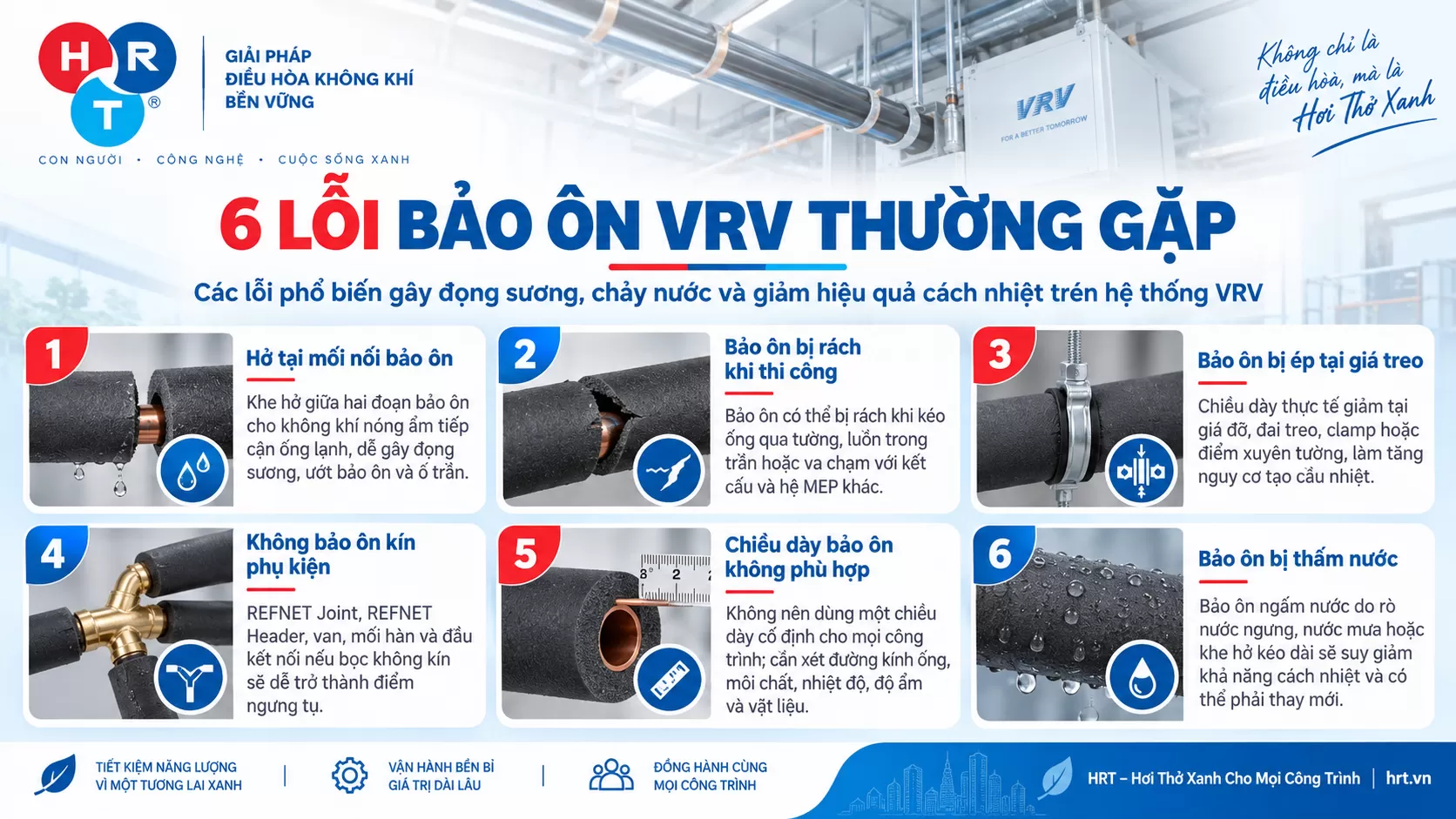
Opening at the insulation joint
If the two insulators are not sealed, they can cause gaps to form.
Hot, moist air can come into contact with the area near the cold pipe and form condensate.
Common signs:
- Water is sitting right at the junction.
- The outer layer is wet.
- Keo bong.
- The joint is open.
- The ceiling underneath shows stains.
This is the first place to check if it's only localized.
Thermal insulation torn during construction
Thermal insulation can be compromised when:
- Pull the tube.
- Through the wall.
- Through the ceiling.
- Construct simultaneously with electricity, fire protection or air duct.
- Cut into by a sharp object.
- Dismantle for repair.
A small tear may not be a problem right away, but it can become a condensation point as moisture builds up.
Thermal insulation laminated at mount
This is a mistake that is easy to overlook.
When the hanging belt or clamp is strongly pressed against the material, the thickness of thermal insulation at that location decreases.
As a result, the insulation at the hanging point is lower than the rest.
Attention should be paid to:
- The rack.
- Hanging straps.
- Clamp.
- Point through the wall.
- Floor - penetrating point.
Non thermal insulation sealed REFNET and accessories
Straightened glands are usually easy to handle.
More complex positions such as:
- REFNET Joint.
- REFNET Header.
- Van.
- The weld.
- Indoor unit connector.
- Outdoor unit connector.
which are easily missed or not completely covered.
Even a small amount of exposed cold metal can form a condensation point.
Inappropriate thickness of thermal insulation
Don't just stick to your routine.
It is necessary to consider simultaneously:
- Pipe diameter.
- Linear type.
- The temperature of the medium.
- Ambient temperature.
- Moisture.
- Materials used.
- Installation conditions.
- Technical requirements of the system.
Thermal insulation properly material but inappropriate environmental conditions still can occur condensation.
Thermal insulation waterproof
A deeply soaked layer of insulation can lose its insulation properties over time.
Sources of moisture can come from:
- Condensate.
- Rainwater.
- Other waterways.
- The gap in the line.
- Execute when the material is wet.
Don't just dry the surface and continue using it if the inside has been soaked for a long time.
Seeing water does not necessarily mean thermal insulation VRV is broken
This is a good place to start before you fix it.
Water in the bare area can come from a variety of sources.
When should thermal insulation error be suspected?
Common signs:
- Water attaches directly to the insulating surface.
- Only one joint is wet.
- There are obvious gaps or tears.
- The phenomenon increases with high ambient humidity.
- Water appears along the pipeline of the solvent.
When should condensate indoor unit be tested?
If the departure country is near the indoor unit, check:
- Condensate drain pan.
- Drainage lines.
- Pipe slope.
- Condensate pump.
- Drain junction.
- Obstructive conditions.
- Thermal insulation condensate pipe.
An important principle
Don't make assumptions.
The correct sequence should be:
Water source identification → Zoning → Inspection → Measurement → Treatment.
Locations with high risk of thermal insulation error
Not all pipe sections carry the same level of risk.
REFNET
Due to its complex shape, REFNET is often more difficult to insulate than straight lines.
Need special inspection part:
- Divisional branch.
- The coupling.
- Transition area between pipe and fittings.
Connector indoor unit
This is an area that is rich in many components:
- Gas lines.
- Liquid sugar.
- Condensate.
- Van.
- Connector.
The diagnosis must be careful not to confuse thermal insulation error with drain error.
Hanging rack
If the support is not suitable, the insulator may be:
- Press thinly.
- Deformity.
- Laceration.
- Expose yourself to metals.
Wall penetration points
When threading the tube through a technical hole, the insulating material may be rubbed and torn.
Repair area
The segments that have been removed from thermal insulation should be checked carefully because the possibility of re-sealing is higher.
Procedure for VRV thermal insulation fault inspection at the scene
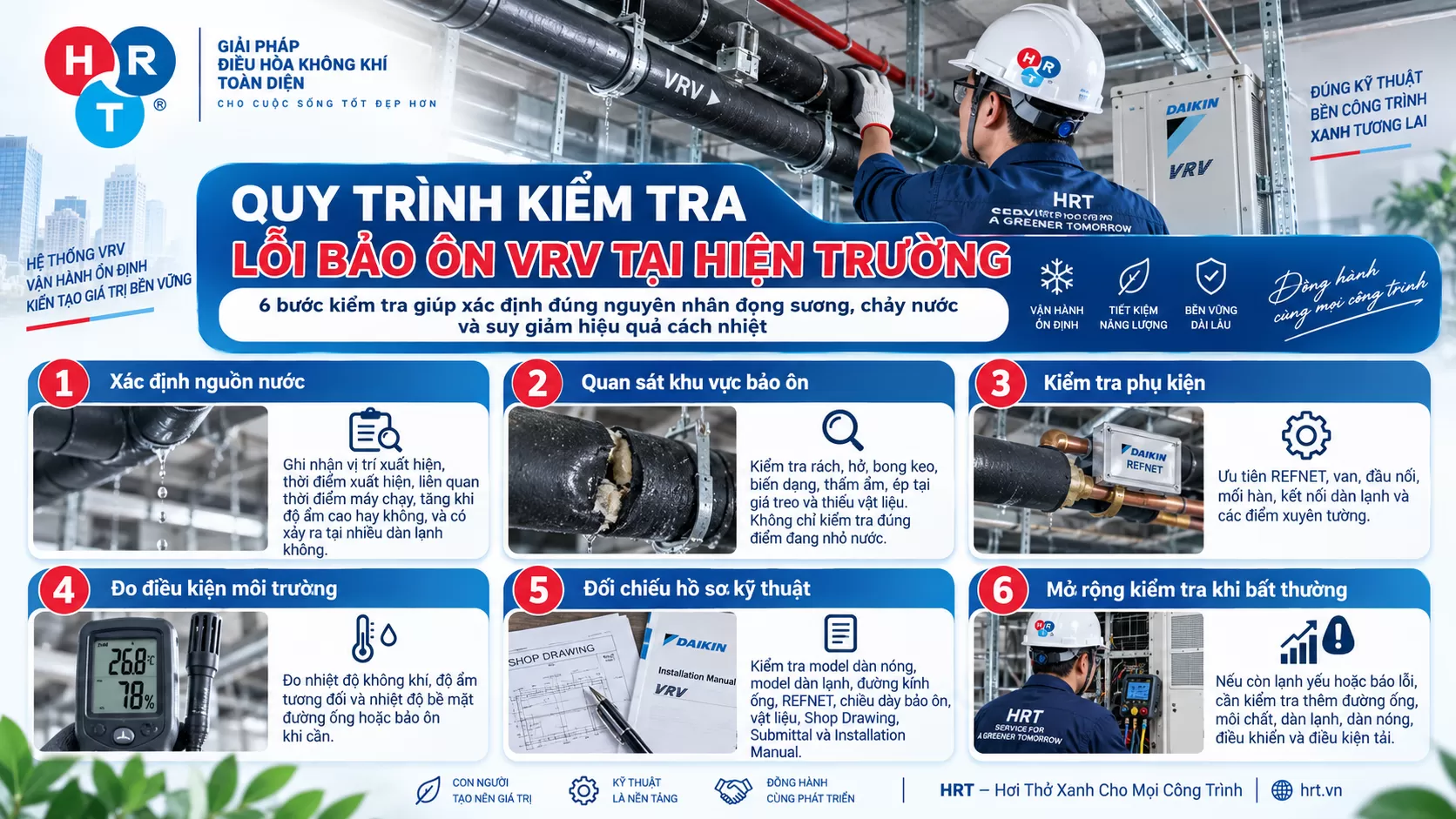
Step 1: Identify the water source
First to note:
- Location of water.
- The time of occurrence.
- Whether it appears when the system is running.
- It increases when it's hot and humid.
- It's one point or multiple points.
Do not open the entire ceiling before determining the area to be inspected.
Step 2: Observe thermal insulation area
Direct Test:
- Laceration.
- Hm.
- Bong keo.
- Loss is constant.
- Deformity.
- Blot the water.
- Press at the bracket.
It is necessary to extend observation around the point where water appears because water can flow along the gland.
Step 3: Check REFNET and accessories
Priority:
- REFNET.
- Van.
- Connector.
- The weld.
- Indoor unit connection point.
- Structural penetration point.
These locations have a higher risk of error than straight pipelines.
Step 4: Measure temperature and humidity
Should be checked:
- Air temperature.
- Relative humidity.
- Surface temperature as needed.
Measurement helps assess dew points with data rather than relying solely on visualization.
Step 5: Compare technical documents
Recheck:
- Model outdoor unit.
- Model indoor unit.
- Pipe diameter.
- REFNET.
- Insulation material.
- Thickness.
- Shop Drawing.
- Submittal.
- Installation Manual.
The goal is to determine whether the materials and current construction are in accordance with the design requirements.
Step 6: Extend the test as needed
If in addition to condensation there are:
- Cold weak.
- The room is not getting warm.
- The treadmill stretches.
- Report errors.
- Many abnormal indoor units.
then should not stop the inspection at thermal insulation.
Systemic evaluation is required.
How to handle VRV insulation errors according to each situation
The junction is open.
Don't just tape the area.
Need:
- Open the joint.
- Check the inside.
- Dry if damp.
- Reattach the insulation.
- Seal the entire slot.
Thermal insulation tear
If the material is still dry and good, you can proceed with proper repair.
If already:
- Soak in water.
- Aging.
- Big tear.
- Multiple deformities.
should change the new paragraph.
REFNET is not sealed
Make sure that the insulation is constantly around the entire fitting.
Should not be left:
- Copper.
- Van.
- The weld.
- Connector.
direct contact with hot humid air.
Hanging rack thermal insulation
Must correct both:
Insulation layer + Suspension structure
If you simply replace thermal insulation and then tighten the clamp, the problem may recur.
Thermal insulation get wet
Before replacing the material should determine:
Where's the water coming from?
If you don't address the water source, the new material may continue to get moist.
Does thermal insulation error affect VRV performance?
Can affect, but the degree depends on the damage range.
A small gap at one point does not mean a serious loss of performance for the entire system.
However, if:
- Thermal insulation errors over a wide area.
- Long tube glands.
- Many accessories are not sealed.
- Waterproof material.
- Pipelines pass through hot space.
then the unwanted heat exchanger increases.
Why can losses increase?
When the insulation no longer works properly:
Pipeline ↔ Ambient
will exchange more heat.
This can increase loss on the gland.
Therefore, the quality of the insulation should be considered as part of the quality of the whole VRV system.
Condensation means the VRV system is lacking gas?
No, no, no.
It is impossible to conclude the condition of the fluid just by seeing condensation.
Need further checking:
- Operation temperature.
- Outdoor unit status.
- Indoor unit status.
- Report errors.
- Loading conditions.
- Piping system.
- Other technical parameters.
Involuntary ingestion of fluids without identifying the cause can complicate the diagnosis.
Common mistakes when repairing VRV insulation
Wrap an extra layer of outside
If the old layer is damp or has gaps in it, adding more wool may not solve the problem.
Correct only small water spots
The water may run along the surface before dripping.
The visible point is not necessarily the faulty location.
See condensation is thinking lack of gas
This is an unwarranted diagnosis.
Only interested in thickness
Thermal insulation is thick enough but the joint is not sealed condensation can still occur.
Close the ceiling too soon
Once the gland is covered, a minor defect can become major repair work.
Checklist acceptance testing VRV pre-ceiling insulation
Materials and materials
Testing:
- The right kind.
- The right thickness.
- No moisture.
- No tears.
- No deformation.
Pipeline
Testing:
- Thermal continuous insulation.
- Do not expose the copper tubing.
- Sealed joint.
- No squeezing at the mount.
REFNET and accessories
Testing:
- Has full thermal insulation.
- Do not expose cold metals.
- Sealed joint.
- No interrupted insulation area.
Wall penetration points
Check thermal insulation is:
- Laceration.
- Cut.
- Compress.
- Press.
- Bong.
Acceptance records
Should have:
- Status image.
- Acceptance testing report.
- Shop Drawing.
- Materials profile.
- Pipeline inspection records.
- As-built documentation as required by the project.
When to switch to full VRV diagnosis?
If thermal insulation has been corrected but the phenomenon is still repeated many times, a wider range should be considered.
Signs to pay attention to:
- Multiple indoor units have the same problem.
- Room temperature is not reached.
- System runs for extended periods.
- There are warnings or error codes.
- Multiple pipeline positions with condensation.
- The system has undergone numerous renovations.
- There is a suspected wrong REFNET or pipeline configuration.
Then check in series:
Outdoor unit → Piping → REFNET → thermal insulation → indoor unit → Drain → Control → Load condition
VRV insulation fault quick identification panel
| Phenomenon | Should be checked first |
|---|---|
| Water right at the splice | Thermal insulation splices |
| Water around REFNET | Insulation Accessories |
| Condensation at the rack | Thermal insulation laminated |
| Thermal insulation wet full section | Ingress water source |
| Water close indoor unit | Drain and gutter |
| Multiple routes of condensation | Temperature, humidity, thermal insulation design |
| Condensation accompanied by weak cold | Complete VRV system |
| Fixed but still recurring | Untreated root cause |
What stage does HRT control VRV insulation failure?
The quality of the insulation should not be checked only when water is present.
The control must begin from:
Design → Material selection → Construction → acceptance testing → Testing & Commissioning → maintenance
In the design stage
Need to identify:
- The type of material.
- Thickness.
- Pipeline.
- Special locations.
- Environmental conditions.
In the construction phase
Need Control:
- The coupling.
- Hanging point.
- REFNET.
- Point through the wall.
- Material status.
Before closing ceiling
This is a very important test.
Any suspected sites should be dealt with before inaccessibility is lost.
Sau khi operation
Need to monitor:
- Condensation.
- Moisture stains.
- Small water.
- Temperature condition.
- Thermal insulation status at maintenance sites.
FAQs about VRV insulation error
Does thermal insulation leak water?
Yes. When the cold surface at the open site reaches condensation conditions, water can form and drip down into the lower area.
Thermal insulation is as thick as possible?
Such conclusions should not be reached. The thickness should be consistent with the material, pipe diameter, temperature and environmental conditions. The quality of the splice is also important.
Why is new thermal insulation still subject to condensation?
Possible due to:
- The transplant is not sealed.
- The material is squeezed.
- An unwrapped accessory.
- High humidity conditions.
- The design is not appropriate.
Is there a need for REFNET thermal insulation?
Yes. REFNET is part of the fluid piping system and should be properly insulated treated.
Condensation is a sure sign of lack of media?
No. Full operation conditions should be checked before conclusion.
Should acceptance testing thermal insulation be done before ceiling closure?
So. This is the time to repair easily and with the least impact on the completion of the work.
Conclusion
VRV thermal insulation failure usually does not start from large damages but from small details:
- An opening.
- A laceration.
- A clamp squeezed too tight.
- An unwrapped REFNET.
- A water - soaked insulation.
If not detected early, these minor errors can lead to:
Condensation → Flow water → Bare pipe → Finishing damage → incurs maintenance costs.
Appropriate processing procedures are:
Source identification → Zone → Insulation thermal test → Measurement of environmental conditions → Profile collation → Processing → commissioning → acceptance testing again
HRT – VRV system solution for construction
HRT deploys the central air conditioning system VRV according to the following process:
Survey → Consulting → Design → Supply → Construction → Testing & Commissioning → Maintenance → Renovation → Optimization
The control of pipelines, REFNET, thermal insulation, condensate and operation conditions from the beginning helps reduce errors that arise after the construction is completed.
HRT – Green Breath for All Buildings
Source: Publisher’s English edition · Vietnamese original on doanvanhoang.com