
VRV maintenance beyond cleaning
Machine-translated from Vietnamese. Read the original in Vietnamese

CEO Đoàn Văn Hoàng – HRT Share how to maintain VRV system from current status, outdoor unit, indoor unit, condensate, electrical control to commissioning and performance proofing, making the system operation more stable and reliable.
Maintenance VRV: Don't end up cleaning
Imagine a maintenance session that just ended.
Air filter was cleaned.
Heat exchanger look cleaner.
Condensate drain pan was processed.
Technician capping machine and press:
“Maintenance is complete"
I'll ask you again:
Before maintenance, how is the device working? After implementation, what results prove that the system has been better or at least returned to the required state?
That's how I see it. maintenance of VRV air conditioning system: proper maintenance of VRV.
I don't want maintenance to just create a list of done tasks.
I want it to generate information that helps the project owner understand the system's state, detect risks and know what to continue dealing with.
VRV has high interconnectivity between outdoor unit, multiple indoor unit, pipeline medium, communication and control. An area that does not reach a temperature is unlikely to be at the indoor unit; the problem may involve airflow rates, loads, sensors, controllers or other components in the system. Therefore, maintenance needs to look at the whole system rather than viewing each device as a stand - alone piece.
Cleaning is a job. maintenance is the process of understanding the condition and confirming the results.
Before you open the computer, please record the initial status
I don't want the technician to start by removing the filter as soon as he arrives.
Before intervening, it is necessary to look at the system while it is still showing the actual state.
How many degrees is the room?
How is Setpoint setting?
Is there an error code?
Does the fan sound strange?
What areas are users reflecting?
A weak cooling indoor unit but no pre-cleaning data will make it very difficult for the engineering team to prove the work just done has handled the problem correctly.
The original HRT also requires recording the initial operation status such as room temperature, setting temperature, outdoor unit – indoor unit status, error codes, noise, vibration and reflection of the user before going into maintenance.
From a management perspective, I think this is baseline.
Without baseline, post-maintenance reporting only describes the job.
With a baseline, we can begin to evaluate the results.
Not all devices need to be treated the same
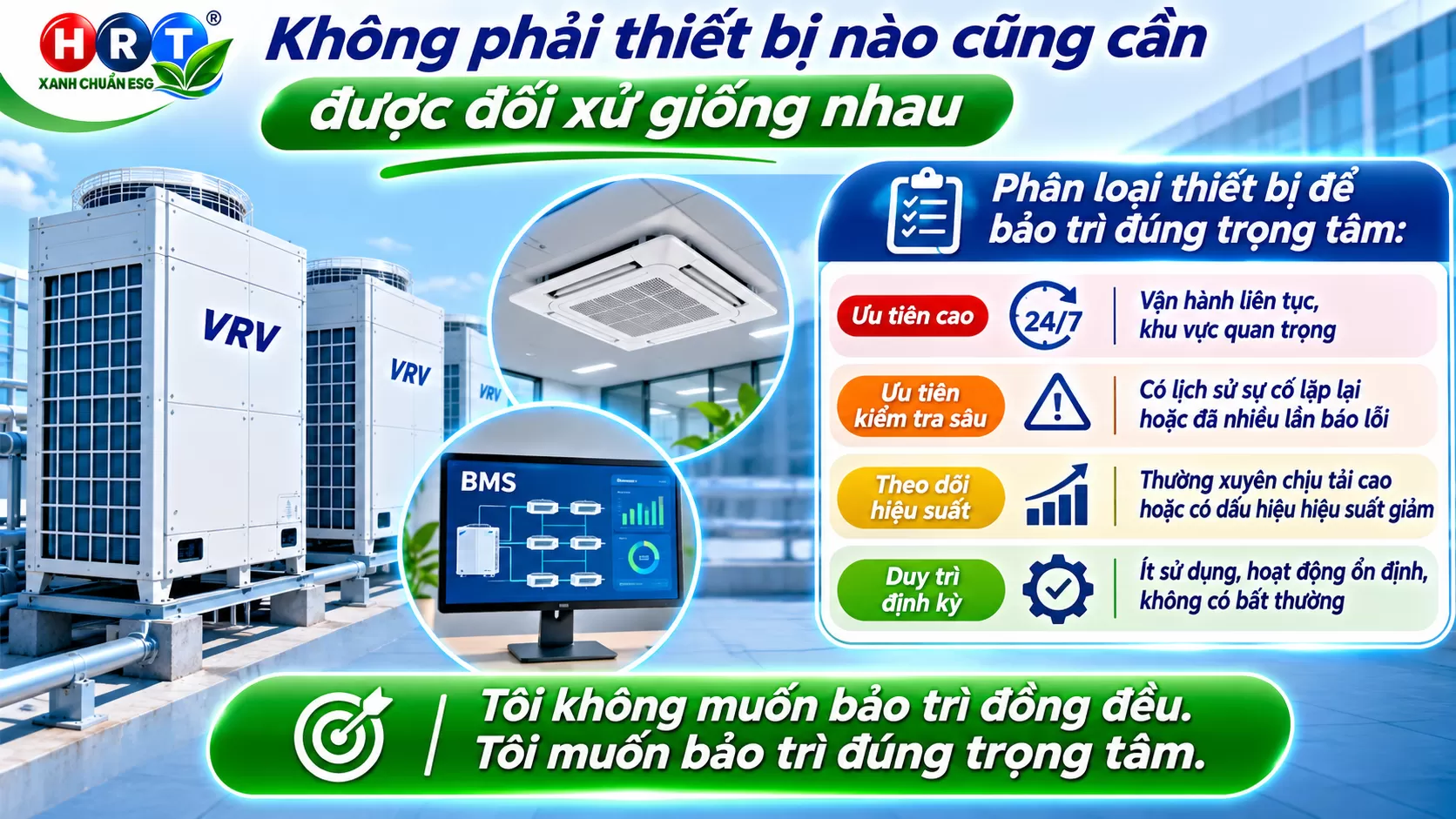
A typical office and a continuous operation control room do not have the same level of risk.
An indoor unit that has reported errors many times should not have the same range of inspections as a device that has been operating stably for years.
So I want the maintenance plan to start with inventorying and sorting equipment.
The list must indicate which outdoor unit connects to which area, which indoor unit serves which room, model, serial, location and unusual history.
With central control system or BMS, the equipment address on the software should be compared with the site. Renovation works need to do this step more and more before planning.
Then you can decide where to go deeper.
Equipment that operates continuously, serves critical areas or has a history of repeated incidents should be given more attention. Equipment that regularly bears high loads or shows signs of declining performance also needs a different approach from the less used and stable group. This is how HRT proposes organizing resources by risk, not replacing the manufacturer's mandatory maintenance requirements.
I don't want uniform maintenance. I want maintenance at the center of gravity.
Indoor unit clean is not enough, must test the space serviceability
Indoor unit is where the user directly feels the result of the system.
So, maintenance indoor unit should not only have one line:
“Sanitary filter and coil"
I would like to know the air distribution capacity after maintenance.
Does the filter still interfere?
Is the heat exchanger clean to the right level?
Does the fan vibrate or make a strange sound?
Is air outlet obscured?
With indoor unit connecting air duct, pipeline, insulation and door visit is in the state that allows maintenance later?
The original HRT also requires evaluation of both heat exchanger and air distribution; with bare air ducts, consider ventilation connections, insulation, doors and accessibility. Cleaning methods must also be consistent with materials and avoid letting water or chemicals affect electrical components.
A clean coil but still lack of wind means that the work should not stop at the conclusion "cleaned”
Keep looking for the cause.
Condensate must be tried, not just looked
A system may function normally immediately after cleaning, but spills may not appear for several hours.
This is why I don't want to test condensate with my eyes alone.
After cleaning the trough and drain, it is necessary to confirm that water actually passes through the gland.
Look at the chute, joints, pipes, and pump if the device is in use.
Especially for high-value ceilings and interiors, a small condensate defect can create much greater damage than maintenance costs. The original HRT also requires testing and confirming the drainage after cleaning by the appropriate method with the equipment.
Dry ceilings are not proof that the drainage system is working.
Outdoor unit needs space to discharge heat, not only need to be washed
I usually ask the engineering team to stand back and look at the entire outdoor unit area.
Not just look at the coil.
Where is the air coming from?
Where does the hot air go?
Is there a new obstruction?
Does the technical space have additional equipment?
Is the fan abnormal?
Does the rack corrode?
The original article HRT also emphasized ventilation conditions, spacing and cooling capacity have a direct effect on the operation of the outdoor unit; maintenance needs to assess coil, fan, rack, corrosion signs and obstacles on the suction – blowing line.
I do not use the same outdoor unit cleaning procedure for all VRVs.
The device, environment and model instructions must determine the method.
Electrical work should be considered professional work, not cleaning.

VRV uses inverter, control board and communication system.
This is an area I don't allow routine manipulation.
Before accessing the electrical part, the performer must isolate the power according to the safety procedure, prevent the power from closing again, and confirm the safe voltage state.
Some variable-frequency drive circuits may still have voltage after the power has been disconnected. The original HRT leads require compliance with standby time and validation method of the correct model, and professional work must be performed by qualified personnel.
After the safety condition, new to the inspection part.
Power supply.
Terminal.
Communications cable.
Remote.
Central control.
BMS if available.
If a communication error has ever occurred, put that history in the scope of the check instead of just confirming that “today the machine did not report an error”.
periodic maintenance does not mean refrigerant charging periodically
This is a point I want the project owner to take special note of.
A closed system should not be supplemented with a solvent just because maintenance is in progress.
If the air conditioning is weak, find out what's wrong.
Dirty filter?
Dirty coil?
incorrect airflow rate?
Wrong sensor?
Inappropriate controls?
Or is there really an abnormality in the fluid flow?
The original article HRT also states that periodic maintenance is not synonymous with periodic filling of solvents. When a leak is suspected, the inspection, repair, leak testing, vacuum evacuation and treatment of solvents must comply with the procedure; additional filling when the cause is unknown may not handle the actual problem.
Cold deficiency is a phenomenon. Lack of a substrate is just one of many hypotheses to prove.
The wrong sensor can cause a good system to be miscontrolled
VRV relies heavily on data.
If the sensor reads incorrectly, the system may make an inappropriate decision even though the mechanical equipment is still normal.
Therefore, if the display temperature is far from the actual perception, I would like the technical team to check the sensor position, the influence of the surrounding environment and the reliability of the signal before batch change setpoint.
The original HRT also recommends that sensor and parameter evaluation be based on technical documentation and equipment data, avoiding inductance adjustment.
This is why I consider VRV maintenance to be more than just mechanical hygiene.
It's also a test of ability. Measure Right – Understand Right – Control Right.
Maintenance frequency should not start with a fixed number
Someone asked:
“How long does it take to maintain VRV once?”
I'll ask again:
How many hours does the device run?
Is the environment dusty?
How important is that area?
What's the history of the incident?
What does the manufacturer require?
The original HRT also determines the frequency required based on the carrier's instructions, uptime, environment and regional importance. The cycle table in the original article is just an organizational suggestion for commercial buildings, not a mandatory cycle for all models.
I want to use maintenance schedule as a flexible system.
Stable device can keep the cycle accordingly.
Equipment in dusty environments must be filtered more often.
Devices with a history of repeated failures must be included in the deeper monitoring group.
The schedule must serve the equipment condition, not let the equipment serve a fixed schedule.
I do not acceptance testing maintenance only with the word “clean”
This is the most important part.
Before starting a contract or maintenance, I want the project owner and contractor to agree:
Which part will be checked.
What data to write.
How to confirm after completion.
What's out of scope.
If maintenance filter and coil, please have proof of condition.
If condensate is treated, get test results.
If checking the control, please confirm the function.
If the system has abnormalities before maintenance, write the result after processing.
HRT also proposes comparing before – after data and saving images, drainage test results, outdoor unit status, electrical – control data, fault codes and technical logs. At the same time, performance should only be compared when load conditions, environment and operation status are sufficiently similar.
A better room temperature after maintenance is not sufficient to conclude increased system performance if two measurements take place at completely different conditions.
To say “better”, to know better than what and under what conditions.
Clearly distinguish completed maintenance from open issues
A maintenance run can complete the right scope but also detect additional problems.
For example:
Control board showing signs of failure.
Fan needs mechanical repair.
The fluid line is suspected of leakage.
This is not the reason to write the entire maintenance batch as “unfinished”
Nor is it a reason to ignore existence.
I want the record to distinguish three clear states:
Work within the scope is completed.
Abnormalities detected require additional repair.
Items are not eligible for confirmation.
The original HRT also requires that damages outside the scope of the specification be specified, with a priority and resolution for the project owner to control costs and responsibility.
Clear status helps managers know which tasks have closed and which ones still need to be monitored.
A good report must make next maintenance times smarter

I don't want every maintenance cycle to start at zero.
The system needs history.
What devices often fail?
What error codes have ever appeared?
What parts have been replaced?
What areas usually have reflections?
Which indoor unit is faster dirty than other locations?
HRT also considers operation logs, servicing history, fault codes and component replacement as important data sources to build risk-based maintenance plans. Without saving history, it is difficult for businesses to identify which devices are trending down.
Over time, maintenance reports have to help us go from:
“How is this device doing?"
To:
“How is this device changing?"
That's the value of accumulated data.
Do not choose maintenance contractors just because the price of one cleaning is lower
A low maintenance quotation does not necessarily create a low total cost.
I want the project owner to look at the real scope that is being done.
Did you check the operation first?
Did you check condensate?
Is there electrical and control rating?
Is commissioning after maintenance?
Any irregular reports and further recommendations?
The original HRT also recommends that when comparing contractors need to see methods, personnel, diagnostic equipment, safety, acceptance records and how handling exists, rather than just looking at unit prices.
If the contract is long term, I would also like to clarify how to handle the incident, priority, material responsibilities, off - site work and how to approve repairs.
Periodic reports must become data for long - term budget planning, repairs and replacements rather than just acceptance testing papers.
CEO view Đoàn Văn Hoàng: I don't maintenance to cleaner machine, I maintenance to more reliable system
When viewing a VRV maintenance report, I don't want to just see:
“Washed"
“Tested"
“Machine works normally"
I want to see the full story.
Before the intervention, what state was the system?
What's the detection?
What's the deal?
What is the result after treatment?
What existence remains?
Who's watching?
When's the next check?
That's how I apply the spirit True – Clear – Dedicated.
Understand Correctly condition before intervention.
Clearly range, data and post-maintenance results.
Dedicated follow up until the abnormality is dealt with or converted into a head of clear responsibility.
HRT concluded that an effective maintenance program should combine preventive testing, technical hygiene, abnormal analysis and acceptance testing with a basis; the benefits lie not only in one-time servicing but also in the ability to limit interruptions, manage costs and extend the useful life of the equipment.
I want to turn that principle into an action statement:
Do not ask how many machines have been cleaned today. Ask after this maintenance, how much better we understand the system and what risks have really been controlled.
Exchange VRV maintenance plan with HRT
For the work in operation, it is recommended to prepare equipment catalog, model, service area, fault history, maintenance logs, user reflection and data from the central control or BMS if available.
From there, it is possible to classify equipment according to the level of risk, determine the appropriate testing scope and build clear pre-test acceptance criteria.
CEO Đoàn Văn Hoàng | HRT
True – Clear – Dedicated
Right from the beginning – Clear to the end – Sustainable Green.
HRT Contact: 0909 326 888
Source: Publisher’s English edition · Vietnamese original on doanvanhoang.com