
Water Chiller: 7 decisions to make before investing
Machine-translated from Vietnamese. Read the original in Vietnamese

Water Chiller investment should not start with choosing the brand or capacity of the machine. This article analyzes 7 key decisions to chilled-water system in accordance with actual load, work infrastructure and operation capacity.
Water Chiller: 7 technical decisions to take before investing in chilled-water system
In many discussions about HVAC systems, the question often comes up very early:
Which brand Chiller should I choose?
How much RT power?
Should I use a screw compressor or centrifugal one?
That's not the beginning, I think.
If it is not yet determined in which area the work needs to be refrigerated, how the load changes, how long the operation time, how much redundancy is needed and what data the operation team will manage the system with, choosing a new machine is just a selection of equipment on an incomplete problem.
Water Chiller is not merely a water cooling machine. It is a system that must coordinate between the Chiller, pump, pipeline, terminal, heat waste system, control and human operation.
So before asking the equipment price, I want the project owner and the technical team to clearly finalize seven decisions that directly affect the investment efficiency for many years to come.
Water Chiller should be understood as a system
A Water Chiller is a device that generates cold water or cooling load. This cold water source is circulated to an AHU, FCU, PAU, heat exchanger or technology device to receive heat, then returned to the Chiller and continues the cycle.
In a compressed air chiller, the refrigerant absorbs heat from the cold water ring at the evaporator. This heat is then passed through the compressor and released into the condenser. air-cooled chiller uses fans to discharge heat through the air; water-cooled chiller transfers heat to a condenser ring of water, then transfers the heat to a cooling tower, dry cooler or heat recovery system.
The point is that cold water is just a means of transporting energy.
It does not produce its own effect if:
- Pump selected wrong pressure head.
- Pipeline imbalance.
- AHU or FCU does not receive enough flow rate.
- The control valve is not working properly.
- Chiller running in inappropriate load mode.
- Sensor displays wrong data.
- Operations team doesn't know when to change the machine's sequence.
A Chiller with good parameters cannot compensate for a designed system or operation that is out of sync.
Water Chiller Not Synonymous With Water-cooled Chiller
These two concepts are often used interchangeably.
Water Chiller emphasizing the object to be cooling is water or solution cooling load.
Water-cooled Chiller describes the heat discharge mode of the device, i.e. the heat is transferred to the condenser water ring.
So a Water Chiller can be:
- Air-cooled Water Chiller – air cooling condenser water wind.
- Water-cooled Water Chiller – water cooling condenser.
Differentiating the right terms helps avoid misleading right from the step of building technical requirements, comparing quotations and selecting equipment.
How does the heat flow through the Water Chiller system?
Instead of just memorizing parts names, I suggest looking at the system in terms of heat.
Heat is taken from space or process
At AHUs, FCUs, PAUs or heat exchangers, cold water receives heat from the air or production equipment.
The air after passing through the coil can be cooled and assisted with dehumidification according to the design conditions. In industrial application, cold water can cool machinery, molds, tanks, lines or a stage that needs temperature control.
Water Carries Heat Return Chiller
After receiving heat, the water temperature rises and the water is returned to the evaporator.
Here, heat is transferred from the water to the refrigerant. The water decreases in temperature and then is pumped back into the system for use.
Refrigerant brings heat to the condenser
Refrigerant after heat absorption is compressor lift the pressure and temperature, then go to condenser.
At the condenser, heat is transferred to the air or to the condenser water ring depending on the type of chiller.
The heat must eventually be discharged into the environment
With air-cooled chiller, the fan passes air through condenser coil to exhaust heat.
With water-cooled chiller, the water condenser ring carries heat from the condenser to the cooling tower or the corresponding heat waste device.
As such, the system does not “create cold” in an absolute sense. It transfers heat from where it needs to be cooled to a location that can safely and efficiently dispose of the heat.
What does a complete Water Chiller system include?
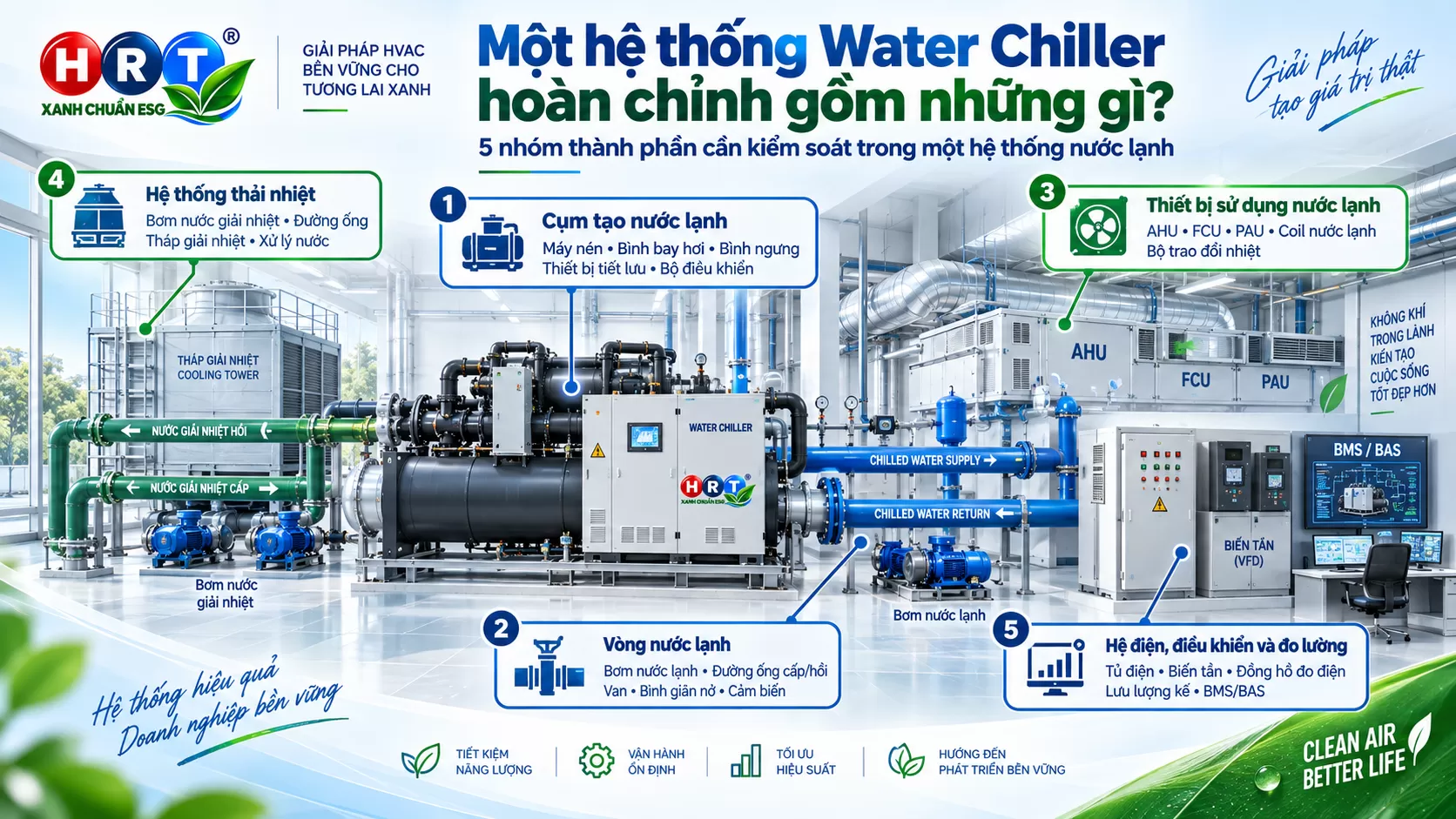
I split the system into five teams so that the project team had easy control over the scope.
Cold water generating cluster
This is the central chiller cluster, usually consisting of:
- Compressor.
- Evaporator.
- Condenser.
- Throttle device.
- Controllers and protective devices.
Depending on the capacity and project requirements, chillers can use compressor scroll, screw, centrifugal or other technologies. It should not be concluded that one type of compressor is always better than the other. Each technology has its own application area, load reduction capability, maintenance requirements and operation characteristics.
Cold Water Ring
Cold water ring usually includes:
- Chilled-water pump.
- Acute and return pipelines.
- Stop Valve, One Way Valve And Control Valve.
- Balancing valve or flow rate control device.
- Expansion tank.
- Air separation equipment, residue filter.
- Temperature sensor, pressure and flow rate.
- Thermal insulation pipeline.
The pump system is not selected separately from the pipeline network. The flow rate, pressure head, valve characteristics and operation mode must be calculated on the same hydraulic model.
Equipment for cold water use
This class may include:
- AHU for areas where concentrated air treatment is required.
- FCU for smaller rooms or areas.
- PAU for outdoor air handling.
- Coil cold water in air handling equipment.
- Heat exchanger for production.
- Technology equipment needs cooling.
Choosing the right Chiller but choosing the wrong coil or wrong control valve can still cause the system to lack refrigeration, difficulty dehumidifying or water imbalance.
Heat exhaust system
With air-cooled chiller, the heat exhaust is mainly located at the condenser coil and fan of the machine.
With water-cooled chiller, the range is usually additional:
- Condenser water pump.
- Pipeline condenser water.
- Cooling tower.
- Valves and balancing devices.
- Water supply system, bottom discharge.
- Water treatment solution.
- Sensors and related controls.
Auxiliary equipment is part of total Chiller Plant power. When evaluating performance, it is impossible to read only the Chiller's own power but ignore chilled-water pump, water condenser pump and cooling tower fan.
Electrical, Control and Measurement Systems
This class usually includes:
- Electrodynamic cabinet.
- Control cabinet.
- Variable-frequency drive.
- Sensors.
- Electricity meter.
- Flow rate meter.
- Plant Chiller Controller.
- Connect BMS or BAS.
- Alert and save data system.
I think this is a group that's often overlooked when it comes to budgeting but decides whether the operational team really owns the system.
Decision 1: what is the actual cooling load of the building?
Do not choose the water chiller capacity from only floor area.
Two buildings with the same area but may require very different cooling load due to differences in:
- Sunlight direction and shading texture.
- Glass area.
- Human density.
- Heat generator.
- Outdoor airflow.
- Requires temperature and humidity.
- Operation time.
- Download technology.
- Expansion possibilities in the future.
Not only maximum load
Peak power indicates the system must be able to meet peak load times. But peak load does not indicate how the device will operate for most of the rest of its life.
A work may only reach the design load for a certain number of hours, but operate thousands of hours at lower loads.
So Chiller selection profile need further answer:
- What is the common minimum load?
- How different is the daytime and nighttime load?
- Do the areas have simultaneous operation?
- Does the background load run continuously?
- Loads vary by season or by output?
- When a machine stops, which part of the load is required to maintain?
The U.S. Department of Energy notes that full load and nonload performance should both be evaluated according to actual operational conditions. A machine with good performance at an uncertain point fits the load profile of the project. AHRI also identifies IPLV/NPLV as primarily a prescribed performance benchmark; it should not be used alone to conclude actual energy savings. ahrinet.org
Results to be finalized
Before selecting the machine, the project team needs to have a minimum of:
- Cooling load peak.
- Cooling load minimum.
- Timed load profile.
- Important loads need backup.
- Expanded script.
- Input design conditions.
- The assumptions and limits of the calculation.
Without these data, RT power is just an insufficient number.
Decision 2: Choose air-cooled chiller or water-cooled?
There is no one right answer for every building.
Decisions must be based on infrastructure, cooling load, space, water supply, noise, maintenance requirements and life-cycle cost.
| Criteria | Air-cooled chiller | Water-cooled chiller |
|---|---|---|
| Heat Discharge Method | Fan blowing air through condenser coil | Heat transfer to water condenser ring |
| Auxiliary system | Less categories often | Need cooling pump, cooling tower and water treatment |
| Main Space | Need a well-ventilated outdoor location | Need machine room and tower layout area |
| Water sources | No need water condenser ring | Need to compensate, flush the bottom and manage water quality |
| Maintenance content | Condenser coil, fan, heat exchanger surface cleaning | Condensers, pumps, towers, scale, corrosion and water quality |
| Points to check | Environmental temperature, hot wind circulation, noise | Water infrastructure, space engineering, water treatment and tower operation |
Trane distinguishes air-cooled chillers that use fans to pass heat through the condenser, while water-cooled chiller transfers heat to the water ring and continues to pass it through a cooling tower, dry cooler or heat recovery system.
I do not choose only by machine price
Chiller purchase price does not fully reflect the cost of the plan.
Need to calculate:
- Pumps and pipelines.
- Cooling tower.
- Water treatment system.
- Electric cabinet and variable-frequency drive.
- Technical area.
- Construction cost of the engine room.
- Auxiliary power.
- Water supply compensation.
- Maintenance supplies.
- Human resource operation.
- Cost of stopping the system when malfunction occurs.
A lower cost option does not necessarily mean a lower total cost of ownership.
Decision 3: How many Chillers and what kind of compressor?
A large machine is not always the easiest option.
Many smaller machines aren't by default the most effective option.
The number of Chillers to follow the load profile
When determining the number of machines, it is necessary to consider:
- Common load levels.
- Minimum load of the system.
- The ability to reduce the load of each machine.
- The required reserve level.
- Rotating maintenance capabilities.
- Limit your power.
- Machine room area.
- Run the engine.
- Expansion possibilities later.
For example, if the majority of the work is only running at low load, a machine that is too large may have to be constantly running at an unfavorable load zone or shut down several times.
Conversely, dividing too many machines can increase:
- Number of pumps and valves.
- Electrical cabinets.
- Connection point.
- Maintenance work.
- The complexity of the control.
- Initial investment cost.
Do not select compressor by technology name only
Common groups include scroll, screw and centrifugal. Some centrifugal chillers use magnetic drives and variable speed controls. Trane lists scroll, helical rotary and centrifugal in commercial chiller configurations, but the choice must still be based on the specific conditions of the project.
I would like to ask the supplier to state:
- Capacity at design conditions.
- Full load performance.
- Performance at non-load points.
- Limit the load.
- Design water temperature.
- Pressure drop through evaporator and condenser.
- Starting current.
- Electricity requirements.
- Noise level.
- Refrigerant type.
- Maintenance conditions.
- Spare parts and technical service.
- Conditions for application of warranty.
Do not place multiple quotations side by side and compare only the nominal capacity and the largest COP.
Decision 4: How will the cold water system be designed and balanced?
Chiller can only operate properly when receiving the right water flow rate.
Flow rate and pressure head must be calculated from the actual system
The pump system should be selected based on:
- Heat transfer capacity.
- Design water temperature difference.
- Pipeline damage.
- Coil loss.
- Damage through the valve.
- Losses through equipment.
- The most unfavorable route.
- Control mode flow rate.
There should be no arbitrary redundancy for both flow rate and pressure head. A lack of baseline redundancy can lead to over-pumping, excessive valve throttles and unnecessary power consumption.
Hydraulic Configuration Latch
Depending on the size and requirements of the project, it is possible to consider:
- Primary pump system constant flow rate.
- Primary – secondary systems.
- Primary pump system variable flow rate.
- Separate water rings for special load groups.
Each configuration has different requirements on:
- Minimum flow rate through Chiller.
- Isolation valve.
- Differential pressure sensor.
- Pumping sequence.
- Two-way valve control.
- Separator pipe or bypass line.
- Coordination between Chillers.
It is not recommended to copy the schematic of another project without checking the operation conditions.
Coil, valve and pump must be selected the same problem
If the coil is selected with an inappropriate temperature difference or the control valve does not retain the necessary control, the system may give rise to high flow rate but low heat exchange capacity.
Common consequences are:
- Supply-water temperature difference – low return.
- The pump must run high flow rate.
- The chiller must boot up even if actual load is not high.
- The far area is still cold.
- Difficult to determine the cause from operation data.
Therefore, hydraulic balance is not the last thing to do. It must be calculated from the design stage and verified when commissioning.
Decision 5: What data will the system be controlled with?
BMS should not be just a multi-colored screen.
Each value displayed must serve a specific operation decision.
Minimum data to monitor
Depending on the scale of the system, the project team should consider measurement points such as:
- Temperature chilled-water supply.
- Temperature chilled-water return.
- Temperature condenser water in and out.
- cold water flow rate.
- Water flow rate cooling.
- Differential pressure system.
- Chiller's electrical capacity.
- Electric power of pump and tower fan.
- Running status, stop and error.
- Valve opening.
- Variable-frequency drive speed.
- instant cooling load.
- System efficiency in kW/RT.
ASHRAE Guideline 22 defines the measurement of thermal load, energy usage and Chiller Plant performance as the foundation of central chilled-water system monitoring.
Control sequence must be written into document
Operation team should know:
- When to start the first Chiller?
- When to Add Next Chiller?
- When to reduce the number of machines?
- Which pump goes first?
- Which valve to open?
- What is the condition of validation with flow rate?
- How long does the chiller stop and the pump stop?
- What parameters is cooling tower controlled?
- How is differential pressure reset according to the load?
- When sensor fails, which mode does the system go to?
- When the BMS connection is lost, will the device continue to operate safely?
ASHRAE emphasizes life-cycle cost selection, BAS control sequence building and commissioning as important contents in Chiller Plant design.
Wrong data can lead to wrong decisions
A small deviation of the temperature sensor, wrong flow rate gauge, or untested electric meter can miscalculate the entire performance calculation.
So, the latch:
- Type and precision measuring equipment.
- Installation location.
- Display unit.
- Sampling cycle.
- Time to save data.
- Limit warnings.
- Testing and calibration methods.
- The person responsible for processing when the data is abnormal.
Decision 6: What evidence to use for acceptance testing of Water Chiller system?
I don't want to end commissioning with:
“The machine was running and the water was cold”
That's just one state observed at a time.
Acceptance testing should demonstrate that the operation system is in accordance with the agreed scope, sequence and criteria.
Check before booting
The dossier should show the inspection:
- Install the device in place.
- Space maintenance.
- Anti-vibration bonding.
- Flow dimension.
- Valves and fittings.
- Pressure testing pipeline.
- Clean and sanitize the system.
- Water quality.
- Thermal insulation.
- Electrical connections.
- Grounders.
- Pump and fan rotation dimension.
- Sensors and control signals.
Functional Testing
Need to try each sequence instead of just running the device independently:
- Pump run and confirm flow rate.
- Isolation valve opens in the right state.
- Chiller receives boot command.
- The interlocking safety works.
- Chiller addition or cut-off according to load.
- Conversion backup pump.
- Warnings are transmitted to the operating system.
- The device responds properly to a signal loss.
- The system returns to safe status upon failure.
Responsiveness Test
Parameters should be recorded in the determined test conditions:
- Supply-water temperature and return.
- Flow rate.
- Differential pressure.
- Cooling load.
- Electricity.
- Vibration.
- Noise.
- AHU and FCU operations.
- Ability to maintain the temperature at the use area.
If the design load cannot be generated at the time of acceptance testing, the record must state that limit and specify additional testing options.
Commissioning is the role that confirms Chiller Plant meets the design goals, not just confirms each bootable device.
Acceptance testing criteria must be available before commissioning date
Don't wait for the construction team to finish to decide what to measure.
From the outset, the parties must agree:
- Test conditions.
- Measuring equipment.
- Forms for recognition.
- Acceptance limits.
- Time tracking.
- Responsibility for handling deviations.
- Conditions for acceptance testing with reservations.
- The contents must be completed before handover.
Decision 7: How will the operation team take over the system?
Handover is not the transfer of a set of documents from a contractor to a project owner.
The goal is to help recipients be able to use the document for operation, detect abnormalities and properly process clues.
Profiles need to be sorted by use needs
The application should include:
- List and device code.
- As-built drawing.
- Schematic diagram.
- Electrical and control diagrams.
- Installation parameters table.
- Operation sequence.
- Warning matrix.
- Water balance results.
- Commissioning minutes.
- Initial performance data.
- Operation and maintenance documentation.
- List of consumable materials.
- Recommended spare parts list.
- Maintenance plan.
- Warranty conditions.
- List of supporting contacts.
Training must be tied to the actual situation
Operation teams should be practicing situations such as:
- Start and stop the system.
- Switch pump.
- Put the backup chiller on.
- Handle flow rate loss warnings.
- Check for temperature differences.
- Recognize a dirty heat exchanger.
- Monitor kW/RT performance.
- Check the sensor data.
- Distinguish between device and control failures.
- Isolate a device for maintenance.
Water-cooled systems need a water management plan
Cooling tower and ring condenser water should be monitored for water supply compensation, bottom discharge, mineral concentration, scale, corrosion and sanitary condition.
The U.S. Department of Energy recommends monitoring the concentration cycle, compensating water flow rate, bottom discharge flow rate, and conductivity for effective management of cooling tower water rings.
Without proper personnel and procedures, the heat exchange efficiency may be impaired even if the chiller does not emit a clear warning.
When to Consider Water Chiller?
Water Chiller usually deserves to be included in the analysis when the building has one or more of the following characteristics:
- Large cooling load or concentrate.
- Many areas use AHUs, FCUs or PAUs.
- Concentrated air treatment is required.
- Long operation time.
- Have technology loads need cold water.
- Need to split load and backup.
- There's an operational engineering team.
- Focused performance monitoring is required.
- There are plans to expand.
- Ability to arrange engine room and auxiliary infrastructure.
However, large areas do not automatically mean choosing Water Chiller.
The project still needs to compare with:
- VRV/VRF.
- Packaged or Rooftop.
- Local conditioning.
- Chiller system combines VRV/VRF.
- Individual outdoor air handling options.
- Independent technology cooling system.
Do not choose the system by habit
One solution that used to work for a hotel may not work for a factory.
An effective system for a mall may not be suitable for buildings with multiple independent renting areas.
I suggest that all options must answer three questions:
- How does the system respond to actual load?
- What resources will the project owner use to operate and maintain?
- What is the total cost over the life of the project?
Common Mistakes When Investing in Water Chiller
Select capacity by area
Area is just an input data. It does not reflect fully the load of people, equipment, outdoor air, humidity, operation hours and production loads.
Compare COP or IPLV only
A performance indicator can not represent the entire system.
Parameters should be compared at project conditions and consider both Chiller, pump, cooling tower, fan, terminal and control sequence.
Choose machine too large to “for safety”
Lack of grounding redundancy can increase investment, reduce stable runtime and cause equipment to frequently operate at low loads.
Safety must be created by calculation, load division, reasonable redundancy and the ability to isolate incidents.
No lowest load counted
The system can operate well at high loads but has difficulties when only a small portion of the area is in use.
Check the Chiller's load reduction limit, minimum flow rate, pump control ability and low-load seasonal operation options.
Ignore auxiliary power
A high-efficiency Chiller can still be located in a Chiller Plant that consumes a lot of electricity if:
- The pump selection is too large.
- Towers run off - load.
- Differential pressure set too high.
- Regular throttle valve.
- dirty heat exchanger.
- Multi-machine sequence is not logical.
No maintenance space layout
The engine room must allow:
- Remove the heat exchanger.
- Remove any hoses or components as needed.
- Approach the power rack.
- Replace the pump.
- Crane or transport equipment.
- Check sensors and valves.
- Drainage when maintenance.
The lack of technical space at the outset will become the operational cost for many years.
Acceptance testing but no background data
Without recording flow rate, temperature, power capacity and initial operation status, management team will lack grounds to assess performance decline later.
HRT procedures recommended when deploying Water Chiller systems
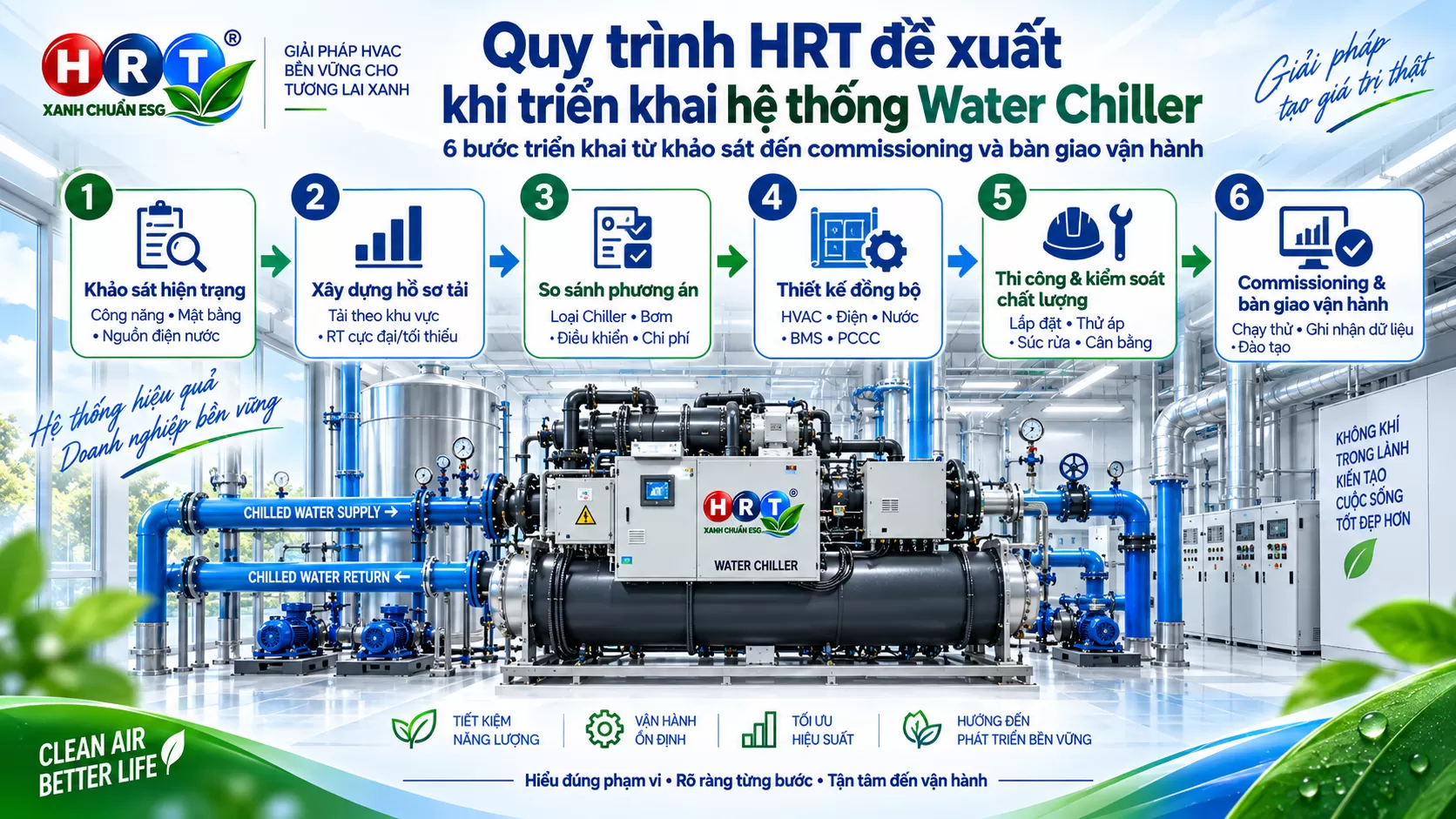
Step 1: Survey the current status and requirements for use
Collect data about:
- Functional.
- The ground.
- Download using.
- Operation time.
- Requires temperature and humidity.
- Power supply.
- Water sources.
- Engine room.
- Cooling tower location.
- Noise and vibration.
- Ability to transport equipment.
- Expansion plan.
For renovation projects, operation data and the status of existing systems should be added.
Step 2: Build the loading profile
Don't stop at an RT number.
Need to build:
- Load by area.
- Maximum load.
- Lowest load.
- Load profile by hour or shift.
- The critical load.
- Future development scenarios.
- Abnormal operation conditions.
Step 3: Compare the plan
Each plan should clearly state:
- Chiller type.
- Number of machines.
- Pump configuration.
- Terminals.
- Heat disposal options.
- Controls.
- Provision.
- Investment costs.
- Operational costs.
- Request maintenance.
- Risk of deployment.
Step 4: Synchronous design
Design documentation should be coordinated between:
- HVAC.
- Electricity.
- Water supply and drainage.
- Structure.
- Architecture.
- - Fire prevention and fighting.
- BMS.
- Production technology if available.
It is not recommended to come to the construction stage to detect lack of transportation lines, lack of power load or no longer location for cooling tower.
Step 5: Construction and quality control
The control points should be determined in advance:
- Input materials.
- Install the device.
- Pressure testing.
- Rinse.
- Thermal insulation.
- Electrical connections.
- Check the signal.
- Hydraulic balance.
- Commissioning each device.
- inter-active commissioning.
Step 6: Commissioning and handover operation
The system should be tested in complete sequence, recording data and training the takeover.
After handover, it is recommended to continue monitoring in the initial stages to detect:
- Inappropriate setpoint.
- Operation schedule not optimal.
- Sensor misalignment.
- The area of imbalance.
- The machine start sequence needs adjusting.
- The difference between the design and the actual use needs.
CEO's View Đoàn Văn Hoàng: Don't Buy Chiller Before Understanding the System

I don't want a Water Chiller project to be evaluated successful just because the machine has been put into the engineering room and can be started.
The results to be seen are:
- Area of use is satisfactory.
- System operation stable.
- Data is enough to control.
- Costs are tracked.
- Operations team understands the device.
- Incidents have a solution.
- Responsibilities of each party are determined.
Understand Correctly: Starting from load and operation conditions
Don't select by area.
Do not copy the configuration of other projects.
No default water-cooled chiller is always better than air-cooled or vice versa.
Any data that is not available shall be recorded as unavailable. Any assumptions in use must be clearly stated.
Clear: Every decision must be well-founded
Why is the power chosen?
What load profile based machine quantity?
What is the contingency level for risks?
What conditions are performances compared?
Acceptance testing by what parameters?
Who is responsible for the operation after handover?
When these questions have written answers, the project will be reduced in dependence on oral exchange and personal experience.
Dedication: Handing over a usable system
The HVAC unit's responsibility does not end when the unit runs.
A good system must help the operator know:
- What's the status of the system today?
- Does performance change?
- What areas are under load.
- Which equipment needs maintenance.
- Any warnings that need immediate action.
- Who to contact when something goes wrong.
Investment Water Chiller is investment for a long-term operation capacity, not just purchase a water cooling machine.
Conclusion
Water Chiller is an important solution for many commercial, industrial and system that needs centralized cold water. However, the effectiveness of the solution is not unique to the brand or capacity of the machine.
The result depends on the whole decision chain:
- Determine the correct load.
- Choose the right method of heat release.
- Reasonable power distribution.
- Design the right water system.
- Select the correct terminal.
- Build data-based controls.
- Commissioning by clear criteria.
- Hand it over to the operations team that can take over.
HRT approaches Water Chiller in the direction of pre-survey, sufficient analysis and synchronous control from central equipment to final use point.
The goal is not just to create cold water.
The goal is to create a system that can operate, test and maintain efficiency in practice.
Frequently Asked Questions about Water Chiller
What is Water Chiller?
Water Chiller is a device or system that generates cold water or cooling load. Cold water is circulated to AHU, FCU, PAU, heat exchanger or technological equipment to cool the air and production processes.
Is Water Chiller a water-cooled chiller?
Not quite. Water Chiller describes a water cooling device. That device can discharge heat either by air or by ring condenser water.
Should you choose air-cooled chiller or water-cooled?
Consider cooling load, installation space, water source, noise, investment cost, operation cost, infrastructure and maintenance capacity. There is not a suitable option for every project.
Can I choose the Chiller capacity by area?
No. Area is only one of many data. The load calculation also needs to consider sunshine direction, cover structure, number of people, equipment, outdoor air, humidity, operation time and technology load.
Does High IPLV Mean Chiller Is Definitely Power Saving?
No. IPLV is useful indicator to compare non-load performance under specified conditions. Actual consumption also depends on load profile, operation temperature, pump, cooling tower, control and maintenance quality. ahrinet.org
Can Water Chiller be used with AHU and FCU?
Yes. AHU, FCU and PAU are common terminals that receive cold water from Chiller system. The selection of coil, flow rate, valve and control should be coordinated with the parameter of the cold water system.
Does Water Chiller System Need BMS?
Not every project requires the use of a BMS. However, with large systems or multiple devices, a BMS can assist in status monitoring, alerting, data saving and operation coordination. The scope of BMS needs to be tailored to the needs and capabilities of the operations team.
Does the old Chiller need to be redesigned?
It is not necessary to replace the whole machine, but it is necessary to check pump, pipeline, coil, cooling tower, power supply, control, flow rate and operation conditions. Replacing the machine at the old capacity is not necessarily an appropriate option if the load or use of the work has changed.
Acceptance testing What parameters does Water Chiller need?
Depending on the scope of the project, it is often necessary to check the supply-water temperature – return, flow rate, differential pressure, power capacity, cooling load, control sequence, safety interlock, operation of pumps, cooling tower and terminal equipment. Test conditions and acceptance limits must be agreed in advance.
Does Water Chiller Save Electricity?
Water Chiller can operate effectively when selected the right load, synchronous design, demand control and maintenance properly. It should not be committed to a fixed saving rate when there is no data load and baseline of the work.
Source: Publisher’s English edition · Vietnamese original on doanvanhoang.com