
What is AHU? Structure, Operating Principle and Role in HVAC
Machine-translated from Vietnamese. Read the original in Vietnamese

What is an AHU? Learn the structure, operating principles and role of an AHU in a central HVAC system, along with types of AHUs, selection criteria and common errors when operating.
What is AHU? The Structure, Principles of Operation and Role in HVAC System
Air Handling Unit (AHU) is an air handling equipment commonly used in central HVAC systems. Not only is it responsible for supplying cold air, AHU also undertakes many functions such as air purification, heat exchange, humidity treatment, outdoor air mixing and return air before bringing air to the area of use.
In buildings such as office buildings, shopping malls, hotels, hospitals, factories and cleanrooms, the choice of the right AHU has a direct impact on the ability to control temperature, humidity, air quality and operational efficiency of the entire HVAC system.
What Role Does AHU Have In HVAC System?
AHU is central air handling equipment
AHUs are designed to receive, filter, cool or heat air and distribute it through an air duct system. Depending on the design, they can handle return air, outdoor air or a mixture of these two sources.
A basic AHU typically consists of a fan, filter, heat exchanger coil, damper, condensate tray and control system. The components work together to bring the post-treatment air to the right area at the required flow rate and conditions.
AHU connects to many other devices
In central HVAC systems, the AHU does not operate independently. The unit can connect to Chiller, chilled-water pump system, control valve, water pipeline, air duct system, sensor and BMS.
With the system using Chiller, cold water is generated from the Chiller and delivered to the AHU's coil. The air passing through the coil will exchange heat with cold water before being introduced into the air duct by the fan.
What Sections Does AHU Configure?
AHU Housing and Frame
Shell And Frame: This is the outer structure of the AHU, which protects the internal parts and limits heat loss. The casing structure should be suitable for installation conditions as well as requirements for insulation, airtightness and maintenance capabilities.
Air Filters
Filters: Air before passing through the coil is usually filtered to remove dust and particles of sizes suitable for the designed filtration level. A clean filter helps maintain air quality and limit dust from adhering to the coil.
Coil Heat Exchanger
Coil: It is the part that performs the heat exchange process between air and refrigerant or cold water. Depending on design, the coil can be used for cooling, heating or assisting in humidity control processes.
AHU Fan
Fan: The fan generates the flow rate and pressure needed to move air through the processing units and distribute it into the air duct system. The selection of a fan should be based on the airflow rate and total pressure loss of the system.
Damper And Wind Mixing Box
Damper and wind mixer box: These components help adjust the amount of outdoor air, return air and exhaust air according to design requirements. The correct adjustment helps the system meet the needs of ventilation and air quality in the building.
Condensate Tray and Drainage Line
Khay condensate: During cooling and dehumidification, condensate can form on the coil. Condensate trays and drains collect and flush this water out of the AHU, limiting stagnation or spillage.
How does AHU work?
Air is fed into the AHU
Air Reception: AHUs can receive return air from the space in use, outdoor air from outside or a mixture of these two sources depending on the design of the system.
Air is filtered before treatment
Air Filter: Air passes through filter levels to remove dust and impurities according to system requirements. Filter condition directly affects the airflow rate and pressure drop of the AHU.
Air to air heat exchanger at coil
Heat Treatment: When passing through the coil, the air exchanges heat with cold water, refrigerant or a heat source depending on the AHU configuration. This process helps bring the air temperature to the required level.
Fan brings air to the air duct system
Air Supply: After being treated, the air is fed into the air duct by the AHU fan and distributed to the areas in the building.
Control system continuous adjustable
Controller: Temperature sensors, humidity, pressure and control devices can be used to adjust fan speed, damper or valve for cold water. With modern systems, AHUs can be connected to BMS for centralized monitoring and control.
Important Functions of AHU
Temperature and humidity control
AHUs help to treat air before it enters the space, thereby supporting the maintenance of temperature and humidity required by the design.
For buildings with strict environmental control requirements, humidity control capabilities of AHUs can play an important role in the operation process.
Outdoor air level and improve air quality
AHU can mix outdoor air with return air to meet ventilation requirements. The amount of outdoor air should be calculated based on the capacity, density of users and design requirements of each building.
Air Filter
The filtration system helps to limit dust and particles in the air stream before being put into use space. The specific filter grade should be selected based on the air quality requirements of each project.
Optimal support for HVAC power
AHU is one of the equipments that affects the energy consumption of HVAC system. The correct selection of flow rate, pressure, coil, fan and control options can help the operation system to match the actual needs.
Current Popular AHUs
AHU Using Cold Water from Chiller
This is a common configuration in central HVAC systems. The chiller generates cold water, which is then pumped to the AHU coil to perform heat exchange with air.
AHU DX
The AHU DX uses refrigerant directly for heat exchange instead of using cold water from the Chiller. This configuration can be selected in those systems that suit the design plan and construction requirements.
AHU combines outdoor air and return air
This type of AHU allows mixing outdoor air from the outside with return air from the space in use. The mixing ratio is determined according to ventilation requirements and operation conditions.
AHU cho cleanroom
In hospitals, pharmaceuticals, electronics, food and other areas requiring environmental control, AHUs can be designed with appropriate filtration levels, temperature, humidity and pressure control.
How Does AHU Other Chiller And FCU Work?
AHU and Chiller
Chiller: The chiller is responsible for creating the cold water source for the system. The AHU uses this cold source to process air and distribute it through the air duct system.
So, AHU and Chiller are two devices that have different functions but can work closely in a central HVAC system.
AHU and FCU
AHU: Usually serves the handling and distribution of large volumes of air through an air duct system.
FCU: Smaller in structure and scale, often used to process air for specific areas or rooms.
The choice of AHU or FCU depends on the size of the building, gas distribution options, cooling load and control requirements.
Where is the AHU Applied?
Office Buildings
AHUs are used to process and distribute air to multiple work areas through an air duct system.
Business Center
Commercial centers with large areas and high densities of users often need HVAC systems that are capable of handling large air flow rates.
Factory and Industrial Zone
AHUs can be used to control temperature, humidity, ventilation and air quality in production areas.
Hospital and cleanroom
Specific environments may require AHUs with the ability to filter, control temperature, humidity and pressure according to the design standards of each area.
Hotels and resorts
AHUs can be used in common areas, halls, restaurants and other spaces that require large volumes of air handling.
What criteria should I base my AHU on?
Determine cooling load and airflow rate
Cooling load and airflow rate are important parameters when choosing AHU. Equipment should meet the actual air handling needs of the building instead of just selecting based on nominal capacity.
Consider air quality requirements
The filter grade, outdoor air ratio and air quality requirements should be determined before selecting an AHU configuration.
Evaluate humidity control requirements
For constructions requiring humidity control, dehumidification and operation conditions related to coil, cold water temperature and airflow rate should be considered.
Calculation of installation and maintenance space
The AHU needs enough space to transport, install, maintain and replace filters or internal components.
Consider Noise and Vibration
Fan, motor, wind speed and mechanical connections can all affect the noise and vibration of the system. This is a factor that should be calculated right from the design stage.
Common Errors When Operating AHU
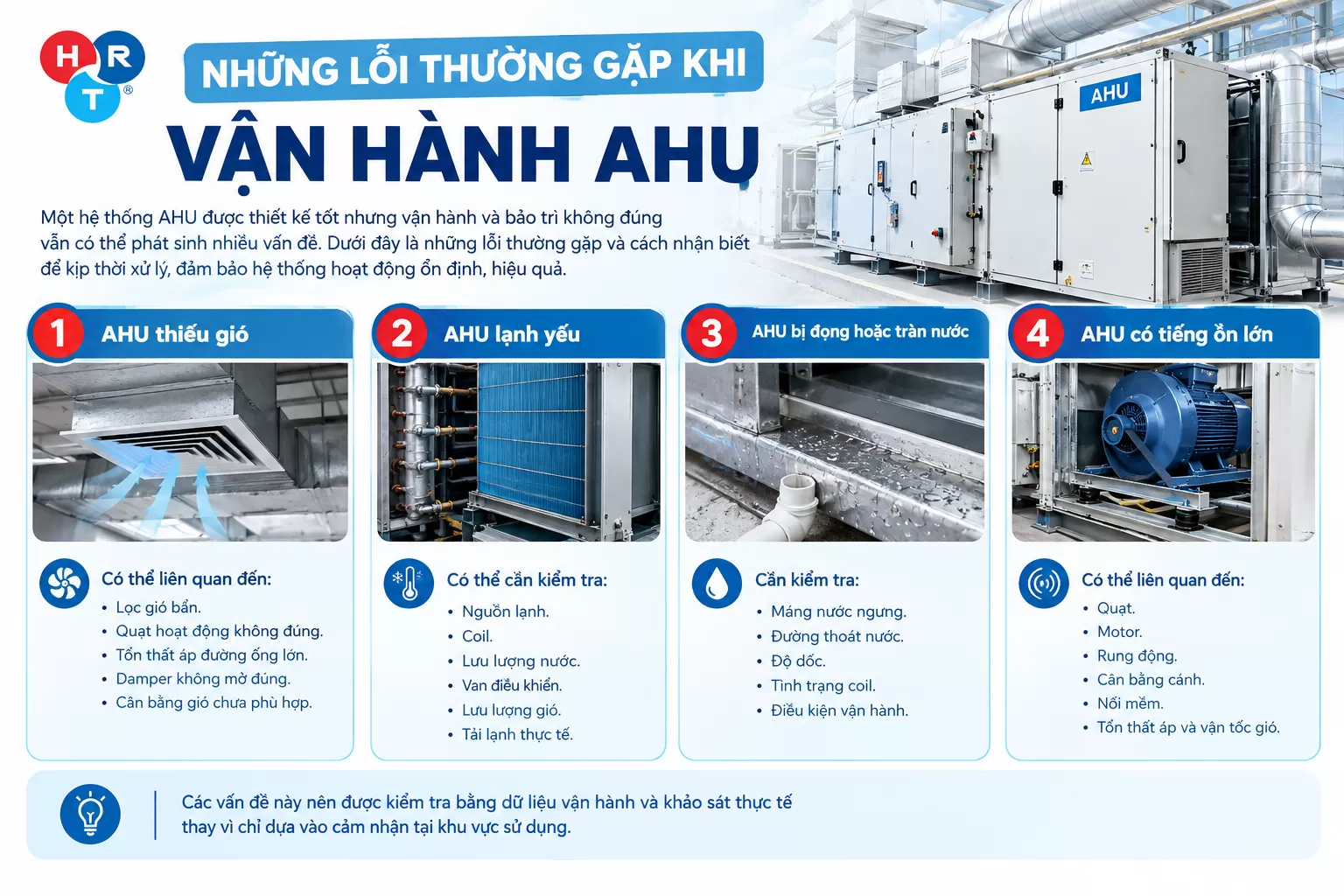
A well - designed AHU system with incorrect operation and maintenance can still cause problems.
AHU lacks wind
Possible causes: dirty air filter, improperly operated fan, large pipeline pressure drop, damper not opening in the right position or inappropriate air balancing system.
Weak cold AHU
Items to be checked: Refrigeration source, coil, water flow rate, control valve, airflow rate and actual cooling load of the area in use.
AHU is stagnant or overflowing
Items to be checked: Condensate drain pan, drain line, pipeline slope, coil condition and actual operation conditions.
AHU with loud noise
Possible causes: Fan, motor, vibration, impeller balance, soft splicing, pressure drop or wind velocity is too high.
The above problems should be evaluated by operation data combined with actual surveys instead of just based on the perception in the area of use.
What Do AHU Maintenance Checks Need?
Filter and coil test
The filter should be periodically checked and cleaned or replaced as needed. Coil should also be checked for dust attachment to ensure heat exchangeability.
Fan and motor test
Check the condition of fans, motors, belts if any, vibration and abnormal signs during operation.
Condensate drainage system test
Troughs and drainage lines should be checked to limit blockages, water stagnation, or spillage into the area inside the AHU.
Check valves, sensors and controls
Control valves, actuators, temperature sensors, humidity, pressure and other signals related to BMS should be checked to ensure the system responds correctly.
Evaluate operating parameters
In addition to checking the equipment, it is recommended to monitor the supply air temperature, return air, airflow rate, humidity, pressure, condensate status and system warnings.
When Should I Check Or Upgrade the AHU?
AHUs should be checked for signs of decreased airflow rate, inadequate temperature, uncontrollable humidity, increased energy consumption, unusual noise, or water stagnation.
For systems that have been in operation for a long time, reassessment of cooling load, airflow rate, coil performance, fans and control systems can also help determine whether the current AHU is still suitable for use.
AHU Solution From HRT
HRT provides HVAC solutions including AHU, Chiller, VRV/VRF, FCU, industrial air conditioning, ventilation and automatic control systems.
For AHU systems, a physical survey should be done before selecting equipment. Factors to consider include cooling load, airflow rate, refrigeration source, pump system, valves, ductwork, outdoor air, exhaust air, control and BMS.
HRT can support from survey, consultancy, design, supply, installation to maintenance and optimization of AHU system according to the actual conditions of each project.
Source: Publisher’s English edition · Vietnamese original on doanvanhoang.com