
What is an HVAC Fan Inverter?
Machine-translated from Vietnamese. Read the original in Vietnamese

1. What is variable-frequency drive VFD for HVAC fan?
VFD – Variable Frequency Drive is a device that controls the frequency and voltage supplied to AC motors, thereby changing the rotation speed of the motor.
When the HVAC fan traction motor is controlled by VFD, the fan speed can be increased or decreased according to the control signal instead of just running fixed at one speed.
VFD is typically applied to:
-
AHU's feed fans.
-
Fan feedback.
-
Outdoor air supply fan.
-
Exhaust exhaust fan.
-
Factory ventilation fan.
-
Some industrial fan systems.
-
VAV system.
-
HVAC system connects DDC/BMS.
Unlike conventional motor starters which mainly perform shut-off and protection of the motor, VFD also allows speed changes according to operation needs.
2. The operation principle of variable-frequency drive for HVAC fans
Can understand the process of VFD control in a simple sequence:
System demand change → Sensor detecting → Controller processing → VFD frequency change → Motor speed change → flow rate and fan pressure change.
Example with AHU system using VAV Box:
When more rooms need more cold wind, the VAV Box opens larger. The static pressure on the pipeline tends to decrease.
Pressure sensor transmits signals to the controller. The controller increases the speed command to the VFD so that the fan generates more flow rate and pressure.
Conversely, when multiple areas have reached the required temperature, the VAV Box closes down. The pipeline pressure increases and the controller reduces the fan speed through the VFD.
This allows the fan speed to be adjusted closer to actual needs rather than constantly running at the design speed.
3. Why can the fan reducer help to reduce the power?
The energy saving capability of VFD involves Fan Affinity Laws – the law of correlation of fans.
Under the right conditions and with the same fan:
-
Flow rate changes close to the proportion of rotational speed.
-
The pressure varies roughly with the speed squared.
-
Aerodynamic power varies roughly with the speed cube.
This explains why when the system only needs a partial flow rate design, reducing the fan speed can be more effective than letting the fan run fast and then using a damper throttle.
However, this is an approximate theoretical relationship. Actual electrical energy also depends on fan performance, motor, VFD, system performance curve, static pressure, operating hours and control strategy.
So, you know, It should not be taken directly from the law of the cube to commit a fixed rate of electricity savings for every building..
4. When should I use VFD for HVAC fans?
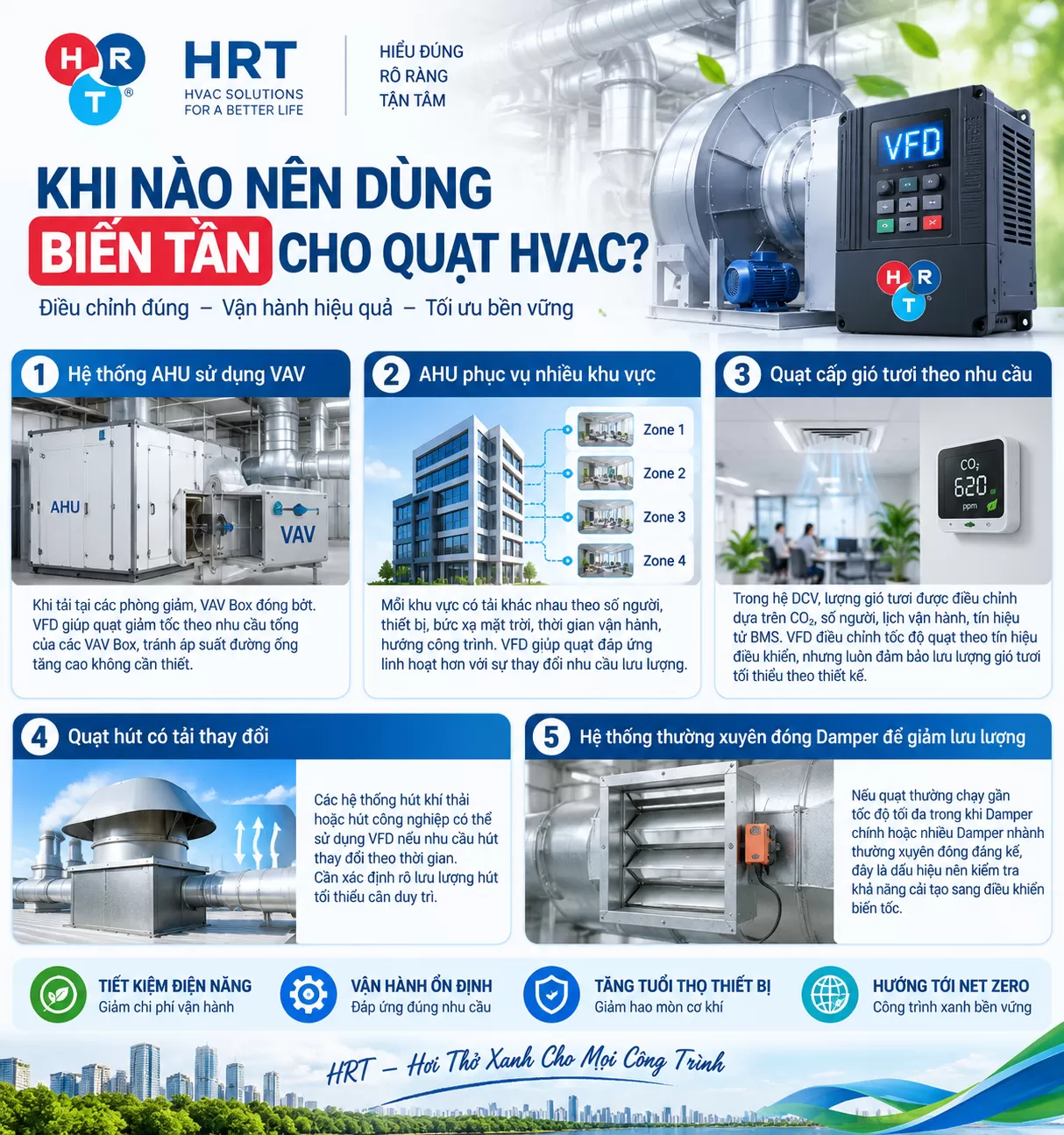
AHU System Using VAV
This is one of the most typical applications.
As the load of each zone changes, the VAV Box adjusts the flow rate accordingly. The total amount of AHU wind to be supplied also varies accordingly.
VFD allows the fan to increase or decrease speed according to the total demand of the system.
AHU serves multiple areas
Offices, malls, hotels and many other buildings often have loads that vary according to:
-
Number of people.
-
Time of use.
-
Electrical equipment.
-
Solar radiation.
-
Outdoor conditions.
Therefore, the fan does not necessarily run at 100% speed during the entire operation period.
Controlled by static pressure
Static pressure sensor can provide signal to DDC/BMS for VFD adjustment.
The goal is to maintain a pressure sufficient that areas receive the required wind without creating too much residual pressure.
Outdoor air supply fan
VFD can combine:
-
Operation schedule.
-
CO2 sensor.
-
Flow rate sensor.
-
Demand-Controlled Ventilation – DCV.
However, even with the speed reduction, it's still important to make sure outdoor airflow minimum as per design requirements.
Exhaust fan and ventilation fan
Variable load suction systems can also use VFDs if the power allows.
For factories or production areas, it is necessary to specify the minimum suction flow rate before changing the fan speed.
A fixed-running fan system may be worth investigating if conditions occur:
5. System signs should be evaluated for VFD mounting
-
Main Damper frequently closes multiple.
-
Many damper branches must be continuous.
-
Many VAV Boxes are frequently closed significantly.
-
Static pressure is usually higher than the need.
-
Loads of work vary sharply between times.
-
Large-capacity fans operate for many hours a day.
-
The project has BMS but the fan only runs On/Off.
-
The uses have changed from the original design.
These signs are not enough to conclude that VFD must be installed, but they are a good basis for conducting detailed survey and measurement.
6. When does VFD not bring much benefit?
Not all HVAC fans require variable-frequency drives.
VFD may not provide significant economic benefits if:
Fan almost always running full load
If continuous system requires flow rate design, the possibility of deceleration is very little.
Process requires a fixed flow rate
Some suction systems, industrial ventilation systems or manufacturing processes need to maintain a continuous minimum flow rate.
Small fan and short operating time
The cost of VFD, sensors, electrical cabinets, programming and renovation can be large compared to the energy saved.
Unsuitable motor or fan
It is not recommended to rely solely on the kW power of the motor to choose VFD. Variable speed operation capability of the entire motor assembly – the fan must be checked.
7. VFD control according to static pressure
In AHU VAV systems, the static pressure sensor is usually placed on the air duct at the design location.
Control Principle:
VAV open multiple → Pressure drop → VFD accelerate fan.
VAV close down → Pressure increase → VFD reduce fan speed.
Controllers often use PID algorithms to maintain pressure around the setpoint.
If the PID tuning is not suitable, the fan speed can be continuously increased – decreased, causing fluctuations in flow rate, noise and unstable operation of the VAV Box.
The position of the sensor is also important. Sensors placed in a non-representative position can cause the controller to misinterpret the actual needs.
8. Static Pressure Reset – the key optimal step
Installing VFD does not mean that the system is optimally operational.
If the setpoint static pressure is always too high, fans may still have to run at high speeds despite reduced demand.
Static Pressure Reset allows to change the pressure setpoint according to the needs of the system.
A common strategy is to monitor the openness of VAV Boxes:
-
If the majority of VAVs are closed for a long time → setpoint can be reduced.
-
If some VAVs are nearly all open → can increase setpoint.
The goal is to create enough pressure for the most disadvantageous area without maintaining unnecessary residual pressure across the system.
BMS can support collecting data of each zone and automatically adjust the setpoint according to operation strategy.
9. Factors to be checked before installing VFD
Motor
Testing:
-
Capacity.
-
Voltage.
-
The current.
-
Insulation grade.
-
Variable-frequency drive operation capability.
-
Low speed cooling capability.
The motor uses coaxial mounted cooling fans which can reduce self-cooling when running too slowly.
Fan
Need to identify:
-
Allowable rotation speed.
-
Working place.
-
Flow rate – pressure characteristics.
-
Mechanical speed limit.
-
Risk of vibration and resonance.
Do not arbitrarily increase the frequency beyond the design limits of the fan.
Minimum flow rate
The system must maintain the minimum amount of wind required for:
-
Coil AHU.
-
Ventilation.
-
Outdoor air.
-
Pressure control.
-
Suction the exhaust.
-
Process technology.
Sensors and controllers
VFD can be controlled according to:
-
Static pressure.
-
Flow rate.
-
CO₂.
-
The temperature.
-
Process signal.
-
BMS/DDC.
Each strategy requires the right sensors and control logic.
10. Common errors when using variable-frequency drive for fans
Some commonly recommended HRT errors to avoid when testing systems include:
-
Set the minimum frequency too low.
-
Set the maximum frequency beyond the fan limit.
-
Change the speed but do not re-measure the flow rate.
-
Setpoint static pressure is too high.
-
Pressure sensor misplaced.
-
PID tuning is not suitable.
-
Ramp-up or ramp-down is not logical.
-
Only check VFD but ignore VAV Box and damper.
-
Do not recheck the system after retrofit.
These errors can cause the system to still consume energy despite VFD, lack flow rate, or operate unstable.
11. How does VFD connect to BMS?
In modern HVAC system, the VFD can connect with DDC or BMS to receive commands and transmit operation data.
Depending on the device, BMS can monitor:
-
Run/Stop.
-
Fault.
-
Frequency.
-
Speed.
-
Operation status.
-
Some other electrical parameters.
BMS can also use data from pressure sensor, CO2, VAV Box or flow rate sensor to adjust the fan speed.
The most important thing is... Control logic. Connecting VFD to BMS but setting setpoint or algorithm inappropriate will not produce optimal effect.
12. After installing VFD do TAB and air balancing need?
Yes, I'm.
The variable fan speed will directly affect the flow rate and pressure in the system.
After retrofit the fan running fixed to variable-frequency drive, should check again:
-
Total flow rate.
-
Flow rate of each branch.
-
Static pressure.
-
Damper state.
-
VAV Box.
-
Minimum speed.
-
Maximum speed.
-
Important setpoints.
Especially for AHU VAV or multi-zone service systems, TAB rechecking helps confirm that all areas still receive the required amount of wind.
13. VFD testing and optimization procedure for HVAC fans at HRT
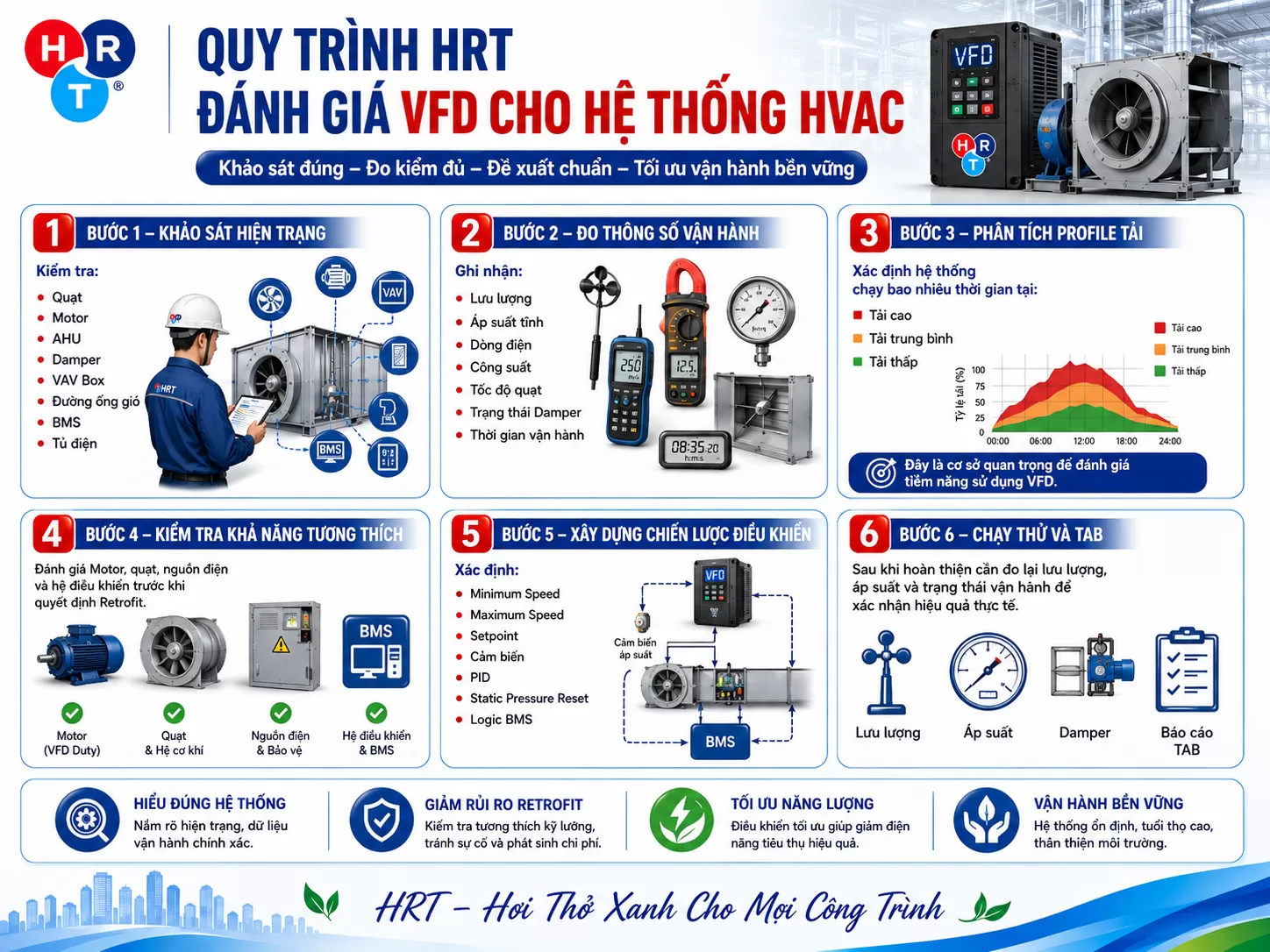
Step 1 – System Survey
Test AHU, fan, motor, damper, VAV Box, air duct, sensor and BMS.
Step 2 – Identify your workplace
Measure or test flow rate, pressure, fan speed and actual operation status.
Step 3 – Analyze the downloaded profile
Determine how long the system runs on high load, medium load and low load.
Step 4 – Check VFD usability
Evaluate motor, fan, power supply, electric cabinet and operation limit.
Step 5 – Build a Control Strategy
Determine control options by pressure, flow rate, CO2 or BMS depending on the capacity.
Step 6 – Installing and commissioning
Set minimum speed, maximum speed, PID, ramp-up, ramp-down and protection limits.
14. Conclusion
Variable-frequency drive for HVAC fan is an effective solution for systems where flow rate or pressure changes over time.
VFD is especially suitable for AHU VAV, outdoor air supply system on demand, variable flow rate ventilation system and integrated HVAC systems BMS.
However, efficiency does not depend exclusively on variable-frequency drive. Motor, fan, air duct system, minimum airflow, VAV Box, damper, sensor, static pressure, setpoint and control logic all must be considered synchronously.
A system that is properly surveyed, measured and controlled will create a better basis for reduce energy consumption, stabilize flow rate and improve HVAC operation efficiency.
Source: Publisher’s English edition · Vietnamese original on doanvanhoang.com