
What is ERV? Compare ERV And HRV In HVAC System
Machine-translated from Vietnamese. Read the original in Vietnamese

WHAT IS ERV? HOW DIFFERENT IS HRV ERV IN THE HVAC SYSTEM?
A room with air conditioning can still be cramped, smelly, and tiresome to the inside if it isn't provided with enough outdoor air.
But when outdoor air is directly applied to the building, the air conditioning system must process a large amount of heat and moisture. This increases the load for AHUs, PAUs, Chillers or VRV / VRF systems.
ERV is used to solve two problems simultaneously:
- Incorporate outdoor air into the building.
- Recovers some of the energy left in the emissions.
However, ERV is not a device that can be installed to save electricity. The effect is achieved only when the flow rate, pressure, thermal load, moisture, suction gas source and pipeline are properly calculated.
HRT's viewpoint:
Understand the right needs – Choose the right equipment – Control the right gas source – Measure well to the end.
What is an ERV?
ERV stands for Energy Recovery Ventilator, which means Ventilation equipment energy recovery.
Equipment operation with two air lines:
- Outdoor air is brought into the building.
- The air in the house is sucked out.
Inside the ERV there is an energy exchange core. Two streams of gas pass through separate chambers but can exchange partly:
- The temperature.
- It's a little damp.
This allows outdoor air to be pre-treated before being delivered to the room or to the back HVAC unit.
ERV can connect to:
- AHU.
- PAU.
- VRV or VRF system.
- Chiller system.
- Independent outdoor air supply pipeline.
- BMS control system.
Why does the building need ERV?
Closed rooms still need outdoor air
Many air conditioners only circulate the air in the room. They can maintain the temperature but do not automatically replenish sufficient outdoor air.
When a closed room is crowded, CO2, odors, and pollutants can build up more quickly.
ERV helps to bring outdoor gas in with a mechanical system instead of depending on:
- The doorway.
- The window.
- Natural leakage.
- External wind conditions.
Outdoor air flow rate must still be calculated according to the capacity, number of people, use time, area and applicable standards.
Outdoor air increases air conditioning load
In hot and humid conditions, outdoor air tends to have a higher temperature and moisture content than room air.
When directly supplying this gas volume into works, the air - conditioning systems must treat:
- Thermal load is present due to temperature difference.
- Thermal load hidden by moisture.
- The heat is coming from the outdoor air.
- The risk of condensation when humidity control is not good.
ERVs take advantage of cooler and drier exhaust to partially reduce the load before outdoor air enters an AHU, PAU or use area.
Four Main Roles of ERV in HVAC
1. Outdoor air level controlled
ERV brings outdoor air into the building according to the designed flow rate.
This solution is suitable for:
- The office.
- Meeting room.
- The hotel.
- School.
- The gym.
- The mall.
- Closed apartments and villas.
- Office area in the factory.
ERV does not mean that it is possible to arbitrarily reduce the flow rate of outdoor air. The device only helps to recover energy during ventilation.
2. Partial heat recovery
In hot seasons, exhaust from air-conditioned rooms is usually cooler than outdoor air. Part of the heat from outdoor air is transferred to the exhaust stream before being ejected.
The resulting outdoor air after ERV is pre-cooled.
In the cold season, the process can go the other way around. Warm exhaust gas assists in preliminary warming of outdoor air before supplying to the room.
3. Partial moisture recovery
ERVs are capable of transferring a portion of moisture between two gas streams.
In hot and humid conditions, the unit can help reduce the amount of moisture entering the building. As a result, the rear cold coil must handle lower moisture loads.
However, an ERV is not a dehumidifier.
Works with tight humidity control requirements may still need:
- PAU handle outdoor air.
- Coil cold enough hidden load.
- Dehumidifying equipment.
- Reheat.
- Temperature and humidity control system.
4. Supports load reduction of air conditioning system
Once outdoor air has been pretreatment, the AHU, PAU or rear air conditioning system must handle smaller temperature and humidity differences.
The actual savings amount depends on:
- The climate.
- Flow rate outdoor air.
- Operation schedule.
- Exchange core performance.
- The pressure drop of the device.
- Fan power.
- Filter status.
- Airtightness of pipeline.
- Bypass mode.
Do not just look at the percentage recovered on the catalog and conclude that the entire project will save accordingly.
How does ERV work?
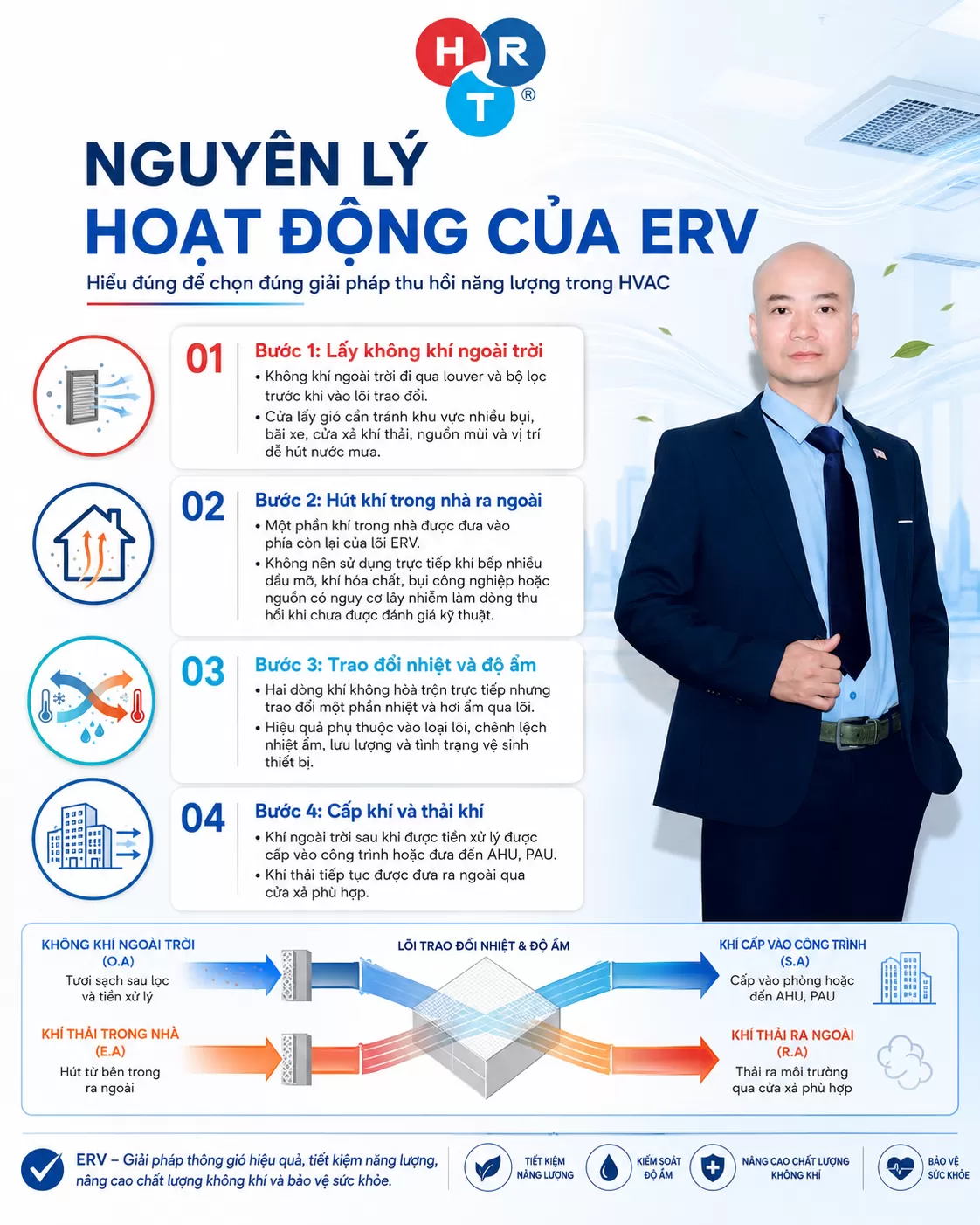
Stage 1: Taking outdoor air
Outdoor air passes through the intake, louver and filter before entering the exchange core.
The air intake must be avoided:
- Exhaust gas outlet.
- The parking lot.
- Garbage disposal area.
- Smoke and odor sources.
- Dusty areas.
- A location that is easy to absorb rainwater.
Stage 2: Indoor Air Suction
Part of the air in your home is drawn into the remaining compartment of the unit.
The source of suction gas must be carefully selected. It is not recommended to use the following gas streams by default for energy recovery:
- Kitchen gas is greasy.
- Chemical gas.
- A little corrosive.
- Heavy industrial dust.
- Toxic gas.
- Sources of infection risk.
Phase 3: Energy Exchange
The two air streams pass through the separate chambers of the ERV core.
Heat and part of moisture are transmitted through the exchanged material. Efficiency depends on:
- Core type.
- The temperature difference.
- Moisture difference.
- Flow rate two lines.
- Level and suction balance.
- Hygienic condition.
- Airtightness of the equipment.
Stage 4: Gas supply and exhaust
The outdoor gas after being pretreatment will:
- Directly to the room.
- Take it to the AHU.
- Take her to PAU.
- Distributed via air duct system.
Exhaust gas continues to be carried out through the outlet accordingly.
Is ERV an air conditioner?
No, no, no.
ERV does not generate refrigeration with compressor such as air conditioner, chiller or VRV/VRF system.
The device only utilizes the energy left in the exhaust to pretreat outdoor air.
After passing the ERV, air can still:
- Not cold enough.
- Not dry enough.
- No wind level yet.
- No filter level required.
So ERV does not replace:
- AHU.
- PAU.
- FCU.
- Central air conditioning.
- Dehumidifiers.
- Specialized filters.
The structure of an ERV device
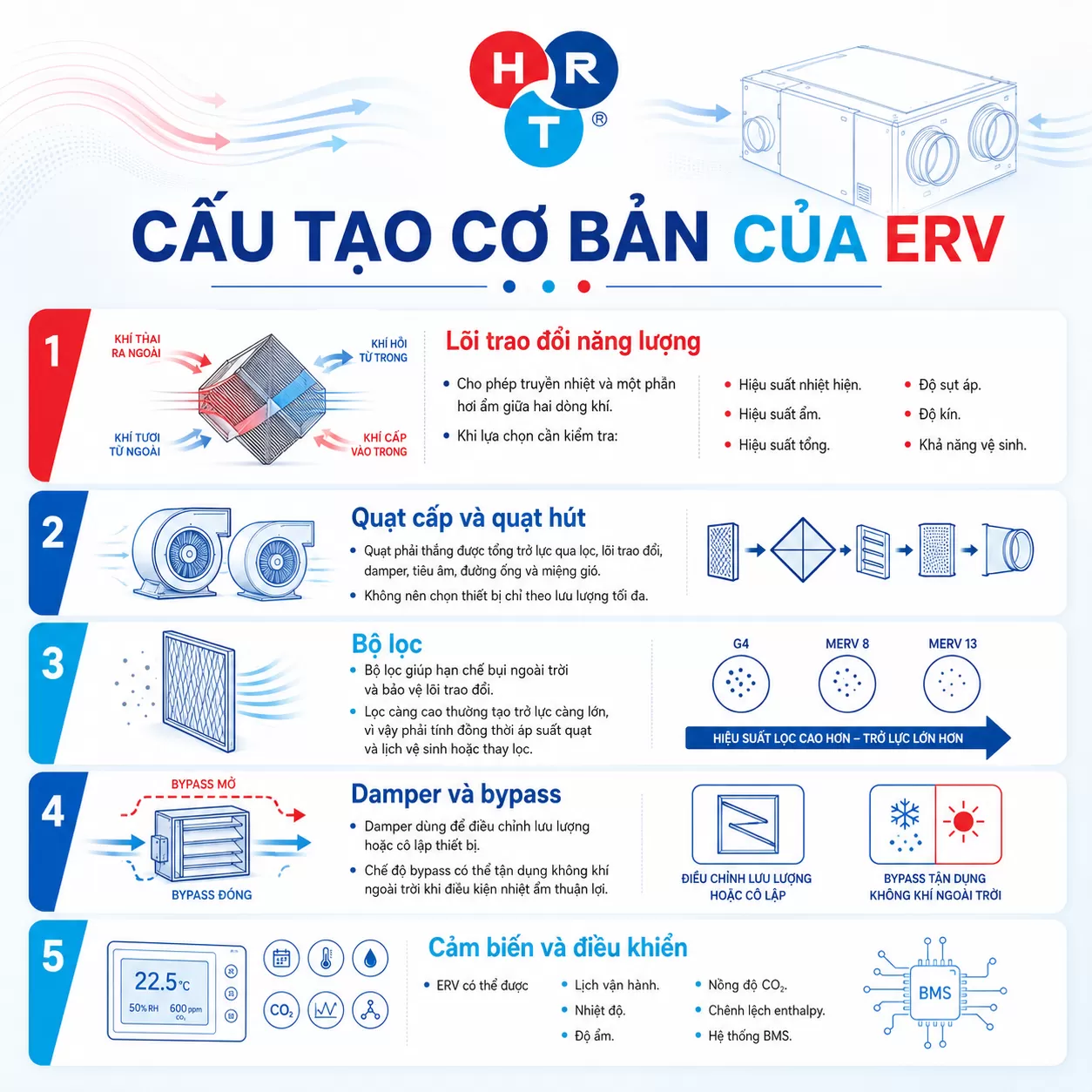
Energy Exchange Core
It is the most important part of the ERV.
The core allows heat and partial moisture transfer between outdoor gas and exhaust.
When choosing to check:
- Sensible heat performance.
- Hidden performance.
- Total performance.
- Pressure drop.
- Airtightness.
- The ability to remove the toilet.
- Material life.
Level fan and exhaust fan
The fan must win the total pressure loss of:
- Filters.
- Exchange core.
- Damper.
- Negative.
- Pipeline.
- Co and quail.
- Air outlet.
ERV should not be selected based solely on maximum flow rate when the device is running freely.
Check the flow rate at the correct external static pressure of the system.
Filters
Outdoor air side filter helps limit dust entering the building. Exhaust air side filter helps protect the exchange core.
The higher the filter level, the greater the pressure loss. Therefore, it must be calculated simultaneously:
- Fan pressure.
- Filter area.
- Cleaning cycle.
- Time for filter change.
- Accessible space.
Damper and bypass mode
Damper is used to adjust flow rate or isolate device.
The bypass mode allows air to pass around the core when outdoor conditions are favorable. For example, cool and dry outdoor air can be directly fed into the building to support natural cooling.
Sensors and Controls
ERV can operate according to:
- Schedule your settings.
- The temperature.
- Moisture.
- CO₂.
- Enthalpy difference.
- Signal from the BMS.
CO2 is a useful indicator of human density but does not represent the total amount of pollutants in the air.
How are ERV and HRV different?
| Criteria | ERV | HRV |
|---|---|---|
| Full name | Energy Recovery Ventilator | Heat Recovery Ventilator |
| Recoverability | Heat and partial moisture | Mainly heat recovery |
| Reduce thermal load current | Yes | Yes |
| Reduces moisture load | Can support | Not a primary function |
| Impact on humidity | Partial reduction of moisture difference | Less direct impact |
| Hot and humid climate | Often beneficial in terms of moisture load | Rear humidification system required |
| Dry cold climate | Can retain a portion of moisture | Air can dry faster |
| Maintenance requirements | Filter, Core, Fan, Damper, Sensor | ERV analogues |
Simply put:
- HRV is primarily heat recovery.
- ERV heat recovery and partial humidity.
When to choose an ERV?
ERV is usually considered when the work:
- There is a relatively large flow rate of outdoor air.
- conditioning operation for many hours per day.
- Stay in a hot, humid area.
- Need to reduce outdoor air load partially.
- Have a relatively clean source of suction air.
- There is enough pipeline space and maintenance.
- Requires stable air quality control.
ERV is especially suitable for offices, hotels, schools, meeting rooms and enclosed buildings with high density of people.
When can HRV or another solution be more suitable?
ERV is not the best option in any case.
HRV or other options may be considered when:
- The building does not want to transfer moisture between the two lines.
- The source of the fume is at risk of smelling.
- There are strict hygiene requirements.
- The system has specialized humidification treatment equipment.
- ERV cross-leak data did not respond.
- The ability to clean the ERV core is not suitable.
- Operating conditions essentially require heat recovery.
Should not choose according to the thinking “The more modern ERV should be definitely better than HRV".
Does ERV cause odor transmission?
The two gas streams in the ERV are not designed to mix directly. However, cross-contamination can still arise due to:
- Gaskets are not sealed.
- Opening of the case.
- Carryover on enthalpy wheels.
- Pressure differential is too large.
- Damper's breached.
- Installation in the wrong direction.
- The intake and outlet lines are too close together.
So, it is necessary to check the manufacturer's data on:
- Leakage rate.
- Core construction.
- Differential pressure allowed.
- Fan layout direction.
- Suction air source allowed to use.
Technical criteria for selecting an ERV
Flow rate outdoor air
Flow rate must be calculated according to the number of people, area, utility, pollution source and applicable standards.
Do not select devices by ad area only.
External static pressure
Total pressure loss should be calculated as follows:
- Pipeline.
- Filters.
- ERV core.
- Damper.
- Negative.
- Cock.
- Air outlet.
Recovery Performance
Must compare the devices at the same:
- Flow rate.
- Temperature condition.
- Humidity condition.
- Two - line equilibrium.
- Test method.
Pressure drop
The core has high efficiency but large pressure loss can increase the fan power.
Overall effectiveness should be assessed, not just in terms of recovery rates.
Noise level
Noise level must be checked at the correct flow rate and working pressure, especially when the device is located near:
- The bedroom.
- Meeting room.
- Classes.
- Space requires quiet.
Space maintenance
The area must be left sufficient for:
- Open the door.
- Replace the filter.
- Remove the core.
- Clean the fan.
- Check the damper.
- Condensate treatment.
- Maintenance motor and controller.
Common Mistakes
Think ERV Replacement Air Conditioner
ERV only pretreat outdoor air, does not guarantee final temperature and humidity.
Select the machine only according to flow rate
The device must simultaneously meet the flow rate and pressure at the working point.
No remaining moisture load
ERV only partially reduces moisture. Refrigeration coil or dehumidification equipment still has to handle the rest.
Kitchen Air Suction Through Conventional ERV
Grease can cling to the core, causing clogging, transmitting odors, and increasing the risk of unsanitary conditions.
Unbalanced level and suction
Two unbalanced gas flows can reduce recovery efficiency and change the work pressure.
No TAB after installation
Fan running does not mean the actual flow rate is correctly designed.
ERV deployment process at HRT
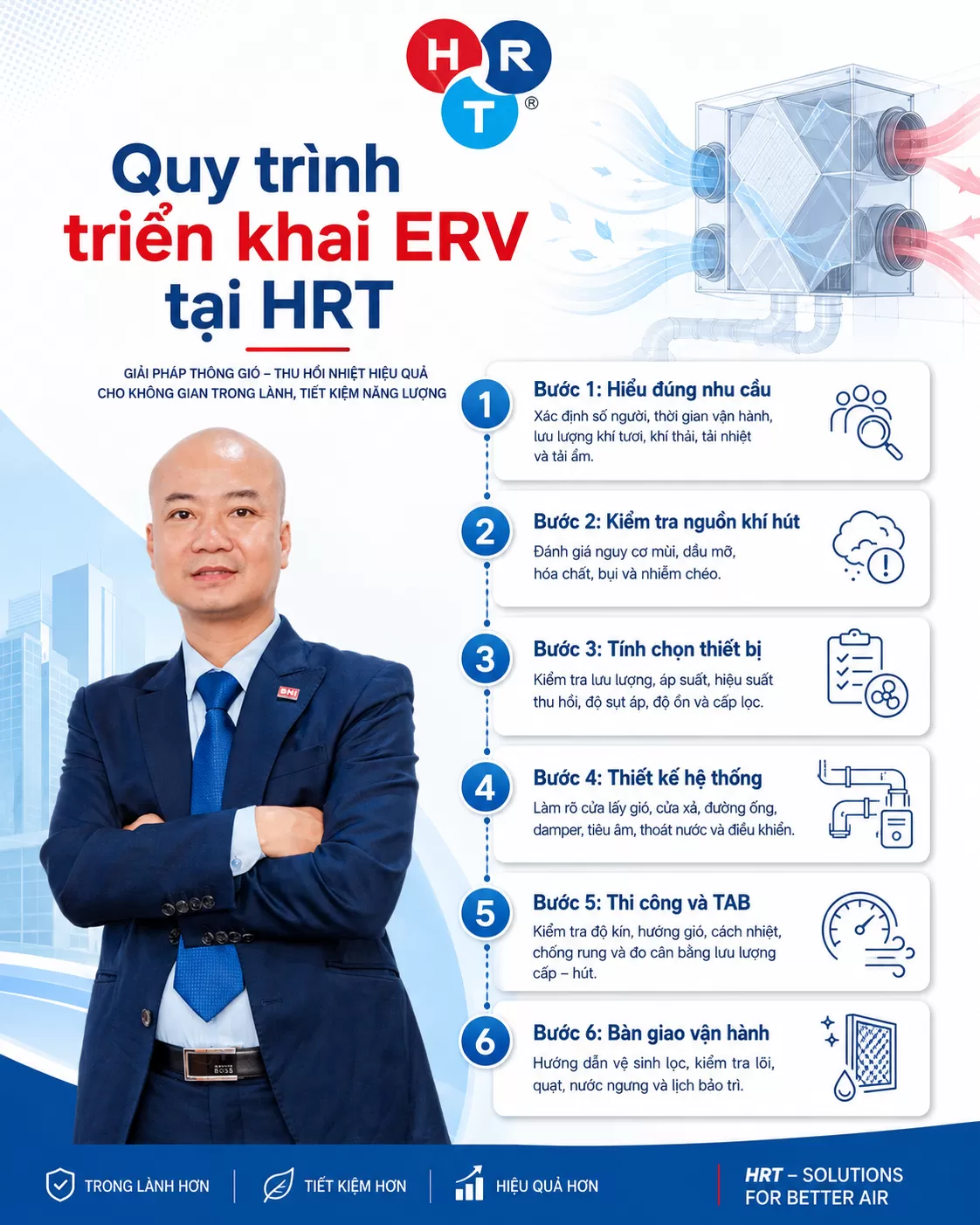
Step 1: Assess suction source
Check odor, grease, chemicals, dust, cross contamination risk and sanitary conditions.
Step 2: Calculate and select the device
Clarify flow rate, pressure, recovery performance, pressure drop, noise level, filtration grade and control options.
Step 3: System design
The application must include:
- The airlock.
- Exhaust door.
- Feeding and suction pipelines.
- Damper.
- Negative.
- Insulate.
- Drain the water.
- Power supply.
- Connect BMS.
- Maintenance interval.
Step 4: Construction and quality control
Check airtightness, wind direction, anti-vibration, insulation, differential pressure and equipment accessibility.
Step 5: TAB and acceptance testing
Actual Measurement:
- Flow rate level.
- suction flow rate.
- Pressure.
- The temperature.
- Moisture.
- Noise level.
- Bypass status.
- Control signal.
Step 6: Handover operation
Guidelines for filter cleaning, core, fan, damper, condensate and maintenance schedule.
Conclusion
ERV is a ventilation device that recovers energy, helps bring outdoor air into the building and takes advantage of part of the heat and moisture of exhaust gas.
Basic differences:
- HRV is primarily heat recovery.
- ERV heat recovery and partial humidity.
ERVs can assist in reducing the load on HVAC but effectiveness depends on the entire system, not just the unit.
Correct flow rate – Select the right pressure – Control the right air source – Balance the right suction level – maintenance clear to the end.
HRT – True Understanding • Clear • Dedicated
Green Breath for All Buildings
Source: Publisher’s English edition · Vietnamese original on doanvanhoang.com