
What is HRV? Heat Recovery Solution in HVAC System
Machine-translated from Vietnamese. Read the original in Vietnamese

What is HRV? Find out the solution for ventilation heat recovery in HVAC systems to help provide outdoor air, reduce energy loss, optimize air conditioning operation and improve air quality in modern buildings.
What is HRV? Principles, Benefits And How To Choose HRV For HVAC System
Ventilation is an important requirement for offices, schools, hotels, apartments, shopping malls and many modern buildings. The tighter the space, the more limited the natural air exchange capacity, making CO2, odor, moisture and pollutants easy to accumulate inside.
However, direct introduction of outdoor air into an air conditioning room can significantly increase the cooling or heating load. HVAC systems must consume additional energy to handle temperature, humidity and dust before supplying air to the area in use.
HRV was developed to reconcile these two requirements: to supply outdoor air to the building and recover part of the heat from the exhaust gas stream before discharging it into the environment.
1. Understand what HRV is
HRV stands for Heat Recovery Ventilator, which can be interpreted as ventilation heat recovery equipment.
During the operation, HRV simultaneously performs the following tasks:
- Drain old air from the building.
- Insert outdoor air into the system.
- Let two streams of gas pass through the heat exchanger core.
- Pretreat outdoor air temperature before supplying to the room.
- Reduces a portion of the load incurred due to ventilation for HVAC systems.
The two air streams are conducted through separate chambers. Heat passes through the surface of the exchange core but outdoor air and exhaust gases are not designed to actively mix directly.
HRV mainly exchange sensible heat, that is, the primary impact on temperature. HRV should not be defaulted to moisture transfer or desiccant like dedicated air handling equipment.
2. Energy problem when supplying outdoor air for the works
Outdoor air increases the handling load
The outside air often has a temperature and humidity different from the conditions in the room. When bringing this gas into the building, the air conditioning system may have to:
- Cooling in the hot season.
- Heat up in the cold season.
- Dehumidify in hot and humid conditions.
- Dust filter and pollutants.
- Adjust the gas status before feeding into the use area.
The larger the outdoor air flow rate, the greater the load that AHU, PAU, VRV/VRF or Chiller must handle.
Emissions still have energy value
Air that is drawn from an air - conditioned room will usually remain at a temperature close to your home's comfort level.
In the hot season, exhaust is usually cooler than outdoor air. If it is directly released, the remaining cold energy is lost as well.
HRV takes advantage of the temperature difference between exhaust and outdoor air to pre-treat outdoor air. As a result, the air state after HRV gets closer to the required state before entering the next treatment equipment.
HRV does not completely eliminate the conditioning load
The unit only recovers a part of the heat, which cannot bring the outdoor air to the correct temperature and humidity setting under any conditions.
AHU, PAU, VRV/VRF, Chiller or coil gas processor must still take care of the remaining thermal load and moisture load.
3. How does HRV work?
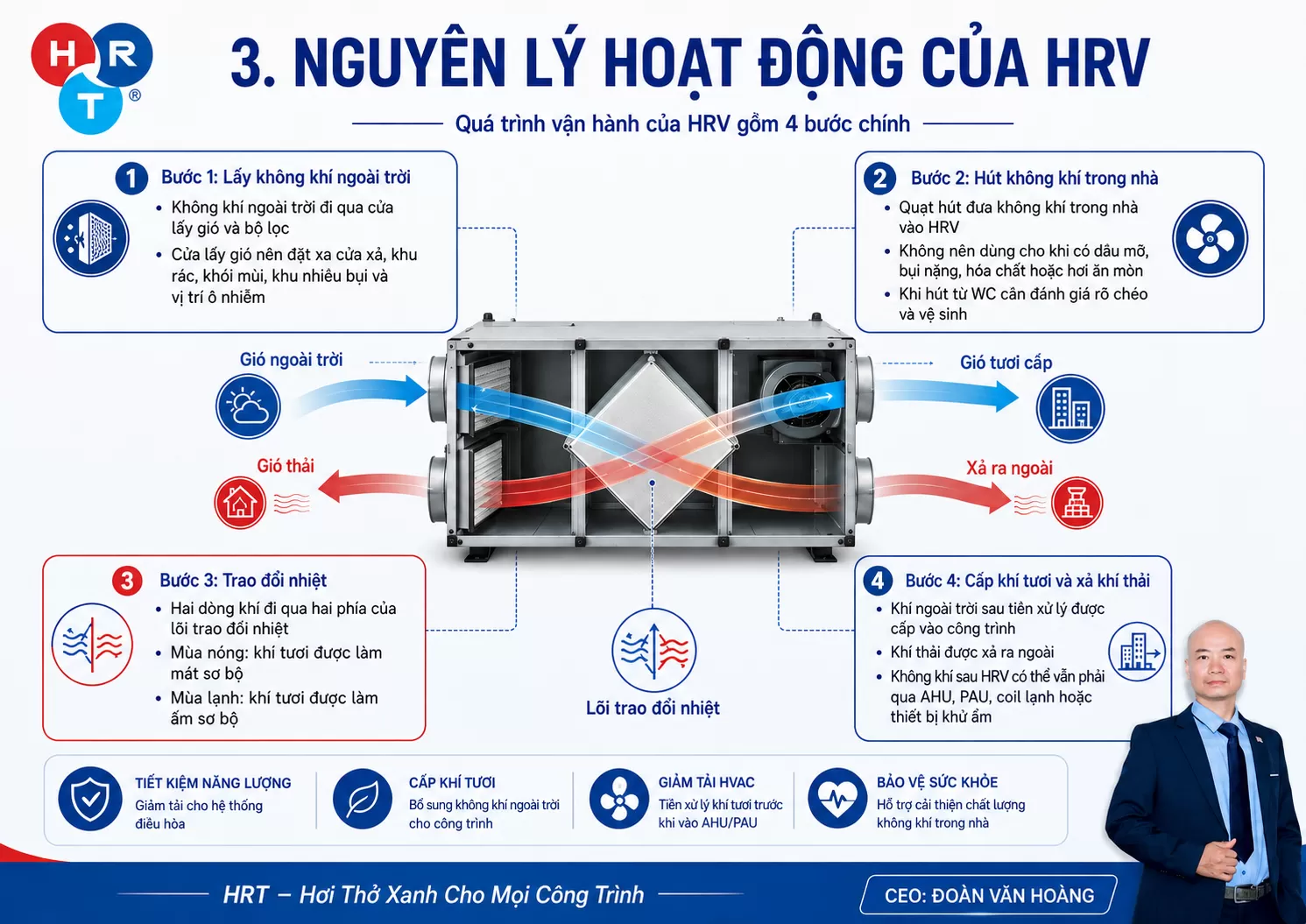
The operation principle of HRV can be divided into four stages.
Stage 1: Insert outdoor air into the equipment
Outdoor air passes through the intake, damper and filter before entering the heat exchanger core.
The inlet should be located far away from:
- Exhaust gas outlet.
- Garbage disposal area.
- Smoke and odor sources.
- Dusty traffic area.
- Sources of chemicals or pollutants.
Inappropriate spacing and orientation can cause exhaust gases to return to the feed line.
Stage 2: Recover air from the indoor
Exhaust fan brings the air in the work to HRV.
The suction gas source should be evaluated before design. It is not recommended to use a conventional HRV core for heat recovery from gases that have:
- Grease.
- Heavy dust.
- Chemicals.
- A little corrosive.
- Dangerous pollutants.
In case of using exhaust gas from toilets, check the level of cross-leakage, equipment structure, differential pressure and hygiene requirements.
Stage 3: Heat Exchanger Through Core
Outdoor gas and exhaust gas pass through both sides of the heat exchanger core.
During the hot season, part of the heat of outdoor air is transferred to cooler exhaust air. So, outdoor air temperature drops before it is fed into the system.
During the cold season, warm exhaust transfers some of the heat to cold outdoor air, which raises the level air temperature.
Stage 4: Outdoor air supply and exhaust
After Heat Exchanger:
- Outdoor gas is pretreatment and put into the building.
- The exhaust gas is discharged into the environment.
In many projects, the air after HRV still has to pass through an AHU, PAU, refrigerated coil or dehumidifier before it is fed into the room.
4. What parts does HRV consist of?
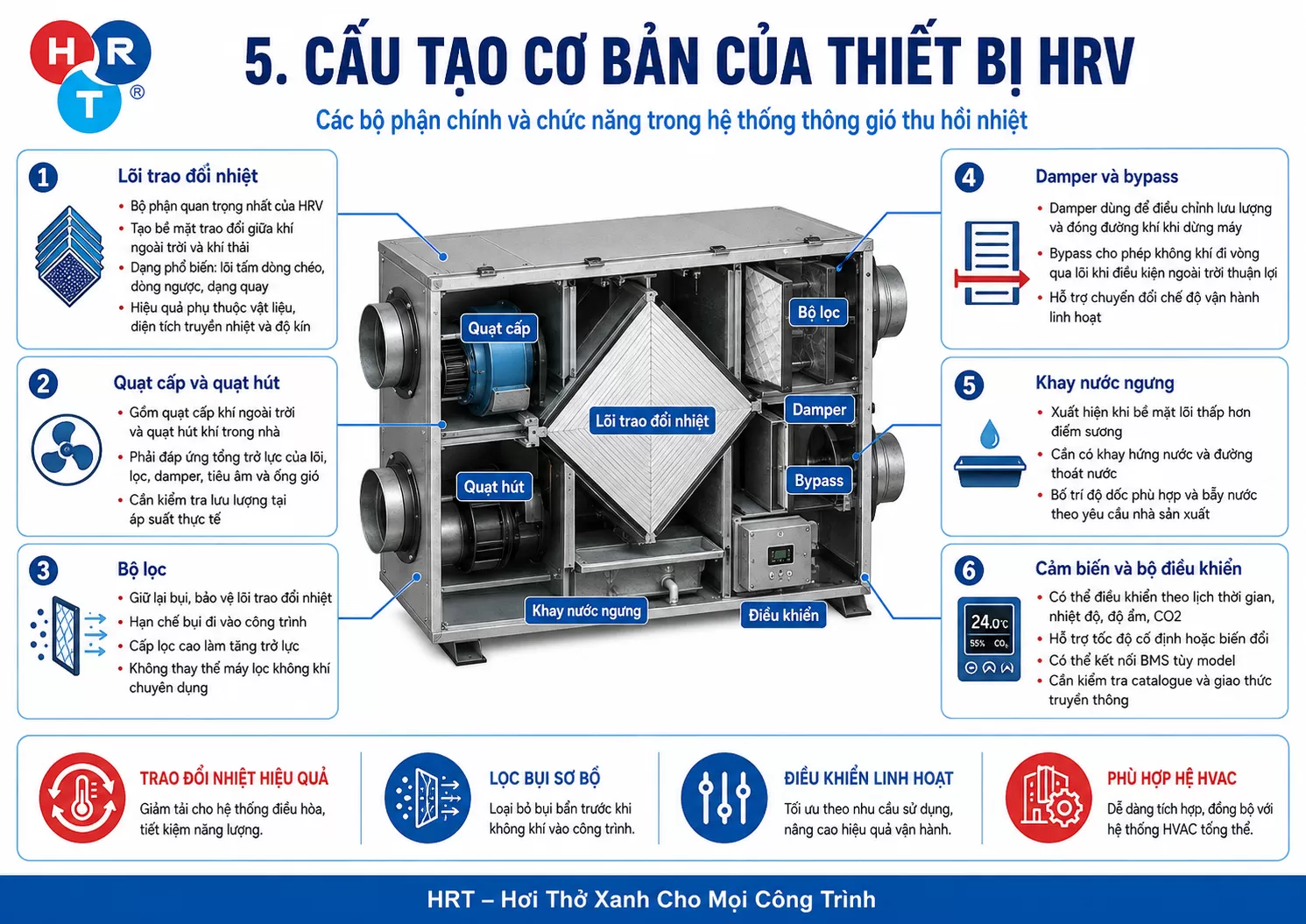
Heat Exchanger Core
The core is the central part of the unit, creating a heat transfer surface between outdoor air and exhaust gas.
Common forms include:
- Cross line plate core.
- Countercurrent plate core.
- rotary heat exchanger.
- Core or dedicated configuration.
The interchangeability depends on the material, surface area, air speed, airtightness and operation state.
Level fan and exhaust fan
HRV usually uses two fans:
- Fan brings outdoor air into the building.
- Exhaust fan indoor air out.
The fan must meet the total pressure loss of filter, exchange core, damper, negative consonant, air duct, quail, numbness and air outlet.
Therefore, it is not recommended to choose HRV based only on free flow rate. It is necessary to check the working point of the fan at the actual pressure.
Filters
The filter is responsible for retaining a portion of the dust, protecting the exchange core and limiting dust entering the system.
Higher filtration levels often increase pressure loss. The filter upgrade must be calculated simultaneously with the fan capacity and the filter surface area.
A filtered HRV is not synonymous with a dedicated air purifier.
Damper and bypass road
Damper is used to:
- Close or open the airway.
- Balance your flow rate.
- Reduce the flow of back air.
- Switch operation mode.
Bypass allows air to pass through the exchanger core when outdoor conditions are suitable or when the system does not require heat recovery.
Condensate Tray and Drainage Line
In some moist thermal states, the core surface may be lower than the dew point and condensate arises.
Then it is necessary to check:
- A water catcher.
- Drainage slope.
- The drainpipe.
- Water traps.
- Sanitary and maintenance capability.
Sensors and controllers
Depending on the model, HRV can operate according to:
- Timeline.
- The temperature.
- Moisture.
- CO2 levels.
- Fixed or variable fan speed.
- Signal from the BMS.
Not all devices have fully integrated sensors and communication protocols. Catalogue must be checked before finalizing the option.
5. Five HRV values bring to HVAC system
Active outdoor air level
HRV helps to bring new air into the building and suck out old air, supporting the improvement of ventilation conditions in closed spaces.
Limit heat loss
A portion of the energy left in the exhaust is used to pretreat outdoor air instead of being disposed of completely.
Reduce Air Conditioner Load
Outdoor air behind the core has a temperature closer to room conditions, which makes the rear unit handle smaller differences.
Support pressure control
When the flow rate of feed and suction is calculated, measured and balanced correctly, HRV can assist in maintaining the appropriate pressure for each area.
Operation more flexible
The unit can be combined with sensors, operation schedule, damper bypass and control system on demand to limit fan running when not needed.
It should be noted that heat recovery performance is not the power saving rate of the whole system. The actual efficiency also depends on fan power, filter pressure loss, airtightness air duct, cross leakage level, weather and operation time.
6. What is the difference between HRV and ERV?
HRV and ERV are both used in energy recovery ventilation systems, but the range of exchange is not quite the same.
Characteristics of HRV
- Mainly sensible heat exchange.
- The main effect on temperature.
- No steam transmission defaults.
- Don't consider it a dehumidifier.
Features of ERV
- Can exchange heat and partial steam.
- It affects both temperature and humidity.
- Often considered when moisture load is significant.
- The ability to transmit moisture depends on the core structure and operation conditions.
Should not choose HRV or ERV based only on the name. Designers need to check:
- Performance data.
- Moisture transfer ability.
- Cross leak.
- Input air status.
- Uses.
- Climate conditions.
- Air quality requirements.
7. What systems can HRV be combined with?
Combined with VRV/VRF
Indoor unit VRV/VRF handles thermal load in rooms, while HRV provides outdoor air and exhaust gas suction.
In hot humid climates, the air after HRV may still have to be dehumidified before it is supplied into the area of use.
Combined with FCU
FCU is responsible for cooling load in each room or each area. HRV can provide outdoor air independently or bring recovered gas into the distribution network.
Do not directly connect outdoor air to the FCU inlet without checking the flow rate, pressure and moisture load handling capacity.
Combined with AHU or PAU
The air following HRV is passed through the AHU or PAU to continue:
- Filter.
- Cooling.
- Heating.
- Dehumidify.
- Adjust your status.
When coupling, differential pressure, operation sequence, reverse suction capacity and the state when either device stops must be clarified.
Combined with Chiller
HRV helps to reduce the load of outdoor air partially before the air flows through the cold coil.
The Chiller still provides cold water for the AHU or PAU to handle the remaining load.
8. What works should consider using HRV
Housing, apartments and villas
Suitable for closed buildings, frequent air conditioning and need stable outdoor air source.
Noise level, ceiling height, inlet and filter change space should be noted.
Office and meeting room
The density of people can vary by hour. HRV can combine CO2 sensor or operation schedule to adjust the flow rate as needed.
Schools and schools
Classrooms with a large concentration of people at the same time require significant ventilation. HRV helps to provide outdoor air while reducing the load due to ventilation.
Hotel Location
The equipment can serve each room or each group of areas. When utilizing toilet exhaust gas, cross-leakage and odor contamination risk must be assessed.
Business Center
HRV can operate independently or combine AHU, PAU. The system should be partitioned according to the history of use to avoid running in a simultaneous manner causing waste.
Factory Building
Heat recovery should only be done when the exhaust gas is clean enough and can be used safely. Gases containing oil, heavy dust, chemicals or corrosive vapors require specialized solutions.
9. Six important criteria when choosing HRV
1. Correct calculation of outdoor air flow rate
Do not select HRV based on floor area only. flow rate must be based on:
- Functional.
- Number of people.
- Time of use.
- Pollution sources.
- Requires ventilation.
- Desired pressure.
2. Correctly identify the source of suction gas
The suction gas must be clarified whether it contains dust, grease, chemicals, odors or corrosive substances. Inappropriate gas sources should be separated from the recovery system.
3. Check flow rate at actual pressure
The device must generate sufficient flow rate after connecting to the filter, air duct, damper, acoustic and air outlet.
The flow rate parameter in the absence of pressure loss cannot represent the actual installation conditions.
4. Compare performance under the same conditions
Compare models at the same:
- Flow rate.
- Input temperature.
- Balanced state.
- Test method.
- Pressure loss.
Do not use peak performance at low flow rates to represent the entire operation.
5. Cross-leakage test
The leakage level between the flue gas and the feed gas is especially important when the suction gas source is odorous or low in quality.
For high-requirement construction, parameters such as EATR and OACF should be considered.
6. Maintenance capability guarantee
The installation site should have enough space to:
- Replace your filter.
- Remove the exchanger core.
- Check the fan.
- Clean the tray.
- Maintenance damper.
- Check the sensors.
After construction, it is necessary to measure and balance the flow rate of suction level instead of assessing by feeling at the air outlet.
10. Common Errors That Make HRV Systems Inefficient
View HRV as air conditioner
HRV does not self-cool, does not have a full refrigeration cycle and does not replace VRV / VRF, Chiller or other air conditioning system.
Given that HRV handles moisture completely
HRV normally mainly exchanges sensible heat. In hot and humid conditions, the air after HRV can still carry large moisture load.
Only interested in recovery performance
A high - efficiency device with a fan that consumes a lot of electricity, large pressure loss, or a low actual flow rate may not provide good overall performance.
Use of inappropriate exhaust sources
Heavy oils, greases, chemicals and dust can contaminate the core, increase pressure loss, reduce performance and generate a risk of pollution.
Unbalanced flow rate level – suction
An imbalance can change the room pressure, cause dust collection, odor generation, or reduce effective outdoor air intake.
Ignore condensate
Incorrect drainage can cause water spills, ceiling moisture, odor and corrosion of equipment.
Place the intake close to the outlet
This layout increases the risk of emissions returning to outdoor air lines.
11. Procedure for deploying HRV system at HRT
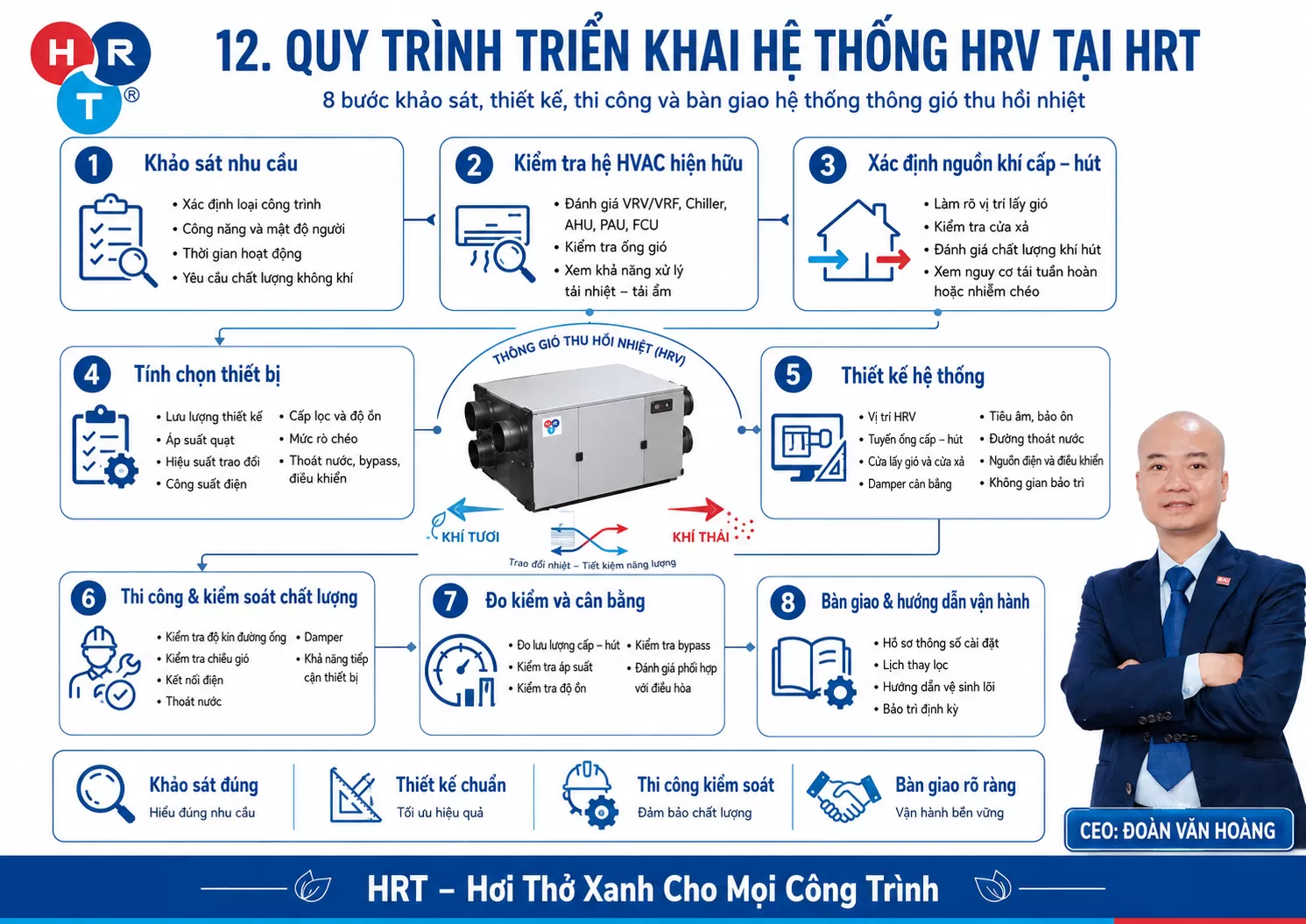
Survey of works
HRT determines the utility, density of use, operating time, source of pollution, and air quality requirements.
Evaluate the existing system
Check VRV/VRF, Chiller, AHU, PAU, FCU, ductwork and thermal load – moisture load handling capability.
Analyze the supply and suction air
Clarify the air intake location, exhaust outlet, suction gas quality, recirculation risk and cross contamination.
HRV Selection
The parameters to be tested include:
- Flow rate.
- Fan pressure.
- Exchange performance.
- Electrical power.
- Filtering.
- Noise level.
- Cross leak.
- Drain the water.
- Bypass.
- Controls.
Engineering Design
The profile clearly shows the location of equipment, pipeline, air intake, exhaust, damper, sound absorption, insulation, drainage, power supply and maintenance space.
Construction and Quality Control
System is tested for airtightness air duct, airflow, electrical connection, damper, drainage line and equipment accessibility.
Measurement and balance
After completion, HRT measures flow rate of suction level, pressure, noise level, bypass mode and the ability to coordinate with air conditioning.
Handover operation
Handover records include installation parameters, filter change schedule, core cleaning instructions and maintenance plan.
12. What does HRV maintenance need to do?
The system should be periodically checked to maintain the flow rate and heat exchange efficiency.
The main items include:
- Clean or replace the filter.
- Check for dust on the exchanger core.
- Check the fan and motor.
- Noise and vibration testing.
- Check the damper and actuator.
- Clean the condensate tray.
- Clear the drain.
- Check the sensors.
- Re-measure the level-suction flow rate.
Dirt filters increase pressure loss, reduce flow rate and cause fans to consume more electricity. Dust-causing cores also reduce heat exchange capacity.
Conclusion
HRV is a ventilation heat recovery solution that helps the building supply outdoor air, limit energy loss and reduce a portion of the load on HVAC systems.
However, efficiency does not depend solely on the exchange core performance. A HRV system that wants stable operation needs to be properly calculated flow rate, select the right fan pressure, control the suction air source, limit cross-leakage, arrange drainage and measure balance after construction.
HRT provides solutions for survey, consultancy, design, construction, testing and optimization of HRV system combined with VRV/VRF, Chiller, AHU, PAU, FCU and ventilation system for each type of project.
HRT – Green Breath for All Buildings
Right From the Start – Clear To the End – Green Sustainable
Source: Publisher’s English edition · Vietnamese original on doanvanhoang.com