
What is PAU? Don't choose just by air flow | HRT
Machine-translated from Vietnamese. Read the original in Vietnamese
What is PAU and why should not choose equipment only according to airflow rate? CEO Đoàn Văn Hoàng – HRT sharing how to choose PAU based on outdoor air handling requirements, humidity control and operation conditions, helping project owner acceptance testing by actual results.
What is PAU? Don't choose equipment only by airflow rate
PAU is an outdoor air treatment equipment before supplying to buildings or transferring to the rear air conditioner. Depending on configuration, PAU can perform filtration, cooling, dehumidification, heating and adjustment of flow rate to meet design requirements.
Let's put ourselves in a device selection meeting. Two quotes at the same airflow rate, approximately the same machine size, but with significant price differences.
If you only look at the current of m3/h, the cheaper option may be considered a reasonable choice. However, before approving, I will ask to clarify: what conditions does air enter the machine, what state must be reached after treatment and can the device meet the changing needs?
The same amount of wind, different input temperature and humidity conditions can create very different processing requirements. Therefore, the flow rate is not enough to represent the full capacity of the PAU.
From an HRT executive perspective, I want the selection to start with the work results that need to be received.
Do not buy a volume of wind specified on the catalog. Determine the quality of the wind flow to be put into the building.
Understand PAU through the task, not just by the abbreviation
The name PAU may appear according to different conventions in the technical documentation. For example, Siemens uses the name Pre-Cooling Air Handling Unit in the equipment convention table. So when reading the drawing, it is necessary to reconcile the accompanying function and configuration, instead of inferring the whole task from the three letters PAU.
In this article, I focus on PAU in charge of outdoor wind treatment for air conditioning – ventilation systems.
What I need to clarify in the file is the boundaries of responsibility: how far the PAU handles, what parts are assigned to equipment in the room and what requirements must be confirmed at the system level.
PAU and AHU should not be distinguished by only shape
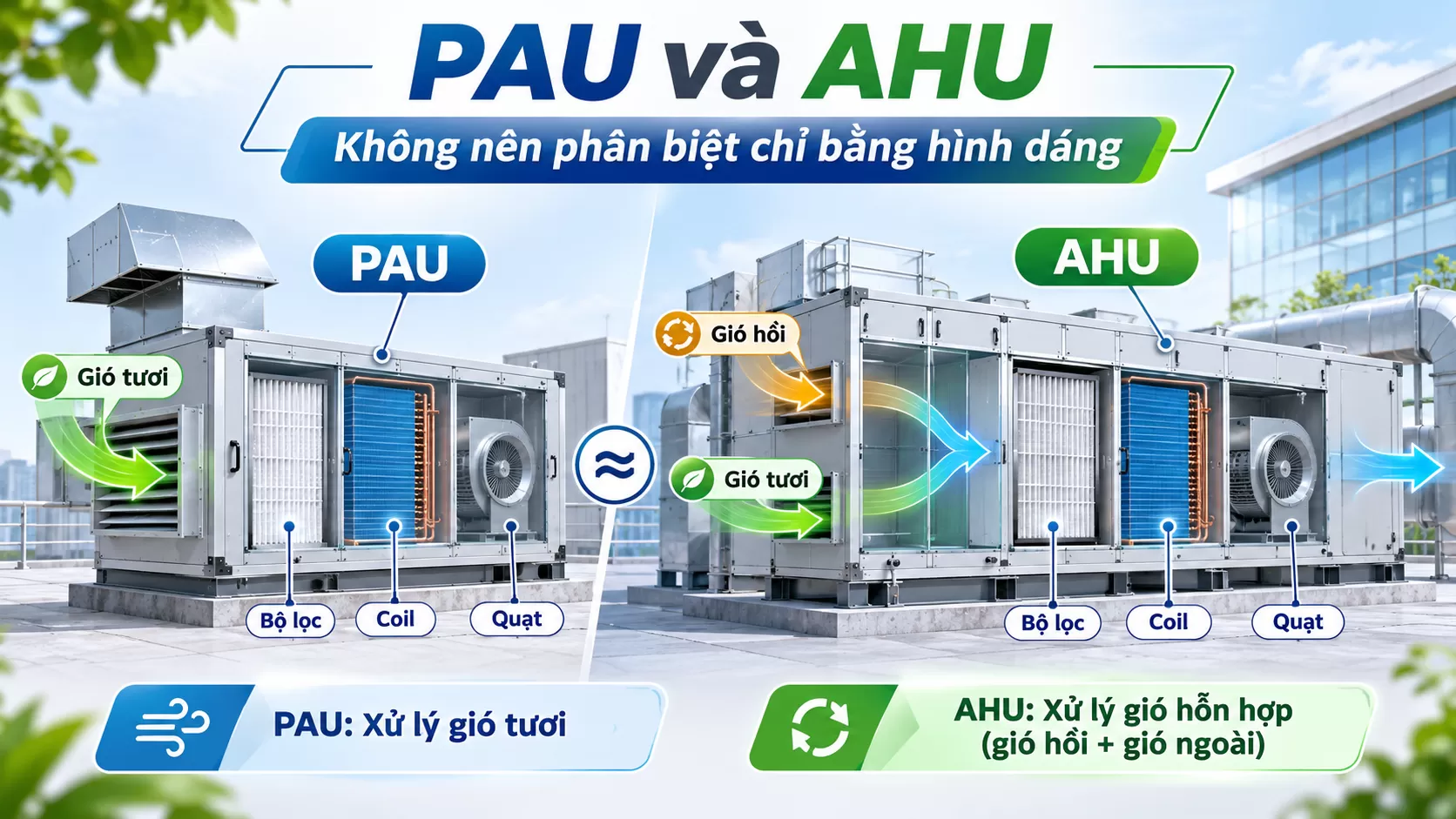
Air handling units can use the same shell, filter, coil and fan. AHUs have a mixed wind treatment configuration or specific requirements for external wind, temperature, humidity and energy recovery. The cold source can be cold water from a chiller or a direct expansion system using refrigerant.
Therefore, I do not want the proposal to just write “PAU other AHU” and stop.
Specify the airflow that each unit receives and the conditions that must be met at the output. If there is an air conditioning unit in the room, specify the load that the unit continues to handle.
Organizational handling of outdoor air is also used in DOAS systems. However, it is not recommended to default to every PAU-named device as fully configured and controllable as a fully designed DOAS system. The actual task of the whole system should be considered.
Device name helps identify. New design diagrams and parameters indicate what the device should do.
Before selecting the machine, please close the wind state to be handed over
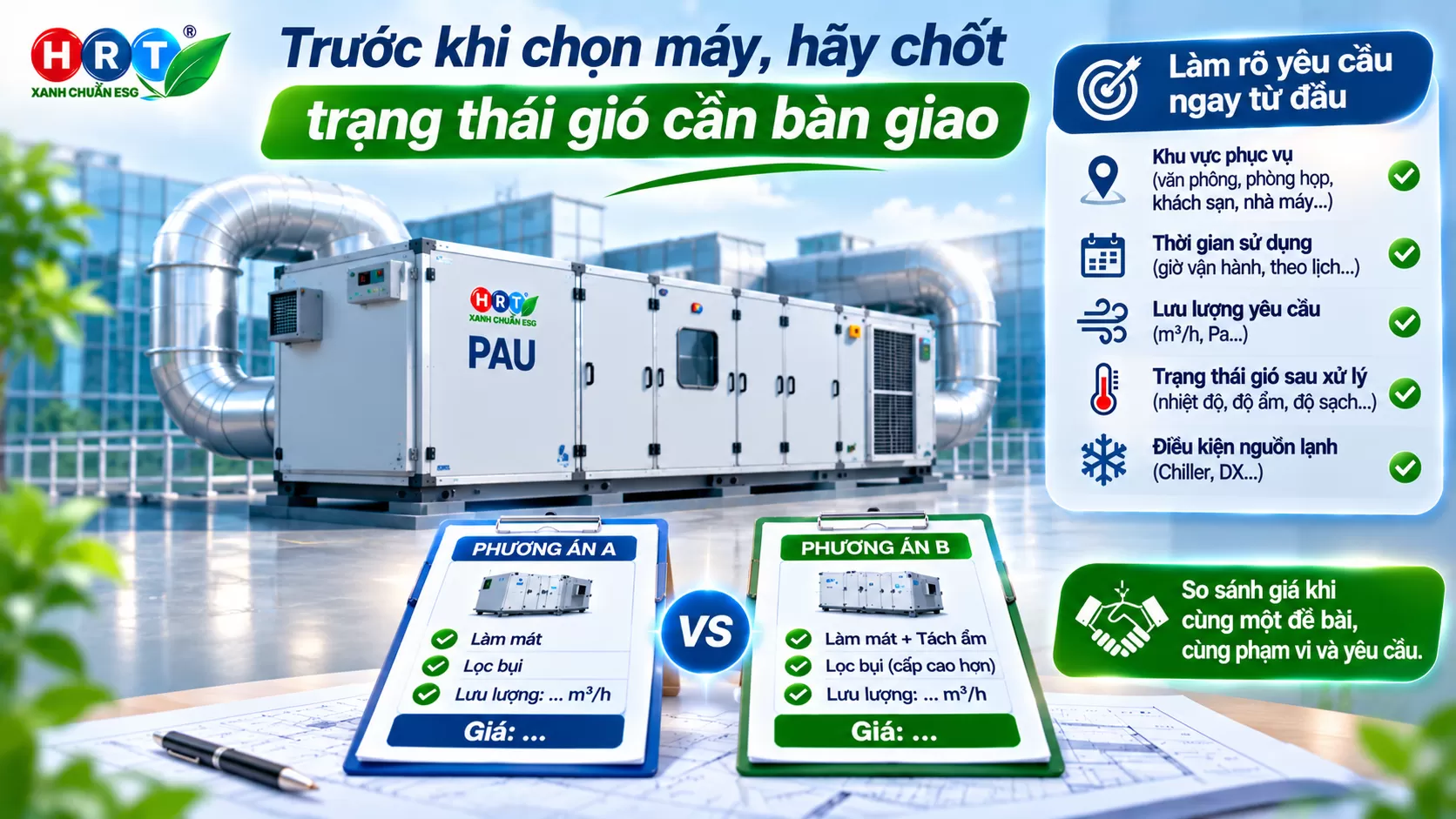
When reviewing the PAU method, I asked the designer to describe the output requirements by the testable conditions.
Do not just write “sufficient outdoor air” or “ensure clean air” These expressions do not help the project owner know what basis to acceptance testing.
I want the profile to identify the area served, usage time, required flow rate, post-treatment air condition and refrigeration source conditions. If there is a humidity control requirement, it should appear in the selection, not waiting for the operation to add it.
For offices, clarify the difference between regular work areas and meeting rooms used from time to time. For hotels, discuss how to serve areas with different schedules. For factories, technology representatives must confirm the conditions that production needs to maintain.
These are the questions I propose to include in the survey, not assumptions that engineers should complete on behalf of users.
Two quotations should only be compared when the same topic
Back at the equipment selection meeting, I'm going to ask you to put all options on the same computational condition.
If one option has moisture separation calculated and the other only considers cooling, the price difference does not reflect an equivalent comparison. Similarly, it is necessary to clarify the filter level, adjustability and control range included in each proposal.
Missing information must be requested before closing.
I don't default to more expensive equipment being better. I want to know what capabilities the investment is buying and whether they are really needed for the building.
Compare prices after task unanimity. Don't reduce the technical range and then call the difference part as savings.
Inside the PAU, parts must serve the same requirement
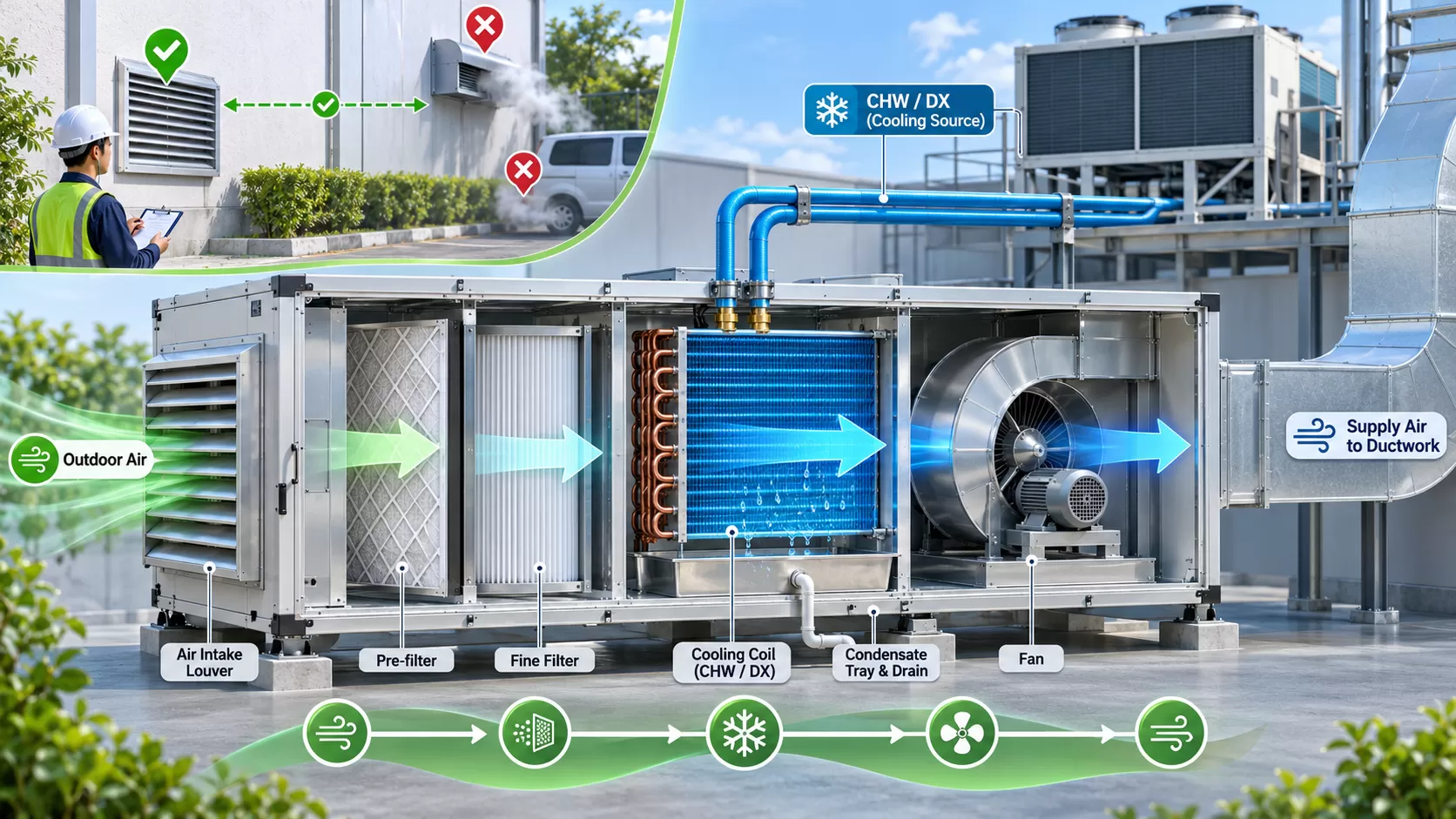
In an outdoor wind treatment system, air is received, filtered, moist heat treated and distributed through the pipeline by a fan. The configuration can add energy recovery or other stages according to the design. This is a coordinated chain, not a collection of independently selected components.
Work starts from the air intake
Before I look inside the machine, I want to check where the air enters the system.
The air intake should be considered in correlation with the exhaust source, vehicle area, exhaust mouth and adjacent sources of pollution. The inappropriate location can introduce contaminated air into the system from the beginning.
During the site coordination session, place the air inlet next to the relevant discharge points on the same drawing. If the site is different from the original plan, re-evaluate before confirmation.
Don't use the filter as a reason to skip picking a spot for air intake.
Particulate filtration and gaseous contamination treatment are different tasks. A dust filter does not automatically treat all gases or odors; those requirements require a solution tailored to the specific contaminant.
Filter, coil and fan must be selected synchronously
For filters, I require both filterability and differential pressure monitoring. The EPA also emphasizes taking into account filter loss and differential pressure tracking to support operation, maintenance.
Therefore, changing filter levels must go along with checking the system's responsiveness. It is not recommended to browse an individual item and then hand over the rest to the operation team for self-regulation.
With cold water coil, PAU needs the corresponding water source and working conditions from Chiller system. With DX configuration, it is necessary to match coil, condenser and control assembly of the system. These two options have different connection requirements, even though they are the same for air treatment.
I want the machine selection table and refrigeration source profile checked together. A coil capacity parameter is not sufficient if the conditions used for publication do not match the conditions that the project can provide.
The moisture load problem can appear when it is not the hottest
This is the part I want project owner to understand when learning PAU principle of operation.
The conditions that cause large cooling requirements and large dehumidification requirements do not necessarily coincide. Innovent manufacturer's instructions note that the selection of outdoor wind treatment systems should consider both cooling design conditions and dehumidification design conditions. Only temperature considerations may miss the humidity control requirements.
So I don't want the portfolio to prove that the device works well on a hot day.
Check also that thermal load in the room is reduced but the outdoor air still carries a lot of moisture. In this case, the system must have a way to maintain the task of handling moisture without overcooling the space.
Cooling and moisture separation are related, but not synonymous
When air passes through a coil surface whose temperature is lower than its dew point, water vapor can condense and be collected. This is the basis of the cold coil dehumidification process. With some configurations, the air after dehumidification needs to be reheated to avoid excessive space cooling; other configurations can take advantage of this cold wind flow to assist with room load handling.
So I don't apply a single wind temperature to every PAU.
What you need to do is determine the humidity treatment requirements, the location of the wind supply and how to coordinate with the equipment behind it. From there to choose the appropriate wind state.
If reheating is required, the plan must explain the reason and energy source used. It should not be considered a default stage without assessing the effect on the operation.
Read the humidity should be with temperature
Relative humidity varies with temperature, even if the amount of steam has not changed. So just looking at a percentage value of humidity is not enough to compare the ability of humidity treatment between air states. Dew points or humidity ratios help to further clarify the amount of steams being controlled.
I recommend that the measurement results at the inlet, after treatment and the area to be recorded with the same temperature, time and operation status.
If you need to conclude that the PAU has not yet achieved the required humidity, indicate the supporting data. It should not be concluded only from the feeling that “the wind is not cold enough” or a separate humidity number on the screen.
Moisture treatment needs a specific criterion. Reaching the temperature does not automatically replace that criterion.
Just because the wind is out of the PAU doesn't mean it's in the right room.
In the distribution plan, the processed wind can be delivered directly to each area or put into the air conditioning equipment in place. Each layout creates different coordination requirements.
This is why I want the PAU diagram to be viewed with the relevant AHU, FCU or terminal drawing.
When delivering through equipment in the room, must check the fan mode
With the configuration of the processed external wind into the inlet of a room device, the fan of that device is involved in delivering the wind to the user. ASHRAE notes that stopping or changing the speed of the fan may affect the amount of external wind being distributed.
I suggest a control scenario that answers the situation: the room has reached temperature but there is still a user, then how does the external wind supply work?
If the option depends on another fan, that dependency must be shown in the operation description and checked when commissioning.
Do not just look at the “PAU running” status and confirm that all areas receive enough wind.
No default ceiling cavity will distribute wind properly
The option of introducing the wind into a ceiling cavity near the unit may reduce piping, but ensuring the correct amount of wind reaches each area is more difficult when there is no direct connection. ASHRAE also makes considerations for calibration and condensation hazards with respect to this layout.
So I want the designer to explain the path of the wind by a specific plan. Which area does the wind reach, where is it regulated and how is it checked?
The acceptance testing range should not end at the machine outlet. It should go to the place that needs to be ventilation.
Write acceptance testing conditions right in the selection proposal

When I approve the PAU, I want to know what data the project team will use to confirm the device's mission completion.
According to the US Department of Energy, commissioning is the process of verifying that the system is installed and operated according to design criteria. The inspection should include damper functions, controls, schedules and parameters to match the needs of use.
For the specific project, I recommend commissioning records that show outdoor conditions, refrigeration mode, fan status and results in areas within the scope of inspection.
The flow rate part should have measurement position and way to compare with requirements. The humid heat part should have data corresponding to operation conditions. The control functions should be confirmed by suitable test situation, not only by the display screen.
No condition has been verified, specify that condition
Assume that the acceptance testing date has favorable outdoor conditions, which differ significantly from the adverse conditions used to select the machine.
In this situation, I suggest separating the results measured at the scene from the capacity confirmed by the selection dossier and the contents that need additional verification.
It is not advisable to use a favorable commissioning to conclude that all modes have been reached.
If there is a limit, the report should state the scope, responsibility and monitoring plan. The operator needs to know which content has been confirmed, which is still open.
I also want the handover records sufficient to trace back from an anomaly to relevant data: which area servers, how the settings are set, where the sensors are located and who is allowed to change modes.
Good acceptance testing is not a record with many confirmation marks. It is a conclusion that explains what you have tested.
The value of PAU must be kept during operation
A plan with separate treatment of the outdoor wind does not automatically become the most economical option.
The equipment still needs energy for the fan and air handling process. Energy recovery from the waste stream can assist in reducing the need for treatment, but must be considered in the appropriate configuration.
When receiving an optimal proposal, I ask to clarify the benefits at a system-wide scale. The portion of load reduced for the rear unit should be placed next to the portion of energy used at the PAU and related components.
I do not want to report power reduction made by reducing the amount of wind that the building still needs. Before changing the running schedule or adjustment mode, please confirm the service demand and conditions are not traded off.
Maintenance must keep the processing capacity, not only clean the case
EPA puts the condition of filter assembly, ability to prevent wind from going around through the filter, coil cleanliness, condensate tray and drainage direction into the content of ventilation system inspection. These are the parts that should be approached when maintenance.
I recommend to review the operation right before closing the machine position. Maintainer must have a filter outlet, open the inspection door and access to the parts to be cleaned.
After maintenance, the report should record operation results within the scope of the work performed. If filtering or configuration adjustments are made, specify parameters to check again.
A cleaner device image does not answer the question of whether the system serves the required requirements.
CEO View Đoàn Văn Hoàng: Clear task assignment for outdoor wind
When project owner asks What is PAUI want answers that help them make decisions, not just remember one more device name.
Before buying the machine, it is necessary to clarify what the work requires at the airflow is provided. When designing, it is necessary To determine how the equipment is processed and how to coordinate with the rest. When handing over, it is necessary the test results corresponding to the agreed requirements.
I want the approver to understand the reasons for the choice. I want the construction team to know what conditions to keep. I want the operator to have enough information to take over and handle when needs change.
That's how I define the spirit. True – Clear – Dedicated in the workplace.
An unclear moisture load plan should be added. A wind supply line that has not proved its capacity to serve each area should be reviewed. An insufficiently grounded result must be properly recorded, not converted into a commitment too soon.
Choose PAU not only for more wind. Choose a wind handling and distribution plan that has clear tasks, implemented conditions and proven way.
Exchange PAU with HRT
To start, the project owner should prepare the utility site, operation schedule, temperature – humidity requirements and existing air conditioning information.
For an active construction, add practical reflections, existing measurement data and recent changes. From there, you can determine which section to survey before deciding to add, replace or adjust the PAU.
Contact HRT: 0909 326 888. HRT
CEO Đoàn Văn Hoàng | HRT
Right from the beginning – Clear to the end – Sustainable Green.
Source: Publisher’s English edition · Vietnamese original on doanvanhoang.com