
What is PAU? Role, Principle and How to Choose PAU in HVAC
Machine-translated from Vietnamese. Read the original in Vietnamese
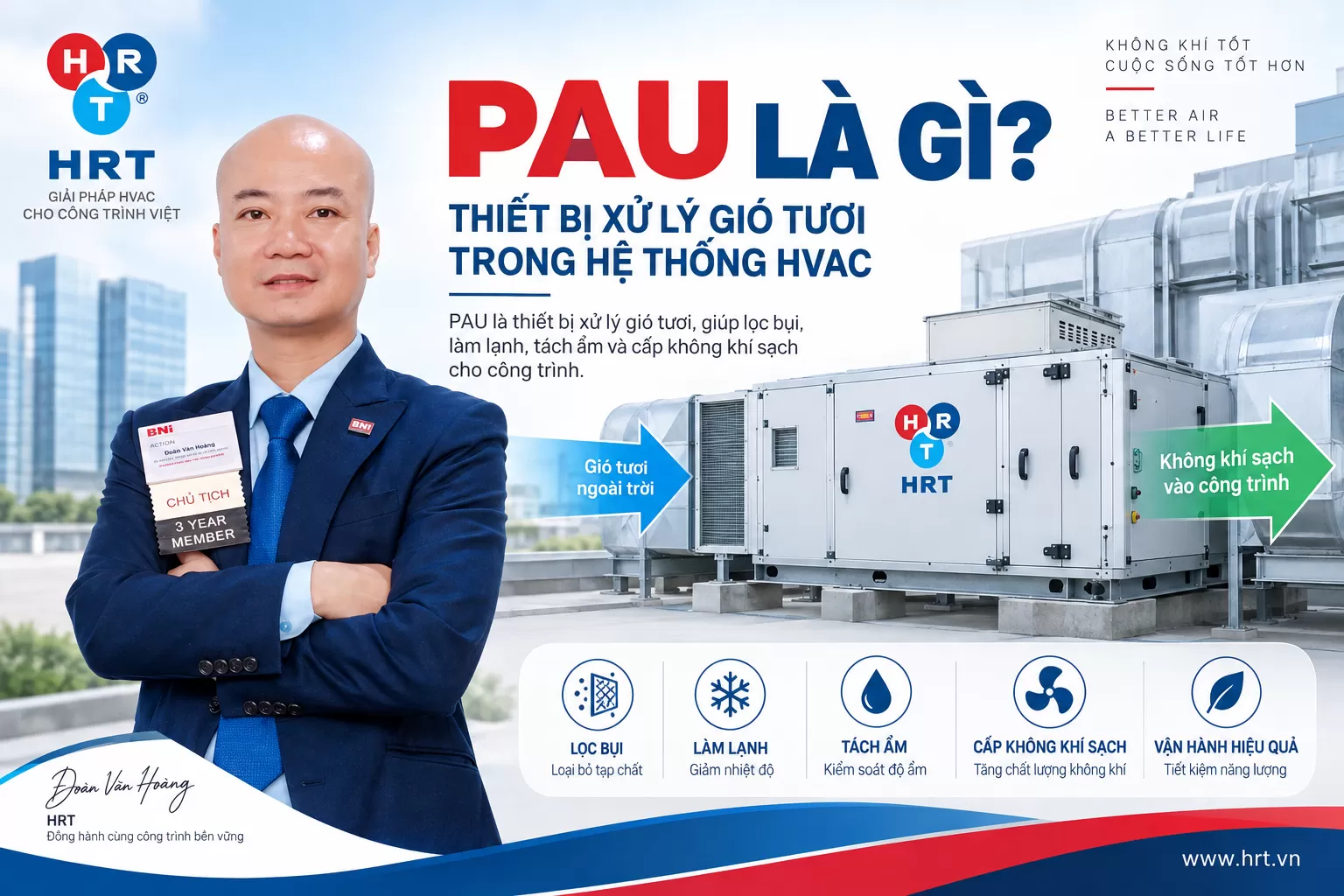
What is PAU? Role, Principles And How To Choose PAU In HVAC System
In many buildings using central air conditioning, the control of room temperature is not enough. The system also has to solve another important problem: How to bring enough outdoor air from outside but not too big thermal load and humidity for the building?
This is one of the most important tasks of PAU.
PAU is commonly found in HVAC systems of offices, hotels, shopping malls, hospitals, factories and many other buildings that require indoor air quality control.
1. What is PAU?
PAU is air handling equipment, usually used to receive and handle outdoor wind before putting into air conditioning spaces or rear HVAC devices.
Depending on the technical documents and naming of each project, PAU may be called:
- Primary Air Unit
- Pre-Cooling Air Handling Unit
Therefore, when reading the HVAC drawing or design documentation, it is necessary to see the actual function of the device instead of relying solely on the abbreviation.
A typical PAU can perform the following tasks:
- Get outdoor air from outside.
- Dust filter and impurities.
- Reduce the air temperature.
- Separate the moisture.
- Create air supply pressure.
- Distribute the wind into the system.
- Connect to the control system or BMS.
In short:
PAU is a device that helps turn hot, humid, dusty wind from the outdoors into a more suitable airflow before putting into the building.
2. Why should not the outdoor wind be directly supplied to the room?
Outdoor air is essential for the building, especially in areas with high density of people.
However, outdoor winds in Vietnam often have:
- High temperature.
- Great humidity.
- Dust.
- Traffic emissions.
- Pollen.
- Other pollutants.
If large amounts of outdoor air are directly brought into the room, the air conditioning system will have to process additionally:
Thermal load current + hidden load due to moisture.
This can lead to:
- Increase cooling capacity.
- High humidity in the room.
- Condensation risk.
- Increase your power consumption.
- FCU or AHU overload operation.
PAU helps pre-treat this air.
3. How does the air flow pass through PAU?
A basic PAU cycle can be understood as follows:
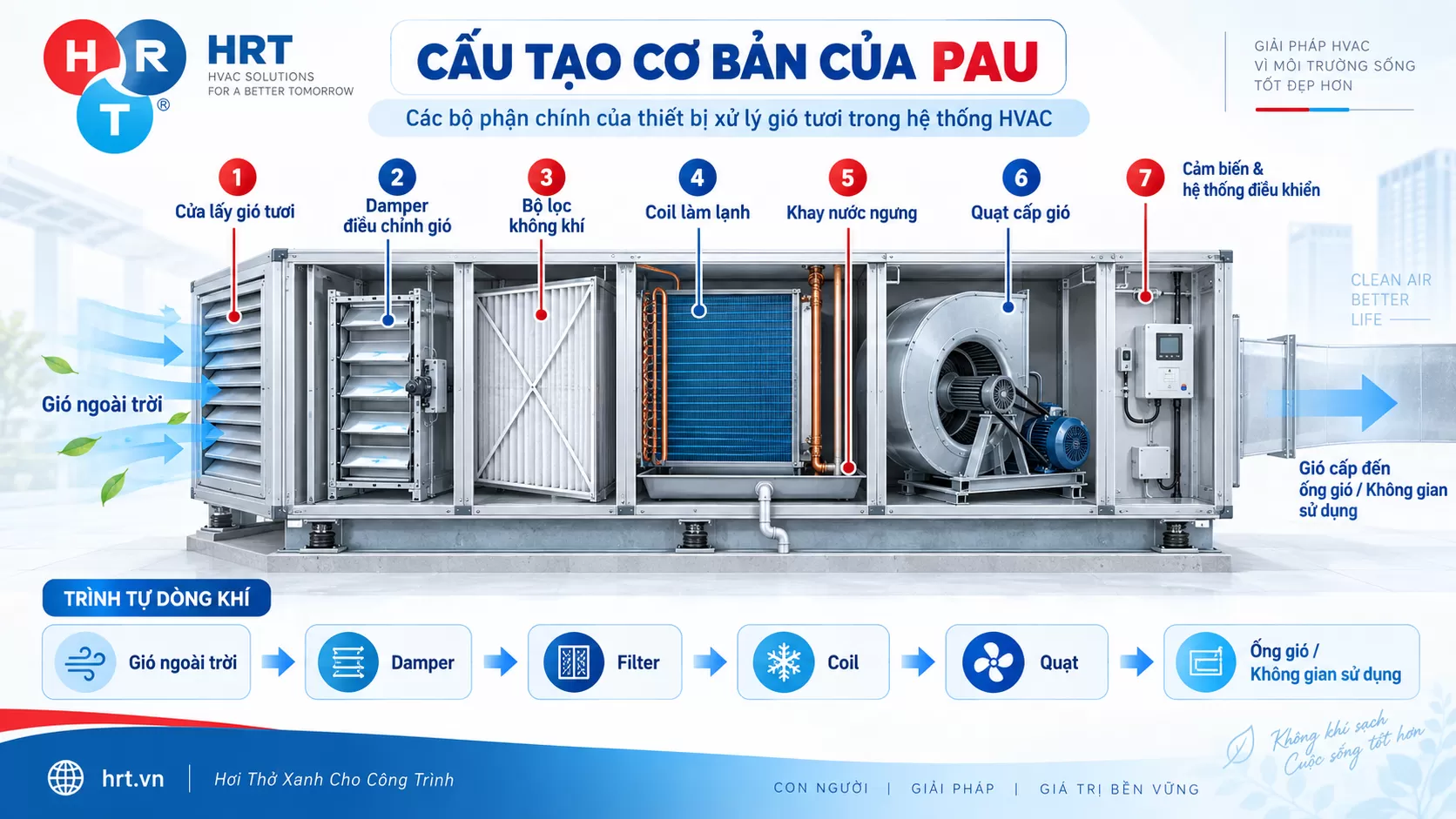
Outdoor wind → Damper → Filter → Coil refrigeration → Fan → air duct → Space using
In the process, air is treated step by step.
Step 1: Receive outdoor wind
Air is fed into the PAU through the intake.
Step 2: Adjust the flow rate
Damper regulates the amount of air entering the system.
Step 3: dust filter
Filters remove particulates and dust from the air.
Step 4: Heat and moisture treatment
The air passes through the cold coil to reduce the temperature.
If the coil surface temperature is lower than the dew point of air, the water vapor will condense and be separated.
Step 5: Wind supply
Pressurized fans bring processed air into the air duct network.
4. What parts does PAU consist of?
A PAU can have many different configurations depending on the project. However, common components include:
Outdoor air intake
Receive air from the outside.
Position to get the wind to avoid:
- Mouth discharge gas.
- The parking lot.
- Generator area.
- Dusty areas.
- Emission source.
Damper
Adjust or open and close airflow rate.
Damper can be driven by motor and integrated with BMS system.
Filter Media
Keep dust and particles in the air.
Can be used:
- Filter rough.
- Filter media.
- High performance filtration.
- Multiple filter levels in a row.
Coil Cold
Coil is responsible for the exchange of heat between air and refrigerant or cold water.
In Water Chiller System:
Cold water → Coil PAU → Heat exchanger → Recovery water
Khay condensate
Collects water generated when moisture in the air condenses on the coil.
Fan Level
Pressure is applied to move air through the unit and air duct system.
Sensors and controllers
May include:
- The temperature.
- Moisture.
- Pressure.
- Differential pressure filter.
- Fan status.
- Flow rate.
- CO2 depending on operation strategy.
5. How does a PAU differ from an AHU and an FCU?
This is one of the most common questions when learning about HVAC systems.
PAU and AHU
PAUs are often focused on outdoor wind treatment.
AHU usually handles:
- Return air.
- Outdoor air.
- Or mixture of return air and outdoor wind.
| Criteria | PAU | AHU |
|---|---|---|
| Wind handle | Mainly wind outdoor | Return air, outdoor air or mixed |
| Air Filter | Yes | Yes |
| Coil Cold | There may be... | Often there are |
| Moisture Separator | Yes | Yes |
| Main functions | Outdoor air handling | Air Conditioning and Distribution |
PAU and FCU
FCU usually handles cooling load in each area or room.
PAU can again take charge of providing outdoor air.
A common configuration:
PAU → outdoor air → Rooms
Simultaneous:
FCU → Chamber air circulation → Thermal load treatment
So PAU and FCU do not necessarily replace each other, but often support each other.
6. How does PAU work in Chiller system?
In Water Chiller projects, PAUs are usually supplied with cold water from the central system.
The cycle can be described as:
Chiller → chilled-water pump → Coil PAU → Recovery water → Chiller
When outdoor wind passes through coil:
- Temperature drops.
- The moisture may condense.
- Post-treatment air is supplied to the system.
This is why calculating PAU cannot be viewed only airflow rate m³/h.
It is necessary to simultaneously consider:
- Outdoor wind temperature.
- Outdoor humidity.
- Wind temperature required after coil.
- Dew point.
- Load Show.
- Hidden load.
- Coil capacity.
7. When should the work use PAU?
PAUs are particularly useful in buildings that require significant outdoor wind.
Offices
Help replenish air for:
- Workspace.
- Meeting room.
- Large space.
Hotel Location
Can provide wind for:
- Resting room.
- The hallway.
- Lobby.
- The restaurant.
- The conference room.
Business Center
Helps coordinate between:
- Outdoor air.
- Suctioning waste.
- Air conditioner.
- Control the density of people.
Factory Supply
Applications at:
- Production area.
- Control room.
- The office.
- The tech park.
Hospital and cleanroom
PAUs can be a component in an overall air handling system.
However, specialized works must comply with specific requirements on:
- Filtering.
- Differential pressure.
- Moisture.
- The temperature.
- The number of air exchanges.
8. How to choose the right PAU for the project
The choice of PAU should not begin with the question:
“How much PAU is needed m3/h?"
It starts with the design conditions.
1. Determination of outdoor air quantity
Flow rate must be determined in accordance with:
- Functional.
- Human density.
- Area.
- Applicable design standards.
2. Determination of outdoor wind conditions
Includes:
- Dry temperature.
- Moisture.
- Enthalpy.
- Seasonal design conditions.
3. Determination of wind status after PAU
Need to know:
- Temperature required.
- Humidity Required.
- Dew point.
4. Calculate the coil load
Not just temperature, but also moisture load.
5. Calculate fan pressure
Total pressure loss may include:
Filter + Coil + Damper + air duct + Coil + air outlet + Accessories
6. Selection of filter level
The grade of filtration must be consistent with the intended use.
7. Maintenance space layout
Enough space is needed to:
- Thay filter.
- Clean the coil.
- Check the fan.
- Maintenance motor.
- Clean the condensate tray.
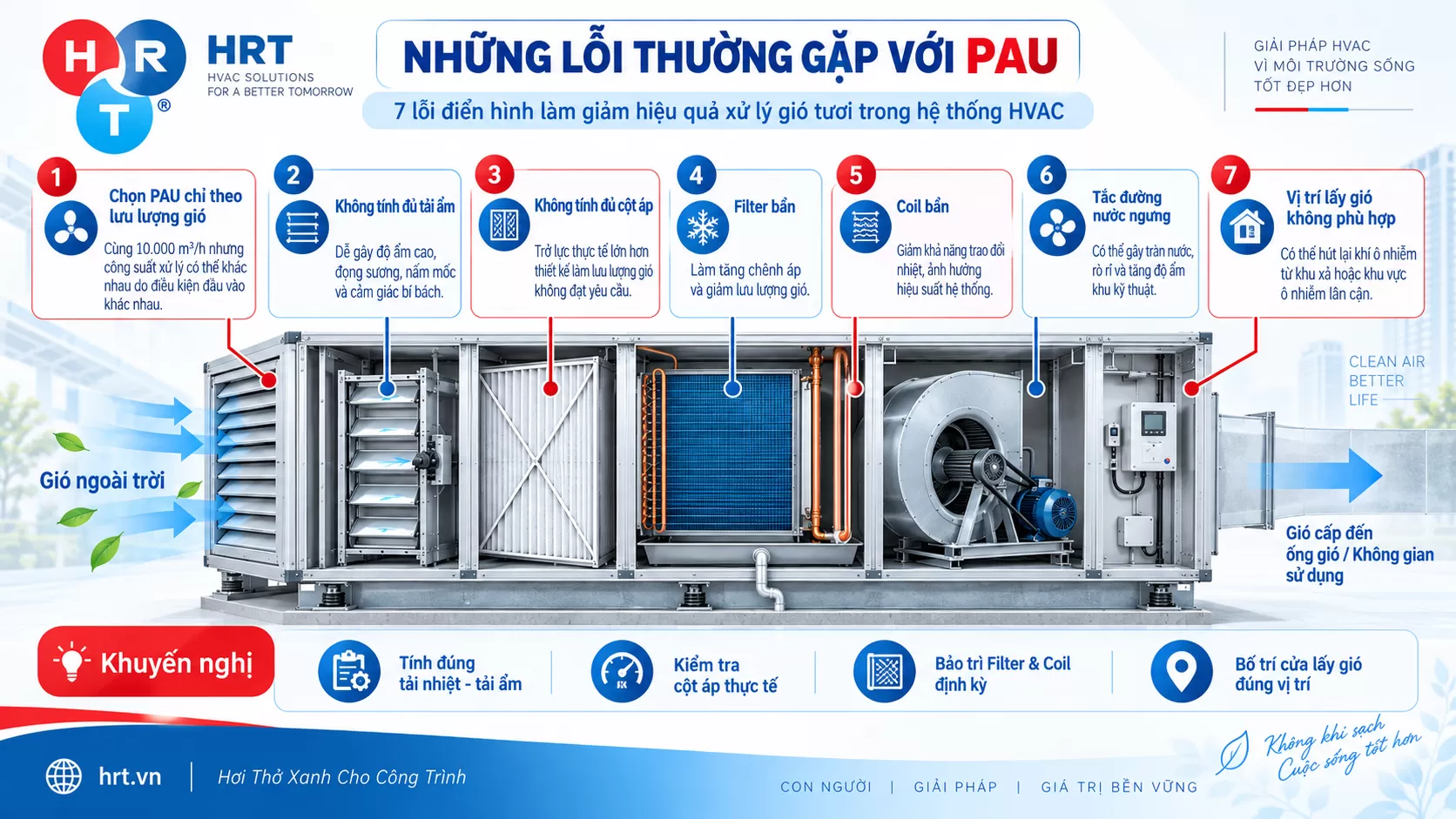
9.7 common PAU errors in practice
A PAU that is selected incorrectly or operates incorrectly can cause the entire HVAC system to operate inefficiently.
1. Only select PAU according to airflow rate
Two PAU together 10.000 m³/h not necessarily have the same processing power.
Input temperature and humidity conditions can be completely different.
2. Not calculating enough moisture load
This is a notable error in Vietnam.
The consequences may be:
- High room humidity.
- Condensation.
- Mold.
- Mysterious feelings.
- Air conditioner runs a lot but does not reach the desired state.
3. Failure to calculate the correct pressure head
If actual pressure loss is higher than design, airflow rate will decrease.
4. Filter too dirty
Dirty Filter Making:
- Increase differential pressure.
- Reduce flow rate.
- Increase fan load.
5. Dirty Coil
Dust-adhesive coil surface reduces heat exchange capacity.
6. Condensate road blocker
May cause:
- Overflow.
- Leakage.
- Water stagnation.
- Increase your risk of mold.
7. Arrangement of the wind intake in the wrong position
If the air intake is located near the exhaust or contamination source, the system can suck dirty air back into the building.
10. Checklist maintenance PAU
A PAU that wants stable operation should be periodically tested.
Basic checklist includes:
- Check the filter status.
- Measure differential pressure filter.
- Clean the coil.
- Check the fan.
- Check the motor.
- Check the ball bearing and vibration.
- Check the damper.
- Clean the condensate tray.
- Check your siphon and drain.
- Check the temperature sensor, humidity.
- Measure your airflow rate.
- Check wind temperature before and after coil.
It is recommended to save data for each maintenance period to compare the trend of performance decline.
11. Does PAU help save energy?
PAU can support HVAC system operation more efficiently if design properly.
However, PAU itself also consumes energy for:
- Fan.
- Cooling.
- Heat up if you have one.
- Control system.
Therefore, optimal PAU should consider synchronization:
Airflow rate + pressure head + Coil + Filter + Control + Operation time
Some solutions can be considered:
- Fan control by variable-frequency drive.
- CO2 sensors when appropriate.
- Controls according to history.
- Monitor differential pressure filter.
- Optimize air supply temperature.
- Energy recovery in the right systems.
12. Some signs that PAU is operating inefficiently
During operation, it is recommended to check the PAU if:
- The room has an unusually high humidity.
- Lack of outdoor air.
- Airflow rate decreases.
- Filter dirty fast.
- Coil closing dirty.
- There's water spilling from the PAU.
- Condensation on air duct.
- High load running fans.
- The power's up.
- The air quality in the room decreased.
It should not be immediately concluded that PAU replacement is necessary.
Need to check the entire system including:
PAU – air duct – Damper – Filter – Coil – Chiller – FCU/AHU – BMS
13. PAU and HVAC solutions of HRT
In HVAC systems, the PAU is not a stand - alone device.
Actual efficiency depends on the synchronous design:
PAU → AHU/FCU → Air duct → Exhaust system → Chiller/VRV → BMS
HRT implements the following items:
- Survey the current status of HVAC.
- Consulting solutions.
- Design the system.
- Select PAU/AHU/FCU.
- Execution of Chiller system.
- Execute ventilation system.
- Adjust your flow rate.
- Maintenance.
- Renovate HVAC.
- Optimize your energy.
Especially for the works are experiencing the situation high humidity, lack of outdoor air, condensation or flow rate not reaching, the overall system testing often brings better results than just replacing the device alone.
Conclusion
PAU is one of the important equipments to handle outdoor air in HVAC system.
The device can perform multiple tasks simultaneously:
Air purification → cooling → Dehumidification → Wind supply → Air quality control.
For hot and humid climates like Vietnam, PAU design needs to pay special attention to moisture load, dew point, fan pressure and post-coil wind state.
A properly calculated PAU system from the beginning will contribute to improving air quality, reducing condensation risk and making the entire HVAC system more stable.
HRT – Air Conditioner ventilation
Green Breath for Buildings
Consulting – Designing – Supplying – Executing – Maintenance – Optimizing HVAC system.
Source: Publisher’s English edition · Vietnamese original on doanvanhoang.com