
What is Water Chiller? Central Cooling Solution for Buildings
Machine-translated from Vietnamese. Read the original in Vietnamese
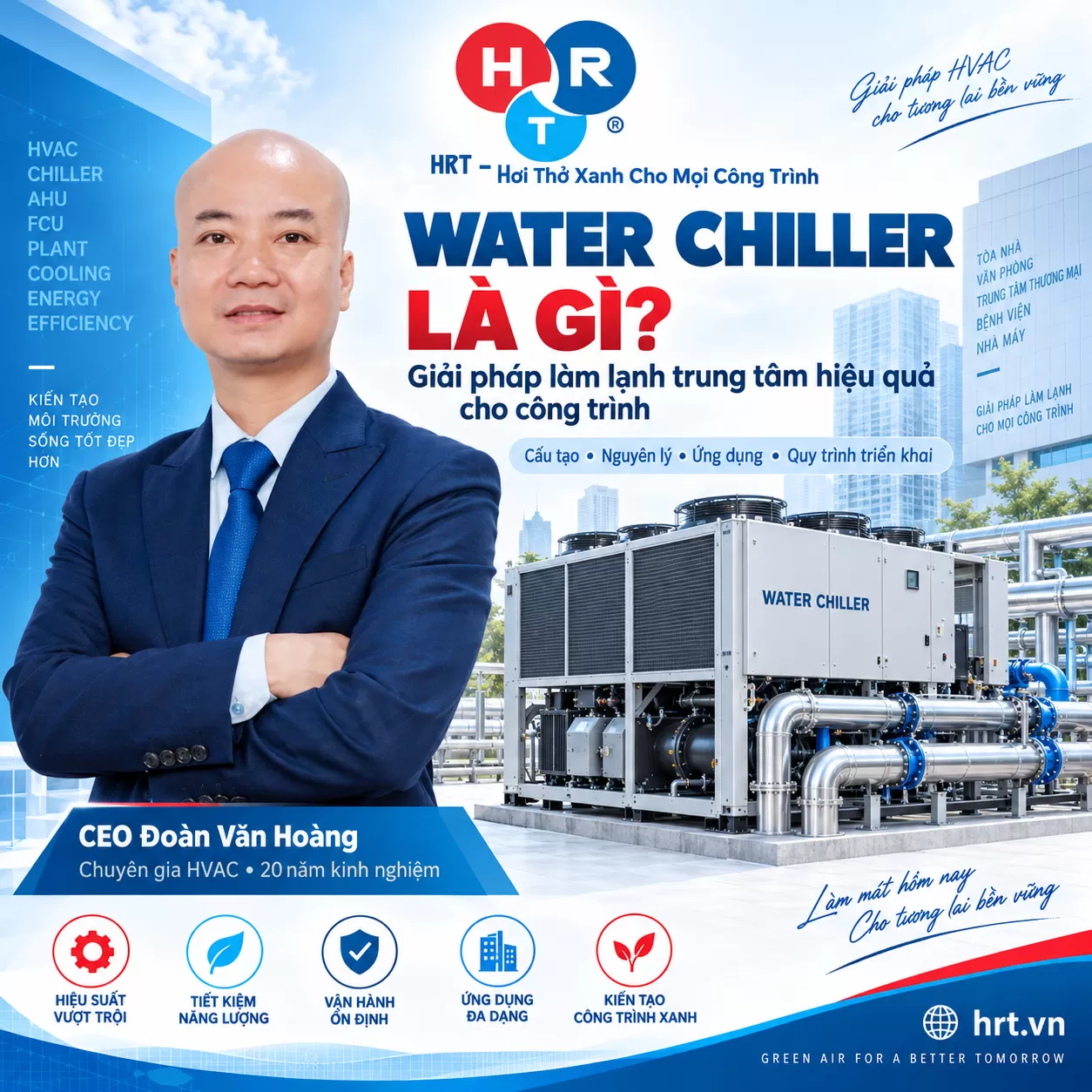
Water Chiller is a central cooling solution that uses cold water to supply AHUs, FCUs and terminals. This article helps understand the structure, principles, applications, errors to avoid and the process of deploying Chiller systems at HRT.
Water Chiller – Central cooling solution for large projects
In high power HVAC systems, Water Chiller is one of the central refrigeration generation solutions which are commonly used for office buildings, commercial centers, hotels, hospitals, factories and industrial buildings.
Unlike local air conditioning or VRV/VRF, Water Chiller does not deliver refrigerant directly to each room.
Instead, Chiller creates Cold water, then the pumping system delivers the cold water to the terminals such as:
AHU – FCU – PAU – Coil Heat Exchanger – Technology Equipment.
In other words, Water Chiller serves as central cold source, and the chilled-water pipeline system serves to transport cold energy to the areas of use.
How does Water Chiller work?
The principle of Water Chiller can be understood in a very simple sequence:
Chiller generates cold water → chilled-water pump → AHU/FCU uses cold → Water absorbs heat → Return to Chiller.
Water Cooling Chiller
The return water from the system enters evaporator – Evaporator.
Here, the refrigerant absorbs heat from the water, causing the water temperature to drop to the design level.
The cold water is then taken out of the Chiller to feed the terminals.
Pumps take cold water throughout the building
Systematic Chilled Water Pump – CHWP generates the flow rate and pressure head needed to deliver cold water to an AHU, FCU or PAU.
The problem here is not just "pumping water".
Pump must properly meet:
Flow rate → pressure head → differential pressure → Load mode.
If the pump selected is too large, the system may consume electricity, cause noise and difficult to balance hydraulically.
AHU and FCU take refrigeration from water
When cold water passes through the coil of an AHU or FCU, air passing through the coil transfers heat to the water.
Air is cooling before feeding into air conditioning space.
The water after absorbing heat will increase the temperature and return to Chiller.
Chiller waste heat to the environment
Heat taken from the final structure must be discharged.
Depending on Chiller technology, heat can be discharged:
Direct to Air for air-cooled chiller.
Or:
Through ring condenser water and cooling tower for water-cooled chiller.
What does a Water Chiller system consist of?
A common mistake is to look at the chiller and ignore the entire system behind it.
In fact, a Chiller Plant can include:
Chiller → chilled-water pump → Pipeline → Valve → AHU/FCU/PAU → Control → BMS.
If using water-cooled chiller, the system also has:
Pump condenser water → cooling tower → Water treatment system.
Chiller Machine
This is the cooling source for the whole system.
A conventional Steam Compressor Chiller has the main parts:
- Compressor
- Evaporator Tank
- Condenser
- Expansion valve
- Control system
Depending on the capacity and operation requirements, the Chiller can use compressor:
Scroll – Screw – Centrifugal.
Chilled-water pump
The pump is responsible for circulating cold water between the Chiller and the terminal.
The selection of pump should be based on actual hydraulic calculations, do not add too large redundancy by feeling.
Chilled-water pipe line
Pipeline is the cold energy transport system throughout the building.
Design to be controlled:
Pipe diameter – Water velocity – pressure drop – Valve – Gas discharge – Residue discharge – thermal insulation.
Non-sealed insulation can cause condensation, cold loss and affect the finishing structure.
AHU – FCU – PAU
This is a group of devices that directly use cold water.
AHU usually serve large area and capable of handling temperature, humidity, air purification and outdoor air.
FCU usually serves each room or each smaller zone.
PAU usually used to treat outdoor air before feeding into air conditioning space.
Water Chiller Does Not Mean Water-cooled Chiller
This is a very easy point to make.
Water Chiller means the system produces cold water.
And... Water-cooled Chiller is Chiller used water to cool condenser.
So Water Chiller can be divided into two large groups.
Air-cooled chiller
Air-cooled Water Chiller use the outside air to discharge heat.
Advantages:
- No cooling tower required
- No need for water condenser pump
- Simple auxiliary system
- Easy to deploy in many projects
However, special attention should be paid to:
Ventilation outdoor unit – Hot air recirculation – Noise – Space maintenance.
Water-cooled chiller
Water-cooled Water Chiller use the water condenser ring to transfer the heat from the condenser to the cooling tower.
Basic Structure:
Chiller → Pump condenser water → cooling tower → Chiller.
This system is often considered at large loads, long-hour operation or in need of high energy efficiency.
In turn, the operation is more complex and must be controlled:
Water quality – scale – corrosion – cooling tower – pump condenser water.
When is Water Chiller the right option?
Not all buildings should use a chiller.
Water Chiller is usually worth considering when the building has one or more of the following characteristics:
- Cooling big load
- Multiple use areas
- Long operation time
- Have large capacity AHU or PAU
- Temperature and humidity control required
- Need cold water for machinery or production process
- Centralized management required by BMS
A Chiller system can be particularly suitable for:
Office buildings – Business centers – Hotels – Resorts – Hospitals – Factory – Data centers – Industrial works.
Where is Water Chiller and VRV/VRF different?
The biggest difference is that transmission method cooling load.
Water Chiller
Chiller generates cold water at the center.
The cold water is then pumped to an AHU, FCU or heat exchanger.
VRV/VRF
VRV/VRF delivers refrigerant directly from outdoor unit to indoor unit.
Therefore, the two systems are suited to different problems.
VRV/VRF often has the advantage of being divided into multiple independent zones, while Chiller has the advantage of large loading systems, AHU/PAU and applications that require cold water.
In fact, some projects can also use:
Chiller + VRV/VRF + Packaged
depending on the function of each area.
Do not just look at the COP of the Chiller
A high-efficiency chiller does not necessarily mean a whole system operation savings.
Actual performance also depends on:
Chiller + Pump + cooling tower + AHU/FCU + Valve + ΔT + Control.
For example, a very good Chiller but:
- Pump Selection Too Large
- Wrong Control Valve
- ΔT low
- Cooling Tower Dirty
- AHU lacks flow rate
- Chiller running in the wrong sequence
then the total power of the system can still be high.
So when evaluating Water Chiller need to look at the level Chiller PlantNot just look at the Chiller itself.
9 Commonly Recommended HRT Errors to Avoid When Deploying Chillers
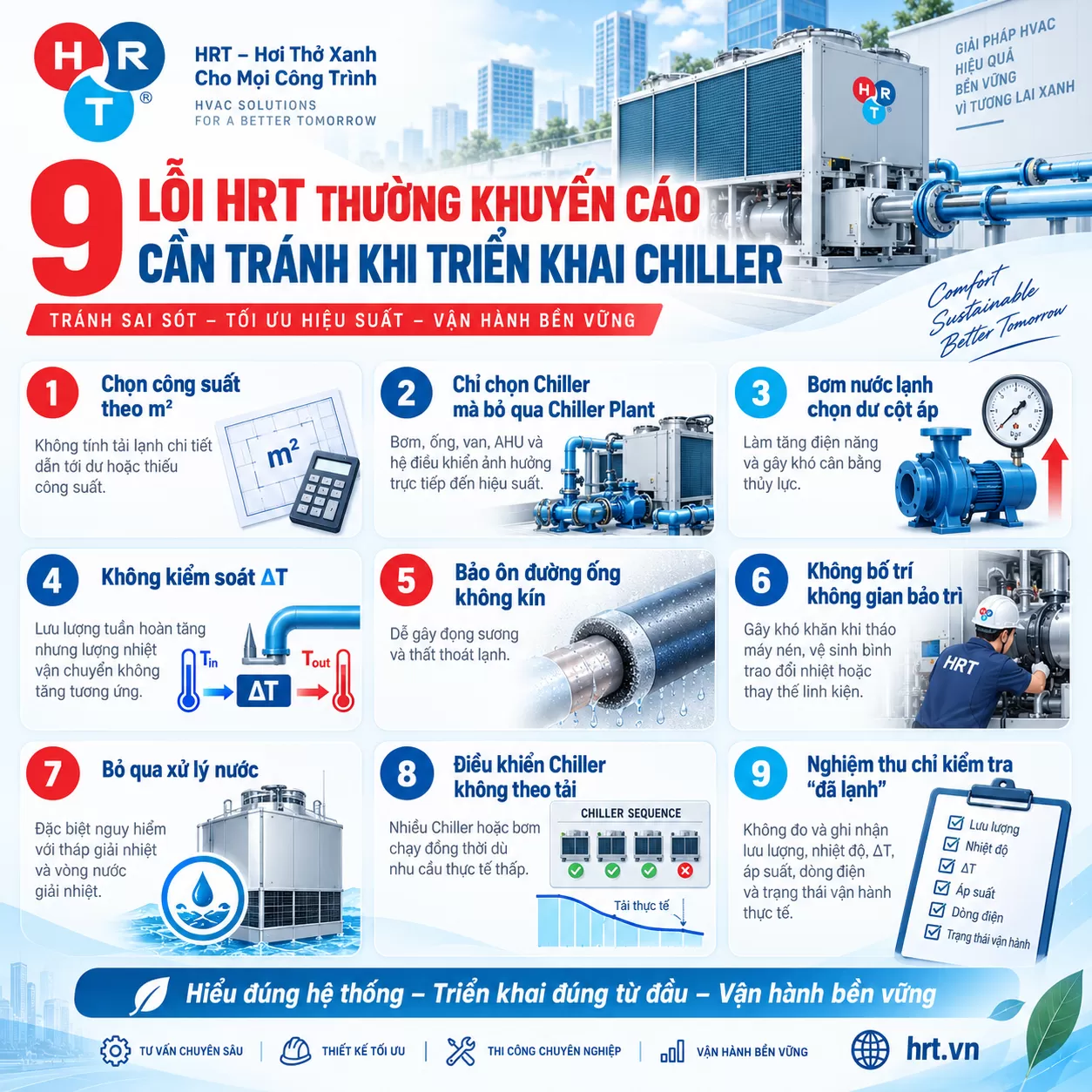
These are the faults that can directly affect the performance, life and stability of your system.
1. Select the capacity by m2
No cooling load calculation for details leading to excess or lack of capacity.
2. Only choose Chiller but ignore Chiller Plant
Pumps, pipelines, valves, AHUs and controls all directly affect performance.
3. chilled-water pump select residual pressure head
Increases power and causes difficulty in hydraulic balance.
4. Uncontrolled ΔT
Circulating flow rate increases but transport energy does not increase correspondingly.
5. Airtight pipeline insulation
Can cause condensation, cold loss and affect the structure of the building.
6. No maintenance space layout
Makes it difficult to clean the device, remove the compressor or replace components.
7. Skip Water Treatment
Especially dangerous for cooling tower system and condenser water ring.
8. Chiller control is not under load
Multiple Chillers or pumps can be run simultaneously despite the low actual refrigeration demand.
9. acceptance testing only test “cooled”
Commissioning must check many parameters such as:
Flow rate – Temperature – ΔT – Pressure – Current – Control logic.
Photo used
Set created infographic:
9 HRT ERRORS EVERY TIME RECOMMEND
NEED TO REMOVE CHILLER DEployment
This image should be placed immediately after the 9 error.
7 steps to deploy Water Chiller system at HRT
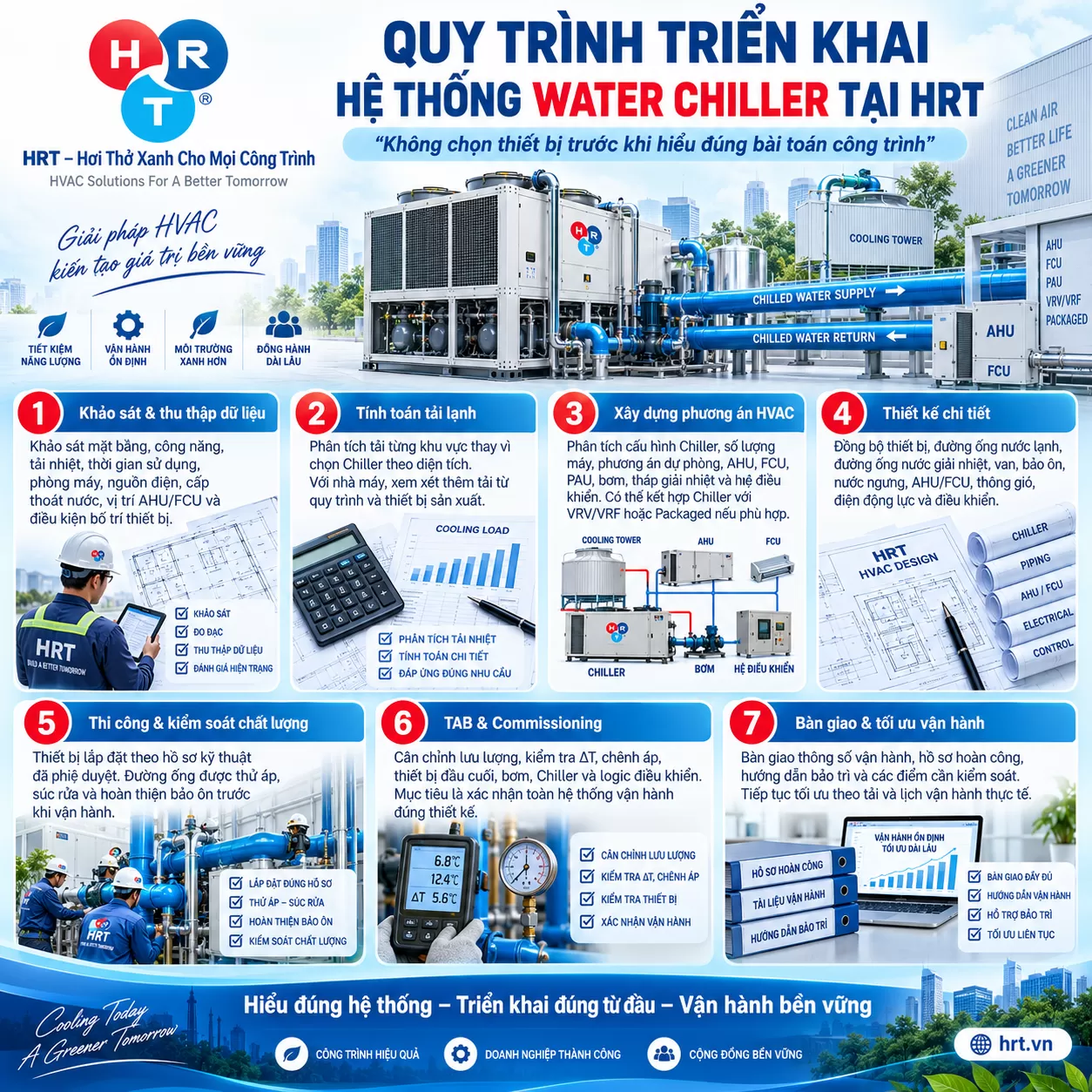
HRT approaches Chiller project on the principle:
Do not select equipment before understanding the construction problem correctly.
Step 1 – Survey and data collection
Survey technical team:
Ground – Function – thermal load – Time of use – Engine room – Electricity – Water supply and drainage – AHU/FCU – Installation conditions.
This is the critical input before calculating cooling load.
Step 2 – Calculate cooling load
HRT analyzes loads by area instead of choosing a chiller based on area.
For factories, it is necessary to calculate:
Load from machinery – Load technology – Heat from the production process.
Step 3 – Build HVAC plan
From the load data, HRT analyzes:
Chiller Type – Number of Units – Standby – AHU – FCU – PAU – Pump – Cooling Tower – Control.
If necessary, the system can be combined with VRV/VRF or Packaged.
Step 4 – Detailed Design
Design documentation needs synchronization:
Chiller – Piping – Valve – thermal insulation – AHU/FCU – ventilation – Electrodynamics – Control.
The goal is to get the systems to work together right from the design.
Step 5 – Construction and quality control
The equipment is installed according to the approved technical dossier.
Pipeline to be made:
Installation → pressure testing → Rinsing → Testing → thermal insulation.
Quality control must be carried out throughout the construction process.
Step 6 – TAB & Commissioning
TAB and Commissioning are one of the most important steps before handover.
Parameters to be tested may include:
Flow rate – ΔT – differential pressure – Pump – AHU – FCU – Chiller – Logic Control.
The goal is not to just confirm that the system “has refrigeration".
The goal is to confirm:
The entire operation system is as designed.
Step 7 – Handover and optimize operation
After commissioning, HRT will hand over:
Operating parameters – as-built documentation – Operation manual – Maintenance manual.
When the actual operation data is available, the system can continue to be optimized according to:
Actual load – Time spent – Subloading chart – Area demand.
What parameters does a good Water Chiller system need to control?
During operation, it is not recommended to monitor only the room temperature.
A professional Water Chiller system needs to pay attention to the following groups of parameters.
Cold Water Temperature
Monitor supply-water temperature and return water to assess the heat transport capacity of the system.
ΔT cold water
ΔT reflects the level of cold use at the terminal.
If ΔT is abnormally low, check AHU/FCU, water flow rate, control valve and operation strategy.
Flow rate
Flow rate should correspond to the design load and configuration.
Too large flow rate does not mean more cold.
Differential pressure
Differential pressure helps to assess the hydraulic condition and operation of pumps, valves, pipelines.
Power Capacity
Need to monitor not only the Chiller power but also:
Chilled-water pump – Condenser water pump – Cooling Tower – AHU.
Optimal Water Chiller needs to see the entire life cycle of the building
The cost of Water Chiller is not just the purchase price of equipment.
Project owner should consider simultaneously:
Investment cost + Electricity + Water + Chemicals + Maintenance + Parts + Human operation + Equipment life.
This is why a low initial cost option may not be the best long - term option.
A good HVAC system needs to meet the following simultaneously:
Investment efficiency – Energy efficiency – Operational capability – Maintenance capability – Durability.
Frequently Asked Questions about Water Chiller
Is Water Chiller Central Air Conditioning?
Water Chillers often serve as the cold source in a central air conditioning system.
Chillers produce cold water, while AHUs, FCUs or PAUs use cold water to treat the air.
Air-cooled chiller need cooling tower?
No, no, no.
Air-cooled chiller discharges heat directly to the air through condenser and fan.
Does a water-cooled chiller need Cooling Tower?
In common configuration, Water-cooled Chiller uses cooling tower to discharge heat from the condenser water ring into the environment.
Is Water Chiller for Factory Use?
Yes, I'm.
In addition to air conditioning, cold water can also serve equipment, production lines or processes.
Should I choose a chiller by area m2?
Shouldn't have.
Area is just one of many inputs.
Calculate cooling load based on the actual conditions of the building.
HRT – HVAC Water Chiller Solution
For Chiller system, HRT does not approach the project in a purely:
“How much RT is needed?"
Instead, the problem is considered as a whole system:
Cooling load → Chiller → Pump → Pipeline → AHU/FCU/PAU → Control → TAB → Commissioning → operation.
HRT implements the following items:
Survey → Consulting → Design → Supply → Construction → TAB & Commissioning → acceptance testing → maintenance → Optimization.
The ultimate goal is not just to create a system that “has cold".
The goal is an HVAC system:
Correct capacity – Correct flow rate – Correct hydraulic – Correct control – Easy operation – Easy maintenance – Energy saving.
HRT – Green Breath for All Buildings
Right From the Start – Clear To the End – Green Sustainable
Source: Publisher’s English edition · Vietnamese original on doanvanhoang.com